
Show

Forgot your password?

Error message here!

Error message here!

Error message here!

Error message here!

Show Error message here!

Show Error message here!

Lost your password? Please enter your email address. You will receive a link to create a new password.

Error message here!

Back to log-in

Close

For Sale

The following items are listed by for sale by users of the site and dealers. They are in no way endorsed or guaranteed by www.antiquearmsresearch.com

Add a Classified Item
to

Clicking on the sword will take you through to the relevant classified item or dealer site.
Don't miss out! - Do you want to be kept informed weekly of new aditions? Just join our weekly update list.

You can also receive regular email notifcations when items match your keywords. To recieve them just register or logon at the top right of this page.
Page 106 of 157
  • Nation : British
  • Local Price : £365
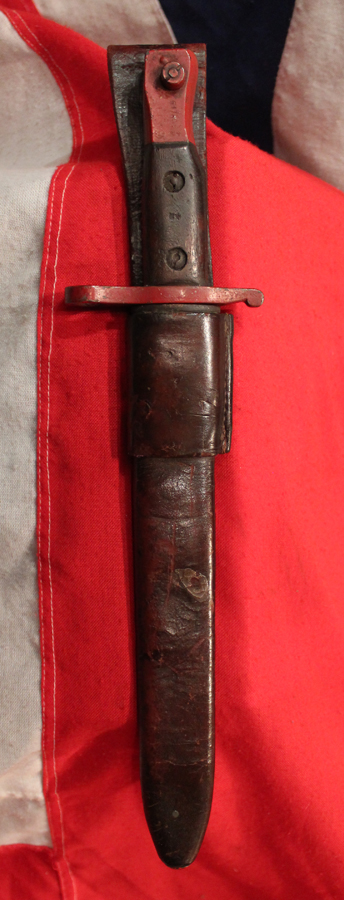
Click and use the code >20566 to search for this item on the dealer website Most Desirable & Rare Canadian WW1 Historical Regimental Ross Bayonet of The 1st Depot Battalion, 1st Quebec Regt. One Of The Great Heroic Regiments Of Canada From The Close of the Great War.
  • Nation : Japanese
  • Local Price : £360.00
Japanese Army Artilleryman&#acute;s Short Sword, Second Model, c1886. Description Straight spear pointed blade with fuller on one side only, the other side flat. Steel crossbar hilt with forward-curving quillons each side, two-piece wood slab grips secured by two steel rivets, steel oval ball pommel. The blade is stamped at the ricasso with two Japanese characters. In 1884 the Imperial Japanese Army directed that rifles were to be withdrawn from Japanese artillerymen and in future short swords were to be issued to them instead. A commission was to be set up to review existing European designs for such swords and produce a new design based upon them, with stocks of Enfield rifle bayonets issued temporarily while this was carried out. This was characteristic of the Meiji period in which Japan deliberately absorbed Western ideas on military organization and equipment, seeking to achieve parity in technology and tactics. Multiple models of short sword emerged from this process “ the version which was probably the first to be introduced (KÅ
  • Nation : British
  • Local Price : £360.00
British Mark I 1856 Pattern Drummer&#acute;s or Bugler’s Sword of the 1st Midlothian (Leith) Rifle Volunteers Band, by Mole. Description Straight unfullered double-edged spear-pointed blade with diamond cross-section, nickel-plated brass hilt with central VR cypher of Queen Victoria, triangular langets and trefoil finials. Brown leather washer. Longitudinally ribbed brass grip, flared pommel. Black leather scabbard with plated brass fittings at throat and chape, the throat piece with teardrop-shaped frog stud bearing incised decoration. The blade is etched on one side with &#acute;MIDLOTHIAN RIFLE VOLUNTEERS BAND&#acute;, above which is a bugle emblem, enclosing the text &#acute;1st&#acute;, all this within a cartouche. It is etched on the other side with the maker&#acute;s mark &#acute;ROBT MOLE & SONS&#acute; also within a cartouche, indicating the maker Robert Mole & Sons. The side of the grip is engraved with &#acute;1 ML 21&#acute;. The throat piece of the scabbard is similarly engraved with &#acute;1 ML 5&#acute;. 21 and 5 are probably rack numbers, and suggest that the scabbard was swapped with at one point, perhaps while in regimental stores. The throat piece of the scabbard is stamped on one side with the maker&#acute;s mark &#acute;MOLE&#acute;. The 1st Midlothian Rifle Volunteers was formed in Leith in 1859, one of a large number of volunteer units which sprang up during the late 1850s due to a perceived threat of invasion of Britain by France. Its initial four companies grew to eight by 1861. It absorbed the 4th Mid-Lothian (Corstorphine) Rifle Volunteer Corps in 1863, adding another three companies. Its size peaked in 1868 with 12 companies, the Band being one. In the Childers Reforms of 1881 militia and volunteer units were amalgamated with the regulars into larger regiments, so the 1st Midlothian became the 3rd Volunteer Battalion, Royal Scots. It was reduced to 10 companies in 1884. Another reorganization in 1888 bumped it down to the 5th Battalion, Royal Scots. In the Boer War it provided 196 volunteers who served with the Royal Scots, earning the battalion its sole battle honour South Africa 1900-02. In 1908 the Haldane Reforms made all Volunteers part of the Territorial Force and it became the 7th Battalion, The Royal Scots. It mustered for WW1 as the 1/7th Battalion. Its A and D Companies suffered heavy casualties before leaving the country, when the troop train carrying them from Larbert to Liverpool collided with a local passenger train at Quintishill near Gretna Green. It remains the worst rail disaster in British history, the military estimating 214 deaths and 191 injured, with additional civilian deaths bringing the count to around 226, the severity of the disaster and the loss of the unit&#acute;s muster roll leading to some uncertainty. Of the 58 survivors who made roll call, only six officers were deemed fit for service, including the regiment&#acute;s Lt Col W. Carmichael Peebles. These joined the other battalions at Liverpool and sailed to Cape Helles, Gallipoli, arriving in June 1915 whereafter it fought at Gully Ravine, Achi Baba Nullah and Krithia Nullahs. The 1/7th was evacuated in January 1916 and transferred to Egypt, fighting in numerous engagements around the Suez Canal and in the advance through Palestine. After the Ottoman surrender it was transferred to France in 1918. Afte WW1 the battalion was reconstituted in the Territorial Army. It fought in WW2 as the 7th/9th (Highlanders) Battalion, Royal Scots. Its lineage is today maintained by A (Royal Scots Borderers) Company, 52nd Lowland, 6th Battalion, Royal Regiment of Scotland. These ornamental short swords were issued to drummers and buglers of infantry regiments, the distinction being that the drummer&#acute;s version was issued with a brass hilt and the scarcer bugler&#acute;s model with an iron hilt. While the pattern was ordered to be adopted in 1856, there is evidence that similar-looking swords were being carried by musicians in some units as early as 1843, and some units did not actually adopt the new pattern until years after its introduction. This example is unusual in having been nickel plated. The plating is of excellent quality and is I believe period. This may have been done to &#acute;convert&#acute; a drummer&#acute;s sword into a bugler&#acute;s version by giving it a finish more like polished iron (and without the need for ongoing polishing to keep it bright), or it may have still been for a drummer but altered for taste. Rifle volunteer regiments were sometimes known to adopt non-regulation uniform standards purely for aesthetics: officer&#acute;s swords painted black or deeply blued are a common one. A degree of latitude was permitted for volunteers, and military bands in general were also less scrupulously held to regulations. If the Midlothians decided that plated swords would look better with their uniform than brass and make their bandsmen stand out, they could have had the work done privately. The blade has light speckled patination. Some rubbing to the etching, leaving the maker&#acute;s mark in particular faint. No damage to the edge, which is unsharpened on both sides. One repair to the blade at the midsection on one side. The nickel plating of the brass parts is excellent, bright and clean with only one tiny area of wear at the base of a quillon on one side, the revealed brass with verdigris. Light The leather of the scabbard has some surface-level cracking and small areas of flaking in places, its stitching is all intact. The chape piece of the scabbard is missing its staple but seems firmly attached regardless. The hilt and grip appear to have been repeened, consistent with the sword having been taken apart for chrome plating. This has not had any adverse effect - the blade is rock solid and rings when tapped.
  • Nation : Swiss
  • Local Price : £360.00
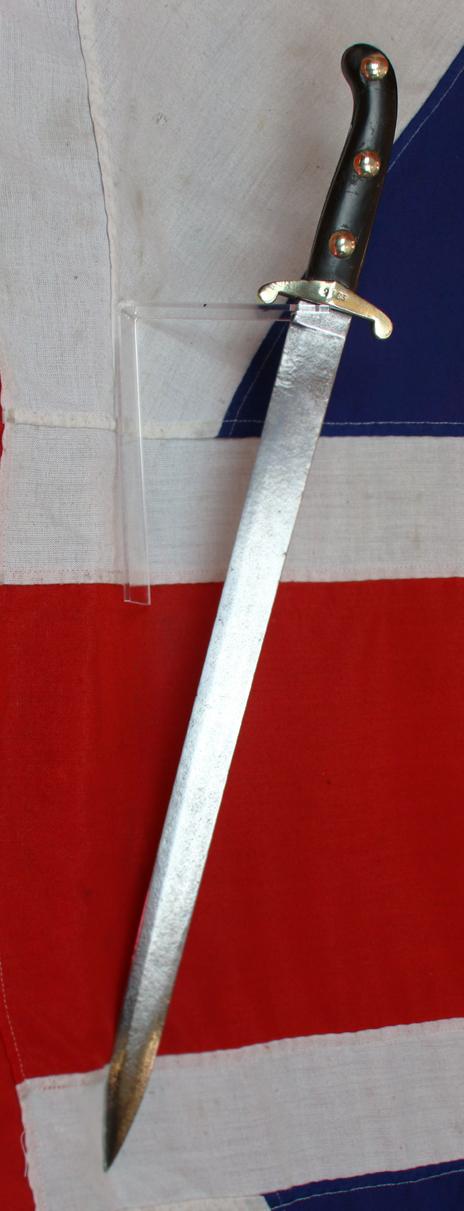
Swiss M1914 Schmidt-Rubin Sawback Bayonet, Early Leather Scabbard. Description Straight spear pointed blade with sawback, swell point and false edge, with single fuller on one side, the other side completely flat. Steel hilt with upper muzzle ring and lower lobe quillon, beaked steel pommel with locking button. Wood slab grips secured by two steel rivets. Brown leather scabbard with steel throat and chape pieces, the throat piece with frog loop with attached leather strap, the chape piece with ball finial. Brown leather frog. The blade is stamped at the ricasso with the manufacturer &#acute;Waffenfabrik Neuhausen&#acute;, and on the hilt with the serial number &#acute;90143&#acute;. The lobe quillon is stamped with a Swiss cross and circle. The scabbard finial is stamped with a Swiss cross. The reverse of the frog is stamped with the rubbed mak &#acute;_Schuss_&#acute; as well as &#acute;H Berger Sellerie&#acute;, a leather goods manufacturer in Prez-vers-Noréaz, a rubbed number &#acute;_2&#acute;, probably the manufacture date, as well as a cartouche (there should be a letter and Swiss cross within this, but these have rubbed). Offically called the Sägebajonett Mod. 1914 (Sawing Bayonet Model of 1914), the M1914 bayonet for the Schmidt-Rubin rifle was based upon the earlier M1878 and M1881 bayonets for the Vetterli rifle, with a similar sawback blade combined with the hilt design from the M1889 Schmidt-Rubin bayonet. The blade is unusual in that it is flat on one side and with a ground edge on the other. It has a &#acute;sawback&#acute;, saw teeth cut into the spine of the blade intended to make it useful for field work like cutting brush. The M1914 was only issued to certain troops such as transport NCOs, artillery drivers and engineers, while most troops carried a shorter knife blade without the sawback. It was used with the M1911 carbine and M1931 (K31) short rifle. This example has the earlier leather scabbard, its design also inherited from the Vetterli bayonets. These scabbards were produced for the M1914 until 1938, when an all-steel scabbard was introduced, which would have been more durable and weather resistant. The leather scabbards were replaced with steel as they wore out, making the leather version uncommon today. The blade is bright overall, some tiny spots of pitting at the tip and light patination in places, the expected rubbing marks from sheathing and drawing on the flat side. Residue suggests the saw has seen use but there are no broken or damaged teeth. The wood grips have some light dents and scratches. Some spots of wear to the plating at the pommel, exposing patinated steel. Scuffing and scratching to the scabbard leather, and a bend mark at the midsection. All the scabbard&#acute;s stitching is intact. Some very small dents and light scratching to the chape piece. The leather frog is flexible with some rubbing to the reverse surface, small losses to the stitching around the belt loop&#acute;s cutout. Its steel rivets and buckle are bright.
  • Nation : German
  • Local Price : £360.00
19th Century Cavalry Sabre in the French M1822 Style, Probably German-made for the US Market. Description Curved blade with one broad & one narrow fuller and hatchet point. Brown leather washer, brass three-bar hilt, ribbed wood grip covered with wire-bound black leather, brass pommel with oval pommel cap and tang button. Steel scabbard with two hanging rings. Blade 35¼ inches in length, the sword 41 inches overall. The knucklebow is stamped near the pommel with the serial or rack number &#acute;94&#acute;. A few loops missing of the wire binding at the pommel end. The leather of the grip has some handling wear, exposing the wood core on some of the raised ribs. One short crack and a chip to the leather at the hilt end.
  • Nation : ?
  • Local Price : 499.00 USD
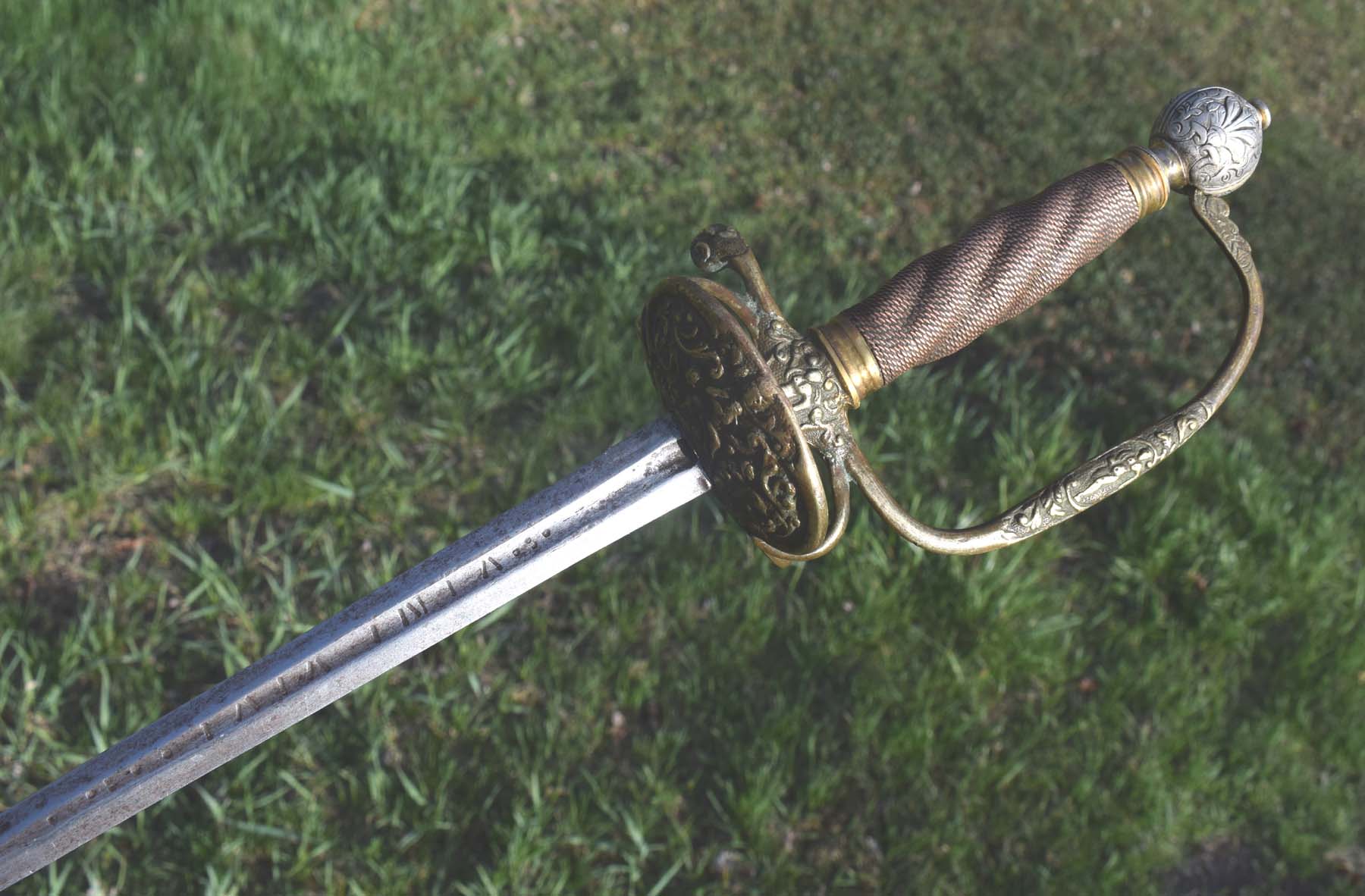
Beautiful Early 18th Century Small Sword / Rapier With Silver Plume Pommel!. Here is a very nice C 1700 – 1740 European small sword. It has a wonderful cast brass hilt with several detailed figures including one with a cat, one with a club (maybe Hercules), one with a trident (possibly Poseidon) and others standing and reclining. Its twisted copper wire grip is in perfect condition as is its silver pommel decorated with a plume, both sides! During the 18th century it was common to award plumes for valor and bravery in both civilian and military life. Perhaps this silver pommel was a reward to a brave person or soldier or possibly the original brass pommel was damaged and a silver one fitted. We will probably never know. Its 29.5” long rapier blade is diamond shape in cross section and stamped “VINIVIVI” in the fullers, both sides with no pitting. Its counterguard has some looseness, but rest of guard is fairly tight. Overall very good condition. A very nice early 18th century sword that would be a great addition to any collection or decor for very little money! Price is firm. Thanks for looking! Check out our other listings for more great swords! Our direct email is: [email protected]
  • Nation : British
  • Local Price : $495.00
British “TOWER” Marked New Land Pattern Flintlock Pistol. Fully functional high quality 20th C copy of a British New Land Pattern Cavalry Pistol. This type pistol was used extensively during the Napoleonic Wars. This representation features flat lock plate with double line borders, stamped “GR” under a crown forward of the flat swan-neck cock and “TOWER” vertically behind. Unmarked 9” round .69 caliber smoothbore barrel with turned rings at the breech. Brass mounts, including butt cap, serpentine side plate, trigger guard, and ramrod thimbles. Hardwood full stock and iron ramrod with button tip. Shows age and use, with patina on barrel and lock, as well as nicks on the stock. It’s definitely been fired. Overall length 15 1/4”.
  • Nation : Dutch
  • Local Price : £355
Click and use the code >25907 to search for this item on the dealer website Most Scarce Original Antique Sharpshooter´s Sword Used By Swiss Mercenaries In the 1849 Italian Revolution. Made by F Horster of Solingen
Page 106 of 157