
Show

Forgot your password?

Error message here!

Error message here!

Error message here!

Error message here!

Show Error message here!

Show Error message here!

Lost your password? Please enter your email address. You will receive a link to create a new password.

Error message here!

Back to log-in

Close

For Sale

The following items are listed by for sale by users of the site and dealers. They are in no way endorsed or guaranteed by www.antiquearmsresearch.com

Add a Classified Item
to

Clicking on the sword will take you through to the relevant classified item or dealer site.
Don't miss out! - Do you want to be kept informed weekly of new aditions? Just join our weekly update list.

You can also receive regular email notifcations when items match your keywords. To recieve them just register or logon at the top right of this page.
Page 110 of 156
  • Nation : British
  • Local Price : 4,200 kr
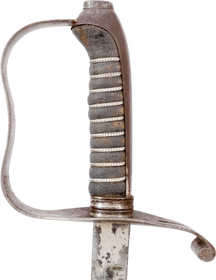
English sergeant sword m / 1796.
  • Nation : -
  • Local Price : 4,200 kr
Officerssaber ca: 1800.
  • Nation : French
  • Local Price : 4,200 kr
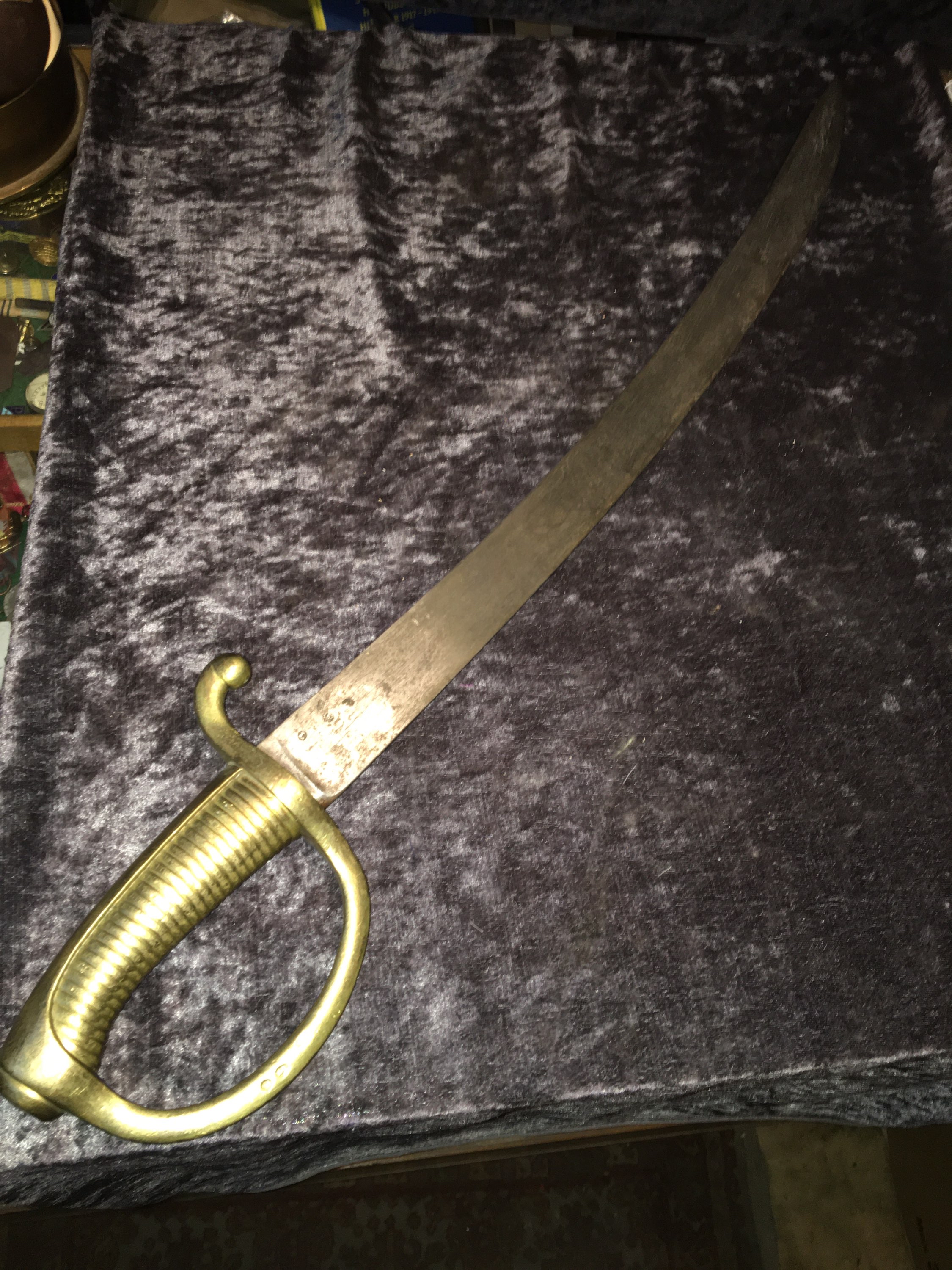
French briquette w/1804.
  • Nation : Austrian
  • Local Price : 455.00 USD
AUSTRIAN 1861 INFANTRY OFFICER’S SWORD. Iron hilt with double slotted guard. Silver wire wrapped ray skin grip. 33” slightly curved broad fullered blade with a little light sharpening at the forte, usually done for cake cutting at a military wedding. Hilt shows remnants of plating with uniform smooth brown patina. Black japanned scabbard with single suspension mount, retains about 90% black surface.
  • Nation : British
  • Local Price : £325.00
British Circa 1820 Bandsman&#acute;s Sword, Shortened Transition Model, Scabbard by Hebbert & Co. Description Cast brass hilt and grip, the hilt of mameluke form with langets and conical finials, spiral grip, lion head pommel, black leather washer. Black leather scabbard with brass throat and chape pieces, the throat piece with frog stud. Blade 20 inches in length, the sword 24½ inches overall. The throat piece of the scabbard is set with the maker&#acute;s mark &#acute;Hebbert & Co London&#acute; and below this a rubbed mark including a &#acute;7&#acute;. The hilt is stamped with the number &#acute;3&#acute;. Hebbert & Co was established in 1814 as Hebbert & Hume. It was primarily a helmet and accoutrement maker, but did retail some swords, the blades probably made elsewhere. After a period of sole ownership by Charles Hebbert it became &#acute;Hebbert & Co&#acute; in 1850. This sets an earliest date for the top mount of the scabbard, although I think the sword may be older (see below). The firm occupied several premises in London over the years, until it closed down around 1912. There was no standard pattern for the ornamental swords carried by military bands in the 18th and early 19th centuries. Each regiment was responsible for equipping its band as it saw fit, and took pride in outdoing each other in their parade dress. Nonetheless there was a common style: a short, usually curved mameluke-style sword with brass fittings and a pommel in the form of an animal head, most often a lion. In 1856 all bandsmen of dismounted units were ordered to carry a regulation pattern sword (which became known as the 1856 Pattern, although it existed before this date for some infantry drummers), which spelled the end for the great variety of beautiful bandsmen&#acute;s swords. I think this may be an interesting transitional example: a bandsman&#acute;s sword produced in the early 19th century, subsequently shortened to resemble the regulation pattern that replaced it. The 1856 Pattern drummer&#acute;s sword has a blade 19½ inches long, while this piece has been shortened to 20 inches “ which given its slightly shorter hilt brings it to 24½ inches in total, exactly the same length as the 1856 Pattern. It is known that in practice some regiments went a number of years before adopting the 1856, e.g. the 31st Foot took until 1863. This piece may be evidence of what such units did in the interim. The blade was probably 26-28 inches long originally “ you can see by how the fuller runs into the point that it has been shortened by removing material from the tip and repointing. A new scabbard was then ordered from Hebbert to fit the shortened blade, with a frog stud of the same type used on the 1856 Pattern. Full-length bandsmen&#acute;s swords hung from a sword belt of hanging rings, which again suggests this is a replacement scabbard, not a shortened original. Accoutrement makers like Hebbert were perfectly capable of making custom scabbards that roughly followed the uniform style. The scabbard is very slightly short for the blade, so the tip has dimpled the chape piece from the inside. Possibly Hebbert assumed the blade would be cut down (by a regimental armourer?) to the same length as the 1856 Pattern, i.e. a full half inch shorter than it actually was. Some spots of patination to the blade, a little light pitting towards the tip. The brass hilt has an even patina with a few small dents to the hilt and quillons. The leather of the scabbard is good with all its stitching intact, some rubbing and a few small cuts to the upper front face. Rubbing wear to the throat piece.
  • Nation : British
  • Local Price : £325.00
British 1879 Pattern Martini Henry Artillery Carbine Bayonet with Sawback Removed. Description Straight single-fullered blade which has had its original sawback removed, steel knucklebow hilt with sword knot slit and muzzle ring. Black pressed leather grips with chequering, steel pommel with external leaf spring. No scabbard. Blade 25¾ inches in length, the bayonet 31¼ inches overall, muzzle ring 0.65 inches in diameter (1.65cm). The blade is stamped on one side of the ricasso with a crown over &#acute;V.R.&#acute; (the lettering very faint), the manufacture date &#acute;12 / 8_&#acute;, meaning December of a year in the 1880s, the last digit no longer present due to the bored hole, two crown inspection marks with &#acute;E&#acute;, for the Royal Small Arms Factory at Enfield, a Birmingham repair/refurbishment mark of a crown over &#acute;BR&#acute;, and issue stamps /90 and /94 for 1890 and 1894. On the other side it is stamped with a broad arrow atop &#acute;WD&#acute;, meaning War Department property, another crown inspection mark with &#acute;E&#acute;, for Enfield, an &#acute;X&#acute; which indicates that the blade passed a manufacturer&#acute;s bending test, two R&#acute;s back to back, a mark meaning the bayonet was deemed unfit for service (often relegated to parade or cadet use), and two broad arrows point-to-point, a mark that was put on War Department equipment that was declared obsolete or to be sold off. The spine of the blade has two more Enfield crown inspection marks, a letter &#acute;W&#acute; and an &#acute;R&#acute;. The exposed tang has another Birmingham repair mark, a letter &#acute;B&#acute;, a Maltese Cross and the number &#acute;18&#acute;. The pommel is stamped next to the mortise slot with another Enfield inspection mark, next to the leaf spring with &#acute;31&#acute; and next to the locking button with another two broad arrows point-to-point. When mounted to a carbine-length rifle the 1879 Pattern bayonet gave a soldier good overall reach, and with its substantial hilt it could also serve as a fighting sword. Its saw-toothed back would have found use in brush-cutting, like other similar designs popular during the 19th century. Production of the bayonets at Enfield continued until 1890. 1879 Pattern bayonets with the sawback removed are a known variation, but no official order to manufacture them has been found and the exact reason for grinding off the saw blade is unclear. Many of the Martini-Henry carbines ended their service lives as drill weapons for cadet forces, and this modification may simply have been to make the bayonets safer for the youngsters who would be handling them on the parade ground. See page 156 of British & Commonwealth Bayonets by Skennerton & Richardson for discussion of this type. The blade has some mottled patination. Its unsharpened edge has no damage, with a little wear to the tip. The hilt has some patination, heavier in the recesses and spotted on the knucklebow and pommel. The leather grips have some light handling wear, a few chips at the edges where the leather touches the exposed tang, and one small spot of abrasion on one side that has removed a few knurled diamonds to expose underlying leather. A hole just over 4mm in diameter has been bored through the ricasso, possibly to allow the bayonet to be hung up or mounted.
  • Nation : German
  • Local Price : £325.00
Bavarian Circa 1810 Infantry Trooper&#acute;s Sword. Description Single-edged hanger blade with narrow fuller running close to the spine and hatchet point. Brass hilt with round forward quillon and plain knucklebow, smooth brass backstrap with tang button, ribbed grip of black leather over wood. Black leather washer. No scabbard. Blade ~23½ inches in length (59.4cm), the sword 28¼ inches (71.8cm) overall. The blade is engraved on both sides with the crown and cypher of Maximilian I Joseph, first King of Bavaria, who reigned from 1806 to 1825. The blade is sharp with a number of nicks and chips to its edge in the upper portion. Scattered spots of cleaned pitting to the blade, more significant patches at the shoulder and near the tip. Some rounding wear to the tip sharpening marks, also polishing marks to the faces. The leather washer has some losses on one side. The grip is all intact with no losses. The brass hilt and backstrap have a few small dents and an even midtone patina.
  • Nation : Spanish
  • Local Price : £325
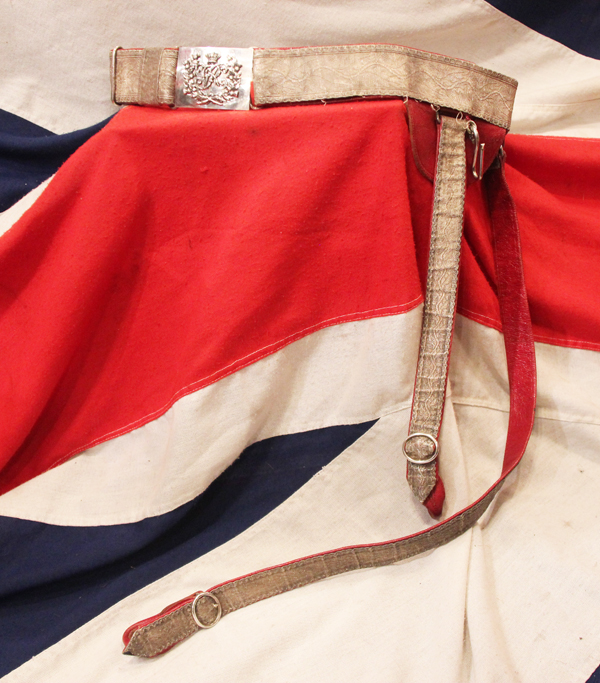
Click and use the code >21339 to search for this item on the dealer website Superb, Victorian, Scottish Lord Lieutenant´s Belt Plate and Silver Bullion, Belt and Sword Straps. Queen Victoria´s Personal Representative in Scotland When She Was Not Available
Page 110 of 156