
Show

Forgot your password?

Error message here!

Error message here!

Error message here!

Error message here!

Show Error message here!

Show Error message here!

Lost your password? Please enter your email address. You will receive a link to create a new password.

Error message here!

Back to log-in

Close

For Sale

The following items are listed by for sale by users of the site and dealers. They are in no way endorsed or guaranteed by www.antiquearmsresearch.com

Add a Classified Item
to

Clicking on the sword will take you through to the relevant classified item or dealer site.
Don't miss out! - Do you want to be kept informed weekly of new aditions? Just join our weekly update list.

You can also receive regular email notifcations when items match your keywords. To recieve them just register or logon at the top right of this page.
Page 117 of 157
  • Nation : -
  • Local Price : 385.00 USD
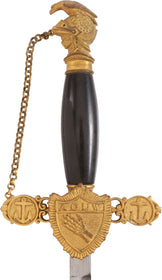
ANCIENT ORDER OF UNITED WORKMEN SWORD. Something went wrong * { box-sizing: border-box; margin: 0; padding: 0; } html { font-family: "Helvetica Neue", Helvetica, Arial, sans-serif; background: #F1F1F1; font-size: 62.5%; color: #303030; min-height: 100%; } body { padding: 0; margin: 0; line-height: 2.7rem; } a { color: #303030; border-bottom: 1px solid #303030; text-decoration: none; padding-bottom: 1rem; transition: border-color 0.2s ease-in; } a:hover { border-bottom-color: #A9A9A9; } h1 { font-size: 1.8rem; font-weight: 400; margin: 0 0 1.4rem 0; } p { font-size: 1.5rem; margin: 0; } .page { padding: 4rem 3.5rem; margin: 0; display: flex; min-height: 100vh; flex-direction: column; } .text-container--main { flex: 1; display: flex; align-items: start; margin-bottom: 1.6rem; } .action { background: transparent; cursor: pointer; border: 1px solid #A9A9A9; padding: 1.2rem 2.5rem; border-radius: 6px; text-decoration: none; margin-top: 1.6rem; display: inline-block; font-size: 1.5rem; transition: border-color 0.2s ease-in; } .action:hover { border-color: #000; } @media all and (min-width:500px) { .text-container--main { align-items: center; } .page { padding: 7.5rem 10.5rem; } } There was a problem loading this website Try refreshing the page. If the site still doesn't load, please try again in a few minutes. Refresh Page
  • Nation : -
  • Local Price : 385.00 USD
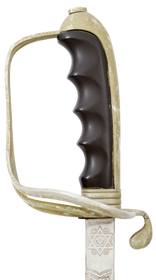
US 1902 PATTERN ARMY OFFICER’S SWORD. See The American Sword, Peterson #77 and pattern still in current use for most officer's other than Naval, Plated hilt with composition finger stall grip.  32 3/4” blade decorated over half its length with U S, foliage, Eagle and military trophies. The forte with THE AMERICAN MILITARY SUPPLY CORP NEW YORK Made in Germany. Etched proof opposite. Records indicate that the retailer was active in the 19th century-about 1941. Plated hilt and scabbard with light surface storage film should clean to bright about overall. Quillon with stable crack. Superior quality and construction including the decoration consistent with its early manufacture.
  • Nation : -
  • Local Price : 385.00 USD
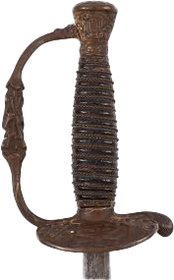
VARIANT FORM SONS OF VETERANS SWORD. Based on the 1860 Staff & Field officers sword with crossed musket knuckle bow. The guard with Army, Navy and Artillery motifs surrounding interlaced S O V logo. All other examples which we found had an S V only logo. 28 1/2" straight blade. Founded in 1881, the Sons of Veterans was a sister organization to the GAR which restricted membership to Union Veterans of the Civil War. The SOV provided the benefits and fraternity to their sons separately avoiding the restriction.
  • Nation : -
  • Local Price : £275.00
Argentine Type C Socket Bayonet for the FN FAL, Falklands War Memento Engraving. Description Tubular steel one-piece bayonet with flash ports and spear-pointed blade with semicircular profile. Blade length 6½ inches (16.5cm), 11 3/8 inches (28.9cm) overall. Black plastic scabbard with eyelet chape, circular frog stud and steel throat piece, green leather frog with buckled retaining strap and belt loop. The bayonet is stamped on the blade at the forte with the serial number &#acute;01-79266&#acute; (some digits difficult to read). The &#acute;01&#acute; prefix specifies allocation to the Argentine Army. The blade is inscribed lengthwise with the commemorative inscription &#acute;FALKLANDS . 21ST MAY “ 14TH JUNE . 1982&#acute;. The engraving is not professional work “ it appears to have been done by hand with an electric pencil, is not perfectly central on the blade and varies slightly in letter size and spacing. It is reminiscent of numerous examples of First and Second World War bayonets captured and inscribed as mementoes. Such items are usually produced by veterans themselves to mark their dates of service, or specific campaigns therein, and this is probably the case for this bayonet. It should be noted that these are not the usually accepted dates of the conflict as a whole, but specifically of the main ground campaign by British forces on the Islands: on the 21st May the British Amphibious Task Group conducted the first landing in force, deploying troops of 3 Commando Brigade at San Carlos on East Falkland in what was codenamed Operation Sutton. 24 days of fighting later the Argentine forces on the Falklands surrendered on the 14th June. The conflict is usually described as beginning with the Argentine invasion on the 2nd April in which there was brief fighting with the British garrison, followed by numerous air and naval actions as the British Task Force approached the islands as well as special forces raids on specific targets preceding the main amphibious assault. It is possible therefore that the former owner was thinking specifically of his own service experience, meaning that he was with those forces that landed. The FN FAL infantry rifle and its bayonet were adopted by Argentina in the late 1950s, initially purchased from FN in Belgium but later made domestically by Argentine manufacturers. Several types of bayonet and webbing attachments were used by the Argentinean Army and Marines during the Falklands conflict: the tubular model was the &#acute;Type C&#acute;, compatible with later models of the FAL (post 1962) which had a 22mm muzzle device. This was used side by side with the &#acute;Type A&#acute; knife bayonet, which fitted to the early FALs. The scabbards are not interchangeable between Types, the blades being of different shapes. Belt frogs for these bayonets are made of either green leather or nylon fabric: the &#acute;Correaje Argentino de Cuero&#acute; (Argentine Leather Belting) load-bearing system was introduced around 1970, but incorporated some preexisting elements including leather frogs and pistol holsters, which were then painted green to match. The nylon &#acute;Correaje Tempex&#acute; (Tempex Belting) was introduced in the early 1980s to replace it which included a new frog. Both forms of load-bearing system were still in use by 1982 so both were carried in the Falklands. Either frog will fit either Type of bayonet. After Argentine forces surrendered to the British on June 14 1982 their small arms were piled up by the thousand in the Islands&#acute; capital Port Stanley, where most Argentine forces had been deployed or driven back to. A large quantity of arms had also been captured earlier at Goose Green, which was a key ammunition dump for the Argentine forces, and still more were gathered later from unengaged Argentine garrisons on the island of West Falkland. The FAL rifles became British government property and were either brought to the UK or dumped at sea, while bayonets and the short machete-like officer&#acute;s sidearms frequently became personal trophies or souvenirs for British soldiers as they would not be illegal to own in civilian life. This example is most likely one such &#acute;bring-back&#acute; converted into a memento. The bayonet is a good example of its type with little service wear and is paired with an M1909 frog, which was originally supplied with bayonets for the series of Argentine Mauser rifles but was one of the elements reused with a new coat of paint for the FAL in the Green Leather Belting scheme. They are not often seen paired with the Type C, supplies perhaps having been mostly used up on the earlier Type A. These had a distinctive modification done to them tucking the seam on one side to accommodate the flash hider prongs of the Type A. This frog is unmodified, more suitable for the Type C and pleasingly symmetrical. The bayonet and frog stud of the scabbard have a black lacquered finish, with some rubbing at raised edges revealing bright steel and a few spots of chipping on the socket. I believe from examination that this lacquer was applied after its service, probably to improve its appearance before the inscription was added “ most noticeably there is a single small chip to the side edge of the blade which appears to have been lacquered over. Light scratching to the plastic scabbard body. Surface level cracking to the leather of the frog on one side (front face, below the frog stud). The leather remains flexible and all the frog&#acute;s stitching is intact.
  • Nation : American
  • Local Price : £275.00
**1970’s 200 YEAR ANNIVERSARY COMMEMORATIVE**American Revolutionary War Wilkinson Sword London Small Sword With Etched Battle Site Names & Dates Blade. ED 2476 -. The American Revolutionary War (April 19, 1775 – September 3, 1783), also known as the Revolutionary War or American War of Independence, was an armed conflict that was part of the broader American Revolution, in which American Patriot forces organised as the Continental Army and commanded by George Washington fought the British Army. The conflict was fought in North America, the Caribbean, and the Atlantic Ocean. The war ended with the Treaty of Paris (1783), which resulted in Great Britain ultimately recognising the independence of the USA. In the 1970’s The English Sword makers Wilkinson Sword made swords styled on Revolutionary wars period examples to commemorate the war’s 200th Anniversary. Our commemorative example sword incorporates concepts of the American Revolution period. It is 27” overall length with a 21” long fullered steel curved blade. The blade is clean and is etched & blued at the ricasso with the Wilkinson Sword London name, crossed swords legend, ‘Made In England’ and QEII Royal Appointment. The sides of the blade below the fuller are blued & etched with Revolutionary war battle site names and dates alongside crossed swords symbols (all illustrated in the images). It has a cast gilt alloy re-curving cross guard with cast foliate decoration and grooved resin hilt which his bound with brass wire. The pommel has an acorn finial. The sword is without scabbard. The price includes UK delivery. ED 2476 (on top of gun rack armoury)
  • Nation : German
  • Local Price : £275.00
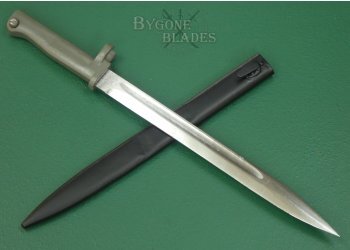
German Ersatz Bayonet. WW1. Carter EB25. #2312006. This steel hilt ersatz bayonet was made in Germany in the early years of WW1 and is one of the rarer of the ersatz bayonets. The height of ersatz bayonet manufacturing was 1916, as the Imperial German war machine rushed to equip the huge number of new troops. This pattern of ersatz bayonet has been designated under Carter’s classification as EB25.The 316mm single-edged blade has a flat spine above a deep single fuller and terminates in a double-edged spear point. The blade retains its full length (it wasn't shortened for Turkish use) and is in good condition with minimal speckles of tarnish. The spine and ricasso both bear inspection stamps.The cast steel hilt is in excellent condition and has been re-painted. The long muzzle ears, false cross guard and birds-beak pommel are characteristic of the EB25. The press-stud attachment mechanism is in perfect working order. The blade is held firmly within the steel grip.The bayonet is complete with its original Ersatz scabbard which has been re-painted. The bayonet sheathes and draws smoothly and is held firmly within the scabbard.This is a highly desirable and rarely encountered Great War ersatz bayonet in very good condition and guaranteed genuine.
  • Nation : Austrian
  • Local Price : £275.00
Austro-Hungarian 19th Century Briquet Sabre by Pacholek. Description Curved unfullered hatchet pointed blade with false edge. One-piece cast brass hilt with ribbed grip, forward curving quillon with ball finial and simple knucklebow, domed pommel. No scabbard. Blade 25¼ inches (64.2cm) in length, the sword 30 5/8 inches (77.8cm) overall. The blade is stamped at the forte on one side with the maker&#acute;s mark &#acute;PACHOLEK GY _UDA_ES_&#acute;, some letters being only partially struck or double stamped. I believe this indicates the manufacturer György Pacholek of Budapest, Hungary. The same area is also stamped with &#acute;10S&#acute; over &#acute;1174&#acute; divided by a horizontal line, partly overstamping the maker&#acute;s mark, the numerals in an Austro-Hungarian style. Simple, sturdy and cheap to produce, the &#acute;briquet&#acute; sabre was found across Europe in the mid-19th century. Austro-Hungarian examples seem to be uncommon but may have been used for infantry or artillerymen. The blade has a quite even light patina, with a few small spots of darker patination. The edge has been sharpened, leaving visible grinding marks on the sides of the blade, and has a number of small nicks on its upper section. A few tiny dents to the brass hilt, which has a mostly even finish, with some darker patination on the quillon finial, pommel cap and on the top of the hilt next to the blade shoulder.
  • Nation : German
  • Local Price : £275.00
Bavarian M1794 Fusilier Trooper&#acute;s Sword. Description Single-edged hanger blade with narrow fuller running close to the spine and hatchet point. Solid cast brass hilt with ribbed grip, smooth backstrap, quillon with squared cushion finial, knucklebow hilt and tang button. No scabbard. Blade ~24½ inches (63.1cm) in length, the sword ~30 inches (76.9cm) overall. The hilt is stamped with &#acute;I.7.Ð&#acute;o.60&#acute;, with some overstamping of the final two digits suggesting these were renumbered at some point. This may be a unit mark, although not one I can interpret. The blade has some patination and speckled light pitting, with patches of heavier pitting along the spine, towards the tip and at the shoulder. A number of nicks to the edge, which is sharp. The brass hilt has only a few small dents and a light, even patina.
Page 117 of 157