
Show

Forgot your password?

Error message here!

Error message here!

Error message here!

Error message here!

Show Error message here!

Show Error message here!

Lost your password? Please enter your email address. You will receive a link to create a new password.

Error message here!

Back to log-in

Close

For Sale

The following items are listed by for sale by users of the site and dealers. They are in no way endorsed or guaranteed by www.antiquearmsresearch.com

Add a Classified Item
to

Clicking on the sword will take you through to the relevant classified item or dealer site.
Don't miss out! - Do you want to be kept informed weekly of new aditions? Just join our weekly update list.

You can also receive regular email notifcations when items match your keywords. To recieve them just register or logon at the top right of this page.
Page 121 of 157
  • Nation : African
  • Local Price : £265
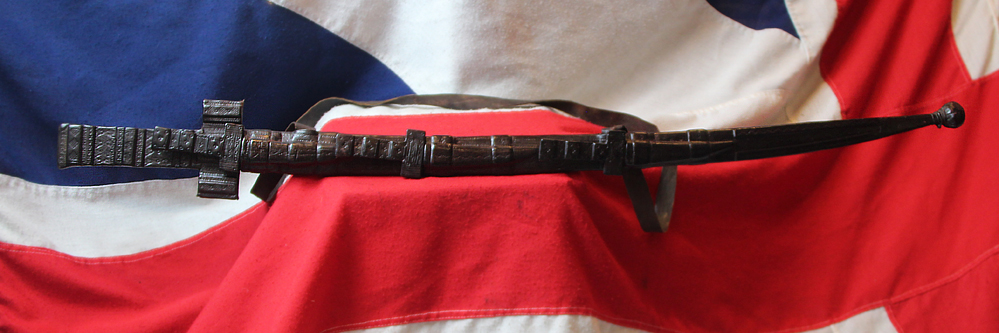
Click and use the code >22536 to search for this item on the dealer website Good And Most Interesting Tuareg Nomadic Berber Sword From The Western African Regions To North Africa
  • Nation : British
  • Local Price : £265.00
British 1903 Pattern Bayonet, 2nd Battalion Gloucestershire Regiment. Description Spear pointed unfullered blade, wood scale grips secured with two screws. Steel beaked pommel with locking button and clearance hole, steel hilt with short quillon and muzzle ring. Black leather 1888 Mk I pattern scabbard with steel throat and chape pieces, throat piece with teardrop frog stud. The blade is stamped on one side of the ricasso with a crowned &#acute;E.R.&#acute;, and 1903 (the pattern), a production date of 12 &#acute;03, meaning December 1903, three crown inspection marks with &#acute;E&#acute; for Enfield and reissue stamps &#acute;07, &#acute;07 (again), &#acute;08 and &#acute;09. On the other side it is stamped with a broad arrow Ward Department mark, the maker&#acute;s mark &#acute;EFD&#acute; for the Royal Small Arms Factory at Enfield, another crown inspection mark with &#acute;E&#acute; and an &#acute;X&#acute; which indicates that the blade passed a manufacturer&#acute;s bending test. The belly of the blade is faintly stamped with &#acute;D&#acute;. The pommel is stamped with &#acute;2GR&#acute; over &#acute;706&#acute;. This indicates that this was bayonet number 706 used by the 2nd Battalion, The Gloucestershire Regiment. The exposed tang is stamped with &#acute;J&#acute;. The throat piece of the scabbard is stamped at the mouth with &#acute;566&#acute;, each digit later cancelled with a strikethrough. The leather of the scabbard is stamped next to the seam with another broad arrow, another crown inspection stamp and the manufacture date &#acute;99. The throat and chape pieces are stamped next to the staples with small crown inspection stamps with &#acute;B&#acute; for Birmingham. The 2nd Battalion Gloucestershire Regiment was originally the 61st (South Gloucestershire) Regiment of Foot, which merged with the 28th (North Gloucestershire) Regiment of Foot in 1881 to form the Gloucestershire Regiment as part of the Childers Reforms. It fought in South Africa in the Second Boer War from 1900, taking part in the Battle of Paardeberg then being deployed to the Bloemfontein area until it returned to England in 1904, after which it would have been reequipped with the new SMLE and bayonet. The 1903 Pattern bayonet had quite a short service life with the SMLE rifle: it was judged to be too short compared to other armies&#acute; bayonets which would be a disadvantage in bayonet combat, so the 1907 Pattern was designed and produced in much larger quantities to replace it. As a regular infantry unit the Gloucestershire Regiment was probably issued with the 1907 Pattern relatively quickly “ the next deployment of the 2nd Battalion overseas was not until 1910 so their 1903s were probably put aside without having seen action. The battalion was stationed at the treaty port of Tientsin in China at the outbreak of WW1 and returned to fight at Ypres and later in Bulgaria, Armenia and Russia. The 1st and 2nd battalions were amalgamated in 1948. In 1994 the one-battalion regiment was merged with the Duke of Edinburgh’s Royal Regiment (Berkshire and Wiltshire) to form the Royal Gloucestershire, Berkshire and Wiltshire Regiment. This was merged with three other regiments to form The Rifles in 2007, its lineage maintained today by 1st Battalion, The Rifles. The blade is bright with patches of light patination increasing towards the tip, no edge damage. The ricasso of the blade retains its original band of bluing, slightly rubbed. The hilt, exposed tang and pommel also have a blued finish, with some wear to this in places on the hilt revealing lightly patinated steel. The scabbard pieces have moderate patination, some very light pitting near the tip of the chape on one side. The wood grips have only a few small dents, small chips next to one of the rivets on one side. The scabbard leather is good and flexible with only light rubbing wear, some dents on its edge, a few small cracks on the lip of the seam but all of its stitching remains intact.
  • Nation : American
  • Local Price : 365.00 USD
AMERICAN SECRET SOCIETY SWORD. Knights of the Maccabees, founded in London ontario and prominent in Michigan. Well modeled hilt with Turkish tent for pommel.and tape wrapped leather grip. 28" blade decorated with foliage, Knights of the Maccabees and owner's name. Blade plated over copper with s little freckling. Plated iron scabbard with three fine high relief mounts.
  • Nation : Spanish
  • Local Price : 365.00 USD
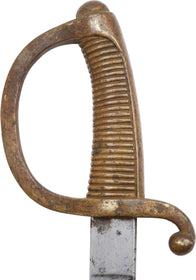
SPANISH ENLISTED MAN’S SWORD 1872. Pattern worn by infantry as well as artillery. Bronze one piece hilt of French styling, with ribbed grip. 27" slightly curved s.e. blade, the right side marked FBA DE TOLEDO 1872. Unrest in Spanish colonies led to the Cuban Revolution of 1868 resulting in the Ten Years War followed by an uneasy peace from the Pact of Zanjón in 1878, the Little War of 1879-80 and the Spanish-American War of 1898 which was fought in Cuba, Puerto Rico and other Caribbean Spanish holdings as well as the Pacific, largely the Philippines. This sword dates to the very onset of the wars and surely served in the Spanish-American War during which the majority of surviving examples of this pattern were captured. The blade fairly crisp with scattered old black oxidation, mostly smooth with minimal pitting.
  • Nation : British
  • Local Price : £260.00
British WW1 1888 Pattern Bayonet, 6th Battalion The Welsh Regiment (Glamorgan Battalion). Description Unfullered spear pointed blade, wood scale grips with two brass rivets. Steel pommel and hilt with short quillon and muzzle ring. Black leather Land Mk II pattern scabbard with steel throat and leather chape. The blade is stamped on one side of the ricasso with a (faint) crown over &#acute;VR&#acute;, the production date of &#acute;9 &#acute;97&#acute;, meaning September 1897, and the maker&#acute;s mark &#acute;Wilkinson London&#acute;. On the other side it is stamped with a broad arrow meaning War Department property, a crown inspection mark with &#acute;W&#acute; for Wilkinson and an &#acute;X&#acute; which indicates that the blade passed a manufacturer&#acute;s bending test. The spine of the blade is stamped with two further crown inspection marks with &#acute;W&#acute;. The pommel is stamped with the unit mark &#acute;6. WEL&#acute;, indicating the Queen&#acute;s Royal Regiment (West Surrey) and the number &#acute;735&#acute;. The exposed tang is stamped with &#acute;2&#acute;. The throat of the scabbard is stamped on each side of the mouth with a broad arrow, and with the serial number &#acute;160&#acute;. The scabbard leather is stamped next to the seam on one side with a broad arrow, the production date &#acute;03 and indistinct marks, probably a crown inspection mark. The 3rd Glamorganshire Rifle Volunteer Corps (Swansea Rifles) was formed in 1859, as part of the widespread Volunteer Movement of the period. As a Volunteer unit it went through many administrative changes but no deployment until the Second Boer War, when it contributed a detachment of volunteers to serve overseas. These men earned the unit&#acute;s first battle honour &#acute;South Africa 1900“1902&#acute;. In 1908 the Haldane Reforms brought Volunteer units into the new Territorial Force and linked them to regular regiments “ the Swansea Rifles therefore became the 6th (Glamorgan) Battalion of the Welsh Regiment, still headquartered at Swansea and forming part of the Territorial Force&#acute;s South Wales Brigade. The Welsh Regiment had been formed in 1881 as part of the Childers Reforms, amalgamating the 41st (Welch) and 69th (South Lincolnshire) Regiments of Foot. On the outbreak of WW1 the battalion volunteered for overseas service and landed in France in October 1914. Territorial battalions were typically deployed still carrying the Lee Metford rifle and 1888 Pattern bayonet, supplies of the Lee Enfield being limited. The 6th Battalion initially served on the lines of communication rather than on the front lines, but attrition caused Territorial battalions to be used in 1915 to reinforce regular brigades. The 6th Battalion (technically the 1/6th by this stage as a replacement 2/6th Battalion was formed as a second line unit in December 1914) therefore joined the 84th Brigade (28th Division), reinforcing the 1st Battalion Welsh Regiment, with which it fought in the Battle of Loos. In 1916 the 6th was moved to the 1st Division, serving as their Pioneer Battalion. In this role it would contribute working parties to assist the division&#acute;s complement of Royal Engineers with their various field tasks, but retained a supporting combat role and would take part in offensives. 1st Division took part in many further actions until the end of the war including the Battle of the Somme, Third Battle of Ypres and the Hundred Days Offensive. The 6th Battalion reformed after WW1 as a Territorial Army unit, absorbing the 7th Battalion. With a growing emphasis on air warfare, the battalion became the 67th Searchlight Regiment in 1938. During WW2 it defended the industrial areas of South Wales against early small-scale Luftwaffe bombing raids, then deployed to protect Cardiff against much larger raids during the Blitz. In 1940 searchlight units were brought under the Royal Artillery, and the battalion remained with the Artillery even after the war. After several amalgamations, the lineage of the original Glamorgan Battalion is today maintained by 211 (South Wales) Battery of 104th Regiment Royal Artillery (The Welsh and Borderer Gunners), an Army Reserve light artillery unit. The blade has some light speckled patination. The tip of the blade has been shortened, possibly by breakage while in use, and has been reshaped and resharpened, with visible grinding marks. There are some minor nicks to the edge and the faint crown mark suggests that the blade may have been repolished above the shoulder.  The wood grips have some light dents. The hilt and pommel have some patination and pitting. The throat piece of the scabbard has pitting and patches of dark patination. The leather of the scabbard has some rubbing and denting, one small spot of green paint, and one notch on the reverse side. The chape end of the scabbard is slightly kinked, but does not interfere with sheathing and drawing.
  • Nation : -
  • Local Price : 3,300 kr
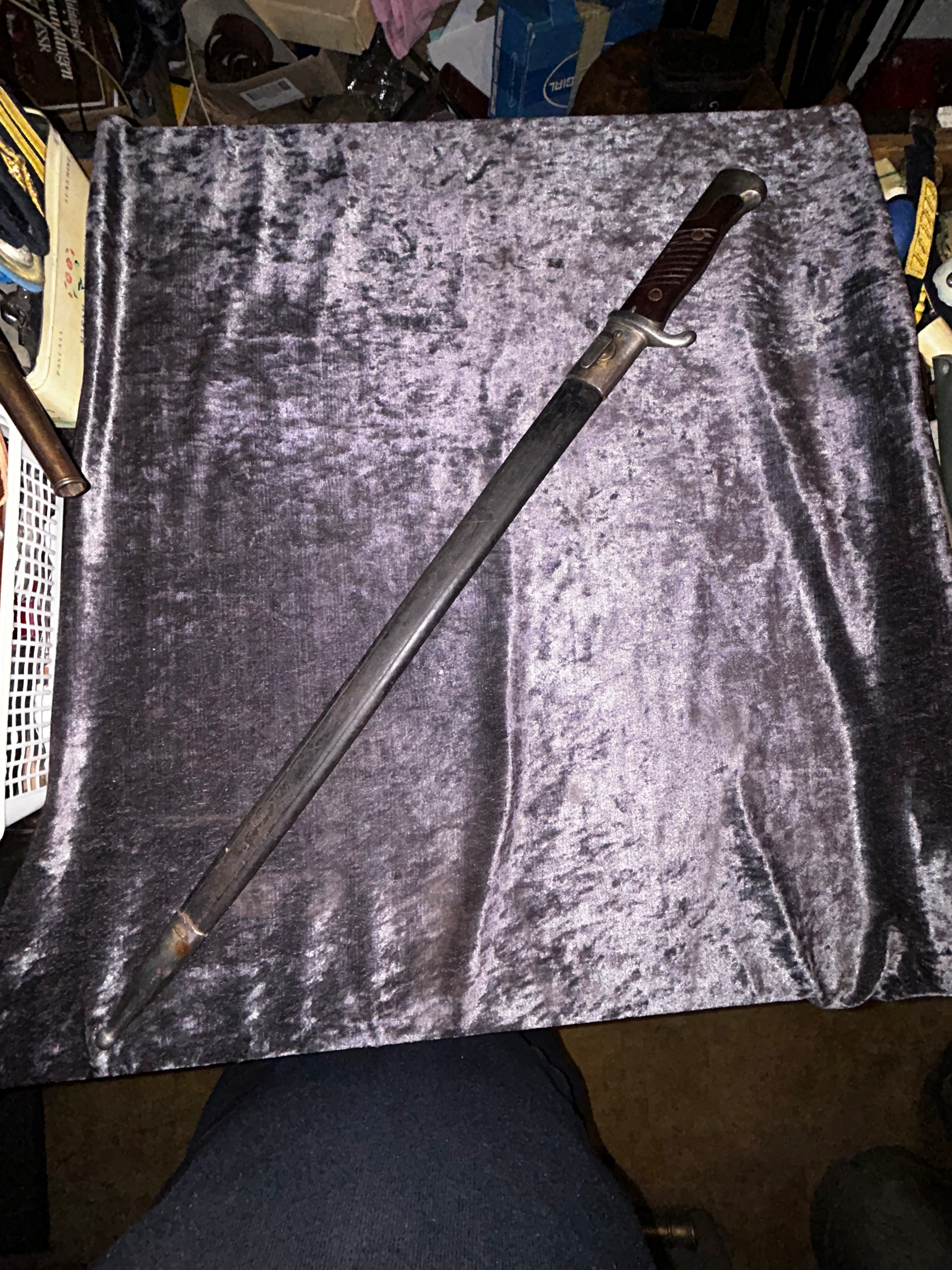
Tysk m/98 lång bajonett nr-lik.
  • Nation : German
  • Local Price : 3,300 kr
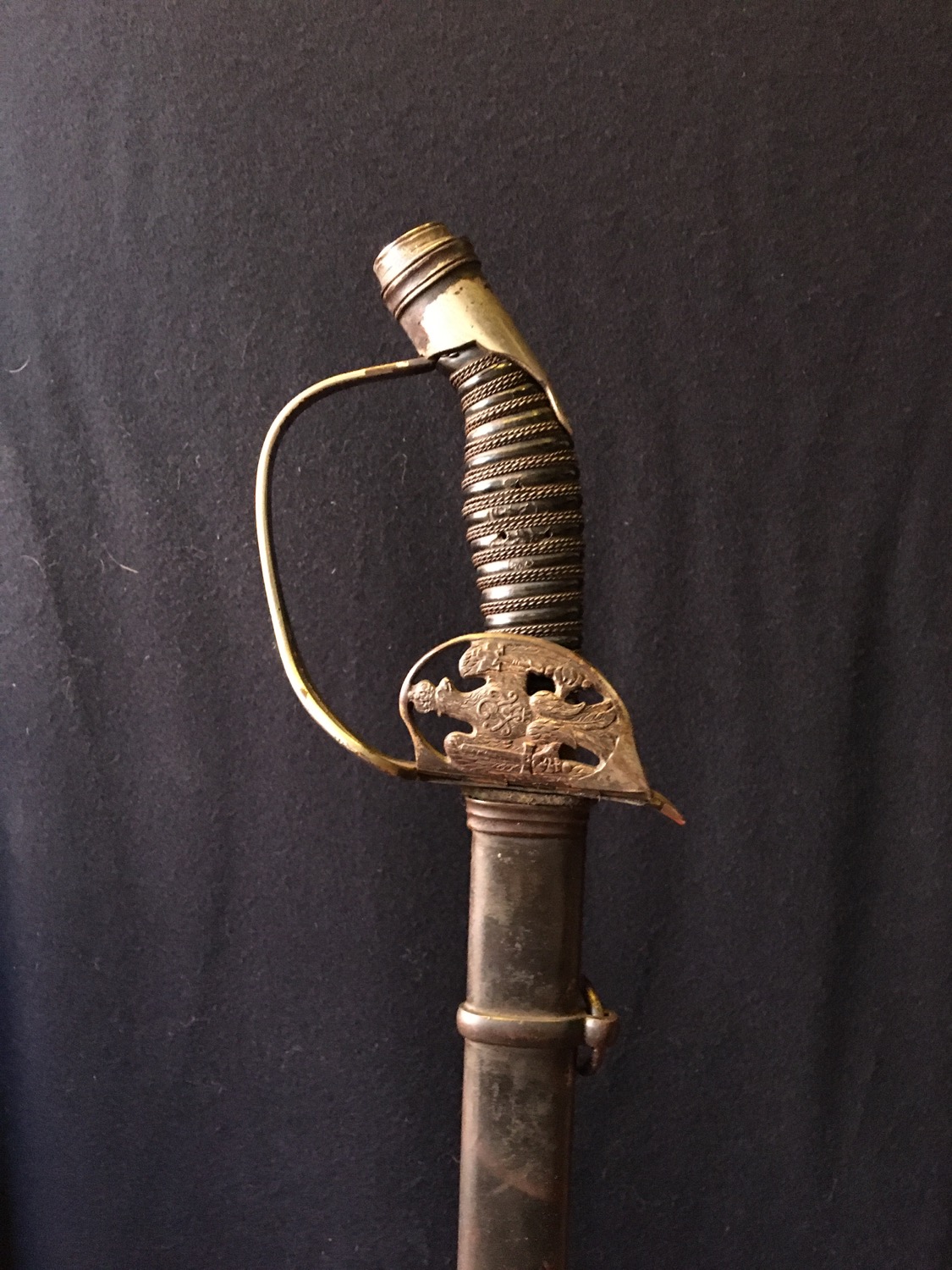
German saber m /1889.
  • Nation : American
  • Local Price : 355.00 USD
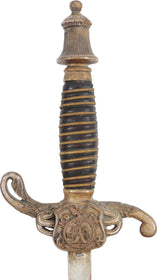
US MILITIA OFFICER’S SWORD C1870’s-80’s. Something went wrong * { box-sizing: border-box; margin: 0; padding: 0; } html { font-family: "Helvetica Neue", Helvetica, Arial, sans-serif; background: #F1F1F1; font-size: 62.5%; color: #303030; min-height: 100%; } body { padding: 0; margin: 0; line-height: 2.7rem; } a { color: #303030; border-bottom: 1px solid #303030; text-decoration: none; padding-bottom: 1rem; transition: border-color 0.2s ease-in; } a:hover { border-bottom-color: #A9A9A9; } h1 { font-size: 1.8rem; font-weight: 400; margin: 0 0 1.4rem 0; } p { font-size: 1.5rem; margin: 0; } .page { padding: 4rem 3.5rem; margin: 0; display: flex; min-height: 100vh; flex-direction: column; } .text-container--main { flex: 1; display: flex; align-items: start; margin-bottom: 1.6rem; } .action { background: transparent; cursor: pointer; border: 1px solid #A9A9A9; padding: 1.2rem 2.5rem; border-radius: 6px; text-decoration: none; margin-top: 1.6rem; display: inline-block; font-size: 1.5rem; transition: border-color 0.2s ease-in; } .action:hover { border-color: #000; } @media all and (min-width:500px) { .text-container--main { align-items: center; } .page { padding: 7.5rem 10.5rem; } } There was a problem loading this website Try refreshing the page. If the site still doesn't load, please try again in a few minutes. Refresh Page
Page 121 of 157