
Show

Forgot your password?

Error message here!

Error message here!

Error message here!

Error message here!

Show Error message here!

Show Error message here!

Lost your password? Please enter your email address. You will receive a link to create a new password.

Error message here!

Back to log-in

Close

For Sale

The following items are listed by for sale by users of the site and dealers. They are in no way endorsed or guaranteed by www.antiquearmsresearch.com

Add a Classified Item
to

Clicking on the sword will take you through to the relevant classified item or dealer site.
Don't miss out! - Do you want to be kept informed weekly of new aditions? Just join our weekly update list.

You can also receive regular email notifcations when items match your keywords. To recieve them just register or logon at the top right of this page.

Page 125 of 157
  • Nation : French
  • Local Price : £230.00
French Model 1831 Artillery Sidearm, Dated 1833 by Pihet Freres, Chatellerault. Description Straight double-edged blade, unfullered with diamond profile and spear point. One-piece cast brass hilt, grip and pommel, the hilt with circular finials, the grip ribbed, the pommel oval with a domed circular tang button. Brown leather washer. Black leather scabbard with brass throat and chape pieces, the throat piece with a frog loop, the leather section with two debossed lines lengthwise on the front face, similar on the reverse face but with one line being the stitching. Blade 48.7cm in length (just over 19 1/8 inches), the sword 63.7cm (just over 25 inches) overall. The blade is stamped on one side at the forte with &#acute;Pihet Frères&#acute; and a five-lobed flowerhead stamp, and on the other side with &#acute;Chatellerault 1833.&#acute; The hilt is stamped on one side with the serial number &#acute;689&#acute;. The throat piece of the scabbard is stamped on the reverse side with a matching serial number &#acute;689&#acute; indicating that blade and scabbard are an original pair. The leather of the scabbard is stamped with the maker&#acute;s mark &#acute;GIRARD LOUIS A CHÃ
  • Nation : British
  • Local Price : £230.00
British Lee Enfield No. 7 Mk 1 Land Service Bayonet, Dated 1946 by Poole. Description Single-fullered bowie knife blade with clipped point, blued for 5mm at the ricasso. Red-brown grips made of Paxolin (resin-impregnated paper, similar to Micarta, and widely used today in circuit boards). Steel scabbard with brass throat piece and circular frog stud. Blue canvas 1937 Pattern Royal Air Force frog with retaining loop. Hilt and pommel lacquered. The blade is stamped on one side at the ricasso with &#acute;No 7 MK 1/L&#acute; and on the other side with a &#acute;P&#acute; within a circle indicating the manufacturer Poole, as well as the manufacture date &#acute;1946&#acute;. The pommel is stamped on one side with a broad arrow War Department mark and on its base with some faint numbering, possibly &#acute;114&#acute;. The exposed track for the sliding button is stamped with a broad arrow War Department mark and faint lettering. The frog stud of the scabbard is stamped with a mark indicating manufacture at the Royal Small Arms Factory at Enfield: a superimposed letter E and D, resembling a D with a horizontal strikethrough. The reverse of the frog is faintly inked with some lettering (illegible). The rear side of the scabbard has been daubed with a patch of yellow paint, almost all hidden by the frog when it is fitted. The penultimate model of bayonet designed for the Lee-Enfield No. 4 rifle and Sten Mk 5 submachine gun, the No. 7 was an attempt to produce a bayonet that was equally useful as a utility/fighting knife and a mounted bayonet, by way of an innovative rotating pommel which contains the locking mechanism. 330,000 were produced between 1944 and 1948, but doubts about the rigidity of the mechanism under stress and its high cost of manufacture meant that the No. 7 was largely passed over for the simpler No. 9. The bayonet designed for the ill-fated EM series of experimental bullpup service rifles was essentially a strengthened No. 7.
  • Nation : -
  • Local Price : 2,900 kr
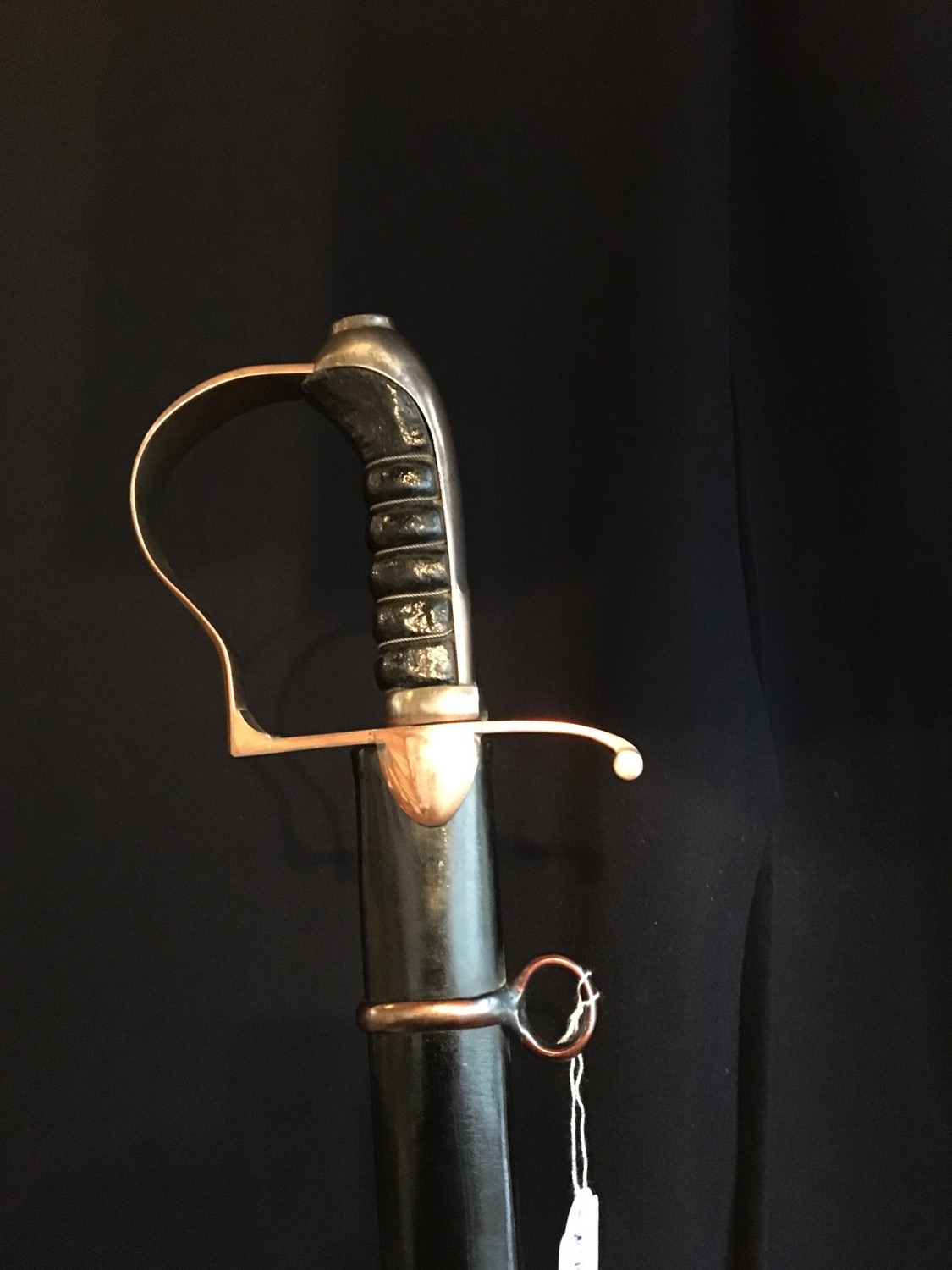
Saber WW1 officer.
  • Nation : -
  • Local Price : 2,900 kr
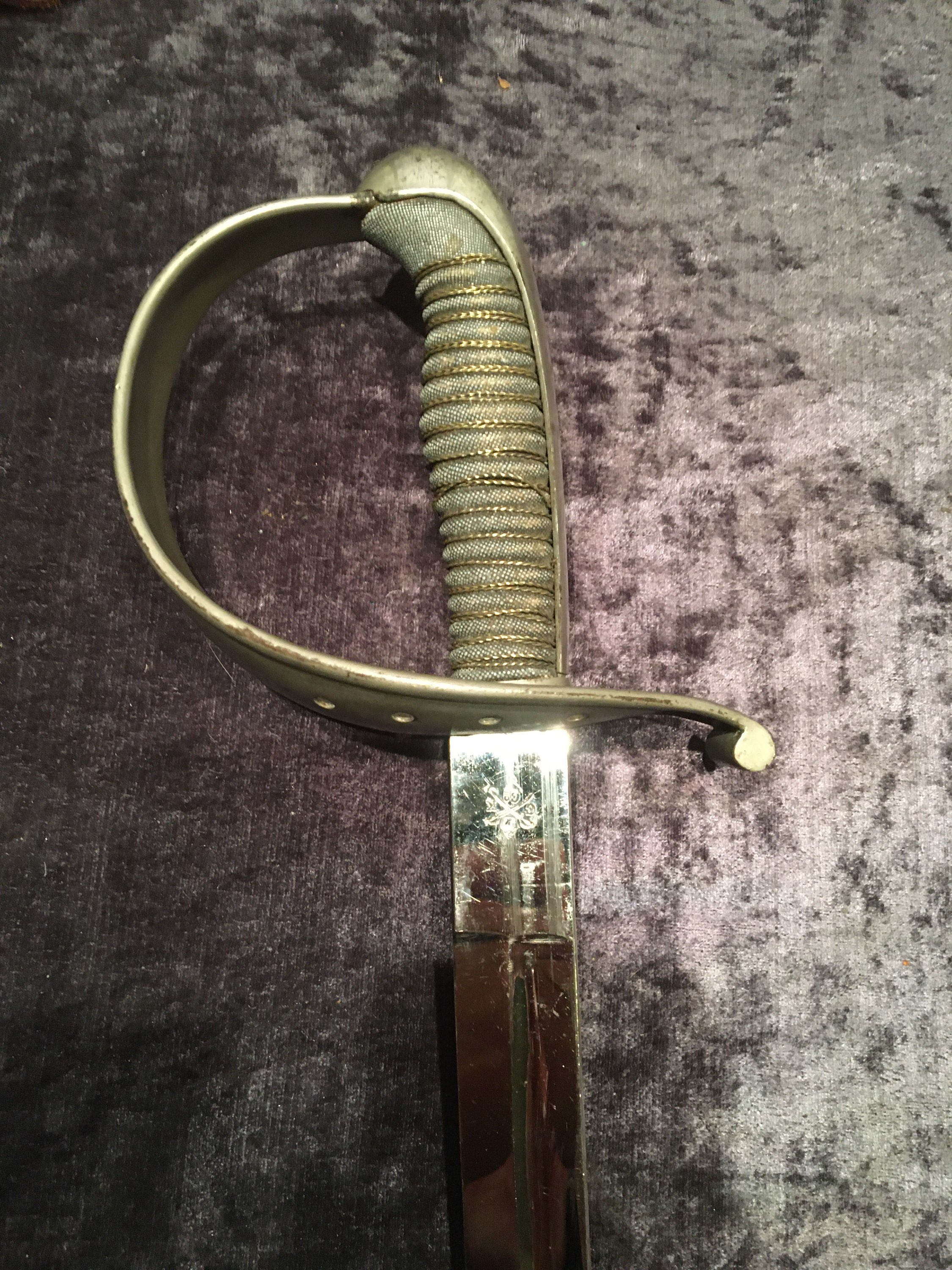
Sable Austria/Switzerland ca: 1860.
  • Nation : Australia
  • Local Price : £225.00
Australian WW2 Owen Submachine Gun Bayonet. Orange 1945. #2410025. The Australian Owen Mk1 submachine gun bayonet is essentially a shortened No.1 (1907 pattern) bayonet and was agreed in August 1944 and notified in General Orders in February, 1945. Production began in February 1945. By mid-April 1945, only 19,000 Mk1 and Mk1/1 bayonets had been produced.The Mk1 had a newly made blade. The Mk1/1 (originally designated Mk2) has a shortened 1907 pattern (No.1 bayonet) blade. Wartime production of the Owen bayonet was at the Orange factory. Post war production was at Lithgow in 1953.This Mk1 Owen SMG bayonet is an early production example made at the Orange factory in March, 1945.The 251mm blade has a rounded spine above a deep single fuller. The blade is in excellent condition, retaining its original black finish and factory edge.The ricasso is stamped with an arrow mark, bend test X and the Orange factory maker’s mark, OA.The obverse ricasso is stamped with the pattern designation, MA over 1907 over 1 and the production date of March, 1945.The cross piece and pommel retain their original finish and the locking mechanism is crisp. The hardwood grip scales are in very good condition and are stamped SLAZ 44.The bayonet is complete with its brown leather scabbard with blackened locket and chape. The locket and chape retain their original finish and are stamped with the OA mark of the Orange factory. The leather is strong and the stitching intact. The bayonet sheathes and draws smoothly and is held firmly within the scabbard.This is an excellent example of a scarce WW2 production Owen submachine gun bayonet.
  • Nation : British
  • Local Price : £225.00
British 1888 Mk 1 Type II Lee-Metford Bayonet. Royal Navy Issue. #2507001. British Pattern 1888 Mk I Type II Lee-Metford rifle Bayonet made in 1896 at the Royal Small Arms Factory at Enfield, London.This bayonet is in excellent condition for its 129 years of age and is highly collectable.The 304mm double-edged blade is marked on the ricasso with a flat crown above VR (Victoria Regina) and the production date, 2 ‘96 (February, 1896). The obverse ricasso is marked with the British War Department WD and broad arrow, a bend test stamp and an Enfield factory inspection stamp. The spine of the ricasso bears an Enfield inspection stamp. The stamps have cleaning wear.The wooden grip scales are in good condition. The left-hand scale has a stabilised crack. Two large brass rivets positioned close together hold the scales securely in place. The wooden hilt scales are drilled with an oil hole above the top rivet. The steel crosspiece and pommel are bright and free from rust. The press-stud locking mechanism is in good, crisp working order. The pommel is stamped with the weapon/issue number 161 and the letter, N, indicating that the bayonet saw service in the Royal Navy.The bayonet is complete with its black leather scabbard with steel mounts. The steel locket and chape are stamped with Enfield inspection marks. The leather is strong and the stitching intact. The bayonet sheathes and draws smoothly and is held firmly within the scabbard.This is an great example of the iconic British Lee-Metford rifle bayonet with scarce Royal Navy issue markings.
  • Nation : German
  • Local Price : £225.00
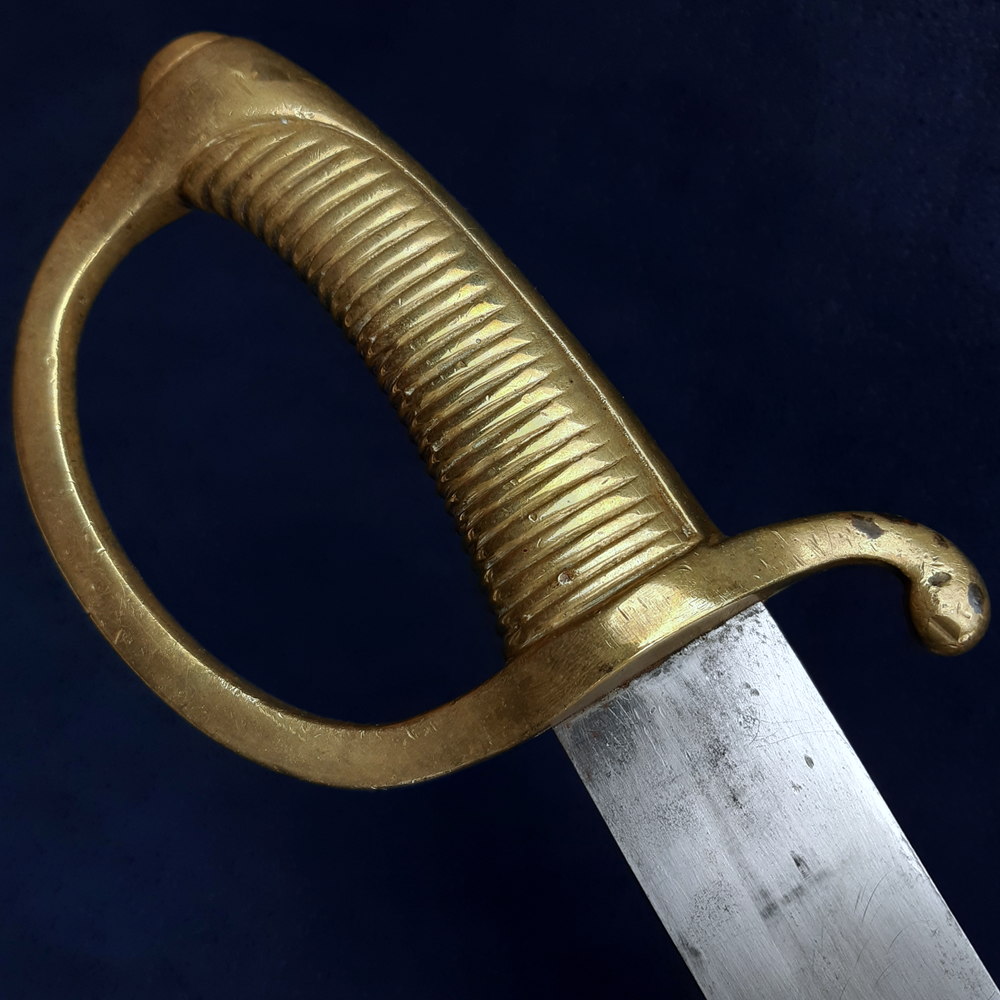
German 19th Century Infantry Briquet Sabre. Description Slightly curved spear pointed blade, unfullered with false edge. One-piece cast brass hilt with ribbed grip, forward curving quillon with comma-shaped finial and simple knucklebow, domed pommel. Black leather scabbard with brass locket and chape, the locket with oval frog stud, the chape piece partly internal with leather covering, with ball finial on the exposed lower section. Blade 65.5cm in length, the sword 78.4cm overall. The blade is bright with a polished finish, only a few tiny spots of patination and old polishing marks. Its edge is sharp with a number of nicks, its tip is undamaged. The brass hilt is likewise bright with a few spots of patination and a few small dents. The scabbard fittings have a midtone patina with some darker spots and a couple of tiny dents - one slightly larger dent to the chape piece which does not interfere with sheathing and drawing. The leather of the scabbard has a few dents and some cracking on the front face but remains sound overall. Its stitching has opened slightly in the section covering the internal chape, perhaps due to shrinkage, but there are paired brass rivets on either side which help secure the leather so it is unlikely to open any further.
  • Nation : British
  • Local Price : £225.00
British Lee Enfield No. 7 Mk 1 Land Service Bayonet with Black Grips, by B.S.A.. Description Single-fullered bowie knife blade with clipped point, blued for 5mm at the ricasso. Black grips made of Paxolin (resin-impregnated paper, similar to Micarta, and widely used today in circuit boards). Steel Mk I scabbard with steel throat piece and circular frog stud. Hilt and pommel blued. The blade is stamped on one side at the ricasso with &#acute;No 7 MK 1/L&#acute;. The pommel is stamped on one side with a broad arrow War Department mark and &#acute;M47A&#acute;, indicating manufacture by the Birmingham Small Arms Company (B.S.A.), specifically their plant at Small Heath, Birmingham, which was assigned the dispersal code M47A during WW2. The flat of the hilt on the blade side and the frog stud of the scabbard are both stamped with a broad arrow. The penultimate model of bayonet designed for the Lee-Enfield No. 4 rifle and Sten Mk 5 submachine gun, the No. 7 was an attempt to produce a bayonet that was equally useful as a utility/fighting knife and a mounted bayonet, by way of an innovative rotating pommel which contains the locking mechanism. 330,000 were produced between 1944 and 1948, but doubts about the rigidity of the mechanism under stress and its high cost of manufacture meant that the No. 7 was largely passed over for the simpler No. 9. The bayonet designed for the ill-fated EM series of experimental bullpup service rifles was essentially a strengthened No. 7. The grips of these bayonets vary in colour due to different materials and formulations used to produce these early composite materials, but are generally red, shading towards brown in some examples. Black grips are a known variation and I have so far seen them predominantly on examples by B.S.A., and occasionally by Elkington “ they are interchangeable parts however, so could readily have been swapped between bayonets of whatever make. Some claim the black grips were intended for parade use or were for specific units e.g. the Guards, and I have indeed seen examples chromed and with parade frog, but former British Army armourer, collector and author Peter Laidler attests that both &#acute;black and brown paxolin grips were issued under the same part number and it really was just pot luck as to whatever colour came through the Ordnance system. It was nothing to do with whatever unit they were issued to&#acute;. This would seem to confirm that there was no differentiated role intended for the black version, it was simply a variation of the same product. Perhaps those found in parade order were selected at the unit level for that role for purely aesthetic reasons, not as a matter of policy. Laidler also notes that black grips seem to be scarcer in civilian collecting today than they were in military service at the time, so there may be survivorship bias at work.
Page 125 of 157