
Show

Forgot your password?

Error message here!

Error message here!

Error message here!

Error message here!

Show Error message here!

Show Error message here!

Lost your password? Please enter your email address. You will receive a link to create a new password.

Error message here!

Back to log-in

Close

For Sale

The following items are listed by for sale by users of the site and dealers. They are in no way endorsed or guaranteed by www.antiquearmsresearch.com

Add a Classified Item
to

Clicking on the sword will take you through to the relevant classified item or dealer site.
Don't miss out! - Do you want to be kept informed weekly of new aditions? Just join our weekly update list.

You can also receive regular email notifcations when items match your keywords. To recieve them just register or logon at the top right of this page.
Page 128 of 157
  • Nation : British
  • Local Price : 2,800 kr
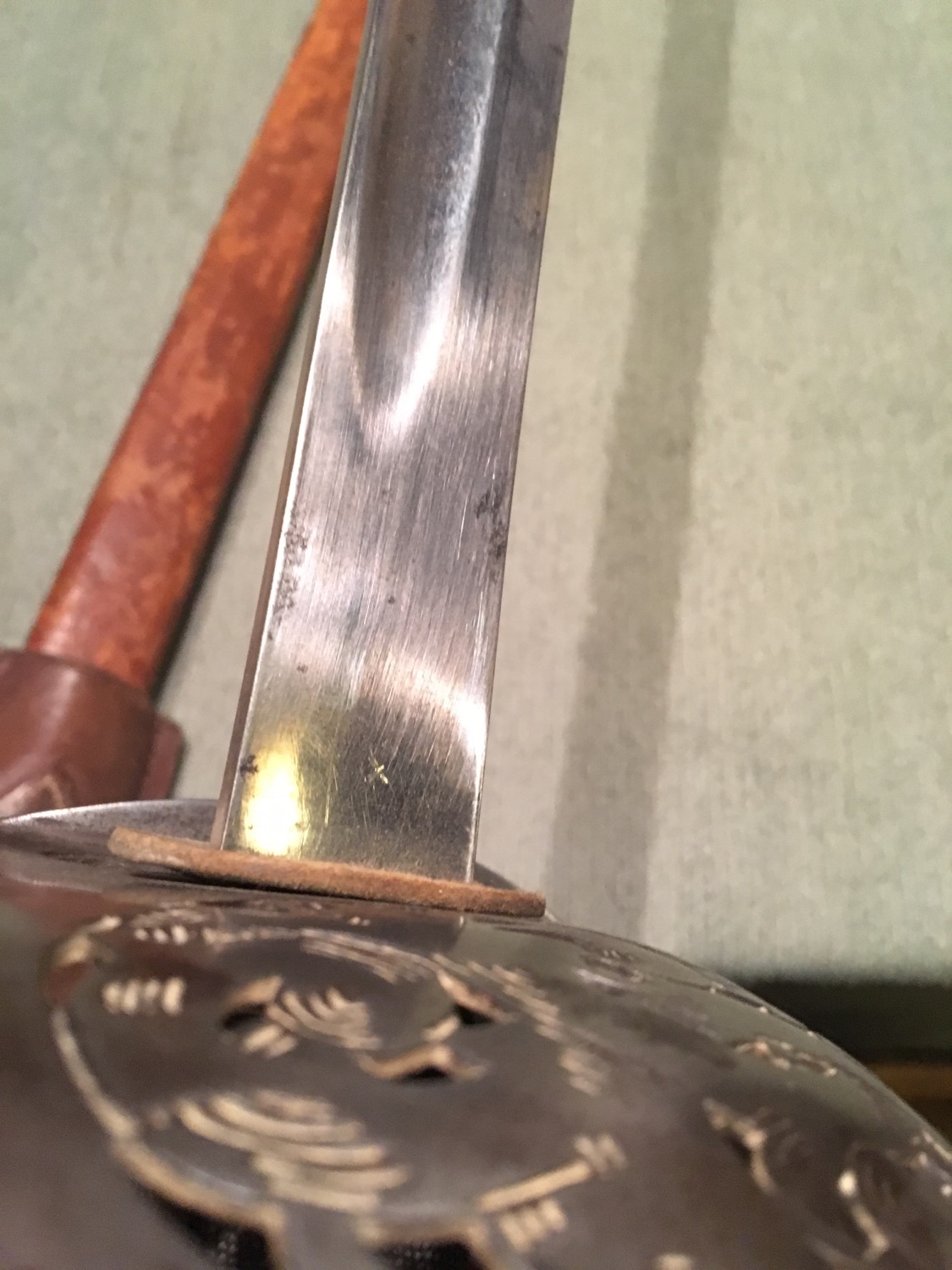
English infantry off saber m / 1897.
  • Nation : French
  • Local Price : £215.00
French M1892 Mannlicher Berthier 1st Pattern Bayonet. Description Straight blade with spear point, single fuller on each face as well as short fuller on the spine running to the tip. Black slab composition grips (meaning that this is the 1st pattern, the 2nd pattern having wood grips) secured to the exposed tang by two steel rivets. Hilt with muzzle ring overlapping the grip and a hooked lower quillon. Many M1892 bayonets had the quillon removed during WW1 “ this example remains intact and original. Steel pommel with locking button. Steel scabbard with frog loop, brown leather frog of the correct type for the M1892, with strap and brass buckle. The bayonet&#acute;s quillon is stamped with a cursive F and the serial number &#acute;38157&#acute;. The scabbard is also numbered on the frog loop band but because of the black paint that has been applied to it this number is illegible, so I cannot tell if the bayonet and scabbard are a matching pair or not. The scabbard has a small &#acute;S&#acute; inspection mark next to the rivet hole on one side. The blade is bright with some light frosting and a few small spots of patination in the fullers. The edge of the blade has been sharpened with visible grinding marks “ the tip has also been ground but is not particularly sharp, probably because of its thick point intended to pierce without breaking. The hilt, tang and pommel have areas of patination, the pommel some speckled cleaned light pitting. Some small indentations to the grip slabs. The scabbard has been painted gloss black “ this is mostly intact with just a few small chips revealing steel. The rivet near the throat of the scabbard is missing. The leather frog has some surface rubbing and loss of stitching in places.
  • Nation : -
  • Local Price : 295.00 USD
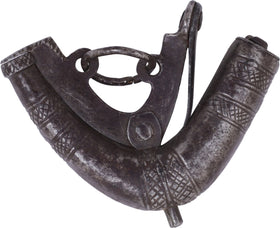
18th CENTURY OTTOMAN PRIMING FLASK FOR FLINTLOCK PISTOL. All iron of small size to hold about three pan charges, likely the most expected to be used in a battle where the opportunity for reloading was rare. Just over 2 3/4" width with curved chamber engraved hatched bands and pivoting spring cut off. Excellent with uniform light to medium surface patina.
  • Nation : -
  • Local Price : £210.00
Norwegian M1894 Krag Jorgensen Bayonet by Kongsberg, Matching Numbers. Description Unfullered spear-pointed blade, wood slab grips secured by a single screw, steel one-piece hilt, backstrap and pommel with integral sprung locking mechanism in the hilt, that both locks the bayonet to its scabbard and locks it onto a rifle. Steel scabbard with projecting hook on the throat piece to engage with the locking mechanism. Blade 8¼ inches in length, the bayonet 13 inches overall. The blade is stamped at the ricasso with a crowned &#acute;K&#acute;, the maker&#acute;s mark of the Kongsberg Våpenfabrikk (Kongsberg Weapons Factory) in Norway. Most M1894 bayonets were produced there, their production totalling 101,750 between 1912 and 1926. A new production run was ordered from Kongsberg during WW2 while Norway was under German occupation, but these have a different maker&#acute;s mark and distinctive Waffenamt stamps. A depot fire in 1941 destroyed 4,693 M1894 and M1916 bayonets, and 31,000 M1894s were converted to fit the M1 Carbine in 1956-57. The hilt is stamped with the serial number &#acute;42847&#acute;. This number is also stamped on the throat piece of the scabbard, indicating an original pair. The body of the scabbard is also stamped with &#acute;847&#acute; “ this may have been matching too and the initial digits were omitted or have been lost. The ricasso on the edge side is stamped with a crown mark. The blade and hilt have a bright finish. The blade is sharp with visible sharpening marks “ some tiny nicks to the edge, which have been mostly sharpened out. The wood grips have a few small dents and chips. A few small, very shallow dents to the scabbard body, which has some small areas of black paint remaining.
  • Nation : British
  • Local Price : £210.00
British WW1 1913 Pattern Bayonet, Dated 1916 by Remington. Description Straight single-fullered knife blade, steel hilt with muzzle ring, wood slab grips with characteristic pair of cut grooves on each slab, secured by two screws. Steel beaked pommel and locking button. Brown leather scabbard with steel locket & chape piece, the locket with teardrop frog stud. Brown leather 1938 Pattern leather frog with retaining loop. The ricasso is stamped on one side with &#acute;1913 5 16&#acute;, indicating that it is the 1913 Pattern, manufactured in May 1916, and the maker&#acute;s mark &#acute;Remington&#acute; within a circle. On the other side it is stamped with a &#acute;broad arrow&#acute; War Department stores mark, two crown inspection marks with &#acute;A&#acute; for America and an &#acute;X&#acute; indicating that it passed a manufacturer&#acute;s bending test. The leather section of the scabbard is stamped next to the seam with a faint &#acute;W&#acute; which would indicate the scabbard was made with a waxed finish. The frog is stamped on the reverse side with the maker&#acute;s mark &#acute;B. H & G. 1940&#acute;, indicating that it was made by the firm of Barrow, Hepburn & Gale in 1940, as well as a broad arrow, &#acute;25&#acute; and &#acute;5A3&#acute;. The chape piece of the scabbard is stamped with &#acute;RE&#acute; for Remington. Inspired by the German Mauser M98 rifle, the experimental Pattern 1913 Enfield was intended to be the next generation British infantry rifle, firing the new .276 cartridge. The outbreak of war curtailed its development and the well-established SMLE was retained in service instead. However with an urgent need for rifles the government opted to redesign the 1913 to take the existing .303 cartridge, calling this new rifle the Pattern 1914 (NB: the bayonet&#acute;s design did not require modifications, therefore it remained the &#acute;1913 Pattern&#acute; bayonet). The production of these rifles and their bayonets was contracted to American manufacturers “ an early handful were made by Vickers but it was clear that British plants were best left to make the SMLE. Remington was the largest manufacturer of the 1914 Pattern and its associated bayonet, producing 1,243,000 of the bayonets between 1916 and 1917. The 1914&#acute;s design was vindicated in that it proved to be more accurate than its predecessor and it was deployed principally as a sniper rifle, the Winchester-made rifles in particular thought to be of high quality, suitable for fitting with telescopic sights. It saw service again during WW2 as rear echelon equipment, e.g. with the British Home Guard, although some were again used in a sniper configuration. The distinctive 1938 Pattern frog that has been fitted suggests that this bayonet was issued to the Home Guard during WW2. The 1913 Pattern should not be confused with the M1917 Enfield, also known as the &#acute;American Enfield&#acute;, which was essentially the same rifle design, this time adopted by the Americans and rechambered in their own .30-06 Springfield cartridge. Its bayonet was also essentially the same as the British model, but with US service marks and a &#acute;1917&#acute; pattern stamp. Founded in 1760 as Hepburn and Sons, Barrow, Hepburn & Gale was a manufacturer of leather goods based in the ancient tannery district of Bermondsey, London, which at times supplied the British Army with items such as saddles and bayonet scabbards. During the Second World War its tannery complex at The Grange, Bermondsey, was hit by aerial bombing and its chairman, George Odey, received a CBE for his company&#acute;s contribution to the war effort. The firm still trades under the same name, notably manufacturing the red leather dispatch boxes used by government ministers since 1853, and the leather purses used in the 800-year-old tradition of Royal Maundy. The blade has no edge damage, slight rolling to the tip. The edge is sharp and the tip is undamaged. It retains its original parkerised finish and blued area at the ricasso, with some small spots of patination, and one spot of light pitting at the end of the fuller on one side. The hilt, exposed tang and pommel have a blued finish with rubbing at raised edges. The wood grips have a few small dents. The scabbard fittings have been painted black with only small spots of wear at edges and on the frog stud exposing bright steel. The leather body of the scabbard has only light rubbing and a few small scratches, all of its stitching is intact. The leather frog has some surface-level cracking to the retaining strap and one surface-level crack on the front of the throat loop next to the frog stud. Its leather is a little stiff but in good condition, with all of its stitching intact.
  • Nation : British
  • Local Price : £210.00
British 1887 Pattern MkIII Martini Henry Sword Bayonet by Wilkinson. Description Straight unfullered spear-pointed blade. Steel hilt with comma-shaped quillon and stepped muzzle ring. Chequered leather grips (technically, knurled) secured by two steel rivets with washers. Black leather scabbard with steel mounts at the throat and chape, with frog hook. The blade is stamped at the ricasso on one side with a crown over &#acute;V.R.&#acute; for Queen Victoria, an issue stamp 4 &#acute;98 for April 1898, and the maker&#acute;s mark &#acute;WILKINSON SWORD COMPANY LONDON&#acute;. It is stamped on the other side with a War Department mark of a broad arrow over &#acute;WD&#acute;, a crown inspection mark with &#acute;W&#acute; for Wilkinson and an &#acute;X&#acute; indicating the blade passed a manufacturer&#acute;s bending test. The spine of the blade is stamped with two further crown inspection stamps for Wilkinson. The scabbard is stamped at the throat with the serial number &#acute;6843&#acute;. The throat piece of the scabbard is stamped under the staple on the front side with a crown inspection mark. The reverse of the scabbard is stamped next to the seam with further marks - these usually consist of another broad arrow over &#acute;WD&#acute; and another crown inspection mark but are illegible on this example due to rubbing. The 1887 Pattern bayonet was introduced into service in the face of the &#acute;British Bayonet Scandal&#acute; “ a controversy (eagerly whipped up by the media) that British Army bayonets were made of inferior metal and/or badly heat-treated, and the Army was outsourcing blade manufacture overseas to the detriment of British industry. The Government responded by centralising bayonet manufacture as much as possible at the RSAF in Enfield. However, Enfield was already overstretched and would not be able to manufacture the new pattern for some time. A tender was put out for private manufacturers to fill the gap “ German manufacturers made the cheapest offers but politics moved the government to choose the British firm Wilkinson of Pall Mall. This contract was instrumental in the rise of Wilkinson as a company and they manufactured around 42,000 1887 Pattern MkIIIs in 1888 and 1889, which made up 83% of the total supplied. The blade has a light patina with some old polishing marks “ it appears to have been refinished during its service life as the issue stamp is fresher and less rubbed than the maker&#acute;s mark next to it. Only a couple of very tiny nicks to the edge, not readily visible. The hilt and pommel have light patination in their recesses. The leather grips have some moderate handling wear that has somewhat smoothed the knurling, some small spots of losses to the leather on one side. The chape piece of the scabbard has some light dents, these do not interfere with sheathing and drawing. The leather of the scabbard has surface rubbing and some spots of abrasion near the throat and beside the seam. All its stitching remains intact.
  • Nation : British
  • Local Price : £210.00
British Lee Enfield 1907 Pattern Bayonet, Chromed with Unusual Reverse Seam Scabbard. Description Straight single-fullered knife blade, steel hilt with muzzle ring, wood slab grips secured by two screws, steel beaked pommel with oil hole and locking button. Black leather No. 1 Mk 2 scabbard with reversed seam, steel locket & teardrop frog stud and steel chape piece. White leather parade frog. The ricasso is stamped on one side with a crown over G.R., 1907 (the pattern), a very faint manufacture date stamp which I believe reads 12 &#acute;16, which would indicate December 1916, and the maker&#acute;s mark &#acute;Wilkinson Pall Mall&#acute;. On the other side it is stamped with a &#acute;broad arrow&#acute; War Department stores mark, four crown inspection marks with &#acute;E&#acute; from Enfield, the reissue date &#acute;18 and an &#acute;X&#acute; indicating that it passed a manufacturer&#acute;s bending test. The leather section of the scabbard is stamped with a diamond-shaped manufacturer&#acute;s mark. The reverse of the frog is stencilled with the serial number &#acute;593&#acute; and inked with the name &#acute;Connolly&#acute; and some indistinct numbers, probably a soldier&#acute;s name. The stand-out feature on this bayonet is its unusually constructed scabbard, which has its seam running down the front panel on the same side as the frog stud, the reverse of the usual arrangement. &#acute;Double-stitched&#acute; scabbards with seams on both the front and back sides were produced in Australia in the 1920s, which allowed smaller pieces of leather to be used in their construction, but why one would be produced anywhere with this single reversed seam is unclear. All metal parts of the blade and scabbard have been chrome plated. This plating has worn in places, particularly the pommel and along the edge of the blade. Some small nicks to the blade&#acute;s edge, particularly towards the point. The wood grips are undamaged with only a few tiny dents. Some light rubbing to the scabbard leather on its flat face (the inside as worn). No dents to the scabbard fittings.
  • Nation : British
  • Local Price : £210.00
British 1855 Pattern Land Transport Corps Sword by Kirschbaum. Description Straight unfullered single-edged blade. Ribbed solid brass hilt with cross guard, symmetrical round finials and oval pommel. No scabbard. The ricasso of the blade is stamped on one side with a knight&#acute;s helm, this mark signifies the maker as C F Kirschbaum of Solingen. Imported German blades are not uncommon on British swords of the period, even those produced for the government. English firms would often buy in German blades then hilt and finish them. On the other side it is stamped with a crown inspection mark. Sidearms with the form of a neoclassical &#acute;gladius&#acute; appear to have originated with Napoleon&#acute;s love for all things Roman, and the French 1771 &#acute;Eagle Head&#acute; Artillery sword. A series of very similar-looking short swords were subsequently designed, including the French 1816 & 1831 Artillery, the US Model 1832 Foot Artillery, the Swiss 1842 Pioneer&#acute;s, the Russian 1848 Pioneer&#acute;s and the British 1855 Land Transport. They were not particularly useful for combat (the gladius having become obsolete for good reasons) so remained either ceremonial items or in the role of a machete for various field tasks such as clearing brush. The Land Transport Corps was formed in great haste in 1855, in the midst of the Crimean War: the British Army&#acute;s disorganized transport had resulted in disastrous supply breakdowns during the harsh winter of 1854, and a rapid response was required. Officers of the new unit carried the 1822 Light Cavalry sword while other ranks were armed with the 1855: a near replica of the French 1831 Artillery sidearm, making this the only British sword to follow the Continental gladius trend. A few dents to the brass hilt as expected for its age. The blade has speckled pitting overall and some areas of more significant pitting.
Page 128 of 157