
Show

Forgot your password?

Error message here!

Error message here!

Error message here!

Error message here!

Show Error message here!

Show Error message here!

Lost your password? Please enter your email address. You will receive a link to create a new password.

Error message here!

Back to log-in

Close

For Sale

The following items are listed by for sale by users of the site and dealers. They are in no way endorsed or guaranteed by www.antiquearmsresearch.com

Add a Classified Item
to

Clicking on the sword will take you through to the relevant classified item or dealer site.
Don't miss out! - Do you want to be kept informed weekly of new aditions? Just join our weekly update list.

You can also receive regular email notifcations when items match your keywords. To recieve them just register or logon at the top right of this page.
Page 154 of 157
  • Nation : Hungarian
  • Local Price : Price on request
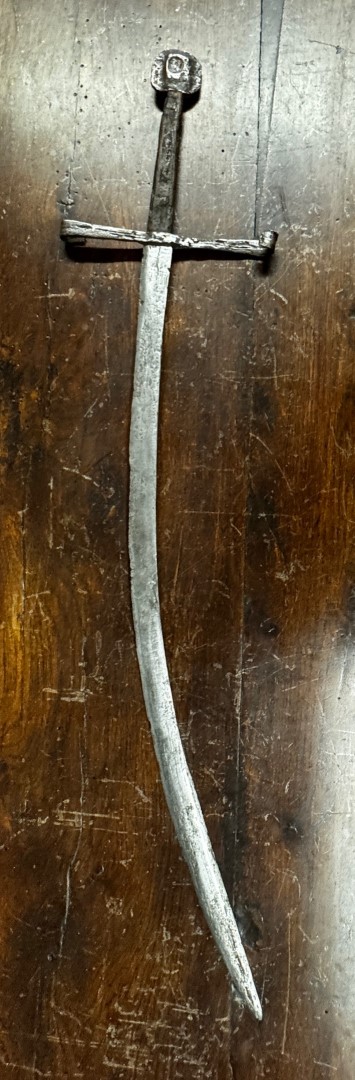
RARE HUNGARIAN WAR SABER CIRCA 1500 WITH ORIGINAL WOODEN GRIP:. 1605) RARE HUNGARIAN WAR SABER CIRCA 1500 WITH ORIGINAL WOODEN GRIP: An exotic and esoterical sword that attracts the eye and the imagination. Very good condition for having been buried in a Hungarian bog for over 500 years. For such a rarity, this “grosses kriegsmesser”  is very reasonably priced for an immediate sale! Discussion: In German, grosses kriegsmesser translates to &156;large/great war knife.&157; This uniquely distinguishable type of sword was popular in Hungary and had a strong following in Germany, where, in the 15th and 16th centuries, it was adopted for warfare. They are somewhat rare, and most examples are ground finds (see page 288, items 12 and 13 in my book). Emperor Maximilian I was very fond of kriegsmessers and owned three on display at the Hofjagd und Rustkammer (#A123, #A145, #A173). The grosses kriegsmesser is a single-edged sword, usually with a strong curvature on the blade, which qualifies it as a saber. The &156;saber&157; is believed to have been introduced to Eastern and Central Europe by Central Asian nomadic invaders as early as the 6th century (see page 267 in my book). Some kriegsmessers have a hook or bird&#acute;s beak pommel, others have no pommel at all, and some have a pommel built into the tang. The kriegsmesser is believed to have been exported to Western Europe from the Hungarian Bohemian region or current-day Hungary.  In the woodcut Triumph of Maximilian (see page 408 in my book), there are five soldiers with kriegsmessers and shields. Maximilian referred to these troops as Gefecht or Fenders. Provenance: -Found in a Hungarian bog.  -An old Hungarian collection.  -Andrew Garcia collection. Conclusion: This is a rare typology of sword. It&#acute;s in good condition #2 for a ground find. The fact it still has its original wooden grip is quite remarkable. This is a sword for the hard-core, enthusiastic collector who is more into a war weapon as opposed to a parade piece. Very reasonably priced at under $3.5K for a quick sale !!!*
  • Nation : Spanish
  • Local Price : Price on request
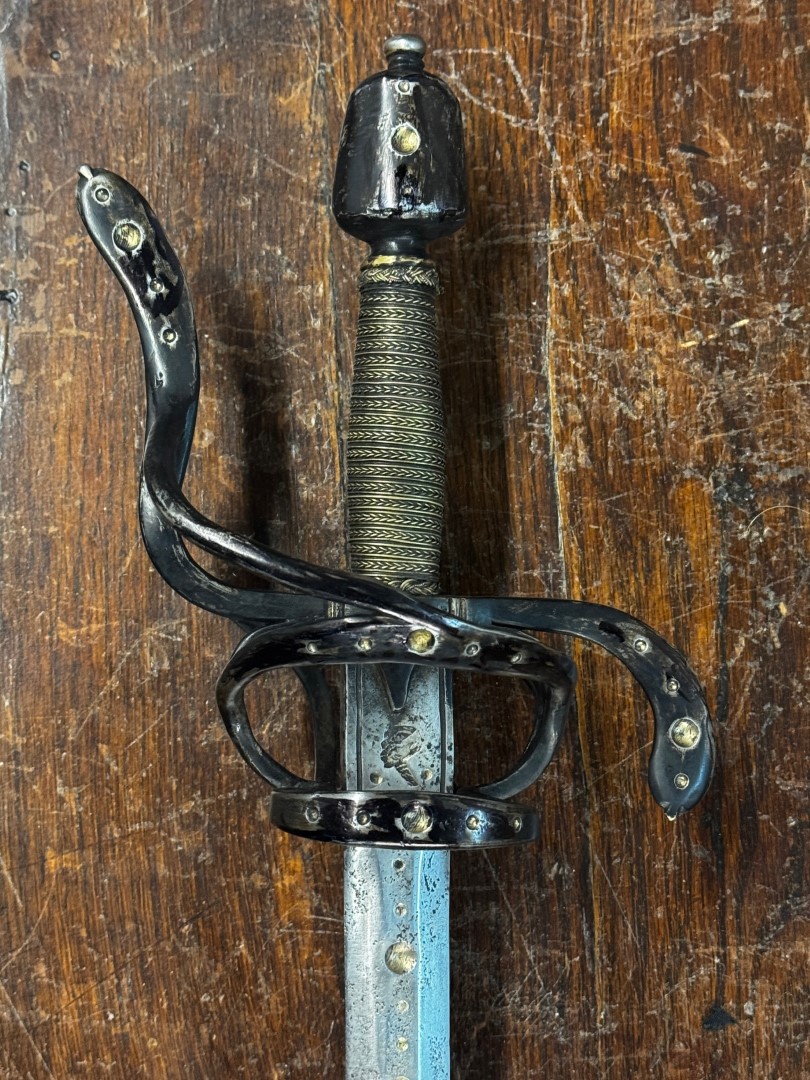
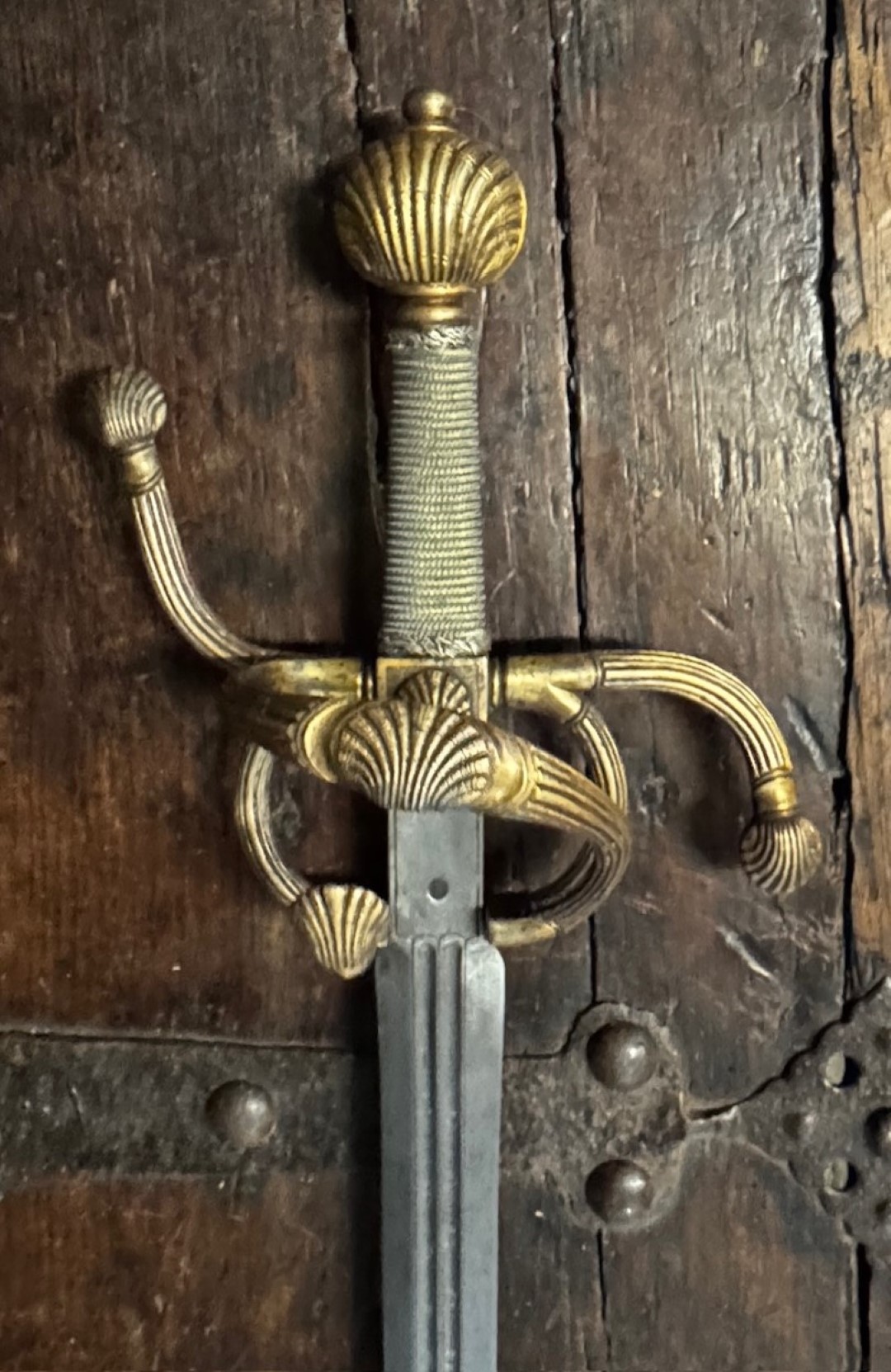
BLACK, GILDED AND DECORATED ITALIAN RAPIER CIRCA 1580 WITH MAKERS MARK:. Description: Under the Norman classification, this is a hilt 57. Constructed with a fuller about a third the length of a strong diamond-section blade that tapers to a very sharp point, a rectangular outlined ricasso stamped with a makers mark in the lower bottom center, a chevron shape at the quillon block, a type 32 pommel with a button at the finial. The hilt with a black finish was probably refreshed and decorated with gilded half-spheres; the fuller decorated en suite with gilded half sphere, replaced grip with Turk&#acute;s heads. Two repairs to the counter guard, rapiers like this were used for fighting, not ballet.   Length: 44.5 inches. Discussion: Military rapiers were longer and usually of stronger blade manufacture than your average civilian rapier. Military rapiers were also exempt from length restrictions. Because fencing is more of a thrusting art, it became commonplace throughout Europe to have as long a blade as possible to obtain an advantage. This extravagance in length reached the point that municipalities passed statutes regarding the allowable lengths of blades. Those in violation had the misfortune of having their rapier blade cropped at the tip at the city gate to comply. One example of these statues is from an English Royal Proclamation on March 17, 1557. The earliest illustration of this sword type is in a 1588 portrait of John Shirley, currently housed in the Metropolitan Museum of Art (#51.194.2). It is also illustrated in a portrait of Luccio Foppa circa 1585 by Giovani Antonio Figino.  In a day and age lacking appropriate policing, the private citizen was forced to protect himself from society&#acute; criminal dregs. The weapon of choice was the rapier from the middle of the 16th to the end of the 17th century. The rapier is a simple but highly effective sword against the non-armored. The rapier was primarily a thrusting weapon that could inflict serious injury to an adversary&#acute; vital organs with minimal effort. It was also an exceptional slashing and cutting weapon; however, the slash was not as lethal as the thrust. The slash was used more as a feint to set up a finishing thrust. The slash was also a dire warning to a would-be assailant of the horrors to quickly follow if he chose not to acquiesce. The rapier is almost undeniably of Spanish origin and is probably Spain&#acute;s most significant contribution to the Renaissance arms race. A highly expensive, ornate rapier was the equivalent of a person in our day and age making a fashion or opulence statement by wearing very expensive jewelry, such as a Rolex or Audemars Piguet watch.  The French adopted the phrase &#acute;espee rapiere&#acute; by 1475, which later was shortened to simply &#acute;rapiere. The English in 1505 spelled it &#acute;rappyer. The Giles Duwes English/ French dictionary of 1532/3 adopted the rapiers definition as &#acute;”Spannyshe sworde”. By 1550, the term rapier had been adopted to describe a slender, sharply pointed sword designed for thrusting, cutting, and slashing attacks. The rapier now consisted of a hilt protected by a handguard. Comparables: Similar examples of type 57’s can be found in: “ The Musee de l Armee in Paris (Cat no. 1379). “ The Wallace Collection (Cat no. 621). Provenance: From a private collector in Austria who seldom, if ever, sells his best !!!* Conclusion: This is an elegant sword with a fighting past. I like the decoration and the condition. This rapier is very reasonably priced at under $4K. This is a rare opportunity. Act now so that you won&#acute;t be disappointed!!!* All my items come with the following: “Free shipping. “10-day review period. “Certificate of Authenticity. “ Free autographed copy of my book if you do not have one. “ In the event of an international shipment, we will help assign the lowest correct Customs tariff so you pay the least as low as 5% or even nothing. I believe you will be very pleased.
  • Nation : British
  • Local Price : Price on request
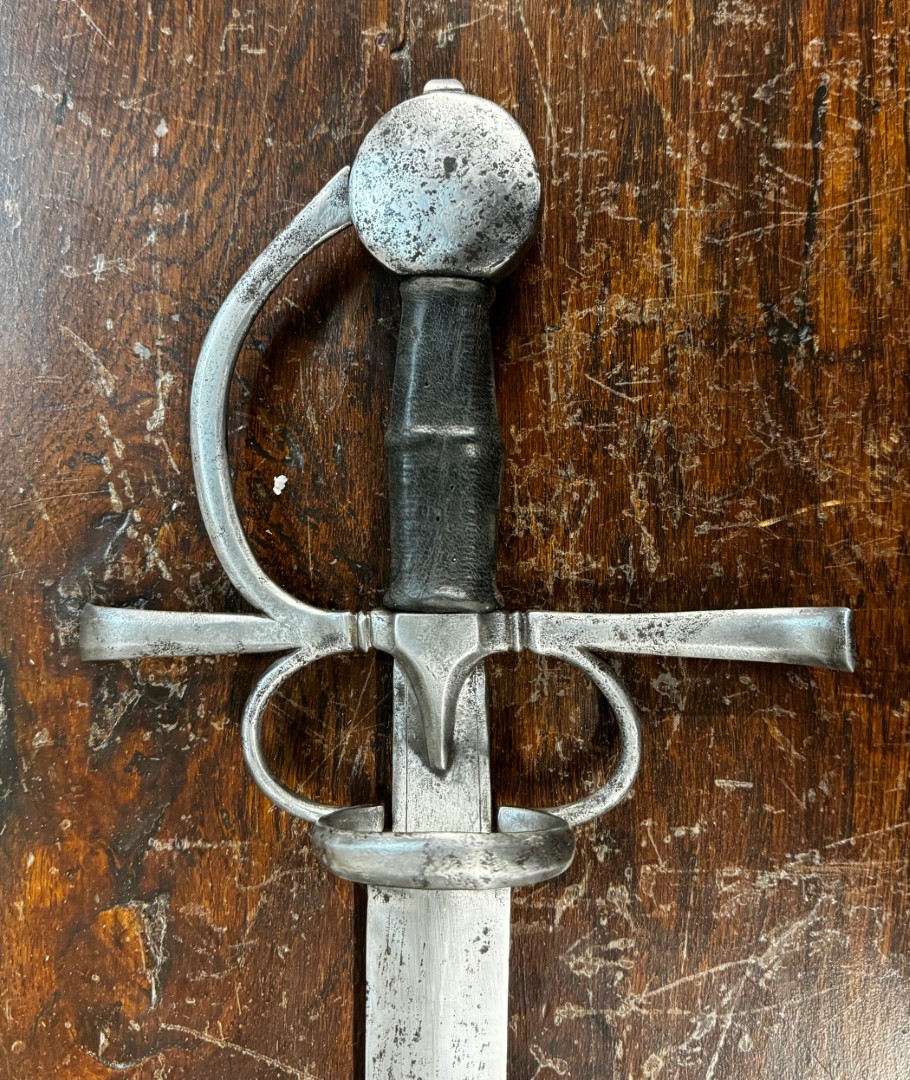
EXCEPTIONALY RARE NORMAN TYPE 41 SWORD WITH ORIGINAL GRIP CIRCA 1560: . Description: Constructed with a tapering blade with a medial ridge, wheel-shaped pommel with square finial, what appears to be an original or working life leather grip, expanding at the ends rectangular guard with curvatures at the tip and facing in opposite directions, quillon block in a chevron shape with two gutters on each side,  knuckle guard extending to the pommel, two finger guards and a ring guard. Condition very good, perhaps slightly over cleaned. Dimensions: total length 41 inches, blade 35 inches. Comparables: -Metropolitan Museum of Art, accession # 14.25.1169 (pl 7). -The State Hermitage Museum St. Petersburg, Z.O. # 1950. – An exceptionally ornate example signed by Damianus de nerve is preserved in The Waffensammlung in Vienna Inv. #A586. Conclusion: For the collector who wants the rare of the rare, here it is. This sword has a very elegant design. It’s the only one of this typology I have had in 35 years. ACT NOW, or you could be very disappointed. I have no idea if I will ever have another. I believe you will be very¦.very¦. pleased. All my items come with the following: “Free shipping. “10-day review period. “Certificate of Authenticity. “ Free autographed copy of my book if you do not have one.
  • Nation : German
  • Local Price : Price on request
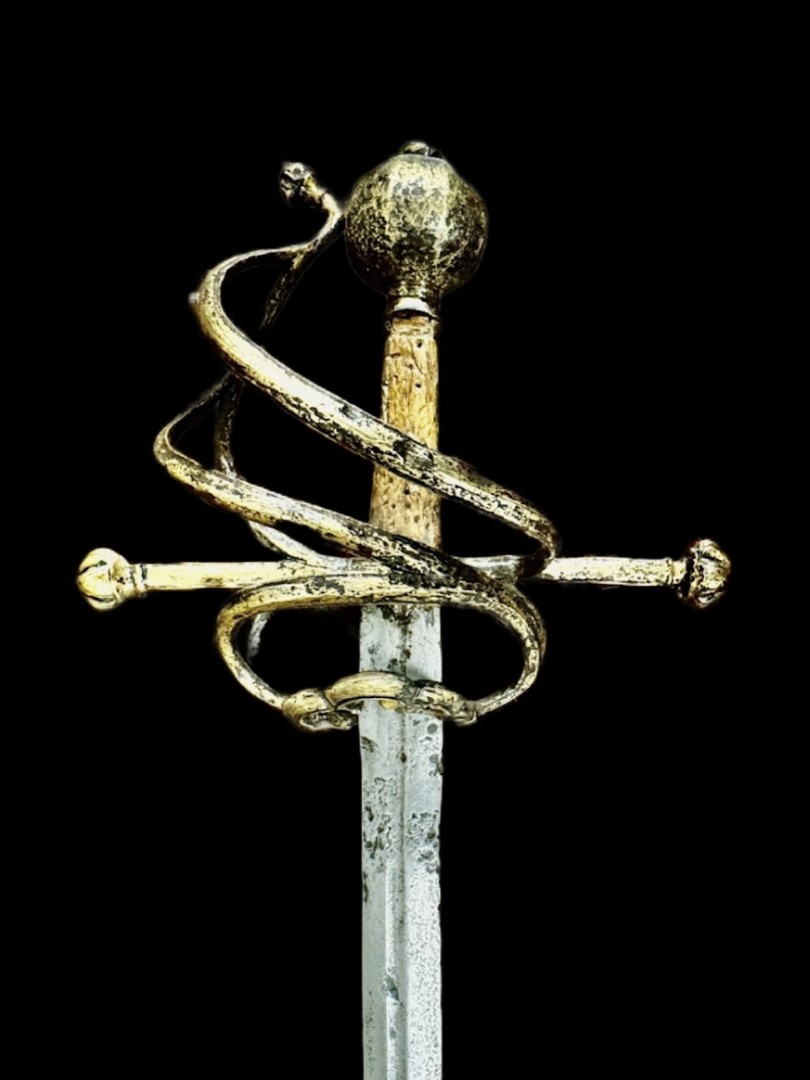
SUPERBLY CONSTRUCTED ELEGANT GILDED GERMAN RAPIER CIRCA 1540. Description: As previously stated under the Norman typology, the sword under discussion has a Hilt 50 with an inner guard 9, a spherical octagonal pommel type 15,  straight swelling quadrilateral quillions tips, a short rectangular ricasso where the fuller originates and extends almost to the tip on both sides, the blade of a stiff diamond-section tapering to a point. Hilt-gilded, original wood grip core. Condition #2.  Length: approximately 43.4 inches. Comparables: –Wallace Collection Cat. No. A576. –The Odescalchi Collection, Rome Inv. # 426. –Musee de l Armee paris Inv # p.O. 1904 Provenance: From a private European collection. Conclusion: An elegant rapier which sadly has some pitting. The good news is that the slight pitting makes it very affordable. If this sword were in mint condition, it would sell for five times its asking price! Even worse would be captive in a museum long ago and now not available in the collectors market at an affordable price.  In summary: A very reasonably priced sword that has a lot of value for the money. If you ever wanted an early world-class rapier but don&#acute;t have a massive bank account, I urge you to ACT NOW and strike while the iron is hot.  Even if you do not collect rapiers, it&#acute;s always good to have one in a collection because they were such an important part of Renaissance Europe. Priced to sell very quickly at under $4,000!!!*
  • Nation : Spanish
  • Local Price : Price on request
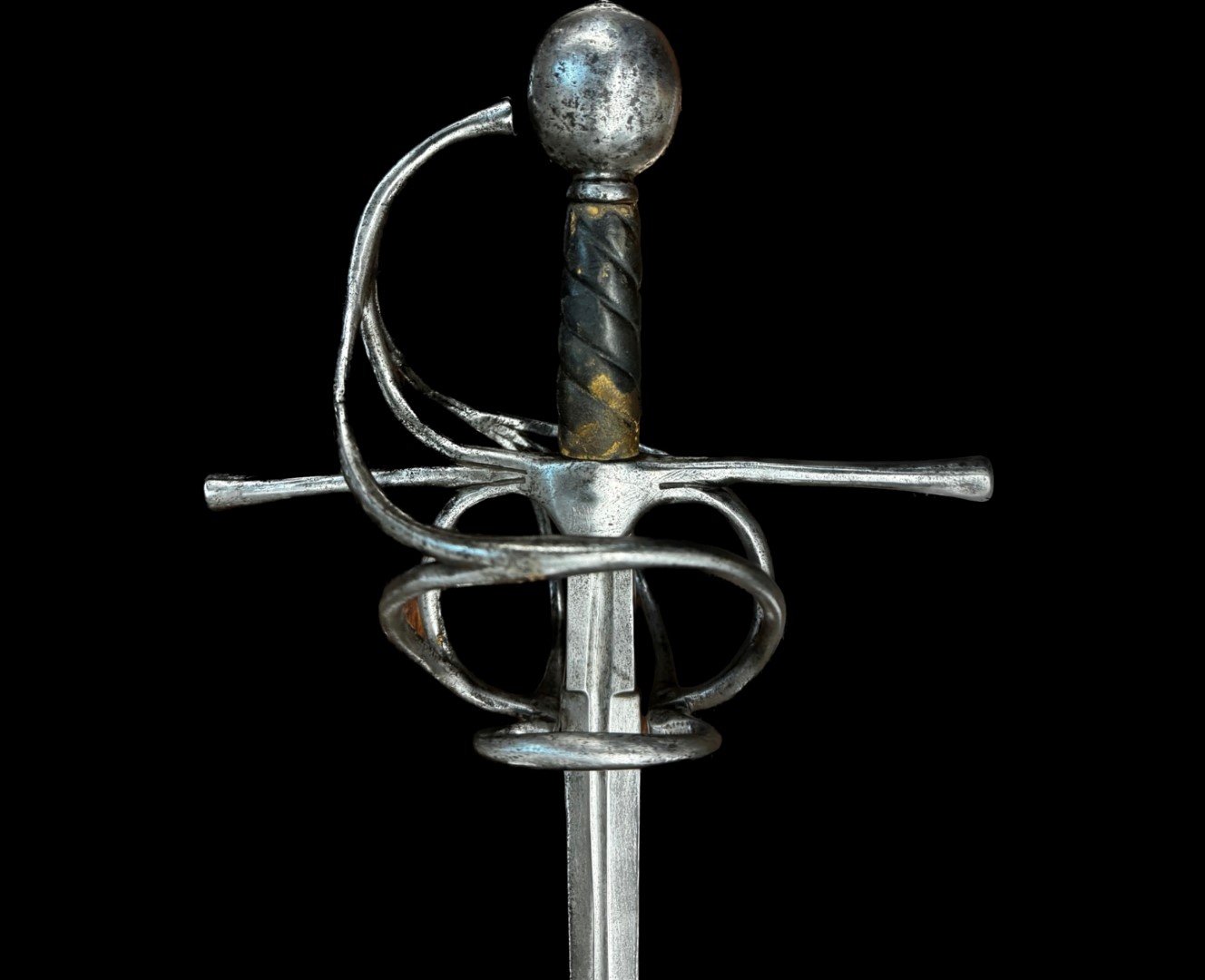
A FINE MASSIVE GERMAN MILITARY RAPIER, CIRCA 1600. Description: An example of this typology of a sword can be found in the painting of Christian the IV of Denmark in 1603 before receiving the Order of the Garter. Another is a painting by Juan Pantoja de la Cruz of Diego Villamayor dated 1605. Under the Norman classification, this is a hilt 58.  Constructed with a strong diamond-section tapering blade to a very sharp point, a short fuller originating at its rectangular ricasso, a chevron shape at the quillon block,  an expanding tubular tip at the quillons and end of the knuckle guard where it meets the type 14 spherical pommel. Original twisting wood grip with original leather covering ( slightly worn).  Length:48.50 inches. Condition: very good. Discussion: Military rapiers were longer and usually of stronger blade manufacture than your average civilian rapier. Military rapiers were also exempt from length restrictions. Because fencing is more of a thrusting art, it became commonplace throughout Europe to have as long a blade as possible to obtain an advantage. This extravagance in length reached the point that municipalities passed statutes regarding the allowable lengths of blades. Those in violation had the misfortune of having their rapier blade cropped at the tip at the city gate to comply. One example of these statues is from an English Royal Proclamation on March 17, 1557. The earliest illustration of this sword type is in a 1588 portrait of John Shirley, currently housed in the Metropolitan Museum of Art (#51.194.2). It is also illustrated in a portrait of Luccio Foppa circa 1585 by Giovani Antonio Figino.  In a day and age lacking appropriate policing, the private citizen was forced to protect himself from society&#acute; criminal dregs. The weapon of choice was the rapier from the middle of the 16th to the end of the 17th century. The rapier is a simple but highly effective sword against the non-armored. The rapier was primarily a thrusting weapon that could inflict serious injury to an adversary&#acute; vital organs with minimal effort. It was also an exceptional slashing and cutting weapon; however, the slash was not as lethal as the thrust. The slash was used more as a feint to set up a finishing thrust. The slash was also a dire warning to a would-be assailant of the horrors to quickly follow if he chose not to acquiesce. The rapier is almost undeniably of Spanish origin and is probably Spain&#acute;s most significant contribution to the Renaissance arms race. A highly expensive, ornate rapier was the equivalent of a person in our day and age making a fashion or opulence statement by wearing very expensive jewelry, such as a Rolex or Audemars Piguet watch. The French adopted the phrase &#acute;espee rapiere&#acute; by 1475, which later was shortened to simply &#acute;rapiere. The English in 1505 spelled it &#acute;rappyer. The Giles Duwes English/ French dictionary of 1532/3 adopted the rapiers definition as &#acute;Spannyshe sworde. By 1550, the term rapier had been adopted to describe a slender, sharply pointed sword designed for thrusting, cutting, and slashing attacks. The rapier now consisted of a hilt protected by a handguard. Comparables: include from such notable institutions as: “ A Odescalchi Collection  inv # 223. “ Wallace Collection cat # A589. “ Zurich Landsmuseum  Inv. No. AG2476 Provenance: From a private world-class rapier collector who seldom, if ever, sells his best. Conclusion: Military-class rapiers like this one seldom make it to the collectors’ market. This is a fighting sword, not a rapier worn by some fat, wealthy person who had bodyguards and never personally engaged in mortal combat in his life. This is a rare opportunity. ACT-NOW! I promise you won&#acute;t be disappointed with the rapier or the price under $3,5K.!!!* All my items come with the following: “Free shipping. “10-day review period. “Certificate of Authenticity. “ Free autographed copy of my book if you do not have one. “ In the event of an international shipment, we will help assign the lowest correct Customs tariff so you pay the least as low as 5% or even nothing. I believe you will be very pleased. ACT-NOW!!!*
  • Nation : Spanish
  • Local Price : Price on request
HIGHLY DECORATED RARE ITALIAN GILDED RAPIER CIRCA 1600:  . Description: This sword, under the Norman classification system, is a type 27 with a shell-shaped gilded pommel, the tips of the quillons, quillon block (front and back), and the center of the side guard decorated en-suite. Incised lines en-suite on the hilt and with punch decoration. It is constructed with a wide, slow tapering blade with two narrow inscribed fullers. On the first fuller side 1: “M. O. H. C. N. I. S.”  with talismanic symbols. On the second fuller side 1: ” D. I. C. R.”  with talismanic symbols. On the first fuller side 2: “R. G. J. I.” with talismanic symbols. On the second fuller side 2: T. A. V.”  with talismanic symbols. A maker mark on the rectangular ricasso with an insisted edge. Wooden handle covered with silver-thread wire grip with Moor’s heads. Approximate dimensions: total length 45 inches, blade 38.5. Discussion: In a day and age lacking appropriate policing, the private citizen was forced to protect himself from society&#acute; criminal dregs. From the middle of the 16th to the end of the 17th century, the weapon of choice was the rapier. The rapier is a simple but highly effective sword against the non-armored. The rapier was primarily a thrusting weapon that could inflict serious injury to an adversary&#acute; vital organs with minimal effort. It was also an exceptional slashing and cutting weapon; however, the slash was not as lethal as the thrust. The slash was used more as a feint to set up a finishing thrust. The slash was also a dire warning to a would-be assailant of the horrors to follow if he chose not to acquiesce quickly. The rapier is almost undeniably of Spanish origin and is probably Spain&#acute; most significant contribution to the Renaissance arms race. A highly expensive, ornate rapier was the equivalent of a person in our day and age making a fashion or opulence statement by wearing very expensive jewelry, such as a Rolex or Audemars Piguet watch. Because fencing is more of a thrusting art, it became commonplace throughout Europe to have as long a blade as possible to obtain an advantage. This extravagance in length reached the point that municipalities passed statutes regarding the allowable lengths of blades. Those in violation had the misfortune of having their rapier&#acute; blades cropped at the tip at the city gate to comply. One example of these statues is from an English Royal Proclamation on March 17, 1557- 1558. Provenance: From a private Italian collection. Conclusion: An exceptionally elegant and rare example of a Renaissance rapier that must have been owned by a very wealthy person or Nobel. It has survived in exceptional condition. It may have been reguilded/refreshed during the Victorian period using original Renaissance gilding, which has been illegal due to gas poisoning for many years.   In my opinion this would make a great addition to any collection or museum. Act now. This sword is priced to sell today. They seldom come this nice. ACT-NOW!!!*
  • Nation : British
  • Local Price : £0.00
**RESERVED**RESERVED** Post 1952 QE II British WD Pattern 1827 Wilkinson Sword Royal Navy Officer’s Sword With Etched Blade Bullion Cord, Portepee and Scabbard. Sn 22120 -. This is a very good British WD Royal Navy Officer’s Sword and Scabbard. The sword has a clean single edged straight blade which is 31” in length (37 ½” overall) with central fuller. Both sides of the blade have blued and etched panels including foliate decoration, Queen’s Crown ER (Elizabeth Regina) II & Queen’s Crown with Royal Navy fouled anchor device. The blade is marked on one side with Wilkinson Sword London name and crossed swords legend together with QEII Royal appointment. The reverse has etched and blued ‘Star’ panel with ‘W’ (Warranted) mark. The spine of the blade is numbered 110274 alongside a small WD ‘broad arrow’ mark. It has a brass Lions head with mane pommel and grip strap & full knuckle guard with the Royal Navy Queen’s Crown and fouled anchor motif. One side of the guard has a small hinged folding langet which, when folded flat fastens to a pin on the throat mount of its scabbard and holds the sword securely in place. The hilt’s fish skin grip with bullion wire binding is undamaged. Attached to the guard is its original bullion cord and portepee. The sword is complete with its black leather scabbard which has gilt brass mounts and 2 hanging rings. All leather and stitching are clean and intact The price includes UK delivery. Sn 22120
  • Nation : Indian
  • Local Price : £0.00
**RESERVED**RESERVED** Era Indian Troops Talwar (Aka Talwaar Or Tulwar) Fighting Sword / Sabre & Khaki Field Covered Scabbard. Sn 21449:15 -. The talwar (also spelled talwaar and tulwar, is a type of curved sword or sabre from the Indian subcontinent). Like many swords from around the world with an etymology derived from a term meaning simply ’sword’. The typical Talwar is a type of sabre, characterised by a curved blade (without the radical curve of some Persian swords), possessing an all-metal hilt with integral quillons and a disc-shaped pommel (sometimes called the ’Indo-Muslim hilt’ or ’standard Indian hilt’). The Talwar was used by both Cavalry and Infantry. When a blow was struck by a skilled warrior, limbs could be amputated and persons decapitated. The spike attached to the pommel could be used for striking the opponent in extreme close quarter circumstances when it was not always possible to use the blade (see pages 601 and 602 of A Glossary of Arms & Armor by Stone where similar Talwars are described and illustrated). Our example From the WW1 era is of the type issued to Indian troops. It has all of the correct Talwar characteristics such all metal construction, small grip, disc with point pommel, curved 32 ½” long, fullered sabre blade, knuckle guard and hilt langets. The Talwar measures 37” overall length. The Talwar has even patina and the blade has just light staining consistent with age. There are no maker or date marks on the sword. The sword is accompanied by its khaki canvas covered wood scabbard indicating WW1 issue. The scabbard has a steel chape. The scabbard is undamaged and clean. The price includes UK delivery. Sn 21449:15
Page 154 of 157