
Show

Forgot your password?

Error message here!

Error message here!

Error message here!

Error message here!

Show Error message here!

Show Error message here!

Lost your password? Please enter your email address. You will receive a link to create a new password.

Error message here!

Back to log-in

Close

For Sale

The following items are listed by for sale by users of the site and dealers. They are in no way endorsed or guaranteed by www.antiquearmsresearch.com

Add a Classified Item
to

Clicking on the sword will take you through to the relevant classified item or dealer site.
Don't miss out! - Do you want to be kept informed weekly of new aditions? Just join our weekly update list.

You can also receive regular email notifcations when items match your keywords. To recieve them just register or logon at the top right of this page.
Page 55 of 160
  • Nation : Spanish
  • Local Price : £1100
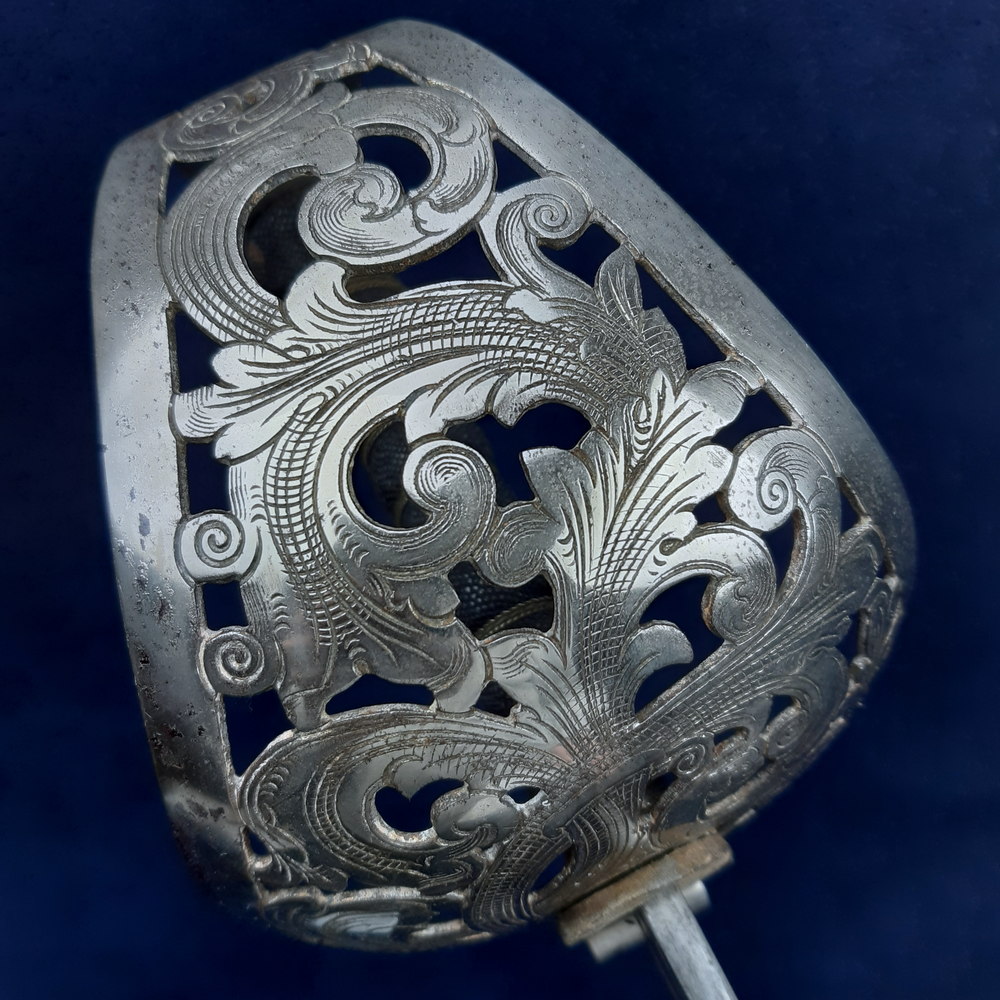
Click and use the code >25411 to search for this item on the dealer website Very Good 1796 Pattern Infantry Officer´s Sword, Beautiful Gilt and Solid Silver Grip. Stunningly Hand Engraved with Royal Crest, Crowned Cyphers And A Standing Infantry Officer Holding His 1796 infantry Sword.
  • Nation : British
  • Local Price : £1,100.00
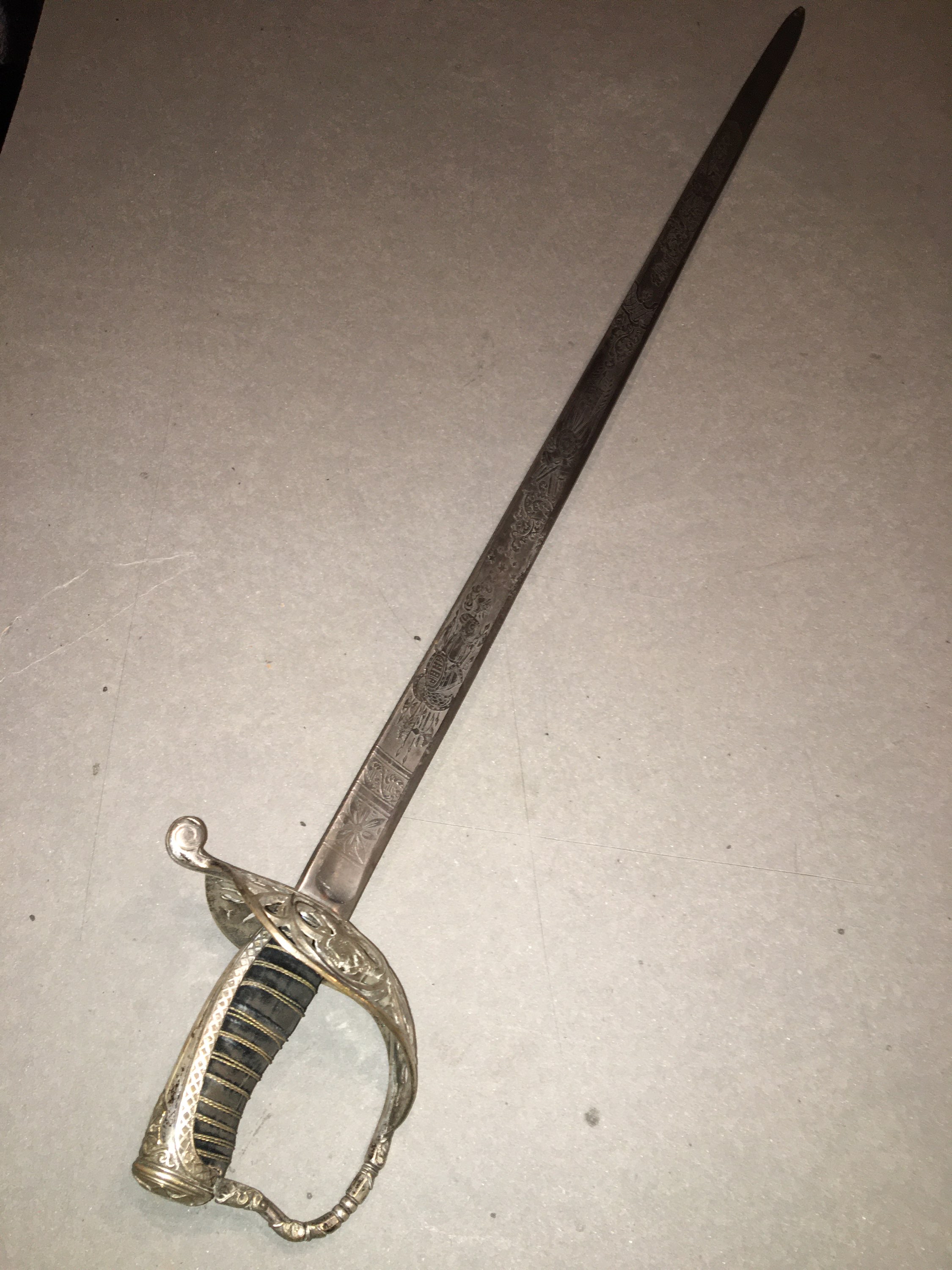
Scottish WW1 Field Officer’s Broadsword of Lt Col. John Robert Balfour, Commander 4th Battalion Royal Scots Fusiliers & 2/8th Manchester Regiment. Description Straight spear-pointed blade with double fullers. Pierced steel guard with foliate &#acute;honeysuckle&#acute; decoration. Black shagreen grip bound with wire, fully chequered steel backstrap and integral chequered oval pommel. Brown leather washer. Leather field scabbard with steel throat and chape pieces, rigid band below the throat piece for hanging from a frog. The hilt parts and scabbard fittings have been nickel-plated. Blade 33 inches in length, 1 1/16 inches wide at the forte, the sword 39½ inches overall. The blade is etched at the ricasso on one side with the retailer&#acute;s mark &#acute;FRASER ROSS & CO. 72 INGRAM ST. GLASGOW&#acute; At the ricasso on the other side is a brass proof slug set within an etched six-pointed star.  The blade is further etched with foliate motifs, thistles, the crown and cypher of King Edward VII (reigned 1901-1910), and &#acute;ROYAL SCOTS FUSILIERS&#acute; beneath a crown and surrounding the badge of that regiment, a flaming bomb. The scabbard leather is inscribed on one side below the rigid band with &#acute;Lt Col. BALFOUR 1/4 RSF&#acute;. This appears to have been done by hand, perhaps using a hot pin or blade as there is blackening around the inscribed lines that may be scorching. In the same area on the opposite side an old paper label has been affixed to the leather with faded writing in ink, the partly legible text I believe reading &#acute;Major _ Balfour&#acute;. Both the label and the inscription indicate John Robert Balfour, who held the rank of Major and later Lt. Col of the 1/4th Royal Scots Fusiliers. I must note that this attribution is tentative, however, as I do not view labels or written markings as 100% definitive, unlike the usual means of identifying a sword&#acute;s owner like a record of sale or engraved initials. It is possible, albeit very unlikely, that these were put on the sword by someone else at a later date. One should note that it was not until WW1 that fractional numbers like &#acute;1/4th&#acute; were used (distinguishing first and second-line battalions with the same numbers), so the markings must have been added after 1914. John Robert Balfour was born in 1864. He attended Glasgow Academy and lived at The Grange in Froom, Ayrshire. He became a 2nd Lieutenant in the 1st Volunteer Battalion, Royal Scots Fusiliers in April 1898. He was promoted to Major in October 1903. The 1st Volunteer Battalion became the 4th Battalion in 1908, with John still at the rank of Major, the second highest-ranked in the regiment under Major & Honorary Lieutenant-Colonel Hugh Barnett. On the outbreak of WW1 the 4th Battalion was mustered at Kilmarnock. In October 1914 John was promoted to temporary Lieutenant-Colonel commanding the battalion. Most likely his predecessor Lt. Col. Barnett, who was transferred to the reserve, was unable to serve overseas so John was moved up into command pro tem. In January 1915 John was promoted to full Lieutenant-Colonel and rated as fit for general service by a medical board in May. The 4th Battalion came under the 155th (South Scottish) Brigade of the 52nd Division, which left England with the rest of via Liverpool in May 1915, transiting via the island of Lemnos to Gallipoli, disembarking in June at &#acute;V&#acute; and &#acute;W&#acute; Beaches on Cape Helles. As they were fresh the 155th Brigade were thrown with the rest of the 155th Brigade into an assault along the Achi Baba nullah towards Krithia on the 12th July. This meant advancing in waves across a no-man&#acute;s-land and capturing Turkish trenches softened up by artillery fire. The only other fresh brigade, the 157th, would wait while artillery prepared their own route, Major David Yuille, one of John&#acute;s immediate subordinates in the 4th Battalion, described the territory over which they had to attack: "Unless one has seen it there is no imagination that can picture a belt of land some 400 yards wide converted into a seething hell of destruction. Rifle and machine-gun bullets rip up the earth, ping past the ear, or whing off the loose stones; shrapnel bursts overhead and the leaden bullets strike the ground with a vicious thud; the earth is rent into yawning chasms, while planks, sandbags, clods of earth, and rugged great chunks of steel hurtle through the air. The noise is an indescribable, nerve-racking, continuous, deafening roar, while drifting clouds of smoke only allow an intermittent view of the damnable inferno." As hostile as the ground was, the Scottish troops successfully reached their objective of the Turkish trenches, in large part because the preceding artillery bombardment had been very effective in the rocky terrain. However, they then had difficulty navigating and fighting in the partly destroyed enemy trench network and became bogged down, taking additional casualties when isolated groups became exposed to Turkish fire and while attempting to locate a third Turkish trench line that did not actually exist. They ultimately consolidated their position in the second line and fought off a Turkish counterattack the next day despite exhaustion, dehydration and poor cover offered by the wrecked trenches, but were in no position to exploit their gains any further. The commander of the 52nd Division, Maj-Gen. Granville Egerton, was later scathing about the battle plan his men had been driven into, calling it &#acute;cruel and wasteful&#acute; to rush into an attack with the depleted forces available. Reinforcements would soon arrive which in a fortnight would have allowed a more forceful attack launched to synchronise with other offensives at Suvla Bay and Anzac Cove. &156;I contend that the Battle of July 12-13th was due to a complete want of a true appreciation of the situation. If the conception of the battle was wrong the tactics of the action were far worse. The division of the attack of two Brigades on a narrow front into two phases, no less than 9 hours apart, was positively wicked.&157; The plan was that of Lieutenant-General Aylmer Hunter-Weston, a much-criticised general notorious for his overly aggressive style, detached attitude to casualties, overly romanticised view of war and intolerance of dissent from subordinates. In fairness the divided attack had been intended to allow the artillery to focus their fire, but attacking alone deprived the 155th of support for hours and made it harder to hold what they had gained. If the 157th and nearby French troops had not also succeeded in their objectives then the 155th might have collapsed. The increasingly erratic Hunter-Weston was relieved of his command on the 23rd July after an apparent breakdown. In August 1915 John was invalided out of Gallipoli and transferred to the No.1 Australian Stationary Hospital at Mudros Bay on Lemnos, suffering from &156;Dysentery and Rheumatism&157;. Disease was a major problem in the Gallipoli campaign which accounted for more casualties than battle wounds. Dysentery in particular, known as the &#acute;Gallipoli Gallop&#acute;, spread rapidly due to poor sanitation. John&#acute;s condition evidently did not improve as in September he boarded a ship and returned to England, and underwent further treatment at the Royal Free Hospital until at least October. The 4th Battalion&#acute;s deployment in Gallipoli continued until it was evacuated in January 1916, transiting to Alexandria via Lemnos. After recovering John appears not to have rejoined the Royal Scots Fusiliers, instead seconded to become temporary Lieutenant-Colonel in command of the 2/8th Battalion of the Manchester Regiment in June 1916. Recruited as a second-line battalion from men living in the Ardwick area of Manchester, the 2/8th was based in Colchester, England as a training unit at the time, providing drafts of men to reinforce the 42nd Division in Egypt. With his combat experience John might have been seen as a good officer to train up green troops for overseas service. The Military Service Act made all territorials liable for overseas service from February 1917, and the 2/8th was deployed to France in the same month with John in command. It sat in Flanders for several months as reserves for a planned amphibious landing into Belgium called &#acute;Operation Hush&#acute;, but this never came to pass “ this may have been for the best as the now recovered Lt-Gen Aylmer-Weston was at one point included in discussions on its tactics. In September 1917 John was ordered to return to England. An internal telegram detailed the reasoning of Field Marshal Haig for this decision: &156;Lieutenant-Colonel Balfour has done good work out here, but I consider that he is too old to remain in Command of a Battalion in the Field¦ I recommend that he be given employment at home.&157; Removal of battalion commanders due to age was not rare and was an ongoing process during the war “ the initial cohort (of regulars) in 1914 were on average 47 years 11.5 months, but this average age dropped rapidly due to removal of those physically unfit, attrition through casualties and rapid promotion of capable younger officers as replacements. By late 1917 the average age for a battalion commanding officer in the BEF was 28. Age was at times used as a euphemism for poor command abilities, although it seems likely that John was genuinely no longer capable of the rigours of field service, being 54 at the time and having been so ill earlier in the war. John&#acute;s temporary rank was made permanent in October 1917. He was demobilised for just over a month from October to November 1917 “ apparently he was demobilised from the army by his own request pending a vacancy, rather than being placed on the Territorial Force Reserve. Why he did this I am unsure “ perhaps he wanted to be certain that he could not be called back except for a particular position he wanted? Records suggest this move later caused a dispute with the War Office over his retirement pay, the War Office confirming that as he was fully demobilised for that month the period should not count towards his duration of service. He assumed command of the 2/1st Ayrshire Yeomanry in November 1917, a cyclist unit within the 9th Cyclist Brigade. Based initially in Scotland, it was moved to Ireland in May 1918. He received the Territorial Decoration in August 1918, a medal awarded for 20 years of commissioned service in the Territorial Force. He appears to have remained in Ireland with the 9th Cyclist Brigade for some time after the end of the war, requesting demobilisation in a letter dated January 1919 from their HQ in Inniskillen. He remained with the Territorials until reaching the age limit of 57 in 1921. The traditionally-styled Scottish broadsword was carried only by Highland infantry regiments until 1881, when the Lowland regiments also adopted Scottish dress and the broadsword along with it (with the exception of the Cameronians). The use of multiple interchangeable hilts may date back to the 1860s, but is first officially mentioned in the Dress Regulations of 1883, which authorized the Highland Light Infantry to use the basket hilt for full-dress occasions and the cross-bar hilt for all other occasions. Field Officers and other mounted officers were entitled to use a third hilt, the form of which varied by regiment. As of 1914 the design seen on this example, which was essentially a steel version of the brass honeysuckle hilt used on the 1856 Pattern Royal Engineers sword, was used by the Black Watch, Argyll & Sutherland Highlanders, and Seaforth Highlanders. The Royal Scots Fusiliers used a different design, a symmetrical basket hilt with thistle designs and the regimental badge. However, I have seen multiple Victorian examples of RSF field officer&#acute;s swords with the &#acute;honeysuckle&#acute; hilt instead. I believe therefore that this hilt is correct for the Edwardian period it was purchased in and there was a switch (or perhaps a standardisation) to the regimental-badge design either in or shortly before 1914. This example&#acute;s hilt is interchangeable, with the pommel unscrewing to allow it to be swapped with the basket or cross hilt (not included). The blade is unsharpened with no edge damage. Spotted light patination to the blade, some of which impacts the etching but does not impede its visibility. All other metal parts have been nickel-plated with some spots of wear revealing patinated steel, most notably the inside and edges of the hilt. The wire binding of the grip is all intact and tight, its shagreen is excellent with no handling wear or losses. The scabbard fittings have some spotted wear to the nickel plating revealing patinated steel. One very small dent to the chape piece, which does not interfere with smooth sheathing and drawing. The leather body has spots of abrasion and staining at the throat end, one small cut to the face revealing the wood core, all of its stitching is intact.
  • Nation : Japanese
  • Local Price : £1,095.00
**MATCHING NUMBERS, BLADE NUMBERED ON SIDE**Original, WW2 Japanese NCO’s Type 95 Katana With ‘The Lijima Swords Factory’ & Kokura Arsenal Marks & Scabbard. Sn 21886 -. This is an original WW2 Japanese NCO’s Katana and scabbard. The sword has the typical aluminium cast handle with lanyard ring and fully functioning scabbard retaining clip. The hilt retains some of its original brown paint. Its early, fullered, 27 ½” blade is stamped on one side ’59554’ and with inspection mark (later examples were stamped on the spine). The blade has no damage and clean. The hilt is stamped with Lijima Swords Factory roundel with crossed swords mark and inspection mark together with Kokura arsenal mark (see pages 185 & 186 of Swords Of Imperial Japan by Dawson). It is complete with its original scabbard which has a single hanging ring. The scabbard has just a few small dents and retains its original olive green paint finish. The throat of the scabbard is stamped with matching number. This piece is clearly a WW2 bring back, surrendered or recovered from the battlefield. The price includes UK delivery. Sn 21886
  • Nation : British
  • Local Price : £1,095.00
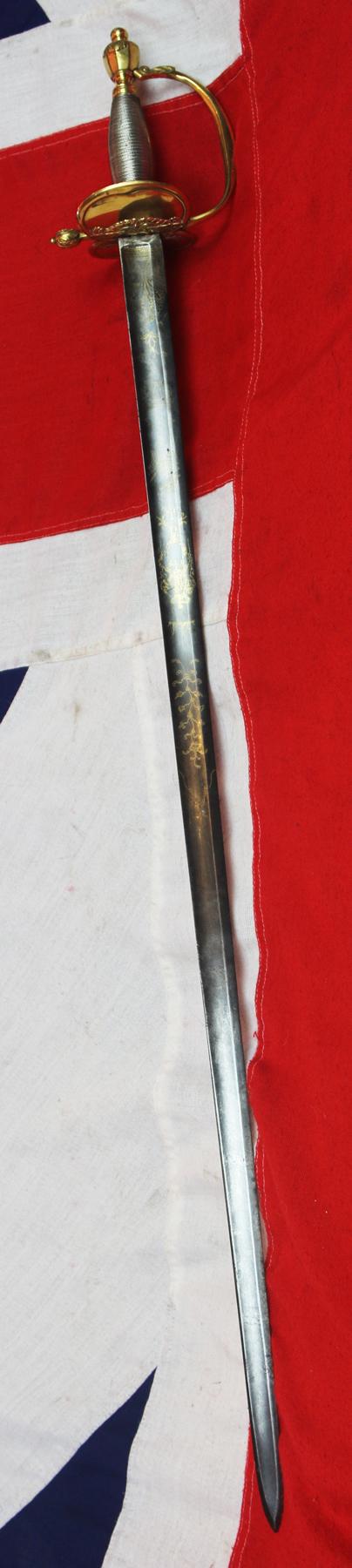
c1750 Silver metal Hilt Court / Diplomatic Small Sword With Blued & Gilt Blade. ED 2626. -. The small sword (also court sword, French: epée de cour or dress sword) is a light one-handed sword designed for thrusting which evolved out of the longer and heavier rapier of the late Renaissance. The height of the small sword’s popularity was between mid-17th and late 18th century. It is thought to have appeared in France and spread quickly across the rest of Europe. The small sword was the immediate predecessor of the French duelling sword (from which the epée developed. This is an excellent original c1750 Court / Diplomatic small sword (see pages 270 to 282 of Wither’s book ‘World Swords’ where many variants of small sword are illustrated. It has a silver metal hilt with part bowl guard and knuckle bow. The urn crown pommel has a ball top. The slim 82 cm blade is straight and undamaged and has just staining consistent with age. The blade has its original hilt washer & etched panels on both sides featuring geometric designs. The sword measures 99 ½ cm overall. The leather scabbard has an aged patina with brass ornate chape and locket with a fancy frog stud. The owners name is inscribed to the rear of the locket: ‘Count Ferdinand de Baillet’ (A Count Ferdinand Charles Louis Antoine de Baillet–Latour (21 January 1850 – 18 September 1925) was a Belgian politician. He was governor of the province of Antwerp from 14 March 1908 until 31 December 1912. Baillet-Latour was born and died in Brussels. Ferdinand de Baillet-Latour was a member of the Antwerp provincial council for the canton Ekeren from 1 July 1902 until 14 March 1908. He was a member of the village council of Brasschaat from 1902 until 1908 and from 1913 until 1824. He was burgomaster of Brasschaat from 1902 until 1908, where he succeeded Armand Reussens, and (provincial) senator in the Belgian Senate from 1912 until 1921).The price for this attractive Court / Diplomatic small sword includes UK delivery. ED 2626. (Rack nr canon)
  • Nation : -
  • Local Price : 13,500 kr
Saber possibly Norwegian ca: 1850.
  • Nation : American
  • Local Price : 1,450.00 USD
CONFEDERATE CUTLASS. Adapted from a captured Union 1860 pattern cavalry saber and patterned after the US model 1860 cutlass, probably by a ship's blacksmith. The blade with MANSFIELD AND LAMB maker's mark to the ricasso and US 1865 opposite. The blade shortened to 24 ¾” with the point reshaped and thinned appropriately. The hilt with the side bars removed and replaced with a brass semi bowl guard. Original wire wrapped leather covered grip, well worn. The hilt with dark patina. The blade with surface rusting which would clean easily, but should be left to preserve the character. The Confederate Navy protected Confederate harbors and engaged with the Union at blockaded ports to draw off gunships allowing blockade runner to dock. As well, the Confederate Navy sailed the globe disrupting supply ships headed to the north. To that end, Jefferson Davis in 1861 declared that the Confederate government would issue letters of marque, to any wishing to aid the South against US shipping, thus establishing privateers under the Confederate flag. The most illustrious of Confederate naval ships was the CSS Shenandoah which traveled as far as Australia and the Indian Ocean, capturing or sinking 38 vessels and remaining active until November of 1865. It was the Shenandoah which fired the last shot (across the bow of a whaler in the Aleutians) of the Civil War.
  • Nation : Russian
  • Local Price : £1,050.00
Rare Russian M1843 Luttich Carbine Bayonet by P J Malherbe. Description Leaf-shaped, double-edged blade with short, narrow central fuller. Brass cross hilt with twin forward-curving quillons, ribbed solid brass grip. External leaf spring secured with a single screw, its fixed button protruding from the opposite side of the grip. Black leather washer. No scabbard. The ricasso of the blade is stamped on one side with the maker&#acute;s mark &#acute;P J MALHERBE A LIÈGE&#acute; above an inspection stamp and the number &#acute;2&#acute;. The hilt is stamped next to the leaf spring near the pommel with a crown over &#acute;B&#acute;. The .704 calibre Brunswick rifle was designed by Captain Berners, a Jaeger officer of the Brunswick Army, and adopted with some modifications by the British Army in 1836. The Russian Imperial Army essentially copied the British Brunswick as their M1843 Luttich Carbine. The carbines and associated bayonets were manufactured on their behalf in Liège, Belgium by the gunmaker Pierre Joseph Malherbe “ &156;Lüttich&157; is the German name for Liège. Numbers produced are uncertain but low “ anecdotally I read that the observed serial numbers on the carbines have been below 1000, and production of the bayonets was probably equal. The Luttich carbines were used in the Crimean War, issued to specialist Russian sharpshooters as it was the only rifled long arm in their arsenal. The British had already replaced the Brunswick with the improved Minie rifle issued to all their infantry, and introduced the new Enfield rifle over the course of the conflict. Examples of the Luttich found outside Russia may well have been originally taken as trophies in that conflict. The blade&#acute;s lower section has some light patination and spots of pitting, a larger patch of pitting around the tip section on one side. The tip of the blade is slightly chipped. The hilt is in good condition with an even patina. The locking mechanism moves freely.
  • Nation : British
  • Local Price : £1,050.00
British WW1 1907 Pattern Bayonet with Early Hooked Quillon, 2nd Battalion Loyal Lancashire Regiment, East African Campaign. Description Straight single-fullered knife blade, steel hilt with muzzle ring and distinctive forward-curving lower quillon, wood slab grips secured by two screws, steel beaked pommel with locking button. Brown leather No. 1 Mk 2 scabbard with steel locket & teardrop frog stud and steel chape piece. Brown leather 1914 Pattern frog with buckled retaining strap and rear strap to attach a helve carrier. This bayonet is still in its original configuration with hooked lower quillon and no oil hole: the quillon was ordered to be removed from new production bayonets in October 1913 and existing examples were often removed by grinding during repair. The ricasso is stamped on one side with a crown over 1907 (the pattern), 11 &#acute;10, indicating the manufacture date to be November 1910 and the maker&#acute;s mark &#acute;EFD&#acute; for the Royal Small Arms Factory at Enfield. It is stamped on the other side with a &#acute;broad arrow&#acute; War Department stores mark, two crown inspection marks with &#acute;E&#acute; for Enfield, a small stamp made up of another broad arrow over &#acute;EFD&#acute; over &#acute;51&#acute;, and an &#acute;X&#acute; indicating that the blade passed a manufacturer&#acute;s bending test “ this appears to have been double-stamped. The pommel is stamped with &#acute;2.N.L.&#acute;, indicating the 2nd Battalion, The Loyal North Lancashire Regiment, and the weapon number &#acute;479&#acute;. The scabbard is identically stamped at the throat with &#acute;479&#acute;, confirming that they are an original pair, and next to the staple on the throat and chape pieces with a faint mark that looks like &#acute;AM&#acute; over &#acute;OA.12&#acute; “ this probably refers to a manufacturer. The leather body of the scabbard is stamped next to the seam with the date &#acute;13&#acute; as well as &#acute;1113&#acute;, &#acute;I^M&#acute;, (where the ^ is a broad arrow), which I think is an Indian stores mark, and the letter &#acute;A&#acute;. The rear of the frog is faintly, informally marked by poking dots and scratching lines, with what looks like &#acute;18278&#acute; and &#acute;F.T.&#acute;, which might be a previous owner&#acute;s initials and soldier number. The frog is of the British 1914 Pattern (part of the Infantry Equipment, Pattern 1914 set of leather webbing). It retains the strap on its reverse side which could be used to attach the helve carrier for an entrenching tool. The 2nd Battalion of the Loyal North Lancashire Regiment was one of only two British battalions deployed to East Africa during the First World War, and the only battalion of British regulars (the other being the newly formed 25th Battalion, Royal Fusiliers). At the outbreak of the war it was deployed to Bangalore, India, joining the 27th (Bangalore) Brigade of the British Indian Army. The Bangalore Brigade was tasked with invading German East Africa via the port of Tanga (in modern-day Tanzania), arriving in November 1914. Despite a substantial numerical advantage this attack, now known as the Battle of Tanga, failed with disproportionate casualties for the invasion force and substantial losses of equipment. The 2nd Battalion had made better progress than most of the British-Indian force but had to withdraw back to their transport ships, which took them to Mombasa. The German East African forces fought a highly mobile guerilla campaign ranging across what is now Uganda, Kenya, Tanzania, Zambia, Malawi, the Congo, Rwanda, Burundi and Mozambique, under the capable command of Paul von Lettow-Vorbeck. While their strength rose to a peak of 11,000 men at the end of 1915 they remained far outnumbered by British Empire forces, who also had support from Belgian and Portuguese allies. Both sides suffered greatly from supply shortages and disease, and the 2nd Battalion was no exception “ it had to be withdrawn from the fight in May 1916 due to ill health among its troops. Early German successes such as Tanga did not translate to long-term advantage, and from 1916 on they were forced out of German East Africa and ground down by the diverse British Empire force, by then under the command of equally capable guerilla fighter Jan Smuts. Their last 1,500 men surrendered in accordance with the Armistice in November 1918. After recuperating in South Africa the 2nd Battalion was transferred to Egypt in January 1917. It seems to have remained in poor condition and was posted to guard lines of communication. In May 1918 it arrived in France and was attached to the 34th Division, with which it took part in various battles of the Hundred Days Offensive in the closing stages of the war. The Loyal North Lancashire Regiment became the Loyal Regiment (North Lancashire) from 1921. It was amalgamated with the Lancashire Regiment in 1970 to form the Queen’s Lancashire Regiment, which merged with two others in 2006 to form the present-day Duke of Lancaster’s Regiment. There is good reason to think that this bayonet was carried by the 2nd Battalion during their time campaigning in East Africa. We know that before the war the 2nd Battalion was posted to India and had been there since 1910, the year of this bayonet&#acute;s manufacture “ before that date it had been in Mauritius so it was certainly away from home when the new bayonet was delivered to them. The scabbard is dated 1913, is probably of Indian manufacture but is identically numbered to the bayonet, suggesting they were brought together in the regimental armoury in 1913 while it was stationed there. This gives the overall picture of pre-war equipment that would have been part of the 2nd Battalion&#acute;s stores in India as of 1914, meaning it is very likely to have been taken with them and carried into the Battle of Tanga and subsequent engagements. The blade is mostly bright, one area of spotted pitting and patination to the spine. The blade retains its blued area at the ricasso. The hilt, exposed tang and pommel have a blued finish. The wood grips have only a couple of dents and some patches of oil staining. The leather scabbard body has light rubbing and surface-level cracking. It is quite flexible, and one should take care to support it once the blade is withdrawn from it. The scabbard fittings are blued, one dent to the chape piece which does not interfere with sheathing and drawing. The frog is in good condition, its leather flexible, some rubbing to the edges on the front side and the retaining strap. One small keyhole-shaped hole to the rear side of the belt loop, just under 1cm long.
Page 55 of 160