
Show

Forgot your password?

Error message here!

Error message here!

Error message here!

Error message here!

Show Error message here!

Show Error message here!

Lost your password? Please enter your email address. You will receive a link to create a new password.

Error message here!

Back to log-in

Close

For Sale

The following items are listed by for sale by users of the site and dealers. They are in no way endorsed or guaranteed by www.antiquearmsresearch.com

Add a Classified Item
to

Clicking on the sword will take you through to the relevant classified item or dealer site.
Don't miss out! - Do you want to be kept informed weekly of new aditions? Just join our weekly update list.

You can also receive regular email notifcations when items match your keywords. To recieve them just register or logon at the top right of this page.
Page 60 of 159
  • Nation : Spanish
  • Local Price : £935
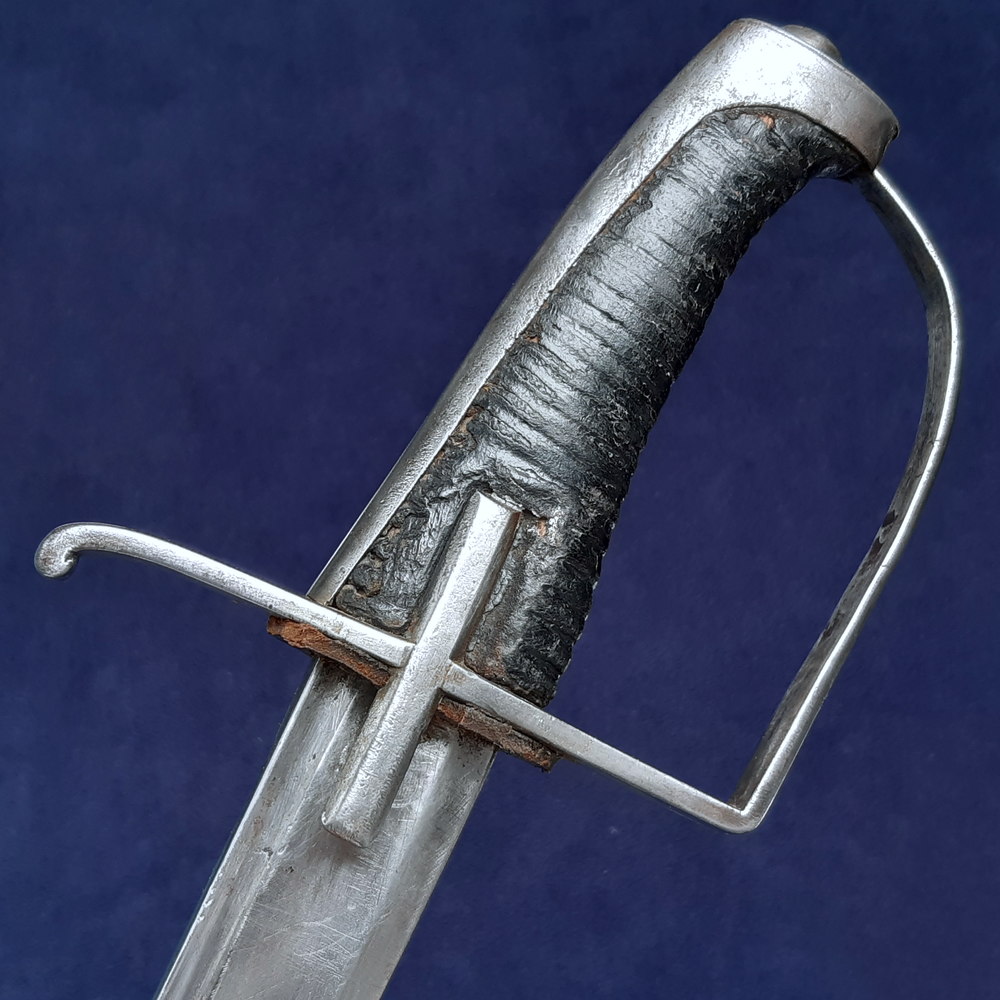
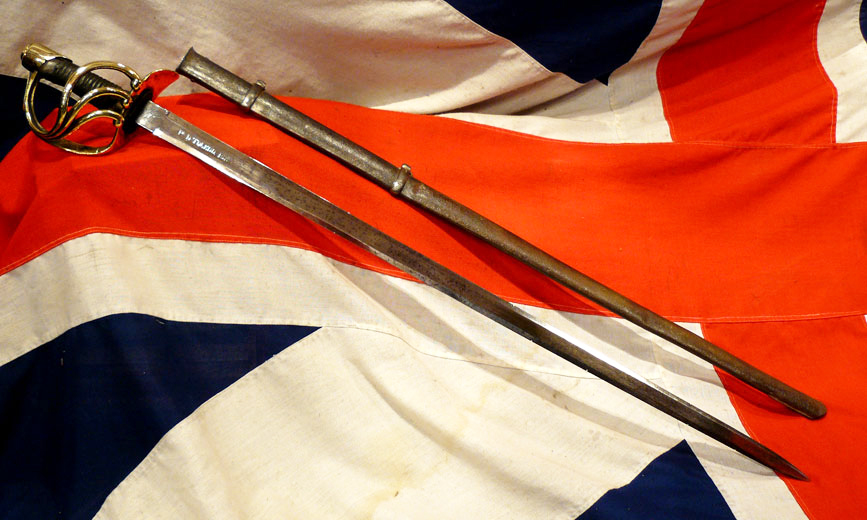
Click and use the code >22097 to search for this item on the dealer website 19th Century Napoleonic Pattern, Spanish Dragoons, Heavy Cavalry of the Line Sword
  • Nation : Persian
  • Local Price : 1,275.00 USD
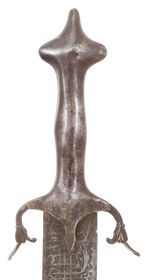
PERSIAN RENAISSANCE REVIVAL SWORD, 19TH CENTURY. Iconic example of this rare type which are dated variously from late 18th century to mid 19th. 28” broadsword blade, replicating the 15th century originals. Decorated with five portraits of nobles each side on a background of thicket made up of stylized thuluth calligraphy. Elaborately shaped iron hilt with cross form pommel and monster form quillon terminals. This example with remnants of silver decoration on both sides. The silver worn and the pommel with a dent each side, probably from ritual use. At least one reference states that these are made with undecorated hilts and we found only one other with decoration, further distinguishing this example.
  • Nation : British
  • Local Price : £925.00
British 1804 pattern Cutlass. A British 1804 pattern Royal Naval Boarding cutlass in excellent condition. The 73cm blade is clean with minor spotting has a crowned &#acute;GR&#acute; cypher and crown over 8 inspection stamp. The figure 8 guard and chequered &156;pineapple&157; grip are in excellent condition with the original black japanning, and stamped with a military broad head arrow. The blade spine is stamped &#acute;Hadley&#acute;, for T Hadley one of the original 1804 contractors. The overall length is 85cmThe origin of this sword first appears on 30 May 1804 when the Board of Ordnance ordered "10,000 Swords for Sea Service to be made to a new pattern suggested by Henry Osborn". The contractors for the 1804 Pattern cutlass of May, 1804 were Henry Osborn, T Hadley, Woolley & Co, Craven and Co, and Dawes. A second order was made in 1808, with no further orders made during 1814-41 when a new pattern was issued
  • Nation : Swedish
  • Local Price : £920.00
Swedish m/1791 Hussar Trooper’s Sword. Description Curved blade with double fullers, one narrow and one broad &#acute;a la Montmorency&#acute;, double-edged at the point. Plain regulation stirrup hilt with faceted rectangular langets, quillon, bevelled knuckle-guard, and one-piece backstrap with slightly beaked pommel cap. Grip of pressed leather over cord-bound wood. Leather washer. Steel wood-lined scabbard in two sections, exposed wood section between them painted black, with two hanging rings. The outside of the hilt is stamped with &#acute;K.2 : 9IL13 : 384&#acute;. The upper hanging ring swivel of the scabbard is stamped &#acute;IL13 : 384&#acute;, indicating a matching pair. I am not certain of these markings&#acute; significance. Sweden&#acute;s first corps of hussars was created in 1757 at the outset of the Seven Years&#acute; War, taking inspiration from the Hungarian Hussars, which served as auxiliaries to the Prussian army of the time. These Hungarians were considered the best light cavalrymen in Europe and their equipment, dress and tactics were hugely influential. One of the first Swedish Hussars, enlisting in 1758 at the age of 16, was Gebhard Leberecht von Blücher, who was captured by the Prussians in 1760, switched sides to join their Belling Hussars and became the most capable and highly-decorated commander in Prussian history. A sabre for the Swedish Hussar regiments was officially approved in 1759, essentially a copy of the successful Prussian Model 1742 (which also inspired the British 1788 Pattern Light Cavalry sword). The m/1759 was in due course replaced by the m/1791, which deviated slightly from the Prussian format with a simpler scabbard and square rather than tapering langets. The m/1791 would have been carried by Hussar units into the Napoleonic Wars when Sweden joined the Third Coalition against France in 1805. Their army fought in Hanover and Swedish Pomerania, notably including the Great Sortie of Stralsund, in the aftermath of which the Swedish hussars distinguished themselves in cutting off retreating French forces: a mere 4 hussars successfully captured 104 French soldiers on the road to Neukalen, while 42 hussars under Bror Cederström secured both a French baggage train and 209 soldiers from the 72nd Infantry. Swedish forces were driven out of Pomerania back to Sweden in September of 1807. At this time the m/1791 was replaced in some regiments by the new m/1807 sabre, while others appear to have retained it until the introduction of the m/1814 or the m/1825 sabres. The blade has a number of nicks to its edge and a rounded tip, which appears to have broken and been reshaped. The grip is in very good condition for its age, but there are some small losses to the leather at its edges. Some surface flaking to the paint on the leather-faced section of the scabbard. The scabbard&#acute;s metal sections have numerous small bumps and dents, which do not interfere with sheathing and drawing. The leather washer has quite roughly cut edges “ this may be a replacement.
  • Nation : French
  • Local Price : £900.00
18th Century French &#acute;Manstopper&#acute; Pistol. A large bore &#acute;manstopper&#acute; pistol from the late 18th or early 19th century. With a twisted damacus barrel, swan neck cock, chequered grip and engraved steel mounts, comprising trigger guard and turned ramrod pipe. Marked on the lock Aubrun à Nantes. The lock and action are in good condition and the pistol holds half and full cock well.The pistol is the work of Jean Aubron ca 1771-1818 in Nantes (France), a town located on the upper Loire River in Brittany. The Aubron family of gunsmiths began in the 1770s with Jean, and was continued by his son Jules Aubron ca 1805-1855 and through the latter part of the 19th century with Jules son Thomas
  • Nation : British
  • Local Price : $895.00
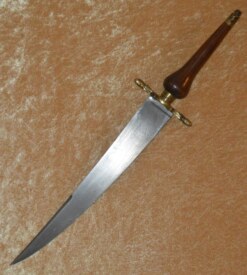
English Plug Bayonet, Last Quarter 17th C. The plug bayonets of England had curved blades more often than any other country. The example offered here features an unmarked slightly curved 11 1/16″ single-edged blade of wedge section, the last 4 3/4″ double-edged. Brass guard with acorn finials and brass pommel with small turned button finial. Figured walnut grip with brass base ferrule. Blade smooth and near excellent, with one tiny edge nick. Grip and guard also near excellent, appearing to have never been mounted in a gun barrel. Overall length 17″. Though probably originating around 1550, the plug bayonet had a relatively short span of use from around 1650-1720 (except in Spain where they were used into the 19th C). Their rise in popularity largely paralleled the development of standing armies in Europe, which were realizing the importance of the musketeer, while at the same time not wanting to wholly abandon the pike. In this sense the plug bayonet can be considered a transitional weapon. However, despite its use as a dagger on its own, it was soon found to be impractical since it's use prevented the musket from being fired. Countless soldiers also found great difficulties in removing a stuck plug bayonet from the muzzle, rendering the musket useless as a firearm. Many were damaged while being removed and as a result relatively few survive. For these reasons it was soon superseded by the socket bayonet, which did not affect the musket's ability to fire and could much more easily be removed.
  • Nation : British
  • Local Price : £895.00
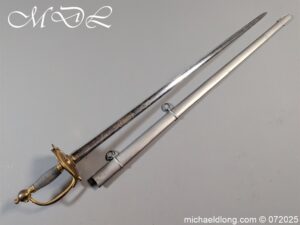
British 1796 Heavy Cavalry Sword by Wooley and Deakin. British Heavy Cavalry Officer’s 1796 Pattern Dress sword with single edged blade engraved with gilt detail including trophies of arms, GR, crown, Royal Coat of Arms and floral decoration plus makers details Wooley and Deakin Short, regulation brass hilt, boat shell guard and ovoid pommel and original grip of twisted silver wire. Complete with steel scabbard which has been cleaned with two loose rings
  • Nation : British
  • Local Price : £895.00
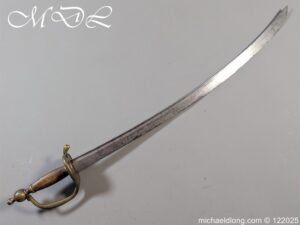
English Infantry Privates Hanger c 1750. English Infantry Privates Hanger c 1750, brass hilt comprising oval pommel on a stand and with a prominent tang-button, D-shaped knuckle-guard which spreads to form a heart-shaped stool around the blade, and very short rear quillon with drop-finial inclined towards the blade. Wooden grip no traces of being bound with wire, slightly curved single-edged blade with a narrow fuller almost at the back edge and stamped with crown over a 2 maker marked bates, overall length 33.75 inch the blade 28 inch
Page 60 of 159