
Show

Forgot your password?

Error message here!

Error message here!

Error message here!

Error message here!

Show Error message here!

Show Error message here!

Lost your password? Please enter your email address. You will receive a link to create a new password.

Error message here!

Back to log-in

Close

For Sale

The following items are listed by for sale by users of the site and dealers. They are in no way endorsed or guaranteed by www.antiquearmsresearch.com

Add a Classified Item
to

Clicking on the sword will take you through to the relevant classified item or dealer site.
Don't miss out! - Do you want to be kept informed weekly of new aditions? Just join our weekly update list.

You can also receive regular email notifcations when items match your keywords. To recieve them just register or logon at the top right of this page.
Page 64 of 161
  • Nation : British
  • Local Price : £865.00
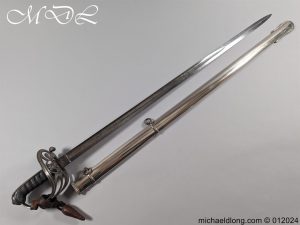
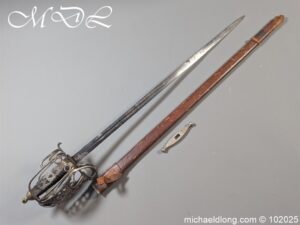
Kings Own Scottish Borderers Officers Sword. Kings Own Scottish Borderers Officers Sword ER 2 with owner initials W T C Regulation pattern sword with full basket and cross guard, the grip fish skin wire bound. straight broad sword blade with small central fuller, etched with E R 2 crown and regimental badge surrounded by thistle floral design. The blade is not in the best of condition with staining but all etching visible. It is complete with field service scabbard. Notes: The Regiment was created in 1689 as a crisis measure for the defence of Edinburgh against the Jacobites and in 2006 became part of the Royal Regiment of Scotland.
  • Nation : British
  • Local Price : £865.00
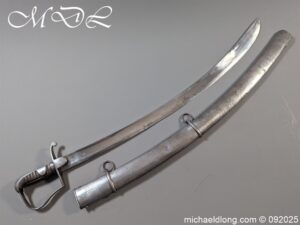
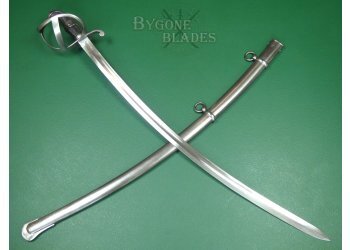
British 1796 Troopers Cavalry Sword. British 1796 Troopers Cavalry Sword curved blade with large fuller each side and stamped with a small crown over broad arrow plus large B O and arrow. The hilt regulation stamped 13, the trip has lost the leather and the wood is split please see images. The spine maker marked Thomas Craven and complete with matching scabbard with two loose rings, blade length 32.5 inch
  • Nation : British
  • Local Price : £865.00
Scottish Clackmannan Rifles Officers Sword. Victorian Clackmannan Rifle Volunteers Officers Sword in overall good condition, regulation hilt with strung bugle below Victorian crown, chequered pommel with tang button and complete with fish skin grip bound with silver wire. The blade which is excellent engraved with Royal cipher and crown to one side and crown and bugle to the reverse along with Clackmannan Rifle Volunteers and owners family crest and motto SPERO. Maker marked PILLIN Soho and complete with plated steel scabbard with two loose rings. Reference: Swords of the British Army Revised Edition Page 160¨ Blade Length: 89cm¨ Overall Length: 105cm
  • Nation : British
  • Local Price : £865.00
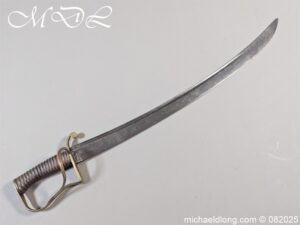
British Army Brass Hilted Sidearm. Very similar to a British Army Hospital Corps Sword c 1861 slightly curved blade with flat back and narrow top fuller however maker marked Enfield with GR and crown. It has been indicated to me that these were initially issued for use by Coast Guard c 1800 and later re-issued to the British Army in 1861 from surplus stock, adopted as a sword to be carried by British Army Hospital Corp Privates Brass hilt with side guard and cast ribbed grip overall length 29.5 inch the blade 25 inch
  • Nation : British
  • Local Price : £865.00
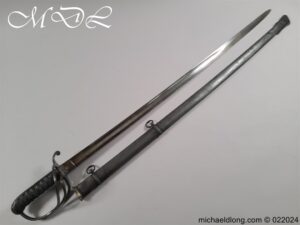
Victorian 18th Hussars 1821 Light Cavalry Officers Sword by Wilkinson. British Victorian 1821 Light Cavalry Officers Sword by Wilkinson Sword London number 21143, in good condition regulation 3 bar hilt with cheered pommel and fish skin grip. Slightly curved blade etched with Wilkinson details and owner initials, the sword is sold with a copy of Wilkinson register but very hard to confirm the name possibly Frederick T. Miles, 18th Hussars. Complete with matching steel scabbard. Overall length 104cm the blade 88.5cm for reference please see Swords of the British Army Revised Plate 78
  • Nation : -
  • Local Price : 1,175.00 USD
RARE, PROBABLY UNIQUE, EXPERIMENTAL HEAVY CAVALRY SWORD C.1820. Produced for one of the major powers, perhaps Saxony, during the rearming after the Napoleonic Wars. During that period, virtually all of the major world powers analyzed their weapons based on performance during the past war and sought to modernize them based on their experience. Many drew directly on French models and adopted them as standard. This example responds directly to the controversy over the use of heavy cavalry which resulted in renewed popularity of lancers. Cavalry swords, including our own through the Civil War, were used as concussion weapons, able to inflict traumatic wounds cracking bones and flesh without cutting as such. The closing velocity of the cavalry charge approached 60 miles per hour and a sword which cut would be embedded in its victim and lost to its owner. This example attempts to improve on the first impact while preserving the ability to counter strike, by reversing the section of the blade. It has a 35 ½” curved blade with forward (convex) back edge (thick) and the inner curve sharp. The tip is clipped in the Eastern European/Ottoman taste. The faces are slightly concave section and the root is struck with a crisp ordnance mark verifying that it was made in a military arsenal. The hilt is substantial, but quite simple, similar to Starr production and the wood grip scales snap into the grips, probably originally covered in oil cloth or leather. Very rarely, including some Swedish officer's swords, are curved double edged blades encountered. This is the only curved inner edged blade we have ever seen. The ordnance mark is crisp and clear and should allow for identification to the country of its origin.
  • Nation : British
  • Local Price : £850.00
British Crimean War Royal Engineer Drivers Sabre. 1850. #2504003. This is a very rare British Crimean War (1853-1856), Royal Engineer driver’s sabre made by Schnitzler & Kirschbaum of Solingen in 1850.At the outbreak of the Crimean War, the Board of Ordnance felt it necessary to equip Royal Engineer wagon drivers with a sword, and as a matter of expediency, purchased sabres originally made for, and recently trialled by the Prussian monarch, Frederick William IV, Guard Hussar Regiment. The sabres bear both the Prussian monarch’s ownership marks and the inspection stamps of British Board of Ordnance inspectors based in Liege.The 888mm (35 inch) curved blade has a broad fuller below a flat spine and terminates in a spear point. The blade has a 220mm upper false edge. The blade is in excellent condition, retaining its unsharpened factory edge. The spine is stamped with the crowned FW cypher of Frederick William IV and the date mark for 1850 above an inspection mark.The ricasso is stamped with the Schnitzler & Kirschbaum maker’s logo and a crowned, British Board of Ordnance Liege inspector’s mark. The forte bears a later inverted arrows, sold out of service mark. These sabres had a short working life and were removed from British service after the Crimean War. Dress regulations for artillery and engineer drivers published in 1855 state that they were to bear no arms of any kind, so it would seem that the provision of these sabres was solely for used during the conflict in the Crimea.The large barred guard is in great condition and consists of a narrow, flattened knuckle bow and a rounded side bar joined by a broader, flattened bar. The guard also has a solid, demi-oval thumb guard and a rear facing quillon. The smooth backstrap incorporates “ears” that are riveted through the wooden grip. The ridged hardwood grip is in great condition retaining its original covering and the blade is firm in the hilt. The front of the guard bears Prussian inspection marks and the letters, K. G.The sabre is complete with its original scabbard with twin suspension rings. The steel scabbard is in good condition with cleaned, shallow pitting. The top of the scabbard bears the British inverted arrows, sold out of service mark and the shoe is stamped with the S&K maker’s mark. The sword sheathes and draws smoothly and is held firmly within the scabbard.This is a great example of a very rare British sword supplied exclusively to Royal Engineer wagon drivers during the Crimean War.
  • Nation : British
  • Local Price : £850.00
British 1827 Pattern Pipeback Rifle Officer&#acute;s Sword, King&#acute;s Royal Rifle Corps (60th Rifles). Description Curved pipeback blade with quill point, pierced steel hilt of &#acute;Gothic&#acute; style with inset Rifles badge of a strung bugle and crown. Steel ferrule, smooth backstrap and oval pommel cap. Wire-bound shagreen grip. Steel scabbard with two hanging rings. No leather washer. The blade is 32½ inches (~82.5cm) in length, the sword 37¾ inches overall (~95.8cm). The blade is etched on one side at the forte with the maker&#acute;s mark &#acute;TATHAM 37 Charing LONDON&#acute;, indicating the firm of Henry Tatham. Moving up the blade on that side it is further etched with foliate motifs within a geometric pattern, then a pair of crossed lances with banners, the left banner reading &#acute;LX REG&#acute; and the right bearing the strung bugle symbol of the Rifle regiments, then a large strung bugle, then a laurel wreath, then &#acute;LX Regt&#acute; surmounted by more laurels, then a crown, a palm wreath and a fleur-de-lys like design. It is similarly etched on the other side with a geometric pattern at the forte, then the crossed lances with banners but with the bugle and text on the opposite sides, then a laurel wreath, then &#acute;The King&#acute;s own Rifle Corps&#acute; surmounted by laurels, then the crown, palm wreath and fleur-de-lys. This detailed custom etching is all legible upon close inspection but is faint. This has probably been worsened by past polishing but faint etching is a common feature for swords from the 1810s to the 1830s. Manufacturers must have used weaker acids or shorter immersion times, but their reason for doing so is unknown. The King&#acute;s Royal Rifle Corps was raised in 1756 as the 62nd (Royal American) Regiment of Foot, and renumbered the 60th (Royal American) Regiment of Foot just under a year later. It was from the beginning a unique force, intended to specialise in forest fighting in the wilderness of North America, where at the time the British colonies in North America were in conflict with the settlers of New France, each side joined by various Native American allies in the &#acute;French and Indian War&#acute;, which was one theatre of the global Seven Years War. Special dispensation was given for the new unit to recruit foreign Protestants, allowing them to make use of Swiss and German volunteers with the necessary skills, as well as American volunteers and men from regular British army units. The result was a unit somewhere between colonial infantry and a foreign legion, with the flexibility to move ahead of its time in equipment and tactics: while it wore cocked hats and swords on parade, in the field the men carried hatchets, short coats with no lace for ease of movement and most importantly, a rifle. The 60th distinguished itself in the successful campaign into Canada in 1760 under General Wolfe, who personally conferred on them the motto Celer et Audax (Swift and Bold). The regiment&#acute;s various battalions distinguished themselves in disparate North American conflicts from Canada to the Caribbean. Two fresh battalions were raised for the American Revolutionary War, where they fought in Georgia. In 1797 the Duke of York became Colonel-in-chief of the regiment, and shortly afterwards the 5th Battalion of the 60th was raised in England as green-jacketed riflemen. This battalion famously went with Wellington to the Peninsular War in 1808, where it was divided into companies attached to regular infantry brigades. Lord Wellington wrote to his brigade commanders that &156;they will find them to be most useful, active and brave troops in the field and that they will add essentially to the strength of the brigade" and stressed that the rifle companies could and should be deployed flexibly: "when opposing the enemy they would of course be on the front, flanks or rear according to circumstances&157;. Marshal Soult identified the British rifle battalions as a key threat in a letter to the Minister of War: &156;The men are selected for their marksmanship; they perform duties of scouts and in action are expressly ordered to pick off officers... This mode of making war and injuring the enemy is very detrimental to us; our casualties in officers are so great that after a couple of actions the whole number are usually disabled in the ratio of one officer to eight men&157;. In 1815 its name finally reflected its role as it became the 60th (Royal American) Light Infantry. However, with its links to North America diminishing and its role as a rifle regiment more clearly established, the regiment was renamed the 60th Duke of York’s Own Rifle Corps in 1824, although at least one battalion was in Canada at all times until 1824. In 1830 it gained the most prestigious patronage of all, becoming the King’s Royal Rifle Corps (sometimes phrased as the King&#acute;s Own, as etched on this sword, or as the &#acute;60th Royal Rifles&#acute;). This sword must therefore post-date 1830, and as the pipeback blade was replaced in rifle officer&#acute;s swords in 1845 with a fullered Wilkinson-style sabre blade, it cannot date to later than 1845. As noted above the style of etching is characteristic of the 1830s at the latest, so I am inclined to think this is a very early example of the 1827 Pattern, and to have been made not long after the new name was granted to this regiment. An identical example, also to the 60th Rifles, from the National Army Museum is illustrated in Robson&#acute;s Swords of the British Army (Revised Edition p.160). From 1845-60 the 1st Battalion served in India, from which it took part in the Sikh War, and Indian Mutiny. It returned to Canada in 1867 to guard against Fenian raids, then accompanied Sir Garnet Wolseley’s expedition across Canadian wilderness to end the Red River Rebellion in Manitoba. The 2nd Battalion fought in the Ninth Xhosa War in South Africa in 1878. The regiment served through both World Wars. In 1958 the regiment was grouped into the new Green Jackets Brigade as the &#acute;2nd Green Jackets, the King’s Royal Rifle Corps&#acute;. In 1966 the three regiments in the Brigade were amalgamated into one &#acute;large regiment&#acute;, with the 2nd Battalion maintaining the lineage of the King’s Royal Rifle Corps. In 2007 the Green Jackets was amalgamated with the rest of the Light Division to form The Rifles. Regimental titles were not officially maintained for the battalions of this new large regiment, but the 2nd Battalion, The Rifles is the descendant unit of the KRRC today. Henry Tatham was a sword cutler and gunmaker founded in 1800. From 1803-1816 he entered into partnership with the cutler Egg during which the firm traded as &#acute;Tatham & Egg&#acute;, then it reverted to his own name until its closure in 1860. The blade is bright, with only a few small spots of patination. Both its true and false edges have been sharpened, leaving sharpening marks, and this edge is undamaged. A few traces of old varnish are present in the recess where the &#acute;pipe&#acute; meets the flat of the blade, which may account for its better-preserved finish. All other steel parts of the sword have a dark patina, with speckled pitting in places. The wire binding of the grip is all present and tight, the shagreen of the grip is sound with only light handling wear. The leather washer has been lost. The scabbard is free of dents, its surface is likewise darkly patinated with speckled pitting overall.
Page 64 of 161