
Show

Forgot your password?

Error message here!

Error message here!

Error message here!

Error message here!

Show Error message here!

Show Error message here!

Lost your password? Please enter your email address. You will receive a link to create a new password.

Error message here!

Back to log-in

Close

For Sale

The following items are listed by for sale by users of the site and dealers. They are in no way endorsed or guaranteed by www.antiquearmsresearch.com

Add a Classified Item
to

Clicking on the sword will take you through to the relevant classified item or dealer site.
Don't miss out! - Do you want to be kept informed weekly of new aditions? Just join our weekly update list.

You can also receive regular email notifcations when items match your keywords. To recieve them just register or logon at the top right of this page.

Page 67 of 161
  • Nation : British
  • Local Price : £825.00
British 1892 Pattern Household Cavalry Trooper’s Sword, Unusual Variant. Description Slightly curved, single fullered blade with spear point, basket guard with pierced foliate &#acute;honeysuckle&#acute; decoration incorporating the cypher &#acute;HC&#acute;, buff leather hilt liner and washer, brass wire-bound shagreen grip, smooth steel backstrap and integral smooth oval pommel. Buff leather sword knot. Steel scabbard with two hanging rings and fixed side loop to the upper band. Blade 32 inches in length (81.3cm), the sword 37¾ inches (95.9cm) overall. The blade is unmarked. The outside of the hilt is stamped with two broad arrows point to point, a mark that was put on War Department equipment that was declared obsolete or to be sold off. The inside of the hilt is stamped near the quillon (under the hilt liner) with &#acute;1 . 08&#acute; above &#acute;4 / 01&#acute; above &#acute;T&#acute; above &#acute;209&#acute;. The first two are most likely issue dates of January 1908 and April 1901, indicating periods this sword was in service. The last number is most likely a serial or rack number. The &#acute;T&#acute; marking is interesting “ see below. Since their inception the regiments of Life Guards and Royal Horse Guards which collectively made up the Household Cavalry carried different swords than the regiments of the regular cavalry. This stemmed from their unique status as bodyguards to the Sovereign, which placed them beyond the effective control of the Army bureaucracy for most of their existence. Until 1882 they designed, ordered and carried swords on their own initiative, not necessarily producing better weapons but enhancing their prestige and elite status. The 1892 Pattern sword for the Household Cavalry was adopted after much discussion of the shortcomings of its predecessor the 1888 Pattern. An intense debate had been ongoing throughout the 1880s of the optimal form for a cavalry sword, which had already resulted in three new models of sword for the regular cavalry in just ten years. It was eventually decided to simply adopt the blade of the then-current 1890 Pattern cavalry trooper&#acute;s sword, paired with essentially the same distinctive Household Cavalry hilt, which had not been particularly criticised. Ironically after all the talk of blade handling and sturdiness, the 1892 Pattern saw no combat. After 1908 the regiments of the Household Cavalry would carry the new 1908 Pattern while in the field, while the 1892 Pattern was retained (in the slightly modified Mk II form introduced in 1902) for parade use only. This was done on the direct request of King Edward VII, who found the 1908 pattern &156;hideous&157;. The use of the 1892 Pattern as their parade sword continues to this day. This example appears to have been modified from a standard 1892 Pattern “ its blade has been reduced in length by 2½ inches from the standard and has also been significantly reduced in breadth by grinding back the edge and the false edge, leaving the fuller roughly central in a blade 2.8cm wide at the shoulder, which rapidly narrows to 2cm along most of the blade&#acute;s length (2.7 on an unmodified example), with a much slenderer point as a result. It has even been reduced in thickness “ the original is 8mm thick along most of its length while this example is 6mm. The removal of material has made the fullers shallower and appears to have removed any previous markings from the blade. Conversion to this extent would have required the sword to be dismantled, and this is shown in its repeened pommel with atypical flat tang button. The changes to the blade allow it to fit into its atypical bespoke scabbard, which is along the lines of the steel parade scabbards used for all infantry officer&#acute;s swords since 1866, but modified with a fixed loop on the top band alongside the two hanging rings, which matches the Household Cavalry&#acute;s hanging configuration. The complex blade conversion has been very well done, and reminds me of very similar conversions done in the early 1900s to make sergeant&#acute;s swords, which also slimmed down 1890 Pattern Cavalry blades in order to fit them into scabbards like those of infantry officers. The parallels are interesting and may suggest some kind of deliberate reuse of old stock across the Army. I can find no reference to an official sword in this configuration, however so why was this sword made? The most logical reason to convert the 1892 Pattern to resemble the infantry sword would be to make it more readily wearable on foot. I think there is a strong possibility therefore that this example is an attempt to create a variant for trumpeters and other bandsmen of the regiments. These men had significantly more dismounted duties than the others, making a shorter sword more practical. At least one example exists of the 1820 Pattern sword for the Life Guards, which is usually more than 37½ inches in the blade and sometimes as much as 38¾, having been shortened to 33 inches, which is thought to have been for these musicians (see p185, The British Cavalry Sword by Dellar). The 1882 Pattern was the first to officially acknowledge this need with two distinct versions of the sword manufactured, one with a 34¾ inch blade for trumpeters and bandsmen, and one with a 38 7/8 inch blade for all other troopers. Notably the short model also had a variant scabbard with two hanging rings, just as this sword does. Officially the scheme of long & short versions was then dropped again in the 1888 Pattern, with a 37½ inch model for all troopers. I doubt that the practical need for a shorter version went away in those few short years, however. Perhaps in practice the bandsmen either used the old short 1882s for their foot duties or, as time passed, produced their own up-to-date short versions by conversion. Might that be the significance of the &#acute;T&#acute; marking on this example “ that it is intended for the regimental Trumpeters? See attached reference of a painting by notable military artist Richard Simkin depicting a trumpeter of the Royal Horse Guards on foot with sword as of 1912. The blade is bright with a high polish overall and only tiny areas of frosting or patination. There is no damage to its edge, which has been sharpened. The hilt including backstrap and pommel is likewise bright and clean. The knot and washer have some small areas of staining, the liner is clean. The buff leather pieces are so good that they may be later replacements, but this is difficult to judge. The wire binding of the grip is all intact and there are no losses or visible handling wear to the shagreen. The scabbard has some light patination and polishing marks.
  • Nation : British
  • Local Price : $799.00
WWII Era British Shermuly Line-Throwing Pistol. William Schermuly,1857-1929, was one of the fathers of modern rocketry. He had served aboard vessels at sea and knew that many lives were lost each year due to shipwrecks. He invented several different line throwing devices, some of which were used in WWI for various purposes, such as throwing telephone lines from trench to trench. Although William started the business, it was his third son, Alfred James Schermuly, who invented and began production of this particular line-throwing gun. Produced during the 1920's, it was highly successful for the throwing of line from shore to ship, or ship to ship for life-saving purposes, and saved countless lives at sea. It used a blank cartridge, which would project and ignite the rocket The pistol is based on the Webley & Scott brass flare pistol, with a steel barrel extension to take a rocket that would propel a wire over long distance. The wire would then be attached to a line to help transfer people from ship to ship or shore to ship. It was made in several versions, some with swivel mounts to use aboard ship, or others, such as this example, which was entirely hand-held and portable. Brass frame stamped “SHERMULY’S/PAT No503324”, with a “P” and “S8” on the left side, and serial number 12932 on the right side and chamber. Chamber and barrel are hinged and released by thumb lever on left side. Round 14” steel barrel of 2” inside diameter, painted gray and featuring original diamond-shaped label on the top (mostly obscure), attached to the 4 3/4” long by 1” diameter brass chamber. Attached to the top of the barrel is a ribbed Bakelite handle for stabilizing the gun while firing. Two-piece mahogany grips; brass trigger guard. Very good original condition, with some wear to the gray paint. Mechanism functions properly. Line-throwing devices were made mandatory in Britain in 1938 for all vessels over 80 tons and 50 feet in length, and this type was widely used on both merchant and naval vessels during WWII. Overall length 23”. Originally, these pistols would have come in a kit and included line, cartridges, and rockets in a wood case. Offered here is the pistol only.
  • Nation : British
  • Local Price : £795.00
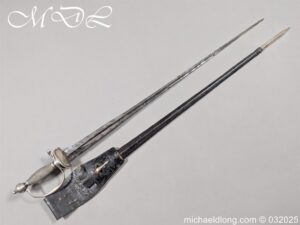
English Silver Hilt Court Sword Hallmark 1786. English Silver Hilted Court Sword Hallmark 1786 London and maker Marked R F “ Robert Foster. Super hilt in the form of the period, hallmarked as is the shell guard with silver wire wrapped grip. The colichemarde blade with good engraving at the ricasso but deteriorates over its length ibn condition please see images. For reference, please see Silver Mounted Swords by Daniek D Harzler page 97. Complete with original leather again with hallmarked fittings, over all length 89cm the blade 72.5cm
  • Nation : British
  • Local Price : £795.00
C1890 Victorian Court / Diplomatic Small Sword With Ornate Brass Clam Shell Hilt & Scabbard. Sn 18015:2. -. The small sword or smallsword (also court sword, French: épée de cour or dress sword) is a light one-handed sword designed for thrusting which evolved out of the longer and heavier rapier of the late Renaissance. The height of the small sword’s popularity was between mid-17th and late 18th century. It is thought to have appeared in France and spread quickly across the rest of Europe. The small sword was the immediate predecessor of the French duelling sword (from which the épée developed. This is an excellent original late Victorian Court / Diplomatic small sword (see pages 270 to 282 of Wither’s book ‘World Swords’ where many variants of small sword are illustrated). It has the typical brass hilt with cross guard clam shell mount. The clam shell has ornate embossed decoration. It has a bar knuckle guard, Crown pommel & Dog’s head finial. The leather & wire binding on the wood handle is tight and intact. The slim 30” triangular section blade is straight and undamaged and has just staining consistent with age. The sword measures 35 ½” overall. It is complete with its original leather bound wood scabbard which has steel mounts and 2 hanging rings. The price for this attractive Court / Diplomatic small sword includes UK delivery. Sn 18015:2.
  • Nation : British
  • Local Price : £795.00
WW1 Era British Gaunt & Son Limited Late Edward Thurkle London 1912 Pattern Heavy Cavalry Officer’s Sword With Etched King’s Crown Blade Numbered 14198, Leather Cord & Acorn Knot & Leather Covered Field Service Scabbard. Sn 17832 -. This is a nice, original, WW1 British 1912 Pattern Heavy Cavalry Officer’s Sword with its scabbard & Frog. The Sword has an undamaged 35 ½” single edged blade with fuller (44" overall). The blade has staining consistent with age and is etched on both sides with foliate panels and King George Crown with ‘GR’ Royal Cypher (George Rex). The ricasso is crisply marked on one side by the manufacturer ‘Gaunt & Son Limited Late Edward Thurkle London’. The reverse has the ordnance acceptance star with inlaid proof roundel. It has a full bowl guard with ornate tooled decoration and wire bound fish skin covered wood grip with thumb recess. The hilt is fitted with an original Officer’s leather Cord & acorn knot. The back of the blade is numbered ‘14198’ which may assist to identify the British officer who originally commissioned this sword. The sword has no visible Regiment marks or dates. It is complete with its original leather bound field service scabbard. The price includes UK delivery. Sn 17832
  • Nation : British
  • Local Price : £795.00
British 1859 Mk II Cutlass Bayonet. #2407021. British Pattern 1859 Type II Naval Cutlass Bayonet for use on the 1858 Enfield .577 Naval Rifle. This cutlass bayonet was made by the German company A. & E. Holler and is one of only 13,000 produced by them. Most of the 13,000 made were used by the Royal Navy, but some were sold to the United States and were used during the American Civil War. The 680mm un-fullered blade has a flat spine and single-edge. The blade terminates in a spear point and has a 240mm upper false edge. The blade is in excellent condition and was service sharpened. The forte is stamped with an oval cartouche containing the maker mark "A. & E. H." A. & E. Holler of Solingen Prussia who used this trademark between 1854 and 1885. The blackened steel bowl guard is in excellent condition. The chequered leather grips are in similarly excellent condition and the external spring catch works perfectly. The lack of British War Department or Naval ownership and inspection stamps suggests that this cutlass bayonet was one of those made for export. The cutlass bayonet is complete with its original black leather, steel mounted scabbard. The leather is in excellent condition with the stitching intact and tight. There are age and use related scuffs to the leather. The steel locket and chape are in good condition with a speckling of tarnish and very shallow pitting. This is an excellent example of a rare British Pattern 1859 Type II naval cutlass bayonet by a scarce maker.
  • Nation : British
  • Local Price : £795.00
**OLDEST BRITISH ARMY REGIMENT**C1870 British Honourable Artillery (HAC) Officer’s Sword By Warren London With Etched Blade & Scabbard. Sn 22645:5 -. Established in 1537 the HAC is the oldest Regiment in the British army. It was primarily a citizen militia and raised in times of national emergency including the Armada, English Civil war and Napoleonic wars. Until the Victorian era, Officers would have followed regular infantry sword patterns. As this was a volunteer army, they would have to pay for all service equipment including their own swords. This sword highlights the strong influence of French sword design in that era, particularly with regard to the knuckle bow and angled or canted pommel (see page 175 of World Swords by Withers).This is a very good example of the HAC Officer’s Sword. Our example has a 31 ½” long, rapier type steel blade (37” overall). The blade has light staining consistent with age. Both sides have foliate engraved panels, one side has stylised combined ‘HAC’ monogram, the reverse has what looks like ‘WRN’ combined stylised monogram possibly the name of the Officer who commissioned this sword. The ricasso is signed by the maker or retailer ‘Warren 23 Cursitor Street, London’. It has brass guard with canted pommel and pierced upturned clamshell featuring the embossed ignited grenade artillery emblem. The undamaged fish skin covered hilt has its original copper wire binding which is tight and intact. The sword is complete with its original steel scabbard. The scabbard with brass shoe, fixed belt bar and mounts with 2 original brass hanging rings has no dents or damage. The price includes UK delivery. Sn 22645:5
  • Nation : British
  • Local Price : £795.00
1901-1910 Victorian British Edward VII 1st Volunteer Battalion Cheshire Regiment 1822 Pattern Infantry Officer’s Sword With Etched & Blue Blade By Hobson & Sons, London, Brass Gothic Style Pierced Basket Hilt & Scabbard. Sn 22426:59 -. The Cheshire Regiment was a line infantry regiment of the British Army, part of the Prince of Wales’ Division. The 22nd Regiment of Foot was raised by the Duke of Norfolk in 1689 and was able to boast an independent existence of over 300 years. The 1st Volunteer Battalion was formed in 1860. The regiment was expanded in 1881 as part of the Childers Reforms by the linking of the 22nd (Cheshire) Regiment of Foot and the militia and rifle volunteers of Cheshire. The title 22nd (Cheshire) Regiment continued to be used within the regiment. On 1 September 2007, the Cheshire Regiment was merged with the Worcestershire and Sherwood Foresters Regiment (29th/45th Foot) and the Staffordshire Regiment (Prince of Wales’s) to form a new large regiment, the Mercian Regiment, becoming the 1st Battalion, Mercian Regiment. The Stockport Armoury building (Armoury Street, Stockport) was the Headquarters of the Cheshire Volunteer Rifles in 1862. The 1822 pattern sword was a radical departure from previous designs, having a ‘gothic’ style pierced basket hilt so named after its resemblance to window shapes in gothic architecture and folding langet on one side. (see page Page 159 of Robson’s swords of the British Army). This original 1st Volunteer Battalion Cheshire Regiment infantry Officer’s Pattern 1822 sword has a post 1845, 32 ½” single edged fullered blade (38 ¾” overall). The blade has blued and foliate etched decoration on both sides. One side of the blade has The etched Rifle Brigade ‘hung Bugle’ badge and ‘1st Volunteers Battn Cheshire Regt’ and etched proof star with inlaid brass roundel together with a stylised monogram possibly the initials of the Officer who owned this sword. The reverse has King Edward VII Royal Cypher ‘ER VII’ (King Edward VII Reigned 1901-1910), Heraldic arms and Maker / retailer name and address ‘Hobsons & Sons 1-3-5 Lexington St London W’. The gothic style voided brass guard has stylised Royal Cypher VR & Queen’s Crown in the centre. The bar guard is fully intact and has the later variant fixed bar langet on one side. Its fish skin grip with finger grooves & wire binding is in good condition with just light service wear. The sword is complete with its steel scabbard which has 2 hanging rings. The price includes UK delivery. Sn 22426:59
Page 67 of 161