
Show

Forgot your password?

Error message here!

Error message here!

Error message here!

Error message here!

Show Error message here!

Show Error message here!

Lost your password? Please enter your email address. You will receive a link to create a new password.

Error message here!

Back to log-in

Close

For Sale

The following items are listed by for sale by users of the site and dealers. They are in no way endorsed or guaranteed by www.antiquearmsresearch.com

Add a Classified Item
to

Clicking on the sword will take you through to the relevant classified item or dealer site.
Don't miss out! - Do you want to be kept informed weekly of new aditions? Just join our weekly update list.

You can also receive regular email notifcations when items match your keywords. To recieve them just register or logon at the top right of this page.

Page 71 of 161
  • Nation : British
  • Local Price : £750.00
Early 1827 British Naval officers sword. Originally introduced in 1827, it replaced the earlier 1822 Pattern. The main changes where the introduction of a solid brass guard with a crown and fouled anchor and a lion pommel. Replacing the previous open bars, royal cypher and stepped pommel. The dimensions for the blade were laid out as thirty -one and a quarter inches long and one and three eights inches wide at the shoulders. This new pattern also marked the abandoning of blue and gilt decoration for more engraving.This is very early example of the 1827, probably made by John Prosser. The ring under the guard for the sword knot, as opposed to two pierced holes, date this to before 1830. A does the St Edwards crown. Shorter than the pattern at only twenty-seven and a half inches it could be a custom order, or a dress sword. Alternately it could be a midshipman&#acute;s sword as they were instructed to acquire &156;blades of a convenient length&157;.A similar sword can be seen in the well known portrait of Captain William Peel VC with one at relief of Lucknow in 1858
  • Nation : American
  • Local Price : £750
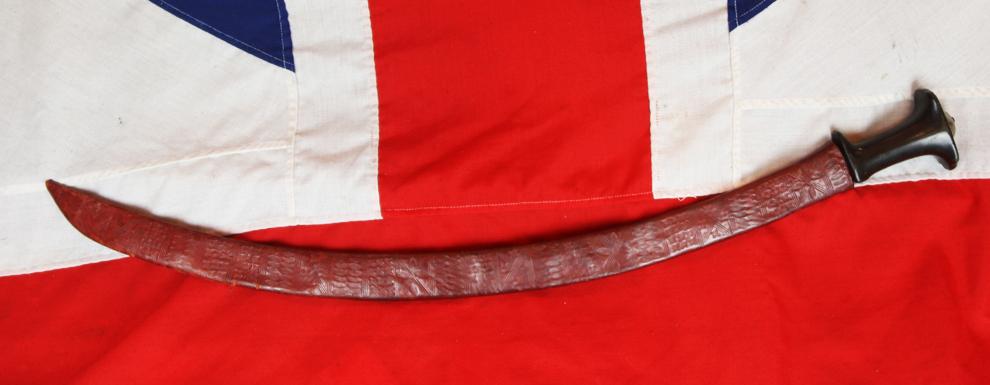
Click and use the code >23573 to search for this item on the dealer website Antique Ethiopian Shotel - Gorode Officer´s Sword Of Emperor Menelik IInd´s Reign, & Then Into Emperor Halie Selassie´s Reign, the Last Ethiopian Emperor
  • Nation : British
  • Local Price : £750.00
18th Century Shearing Sword. A silver-hilted British Shearing sword, London 1761. With a tapering double-edged blade, silver hilt cast and chased with writhen designs, comprising boat-shell guard, a pair of quillons with scalloped terminals, knuckle-guard struck with marks (rubbed), and spirally-moulded ovoid pommel, and the grip bound with plaited copper alloy wire and ribband between silver collars, 74.7 cm bladeThe handle is marked for William Kinman, (a raised ’WK’ within a shaped cartouche). He was a prominent London silver hilt maker and leading member of the Founders Company of which he was elected Master in 1780The shearing sword was popularised by fencing masters William Hope and Donald Mcbane as a cut and thrust blade, but with out the weight commonly found in the backsword. Only around for a short period, the however had a long service life, before eventually being replaced by the single edged spadroon
  • Nation : British
  • Local Price : £750.00
British Circa 1804 Naval Cutlass with Unusual Variant Blade. Description Single fullered spear pointed blade with upturned tip section, iron &#acute;figure eight&#acute; hilt with sword knot slit, tubular quillon. Solid iron grip cast with corrugated texturing. Barest fragments of a leather washer. Blade 28 3/8 inches in length, the cutlass 33¼ inches overall. No scabbard. This cutlass has the &#acute;figure-eight&#acute; hilt and grip that were used on the first standardised cutlass for the Royal Navy, the 1804 Pattern, but pairs these with an unusually shaped blade, neither fully straight due to its upturned tip nor with a continuous curve. Its single narrow fuller running close to the spine is of the style seen on British hangers and backswords of the 18th century, whereas the 1804 Pattern was unfullered, simpler to manufacture but heavier in use. This blade shape seems to be rare but has been seen on other cutlasses of the late 18th century. See Lot 212 sold at Antony Cribb auctions on 26th Nov, 2024: described by them as a late 18th century American cutlass, that example has the same unusual blade shape but with a simpler iron strap hilt and ribbed wood grip. The Cribb example might indeed be American in origin, but this example is more likely British in origin because of its use of the Pattern hilt and grip. That said, British and American cutlasses of that period shared design features and components could be traded or reused. Without a maker&#acute;s mark this identification can&#acute;t be conclusive. With no evident military marks either I would suggest this cutlass was made for the commercial market: suppliers of the period sold even-handedly to the Royal Navy, merchant shipping and the growing American market. Compared with the Cribb example and most other pre-Pattern cutlasses I would say this was the better sword: the textured and contoured cast iron grip was less likely to turn in the hand and coped better with sea air than smooth wood, the figure-eight hilt offered more hand protection than a simple knucklebow, and providing a knot slit allowed it to be tied to the hand more securely. Logically this cutlass must postdate 1804, and was perhaps a transitional piece or a manufacturer making use of the availability of Pattern components to pair with traditional blades “30,000 of the 1804 Pattern were ordered split between ten different manufacturers in the period from 1804 to 1808, so plenty of parts would have been available from the production boom. Like other swords of this period the hanger has a low carbon tang and shoulder, forge welded to a higher carbon steel blade, and the differential aging of the two materials can be seen clearly at the transition point. The two pieces were stepped to increase the surface area of the weld: one can see the line of the weld on the spine and the iron surface extends further up the blade on the right face than the left (roughly 7 inches vs 6 inches). The blade is unsharpened with a few small dents to its edge and a slightly rolled tip (~1mm). Its surface has areas of patination, light scratching, spots of light pitting in the fuller and around the tip. The hilt and grip have the common black japanned finish, but have also been painted with an unusual tan colour. It is difficult to tell which was applied first but more of the tan remains, particularly on the inside of the hilt. Both have rubbing and flaking exposing heavily patinated iron. Slight rotational movement to the grip.
  • Nation : Japanese
  • Local Price : £750
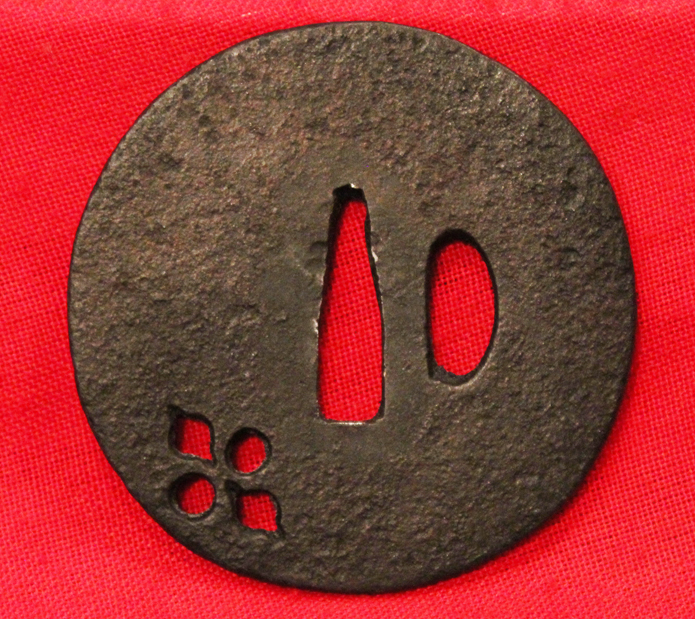
Click and use the code >19741 to search for this item on the dealer website Ko Tosho School Swordsmith Made Koto Katana Tsuba Circa 1400
  • Nation : American
  • Local Price : £750
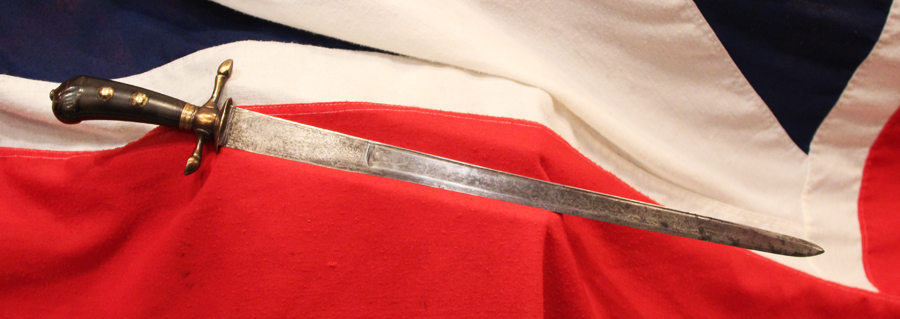
Click and use the code >21684 to search for this item on the dealer website Fine and Beautiful Carved Horn Hilted 18th Century Royal Naval Officer´s Hanger Sword, Cutlass or Cuttoe
  • Nation : British
  • Local Price : £745.00
Boer War 1901 Dated 1899 Pattern, British WD Wilkinson Heavy Cavalry Sword Regiment Marked ‘5Y NK’ To The 5th Norfolk Yeomanry Cavalry & Mole Patent WD Scabbard Sn 22198 -. The Norfolk Yeomanry was a volunteer cavalry (Yeomanry) regiment of Britain’s Territorial Army accepted onto the establishment of the British Army in 1794. After seeing action in the Second Boer War, it served dismounted at Gallipoli, in Palestine and on the Western Front during the First World War. Between the wars it converted to the Royal Artillery , and served as an anti-tank regiment in France, the Western Desert, Italy and North West Europe during the Second World War. After the war it served as a Territorial Army air defence unit and then as an Army Air Corps unit. This is an excellent original Troopers Sword to the Norfolk Yeomanry Cavalry (see pages 54 & 55 of Swords of The British Army by Robson). The Sword has a 33 ½” single edged, slightly curved blade with fullers (40” overall length). The blade is undamaged and clean with just a few scuffs consistent with scabbard carry. The ricasso is marked on both sides. One side has War Dept arrow and inspection mark. The reverse has ‘Wilkinson London’, 9 01 date (September 1901) and inspection marks. The spine of the blade is stamped ’/99’ (1899 Pattern) together with inspection mark. The full bowl guard is Regiment marked on the inside ‘5 Y NK’ to the 5th Squadron Norfolk Yeomanry Cavalry together with other indistinct numbers. The Sword’s black hard boiled leather chequered grips with 3 rivets are secure and undamaged. It is complete with its original steel scabbard with 2 fixed hanging rings. The scabbard has WD inspection marks and is stamped ‘Mole Patent’. The scabbard has even patina and just a few small dents. The price for this Regiment marked Boer War sword includes UK delivery. Sn 22198
  • Nation : French
  • Local Price : 9,500 kr
French cavalry saber AN IX = 1802.
Page 71 of 161