
Show

Forgot your password?

Error message here!

Error message here!

Error message here!

Error message here!

Show Error message here!

Show Error message here!

Lost your password? Please enter your email address. You will receive a link to create a new password.

Error message here!

Back to log-in

Close

For Sale

The following items are listed by for sale by users of the site and dealers. They are in no way endorsed or guaranteed by www.antiquearmsresearch.com

Add a Classified Item
to

Clicking on the sword will take you through to the relevant classified item or dealer site.
Don't miss out! - Do you want to be kept informed weekly of new aditions? Just join our weekly update list.

You can also receive regular email notifcations when items match your keywords. To recieve them just register or logon at the top right of this page.

Page 78 of 160
  • Nation : British
  • Local Price : £650.00
British Edward VIII 1897 Pattern Infantry Officer&#acute;s Sword by Flights Ltd. Description Straight single-fullered spear-pointed blade. Steel hilt with pierced and imprinted decoration including the crown and cypher of King Edward VIII. Steel ferrule, fully chequered steel backstrap, integral oval pommel with tang button. Wire-bound black shagreen grip, brown leather washer, red and gold parade sword knot with silver acorn. Brown leather field scabbard with frog strap, nickel plated steel throat piece. Blade length 32½ inches, 0.98 inches (2.5cm) wide at the shoulder, the sword 38¾ inches overall. The blade is faintly etched at the ricasso on one side with the retailer&#acute;s mark &#acute;FLIGHT&#acute; indicating Flights Ltd “ there would have been more text including the company&#acute;s street address but this has been polished off, seemingly deliberately given that there are visible polishing marks and none of the other etching shows any signs of rubbing. At the ricasso on the other side is an etched six-pointed star within which is a brass proof slug stamped with &#acute;PRO_&#acute; and a fleur de lys. Some letters are illegible but this should read &#acute;PROVED&#acute;. The blade is further etched on one side with the royal crown and shield, on the other side with the crown and cypher of Edward VII, and on both sides with a wreath of laurel & palm and foliate motifs. There is a cartouche for the optional etching of the owner&#acute;s name, which has been left blank. King Edward VIII reigned from January to December 1936, a total of 326 days from the death of his father George V until his abdication. He was never coronated, but his cypher, monogram and likeness were used on various items produced during his very brief reign. Army officers&#acute; swords bearing his cypher are rare today because for one to exist it would most likely have to have been made during this brief window of time. Officer&#acute;s swords were privately purchased on an individual basis. The most common time for the officer to buy one was when he was newly commissioned, a sword being a necessary part of his new uniform, at which point the cypher of the current monarch would be used. This would limit the supply of Edward VIII swords to the number of Army officers commissioned during that period, with some margin for stock produced but not sold. Existing officers purchasing a new sword for a new monarch would be very unusual, as swords with an old monarch&#acute;s cypher remained acceptable for wear (provided they were of an acceptable Pattern) and could be a point of pride as they demonstrated an officer&#acute;s length of service. Rehilting of old swords rather than a complete replacement did occur to some extent - I have previously seen a sword with a George V marked blade paired with an Edward VIII hilt. This would have been substantially cheaper and not left the officer with a redundant sword, but would still have been an unnecessary expense done purely for looks. By the same logic there may be swords out there made as an Edward VIII then rehilted for George VI, but I have not yet encountered one and they would have to be rare indeed as a fraction of an already small number. This example has the cypher of Edward VIII on both blade and hilt, making it true 1936 production with no modifications. Its excellent overall condition invites the question of whether it was carried much, or quietly put away when the King shocked society by abdicating in order to marry a woman widely considered unsuitable to be Queen Consort. A great many coins, stamps and items of memorabilia made in honour of the new King were simply junked. The polishing off of the retailer&#acute;s name from this example is also an interesting detail. Did this sword actually make it to an officer at all, or did it end up as redundant stock, like the mountains of unsold Edward VIII coronation mugs? The firm of William Flight was established in Winchester in 1750. It was at the outset a tailor&#acute;s shop, becoming specifically a military tailor in around 1852 “ both the King&#acute;s Royal Rifle Corps (60th Rifles) and the Rifle Brigade had their depot in the former &#acute;King&#acute;s House&#acute; at Winchester (later called the Rifle Depot, then the Green Jackets Depot, then the Upper Barracks, now called the Peninsula Barracks), totalling eight battalions of potential customers. It remained in the family for generations, Frederick William Flight taking over in 1867. The firm moved to 90 High Street in 1875. The business became Flights Ltd in 1920 and gave up its old Winchester premises in favour of newer branches at London and Aldershot. It ceased trading in 1956. The blade&#acute;s finish is excellent with minimal patination: some spots near the tip, a few light and very small spots in the etched section with little impact. The etching is bright and clear, retaining the contrast between the matt acid-etched background and the reflective polished designs within it. The blade&#acute;s edge is unsharpened and undamaged. The shagreen of the grip is all intact with light handling wear, its wire binding is all present with some movement to three loops. Fractional movement to the ferrule. The scabbard mouth, hilt, ferrule, backstrap and pommel have all been nickel-plated and this plating is in very good condition with only tiny spots of flaking at the edges of the hilt. The sword knot has some small spots of fray exposing to the wires exposing the fibre core above the acorn and next to the hilt (where it would rubs against the edge). The leather of the scabbard is good with only a few very small scuffs, the stitching of the frog strap bands have partly opened but it remains well attached.
  • Nation : -
  • Local Price : £650.00 GBP
Very Fine Ottoman Yataghan. An early 19 century Ottoman empire yataghan sword in its scabbard; recurved blade bears gold cartouches with decorative inscriptions; multi section horn and walrus ivory hilt with opal or jadeite cabochon inset pommel. A very fine item, its shape and the distinct lack of Islamic writing suggests it is possibly of Greek"
  • Nation : Spanish
  • Local Price : £650
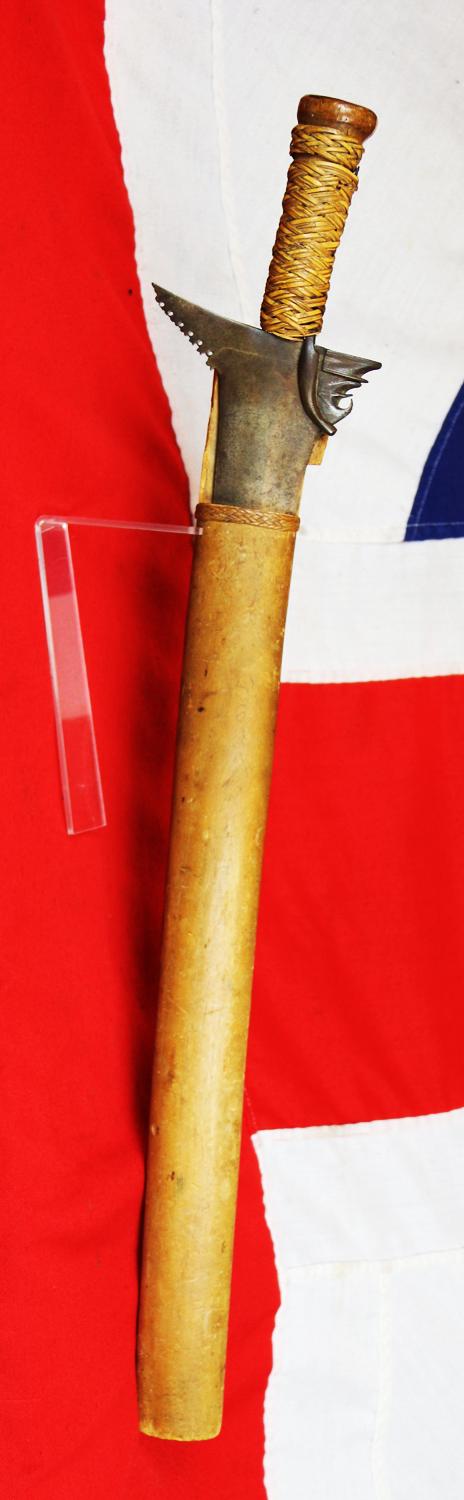
Click and use the code >25638 to search for this item on the dealer website Fabulous & Massive Antique Moro Keris Kalis, A Phillipines Pre Colonial Style Warrior´s Sword
  • Nation : British
  • Local Price : $895.00
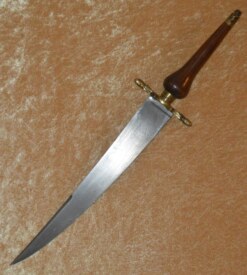
English Plug Bayonet, Last Quarter 17th C. The plug bayonets of England had curved blades more often than any other country. The example offered here features an unmarked slightly curved 11 1/16″ single-edged blade of wedge section, the last 4 3/4″ double-edged. Brass guard with acorn finials and brass pommel with small turned button finial. Figured walnut grip with brass base ferrule. Blade smooth and near excellent, with one tiny edge nick. Grip and guard also near excellent, appearing to have never been mounted in a gun barrel. Overall length 17″. Though probably originating around 1550, the plug bayonet had a relatively short span of use from around 1650-1720 (except in Spain where they were used into the 19th C). Their rise in popularity largely paralleled the development of standing armies in Europe, which were realizing the importance of the musketeer, while at the same time not wanting to wholly abandon the pike. In this sense the plug bayonet can be considered a transitional weapon. However, despite its use as a dagger on its own, it was soon found to be impractical since it's use prevented the musket from being fired. Countless soldiers also found great difficulties in removing a stuck plug bayonet from the muzzle, rendering the musket useless as a firearm. Many were damaged while being removed and as a result relatively few survive. For these reasons it was soon superseded by the socket bayonet, which did not affect the musket's ability to fire and could much more easily be removed.
  • Nation : British
  • Local Price : £645.00
Victorian British Pattern 1827 Manchester Volunteer Rifles Officer’s Sword With Blued & Etched Panels Blade By S&S Smith Manchester & Scabbard. Sn 22089 -. Originally raised as the King’s Royal Rifle Corps in 1755, the Rifle Brigade was officially formed in 1800. Initially Officer’s carried a lighter version of the 1796 pattern Light cavalry sabre, later adopting the 1803 pattern Infantry Officer’s Sword with strung bugle motif placed within the knuckle bow. The Regiment, always renowned for its individuality both in uniform and tactics, it was no wonder that they eventually gained their own distinctive pattern of sword. The 1827 pattern is defined by an all steel hilt coupled with the replacement of the usual Royal Cypher with a strung bugle and Queen’s Crown in the hilt . The Manchester Volunteer Rifles were raised in 1859/60. Their expansion in WWI as eighteen battalions of the Manchester Regiment saw the Regiment play a significant role in the Great War. This is a very good, original example of the 1827 Pattern Sword To The Manchester Volunteer Rifles with Scabbard. The sword has a 32 ½” long elegantly curved blade with fullers (39” overall). The blade has just staining consistent with age and is blued & etched on both sides with foliate panels & banners together with Queen’s crown on one side and Rifle Brigade Bugle and Victorian Queen’s Crown ‘VR’ Victoria Regina panel ‘Manchester Rifles’ on the reverse. It also has the ordnance acceptance star with inlaid roundel at the ricasso on one side. The blade is signed by the maker ‘S&S Smith 34 Cross St Manchester’. It has a voided knuckle guard with the correct Rifle Brigade Queen’s crown with strung bugle motif, stepped pommel with ball end and wire bound, fish skin covered handle in excellent condition with all wire complete and intact. It is complete with original leather scabbard with steel mounts & 2 hanging rings. The price includes UK delivery. Sn 22089
  • Nation : German
  • Local Price : £645.00
1860-1864 Italian Model 1860 Heavy Cavalry Trooper’s Sword With Blade By ‘S&K’ (Schnitzler & Kirschbaum, Solingen, Germany) & Scabbard. Sn 22645:6 -. An original Italian Model 1860 heavy cavalry troopers sword made circa 1860 -1864, with blade by German maker S&K (Schnitzler & Kirschbaum, Solingen, according to Bezdek’s German Swords and Sword Makers, this firm was active between 1811 and 1864). Withers in his book World swords (page 121), states that German sword makers produced large quantities of swords for export to both European & American markets during the mid-19th century including both Union & Confederate forces during the American Civil War, many of these swords were not marked with German identification marks, signifying Germany’s reluctance to identify or align themselves with any particular combatant allowing them to sell to both warring Governments. Our example of the Model 1860 is in excellent condition. It has a 35 ¼” long, curved, fullered steel blade which has just light staining consistent with age. It measures 41 ¼” overall length. One side of the ricasso is marked ‘S&K’ which is the manufacturer mark of Schnitzler & Kirschbaum. The reverse has a small inspection mark (all illustrated). It has the correct voided steel bowl guard which is slotted for cord and stepped pommel cap. Its original leather covered grooved grip has some of its original wire binding which is intact and tight. It is complete with its original steel scabbard which has its original hanging rings and long shoe. The scabbard has even patina & no damage. Sn 22645:6
  • Nation : British
  • Local Price : £645.00
Victorian & WW1 Era British Robert Mole & Sons Birmingham 1895 / 97 Pattern Infantry Officer’s Sword With Etched Blade, Leather Covered Scabbard, Frog & WW1 Era Sam Browne Equipment Belt Rig With Cross Belts. Sn 22832 -. This is an excellent original, 1895 / 97 Pattern British Infantry Officer’s Sword set (see page 179 of World Swords by Withers). The Sword has a 32 ½” single edged blade with fuller (39" overall). The blade is clean with etched and blued panels and Queen’s Crown VR (Victoria Regina) to both sides. The ricasso is marked by the manufacturer ’Robt Mole & Sons Makers Birmingham’. The reverse has the ordnance acceptance star and inlaid proof roundel. The hilt is fitted with its original leather washer. It has an ornate voided bowl guard with stylised Victorian Royal Cypher ‘VR’ (Victoria Regina) and Queen’s Crown. It has an undamaged wire bound fish skin grip together with stepped steel pommel with ball top. It is complete with its brown leather covered wood scabbard which has a German Silver throat mount & chape. The scabbard is fitted with an original brown leather frog with straps, brass stud and buckles attached to a WW1 era Officer’s Sam Browne equipment belt rig. The belt has all brass buckles and fittings including shoulder cross straps. The buckles, leather & stitching of all components of the rig are clean & intact. The belt is 49 12” length and 2 ¼” wide. It is adjustable from approx UK size 31" to 37" waist. There are no visible manufacturer, date or WD marks on the rig. The price for this Victorian and WW1 era Officer’s Sword with scabbard, frog and Sam Browne rig includes UK delivery. Sn 22832
  • Nation : British
  • Local Price : £645.00
1830-1837 William IV British 1822 Pattern Infantry Officer’s Sword With Correct Pipe Back Blade, Brass Guard & Scabbard. Sn 21507 -. The 1822 pattern sword was a radical departure from previous designs, having a ‘gothic’ style pierced basket hilt so named after its resemblance to window shapes in gothic architecture and folding langet on one side. Pre 1845 these swords had pipe back blades. Post 1845 they were made with slightly curved fullered blades (see page 173 of World Swords by Withers & Page 159 of Robson). This original infantry Officer’s Pattern 1822 sword has a pre 1845, 31” single edged blade pipe back blade (36” overall). The blade has staining consistent with age. There are no maker or date marks on the blade. The gothic style voided brass guard has stylised Royal Cypher WR IV & King’s Crown in the centre indicating manufacture during King William IV’s short reign 1830-1837. The bar guard is fully intact but does have a shallow dent. It has the correct folding langet on one side. Its fish skin grip with finger grooves & wire binding is in good condition. The sword is complete with its brass mounted leather scabbard which has a single brass hanging ring. All leather and stitching are clean and intact. The price includes UK delivery. Sn 21507
Page 78 of 160