
Show

Forgot your password?

Error message here!

Error message here!

Error message here!

Error message here!

Show Error message here!

Show Error message here!

Lost your password? Please enter your email address. You will receive a link to create a new password.

Error message here!

Back to log-in

Close

For Sale

The following items are listed by for sale by users of the site and dealers. They are in no way endorsed or guaranteed by www.antiquearmsresearch.com

Add a Classified Item
to

Clicking on the sword will take you through to the relevant classified item or dealer site.
Don't miss out! - Do you want to be kept informed weekly of new aditions? Just join our weekly update list.

You can also receive regular email notifcations when items match your keywords. To recieve them just register or logon at the top right of this page.

Page 87 of 161
  • Nation : British
  • Local Price : £550.00
British Bandsman&#acute;s Mameluke Sword, Early 19th Century. Description Curved single-fullered blade with spear point. Brass mameluke hilt with langets, its crossbar with ball finials, brass ferrule, brass backstrap and integral pommel in the form of a lion&#acute;s head. Carved ivory grip with chequering, banding and sunburst. Brown leather washer recessed into the hilt. Black leather scabbard with gilt brass locket, chape and middle mount, with hanging rings on the locket and middle rmount. Blade 25¼ inches in length, 1 1/16 inches wide at the shoulder, the sword 31 inches overall. The only marking on the blade is a partly worn etched panel with the maker&#acute;s or retailer&#acute;s name &#acute;___PIN & Co, LONDON & DUBLIN&#acute;. The only maker or retailer that would seem to fit is Mappin & Co., which went by that name from around 1862-1863 (my sources differ on the start date, some ranging as early as 1859). However, I can find no record of Mappin having offices in Dublin. This certainly a non-regulation sword - there were no standard patterns of sword carried by Army musicians until 1856, and regiments sourced at their own expense whatever they felt looked appropriately grand on parade resulting in a huge number of variations. A number of bandsman&#acute;s swords take design cues from the dress mameluke: the mameluke sword was popular during the 19th century, initially introduced to Europeans during Napoleon&#acute;s Egyptian campaigns of 1798-1801. The Duke of Wellington owned and carried one from his service in India, and it became an outright craze among British officers to have one as a dress sword, officially acknowledged with the 1822 cavalry dress regulations and the 1831 pattern staff officer&#acute;s sword, which is still carried by General Officers to this day. Five swords with identical carved grips and lion&#acute;s head pommels to this example, and with similar but not identical mameluke hilts & curved blades, are held at the Royal Armouries with item numbers IX.386, IX.395, IX.5385, IX.5480 and IX.7187. These are described as &#acute;Band Sword Type M&#acute; “ this is not an official Army designation, but a recognition by the Armouries curators that their group represents a clear type. I have also seen two examples of a different closely-related type, which has an identical grip to this one, a near-identical hilt (with shorter bars) but a different lion head at the pommel “ one of these being Lot 108 at Warwick & Warwick auctioneers&#acute; sale of the 16th October 2024. The blade has some areas of cleaned pitting, and there is slight movement to the backstrap. There is some hairline cracking to the grip, not enough to affect it structurally, and one small chip near the pommel. Some dents to the scabbard fittings, which have an aged patina. Take care to support the scabbard once the sword has withdrawn, the leather remains flexible. Due to the ivory used in its grip, this sword cannot be exported from the UK. It has been declared and registered as antique ivory under the provisions of the UK Ivory Act and therefore can be sold within the UK. Please note that this is a one-time registration: if you purchase this sword and wish to resell it you must register it again.
  • Nation : British
  • Local Price : £550.00
British Circa 1790 Naval Officer’s Fighting Sword, Probably By Thurkle. British Swords: British Circa 1790 Naval Officer’s Fighting Sword, Probably By Thurkle .form-horizontal .control-label{width:250px; !important; } #redim-cookiehint-bottom {position: fixed; z-index: 99999; left: 0px; right: 0px; bottom: 0px; top: auto !important;} // (function() { if (typeof gtag !== ’undefined’) { gtag(’consent’, ’denied’, { ’ad_storage’: ’denied’, ’ad_user_data’: ’denied’, ’ad_personalization’: ’denied’, ’functionality_storage’: ’denied’, ’personalization_storage’: ’denied’, ’security_storage’: ’denied’, ’analytics_storage’: ’denied’ }); } })(); if(jQuery().jquery==’1.11.0’) { jQuery.easing[’easeOutExpo’] = jQuery.easing[’easeOutCirc’] }; /* MAX IMAGE WIDTH */img { height:auto !important; max-width:100% !important; -webkit-box-sizing: border-box !important; /* Safari/Chrome, other WebKit */ -moz-box-sizing: border-box !important; /* Firefox, other Gecko */ box-sizing: border-box !important; /* Opera/IE 8+ */ }#map_canvas img, .gm-style img { max-width:none !important; }.full_width { width:100% !important; -webkit-box-sizing: border-box !important; /* Safari/Chrome, other WebKit */ -moz-box-sizing: border-box !important; /* Firefox, other Gecko */ box-sizing: border-box !important; /* Opera/IE 8+ */ }.S5_submenu_itemTablet{ background:none !important; } #s5_right_wrap, #s5_left_wrap, #s5_right_inset_wrap, #s5_left_inset_wrap, #s5_right_top_wrap, #s5_left_top_wrap, #s5_right_bottom_wrap, #s5_left_bottom_wrap { width:100% !important; } #s5_right_column_wrap { width:0% !important; margin-left:-0% !important; } #s5_left_column_wrap { width:0% !important; } #s5_center_column_wrap_inner { margin-right:0% !important; margin-left:0% !important; } #s5_responsive_mobile_drop_down_wrap input { width:96% !important; } #s5_responsive_mobile_drop_down_search input { width:100% !important; } @media screen and (max-width: 980px){ body { height:100% !important; position:relative !important; padding-bottom:48px !important; } #s5_responsive_menu_button { display:block !important; } } @media screen and (max-width: 970px){ #subMenusContainer .S5_subtext { width:85%; } } #s5_responsive_mobile_sidebar { background:#414141; background: -moz-linear-gradient(top, #414141 0%, #414141 100%); background: -webkit-gradient(linear, left top, left bottom, color-stop(0%,#414141), color-stop(100%,#414141)); background: -webkit-linear-gradient(top, #414141 0%,#414141 100%); background: -o-linear-gradient(top, #414141 0%,#414141 100%); background: -ms-linear-gradient(top, #414141 0%,#414141 100%); background: linear-gradient(top, #414141 0%,#414141 100%); font-family: Oswald !important; } #s5_responsive_mobile_sidebar a, #s5_responsive_mobile_search, #s5_responsive_mobile_sidebar_login_register_wrap, #s5_responsive_mobile_sidebar_menu_wrap, .module_round_box-sidebar, .module_round_box-sidebar .s5_mod_h3, .module_round_box-sidebar .s5_h3_first, .module_round_box-sidebar .s5_h3_last, #s5_responsive_mobile_sidebar_menu_wrap h3 { color:#FFFFFF !important; font-family: Oswald !important; } .s5_responsive_mobile_sidebar_inactive .s5_responsive_mobile_sidebar_title_wrap:hover, #s5_responsive_mobile_sidebar_title_wrap_login_open, #s5_responsive_mobile_sidebar_title_wrap_register_open, #s5_responsive_mobile_sidebar_search_wrap_inner1, #s5_responsive_mobile_sidebar .first_level_li:hover { background:#303030; cursor:pointer; font-family: Oswald !important; } .s5_mobile_sidebar_h3_open, #s5_responsive_mobile_sidebar_menu_wrap h3:hover { background:#303030; cursor:pointer; } .s5_mobile_sidebar_h3_open span, #s5_responsive_mobile_sidebar_title_wrap_register_open, #s5_responsive_mobile_sidebar_title_wrap_login_open, #s5_responsive_mobile_sidebar a.s5_mobile_sidebar_active, #s5_responsive_mobile_sidebar .s5_mobile_sidebar_h3_open a { color:#fd9e21 !important; } #s5_responsive_mobile_sidebar_menu_wrap div, #s5_responsive_mobile_sidebar_login_bottom, #s5_responsive_mobile_sidebar_register_bottom { background:#2A2A2A; } #s5_responsive_mobile_sidebar_search_wrap, #s5_responsive_mobile_sidebar_login_register_wrap, #s5_responsive_mobile_sidebar_menu_wrap { border-bottom:solid 1px #555555; font-family: Oswald !important; } #s5_pos_sidebar_top, #s5_pos_sidebar_bottom { border-bottom:solid 1px #555555; } #s5_responsive_mobile_sidebar_login_bottom #modlgn-username, #s5_responsive_mobile_sidebar_login_bottom #modlgn-passwd, #s5_responsive_mobile_sidebar_register_bottom input { background:#FFFFFF; color:#666666; border:solid 1px #FFFFFF; font-family: Oswald !important; } #s5_responsive_mobile_bottom_bar, #s5_responsive_mobile_top_bar { background:#333333; background: -moz-linear-gradient(top, #333333 0%, #333333 100%); /* FF3.6+ */ background: -webkit-gradient(linear, left top, left bottom, color-stop(0%,#333333), color-stop(100%,#333333)); /* Chrome,Safari4+ */ background: -webkit-linear-gradient(top, #333333 0%,#333333 100%); /* Chrome10+,Safari5.1+ */ background: -o-linear-gradient(top, #333333 0%,#333333 100%); /* Opera11.10+ */ background: -ms-linear-gradient(top, #333333 0%,#333333 100%); /* IE10+ */ background: linear-gradient(top, #333333 0%,#333333 100%); /* W3C */ font-family: Oswald !important; } .s5_responsive_mobile_drop_down_inner, .s5_responsive_mobile_drop_down_inner input, .s5_responsive_mobile_drop_down_inner button, .s5_responsive_mobile_drop_down_inner .button, #s5_responsive_mobile_drop_down_search .validate { font-family: Oswald !important; } .s5_responsive_mobile_drop_down_inner button:hover, .s5_responsive_mobile_drop_down_inner .button:hover, .s5_responsive_mobile_present #s5_responsive_mobile_drop_down_wrap .btn, .s5_responsive_mobile_present #s5_responsive_mobile_drop_down_wrap .btn:hover { background:#333333 !important; } #s5_responsive_mobile_drop_down_menu, #s5_responsive_mobile_drop_down_menu a, #s5_responsive_mobile_drop_down_login a { font-family: Oswald !important; color:#FFFFFF !important; } #s5_responsive_mobile_bar_active, #s5_responsive_mobile_drop_down_menu .current a, .s5_responsive_mobile_drop_down_inner .s5_mod_h3, .s5_responsive_mobile_drop_down_inner .s5_h3_first { color:#fd9e21 !important; } .s5_responsive_mobile_drop_down_inner button, .s5_responsive_mobile_drop_down_inner .button, .s5_responsive_mobile_present #s5_responsive_mobile_drop_down_wrap .btn, .s5_responsive_mobile_present #s5_responsive_mobile_drop_down_wrap .btn:hover { background:#fd9e21 !important; } #s5_responsive_mobile_drop_down_menu .active ul li, #s5_responsive_mobile_drop_down_menu .current ul li a, #s5_responsive_switch_mobile a, #s5_responsive_switch_desktop a, #s5_responsive_mobile_drop_down_wrap { color:#FFFFFF !important; } #s5_responsive_mobile_toggle_click_menu span { border-right:solid 1px #333333; } #s5_responsive_mobile_toggle_click_menu { border-right:solid 1px #333333; } #s5_responsive_mobile_toggle_click_search span, #s5_responsive_mobile_toggle_click_register span, #s5_responsive_mobile_toggle_click_login span, #s5_responsive_mobile_scroll a { border-left:solid 1px #333333; } #s5_responsive_mobile_toggle_click_search, #s5_responsive_mobile_toggle_click_register, #s5_responsive_mobile_toggle_click_login, #s5_responsive_mobile_scroll { border-left:solid 1px #333333; } .s5_responsive_mobile_open, .s5_responsive_mobile_closed:hover, #s5_responsive_mobile_scroll:hover { background:#333333; } #s5_responsive_mobile_drop_down_menu .s5_responsive_mobile_drop_down_inner, #s5_responsive_mobile_drop_down_register .s5_responsive_mobile_drop_down_inner, #s5_responsive_mobile_drop_down_login .s5_responsive_mobile_drop_down_inner, #s5_responsive_mobile_drop_down_search .s5_responsive_mobile_drop_down_inner { background:#333333; } .s5_wrap { max-width:1300px !important; } @media screen and (min-width:580px) and (max-width: 1100px){ #s5_top_row1 .s5_float_left { width:100% !important; } } @media screen and (min-width:580px) and (max-width: 1100px){ #s5_top_row3 .s5_float_left { width:100% !important; } } @media screen and (min-width:580px) and (max-width: 1100px){ #s5_below_columns_inner .s5_float_left { width:100% !important; } } @media screen and (min-width:580px) and (max-width: 850px){ #s5_bottom_row2 .s5_float_left { float:left !important; width:50% !important; } } @media screen and (min-width:580px) and (max-width: 850px){ #s5_bottom_row3 .s5_float_left { float:left !important; width:33.3% !important; } } #s5_below_columns_wrap1 { background:#d9caa5 !important; } #s5_below_columns_wrap2 { background-color:# !important; background-image:url(images/couple.jpg) !important; background-size: contain; background-attachment: scroll !important; background-repeat:no-repeat !important; background-position:center left; } #s5_menu_wrap.s5_wrap, #s5_menu_wrap.s5_wrap_fmfullwidth { -moz-opacity: 1; -khtml-opacity: 1; filter:alpha(opacity=100); opacity:1 !important; } .s5_wrap_fmfullwidth ul.menu { width:96%; } #s5_menu_wrap.s5_wrap_fmfullwidth { height:72px; width:100% !important; z-index:2; position: fixed; top:0px !important; margin-top:0px !important; left:0 !important; margin-left:0px !important; -webkit-backface-visibility: hidden; -webkit-transform: translateZ(2); } .subMenusContainer, .s5_drop_down_container { position: fixed !important; } #s5_menu_wrap.s5_wrap { height:72px; position: fixed; top:0px !important; z-index:2; margin-top:0px !important; } #s5_menu_wrap { -webkit-transition: top 500ms ease-out; -moz-transition: top 500ms ease-out; -o-transition:top 500ms ease-out; transition: top 500ms ease-out; } #s5_menu_wrap.s5_wrap_fmfullwidth, #s5_menu_wrap.s5_wrap { top:0px; } #s5_menu_wrap.s5_wrap, #s5_menu_wrap.s5_wrap_fmfullwidth { border-bottom:1px solid #020101; background: #fff !important; /* Old browsers */ background: -moz-linear-gradient(top, #fff 0%, #fff 100%) !important; /* FF3.6+ */ background: -webkit-gradient(linear, left top, left bottom, color-stop(0%,#fff), color-stop(100%,#fff)) !important; /* Chrome,Safari4+ */ background: -webkit-linear-gradient(top, #fff 0%,#fff 100%) !important; /* Chrome10+,Safari5.1+ */ background: -o-linear-gradient(top, #fff 0%,#fff 100%) !important; /* Opera 11.10+ */ background: -ms-linear-gradient(top, #fff 0%,#fff 100%) !important; /* IE10+ */ background: linear-gradient(to bottom, #fff 0%,#fff 100%) !important; /* W3C */ filter: progid:DXImageTransform.Microsoft.gradient( startColorstr=’#fff’, endColorstr=’#fff’,GradientType=0 ) !important; /* IE6-9 */ } #s5_menu_wrap.s5_wrap, #s5_menu_wrap.s5_wrap_fmfullwidth { -webkit-box-shadow: 0 0 5px rgba(0, 0, 0, .1); -moz-box-shadow: 0 0 5px rgba(0, 0, 0, .1); box-shadow: 0 0 5px rgba(0, 0, 0, .1); } /*= 200 - s5_fmenuheight_new){document.getElementById("s5_menu_wrap").style.top = "0px";} else {document.getElementById("s5_menu_wrap").style.top = "-500px";} if(document.getElementById("s5_floating_menu_spacer")!=null){if (window.pageYOffset >= 200 && window.innerWidth > 980){document.getElementById("s5_floating_menu_spacer").style.height = s5_menu_wrap_height + "px"; document.getElementById("s5_menu_wrap").className = ’s5_wrap_fmfullwidth’; document.getElementById("subMenusContainer").className = ’subMenusContainer’; if (s5_menu_wrap_parent_height >= s5_menu_wrap_height - 20 && s5_menu_wrap_parent_parent_height >= s5_menu_wrap_height - 20 && document.getElementById("s5_menu_wrap").parentNode.style.position != "absolute" && document.getElementById("s5_menu_wrap").parentNode.parentNode.style.position != "absolute") {document.getElementById("s5_floating_menu_spacer").style.display = "block";}}else { document.getElementById("s5_menu_wrap").className = ’’; if (document.body.innerHTML.indexOf("s5_menu_overlay_subs") @media screen and (min-width: 650px){.s5_responsive_mobile_sidebar_show_ltr {width:400px !important;}.s5_responsive_mobile_sidebar_body_wrap_show_ltr {margin-left:400px !important;}.s5_responsive_mobile_sidebar_show_rtl {width:400px !important;}.s5_responsive_mobile_sidebar_body_wrap_show_rtl {margin-right:400px !important;}#s5_responsive_mobile_sidebar_inner1 {width:400px !important;}} // // function s5_search_open() {jQuery(’#s5_body_padding’).addClass(’s5_blurred’);document.getElementById(’s5_search_overlay’).className = "s5_search_open";} function s5_search_close() {jQuery(’#s5_body_padding’).removeClass(’s5_blurred’);document.getElementById(’s5_search_overlay’).className = "s5_search_close";} .btn-link:hover { color:#fd9e21; } .button:hover, .readmore a:hover, .readon:hover, button:hover, .s5_ls_readmore:hover, .dropdown-menu li > a:hover, .dropdown-menu li > a:focus, .dropdown-submenu:hover > a, .dropdown-menu .active > a, .dropdown-menu .active > a:hover, .nav-list > .active > a, .nav-list > .active > a:hover, .nav-pills > .active > a, .nav-pills > .active > a:hover, .btn-group.open .btn-primary.dropdown-toggle, .btn-primary:hover, .item-page .dropdown-menu li > a:hover, .blog .dropdown-menu li > a:hover, .item .dropdown-menu li > a:hover, .btn:hover, .pagenav a:hover, .s5_scrolltotop, .s5-buttonhighlight, .s5_tab_show_slides_container_wrap_outer .s5_tab_show_prev:hover, .s5_tab_show_slides_container_wrap_outer .s5_tab_show_next:hover, .jdGallery a.right:hover, .jdGallery a.left:hover, .s5_ls_search_word, #s5_categorypopup, #s5_categorybutton:hover, p.readmore a:hover, .module_round_box.highlight1, span.addtocart-button input.addtocart-button:hover, span.addtocart-button input.notify-button:hover, .cart-view button:hover, span.details-button input.details-button:hover, .control-buttons button:hover, #paymentForm button:hover {background-color:#fd9e21 !important;} .nav-child li.active a, .show_cart a, #s5_bottom_menu_wrap ul.menu li a:hover, #s5_bottom_menu_wrap ul.menu a:hover, #subMenusContainer li a:hover, .s5_menu_overlay_subs #subMenusContainer li:hover a {color:#fd9e21 !important;} #s5_bottom_row2_area_inner {border-bottom:1px solid #f2f2f2;} .inputbox:hover, .registration input:hover, .login input:hover, .contact-form input:hover, #jform_contact_message:hover, input:hover, textarea:hover, textarea:focus, input[type="text"]:focus, input[type="password"]:focus, input[type="datetime"]:focus, input[type="datetime-local"]:focus, input[type="date"]:focus, input[type="month"]:focus, input[type="time"]:focus, input[type="week"]:focus, input[type="number"]:focus, input[type="email"]:focus, input[type="url"]:focus, input[type="search"]:focus, input[type="tel"]:focus, input[type="color"]:focus, .uneditable-input:focus, .pagination .pagination a, .module_round_box.highlight, .vmproduct .product-container:hover {border-color:#fd9e21;} .jdGallery .slideInfoZone p, .s5_highlightfont {font-family: Roboto !important;} body, .inputbox {font-family: ’Source Sans Pro’,Helvetica,Arial,Sans-Serif ;} .jdGallery .slideInfoZone, .s5_tab_show_slide_inner {max-width:1300px !important;} /* k2 stuff */ div.itemHeader h2.itemTitle, div.catItemHeader h3.catItemTitle, h3.userItemTitle a, #comments-form p, #comments-report-form p, #comments-form span, #comments-form .counter, #comments .comment-author, #comments .author-homepage, #comments-form p, #comments-form #comments-form-buttons, #comments-form #comments-form-error, #comments-form #comments-form-captcha-holder {font-family: ’Source Sans Pro’,Helvetica,Arial,Sans-Serif ;} .s5_wrap, .s5_tab_show_slide_inner {width:96%;} #s5_loginreg, #s5_categorybutton, #s5_nav li a, .S5_parent_subtext, .jdGallery .slideInfoZone h2, .jdGallery .slideInfoZone p, #s5_bottom_row3_area1 .module_round_box h3, .btn, .button, button, .inputbox.mailchimp_signup, .module_round_box.centered h3, .s5_uppercase, #s5_countdown .text .type-time, .button, p.readmore a, a.readon, .-products .s5_tab_show_button_text, #s5_search_overlay .s5_mod_h3_outer h3, #s5_cart, span.addtocart-button input.addtocart-button, span.addtocart-button input.notify-button, .cart-view button, span.details-button input.details-button, .control-buttons button, #paymentForm button {text-transform:uppercase;} #s5_center_area2 {padding-bottom: 100px;padding-top: 100px;} #s5_menu_wrap_outer {background-color:#;} .module_round_box.one .s5_module_box_1 { background-image: url("https://blackthorn-antiques.com/images/") !important; background-color: #f8f8f8; background-position:bottom right;} .module_round_box.two .s5_module_box_1 { background-image: url("https://blackthorn-antiques.com/images/british-arms.JPG") !important; background-color: #dbdbe6; background-position: bottom right;} .module_round_box.three .s5_module_box_1 { background-image: url("https://blackthorn-antiques.com/images/") !important; background-color: #eaeaea; background-position: bottom right;} .module_round_box.four .s5_module_box_1 { background-image: url("https://blackthorn-antiques.com/images/") !important; background-color: #e0e1d9; background-position: bottom right;} .module_round_box.five .s5_module_box_1 { background-image: url("https://blackthorn-antiques.com/images/Hotchkiss.JPG") !important; background-color: #c6c1c7; background-position: bottom left;} .module_round_box.six .s5_module_box_1 { background-image: url("https://blackthorn-antiques.com/images/") !important; background-color: #deedda; background-position: bottom right;} #s5_menu_wrap_outer {background-color:#f9f9f9;} (function(i,s,o,g,r,a,m){i[’GoogleAnalyticsObject’]=r;i[r]=i[r]||function(){ (i[r].q=i[r].q||[]).push(arguments)},i[r].l=1*new Date();a=s.createElement(o), m=s.getElementsByTagName(o)[0];a.async=1;a.src=g;m.parentNode.insertBefore(a,m) })(window,document,’script’,’//www.google-analytics.com/analytics.js’,’ga’); ga(’create’, ’UA-135463198-2’, ’auto’); ga(’send’, ’pageview’);
  • Nation : British
  • Local Price : £550.00
British WW1 1908 Pattern Cavalry Trooper&#acute;s Sword with Field Camouflage Paint, Dated 1916. Description Straight single-fullered blade with spear point, steel basket hilt. Brown leather washer, chequered brown plastic grip. Smooth oval steel pommel. Brown leather sword knot. Steel scabbard with fixed opposed hanging rings. Blade 34¾ inches in length past the washer, the sword 42½ inches overall. The blade is stamped at the ricasso on one side with a broad arrow War Department stores mark, &#acute;S.B & NLD&#acute; indicating that it was manufactured by Sanderson Brothers & Newbould, a crown inspection mark with &#acute;E&#acute; for Enfield and an &#acute;X&#acute; indicating that the blade passed a manufacturer&#acute;s bending test. It is stamped on the other side with the manufacture date &#acute;3 16&#acute; for March 1916, and two further crown inspection marks with &#acute;E&#acute;. The spine of the blade is stamped &#acute;P 08&#acute; indicating the pattern. The spine side of the throat piece is stamped with &#acute;WSC&#acute; indicating that it was manufactured by the Wilkinson Sword Company. There may be other stamps on the guard and scabbard, such as on the inside of the guard (there are some small protrusions on the outside that suggest there may be a unit mark) and the spine of the main section of the scabbard, but the multiple layers of paint applied to it have obscured these areas. The top layer in particular was applied thickly and will have pooled in depressions like stampings. Paint was often applied to cavalry trooper&#acute;s swords during the First World War as camouflage, and to reduce reflection off the polished metal which could give away a unit&#acute;s position. This was often removed after the conflict to return swords to parade condition, so examples with intact field paint are relatively rare and may show a fair amount of wear from their usage. Painting does not seem to have been done preemptively or according to a central plan “ rather it was done ad hoc by deployed soldiers themselves. The odds of a camouflaged sword having been carried on a campaign are therefore very high. Several colours of paint can be found, although only one seems to have been applied at a time, with no patterning. The colour chosen generally matches the terrain of the theatre in which a unit served but was probably also dependent on availability. This example appears to have originally been painted khaki which would be appropriate for an arid environment, which has then been overpainted with a very dark green suitable for a more temperate one. Some wear has occurred to the paint layers leaving a mottled appearance that shows both colours, as well as bare steel in places where the paint has been completely lost. Sanderson Brothers and Newbould was established in 1776 as Naylor and Sanderson, a steelmaker and cutlery manufacturer based in Sheffield. Naylor retired in the 1820s after which his business partners, the four brothers Sanderson, took over full control of the business. They operated multiple sites at Newhall Road and the Attercliffe Steelworks and in 1835 acquired the Don Glassworks to convert it to a steelworks, with 180 crucible furnaces on that site alone by 1872, then adding state of the art gas furnaces in 1873. Sanderson and Newbould described itself as &#acute;Manufacturers of steel saws, small tools, etc.&#acute; It does not appear to have made swords until around the time of the First World War, although it took War Office contracts to produce 1907 Pattern bayonets for the Lee Enfield at some point before 1911. During WW1 the bayonet manufacturing facilities at Enfield were moved to Sheffield and it is thought that they were reinstalled at one of Sanderson&#acute;s facilities, making it the second largest bayonet manufacturer after Wilkinson. Multiple different models of sword have been recorded with Sanderson&#acute;s mark, from standard issue cavalry trooper&#acute;s swords to officer&#acute;s swords that would have been sold individually “ but always WW1 era models. A number of manufacturers stepped in to produce swords during the war but Sanderson appears to have capable of doing so at some scale. After WW1 the firm returned to its usual business of steel, files and sawblades. After WW2 the famous &#acute;Stalingrad Sword&#acute; was rolled into shape there from Sanderson&#acute;s steel before being sent to Wilkinson Sword for finishing. The firm merged with fellow Sheffield steelmaker Kayser Ellison and Co Ltd in 1960 to form Sanderson Kayser, which ceased trading around 1997. The blade is excellent, retaining its bright finish with only tiny spots of light patination. Its edge has been sharpened with just one tiny nick near the end of the fuller, no tip damage beside some very light scratching near it. A tiny band of brown residue sits at the very base of the blade against the washer “ I am unsure if this is rust or some paint overspill. It seems to move quite readily to be rust, so I have opted to leave it alone. The aforementioned camouflage paint has been applied to the inside and outside of the guard, most of the washer and the exterior of the scabbard. The inside of the scabbard mouthpiece is unpainted - it has some patination and residue that may be spots of the khaki paint. Wherever the paint has completely worn away, e.g. the edges of the guard, the exposed steel has a dark patina and light speckled pitting, suggesting there has been no more recent loss of paint. A few specks of white paint to the outside of the guard, probably incidental. The pommel has lost almost all its paint, with moderate pitting and dark patination overall. The strap and acorn of the sword knot has been lost, leaving only a short surviving section tied onto the hilt. The metal beneath this is heavily patinated. The plastic grip has some deliberate scoring to the backstrap area. The plastic is very dry-feeling, a little faded in tone with some surface-level cracking (sun damage?), but is solid in the hand. Rust and some encrustation to the ferrule. The scabbard is free of dents. Like the guard it shows very dark black patination in areas where the paint has worn, including the faces of the throat piece, the fixed rings, the leading and trailing edges, particularly in the lower section, and the chape end.
  • Nation : British
  • Local Price : £550.00
British Indian Short Sabre, pre-1855. Description Slightly curved double-edged blade with spear point, no fuller or ricasso, both faces slightly convex for a lens-shaped cross-section. No leather washer, steel P-shaped hilt with faceted knucklebow including sword knot slit and comma-shaped quillon, wide semioval langets, steel ferrule, backstrap and integral pommel cap. Ribbed wooden grip covered with shagreen bound with wire, a section of black leather at the base. Black leather scabbard with steel throat and chape pieces, the throat piece with oval frog stud. Blade 26 inches in length, 33mm wide at the shoulder, the sword 30 7/8 inches overall. The blade is unmarked. The scabbard is stamped next to the seam with &#acute;BO&#acute;, the stamp of Board of Ordnance ownership, as well as a broad arrow with &#acute;I&#acute;, which is an Indian stores mark. The government markings on its scabbard suggest that this sword saw official service in India. This model of sword is not a standard Pattern with its design specified by the military: instead it was probably a commercial design purchased &#acute;off the shelf&#acute; from a private manufacturer. It has an unusual combination of an unfullered blade, which reminds me somewhat of the British circa 1845 &#acute;Dundas&#acute; artillery hangers: this blade is the exact same width, albeit 1½ inches shorter and unlike the Dundas it does not have a flat spine, instead having a false edge running all the way to the shoulder. This atypical blade is paired with a hilt and grip in the style of a Georgian sabre. Overall it seems to sit somewhere between simple British hangers and more elaborate sabres, similar in form to other sidearms produced for infantry and/or foot artillery in India like this piece also for sale here with a very similar blade. There exist numerous examples of both arms produced in India influenced by British designs, and arms produced in Britain specifically for the Indian market, and this could be either, although I would incline towards British production. The Board of Ordnance was constituted by Royal Warrant in 1673, continuing the work of the Office of Ordnance which had been in existence since at least the 1460s. It was responsible, broadly, for managing military installations and supplying equipment, weapons and ammunition for the Army and Navy, including the critical task of ensuring a national gunpowder supply. It founded and controlled the Royal Artillery and Royal Engineers, and grew to become the second largest government department after the Treasury. In the Crimean War the British Army suffered from wide-ranging logistics failures, for which the Board of Ordnance was held partly responsible. Reform was demanded and in the process the Ordnance Board Transfer Act 1855 moved all previous responsibilities of the Board, including stores, into the War Department, and the marking of a broad arrow with &#acute;BO&#acute; was replaced with &#acute;WD&#acute; thereafter. While old stores would not have been remarked and the old version might have persisted for a while during the reorganisation, we can be reasonably sure that this sword&#acute;s production predates the demise of the Board of Ordnance. I would tentatively date this piece to the 1840s: compare this non-standard cutlass also for sale here, which is identically Board of Ordnance-marked for Indian service and has a very similar blade, with a rarely-seen manufacture date of 1844. The sword has signs of previous cleaning, with polishing marks on the blade and the scabbard fittings in particular polished bright (except in recesses like under the frog stud) and possibly restored “ I note that the portion of the grip nearest the pommel is covered with black leather rather than shagreen, which may be a replacement. The blade is unsharpened with no edge damage, light speckled patination overall and some light scratching towards the tip, and the previously mentioned polishing marks. The hilt and backstrap have some very light cleaned peppered pitting and spots of patination in places, the ferrule has only some tiny spots of light patination. The grip is solidly peened, there is some fractional movement to the hilt and some slight sideways movement to the ferrule. The shagreen of the grip has some moderate handling wear, small areas worn smooth and some small patches lost to expose the wood core: next to the ferrule on one side, and in the recesses near the pommel end on the other side. The scabbard fittings are bright with polishing marks, some small spots of dark patination. The scabbard leather is very good for an Indian piece of its age (heat, humidity and sometimes poor storage being the issues), it is strong and capable of supporting itself even with the blade withdrawn, with only light abrasion and a few shallow dents to its surface, all of its stitching is intact.
  • Nation : British
  • Local Price : £550.00
Victorian Welsh 6th Denbighshire Rifle Volunteers Officer&#acute;s Sword. A good and rare example of the Light Infantry regulation pattern. The slightly curved single edged blade is etched with a crowned VR cypher and title &156;6th Denbigh Rifle Vols&157;. Also etched with the original owners name of &156;ARTHUR W ADAMS&157;.The sword is in excellent condition with brigh crisp etching. Oddly the proof slug appears to have been stamped twice, something that I have not come across before. The balde is solid in the guard with no movement.Arthur Walter Adams, born in 1857 to Llewellyn Adams and Caroline L Adams in Ruthin Denbighshire. He was commissioned to Second Lieutenant (supernumerary) in the Volunteer Rifle regiment in June 1875, eventually resigning his commission in 9th June, 1880.On the forte it has the retailer&#acute;s details &156;Hobson & Sons St Martins Lane London&157; Originally based close to the Woolwich Barracks, Hobson was a Clothing and Regimental Regalia outfitter to officers. Quickly growing they established themselves as on of the top outfitters in London. The St Martins address dates the sword to around 1873-1877
  • Nation : -
  • Local Price : 7,000 kr
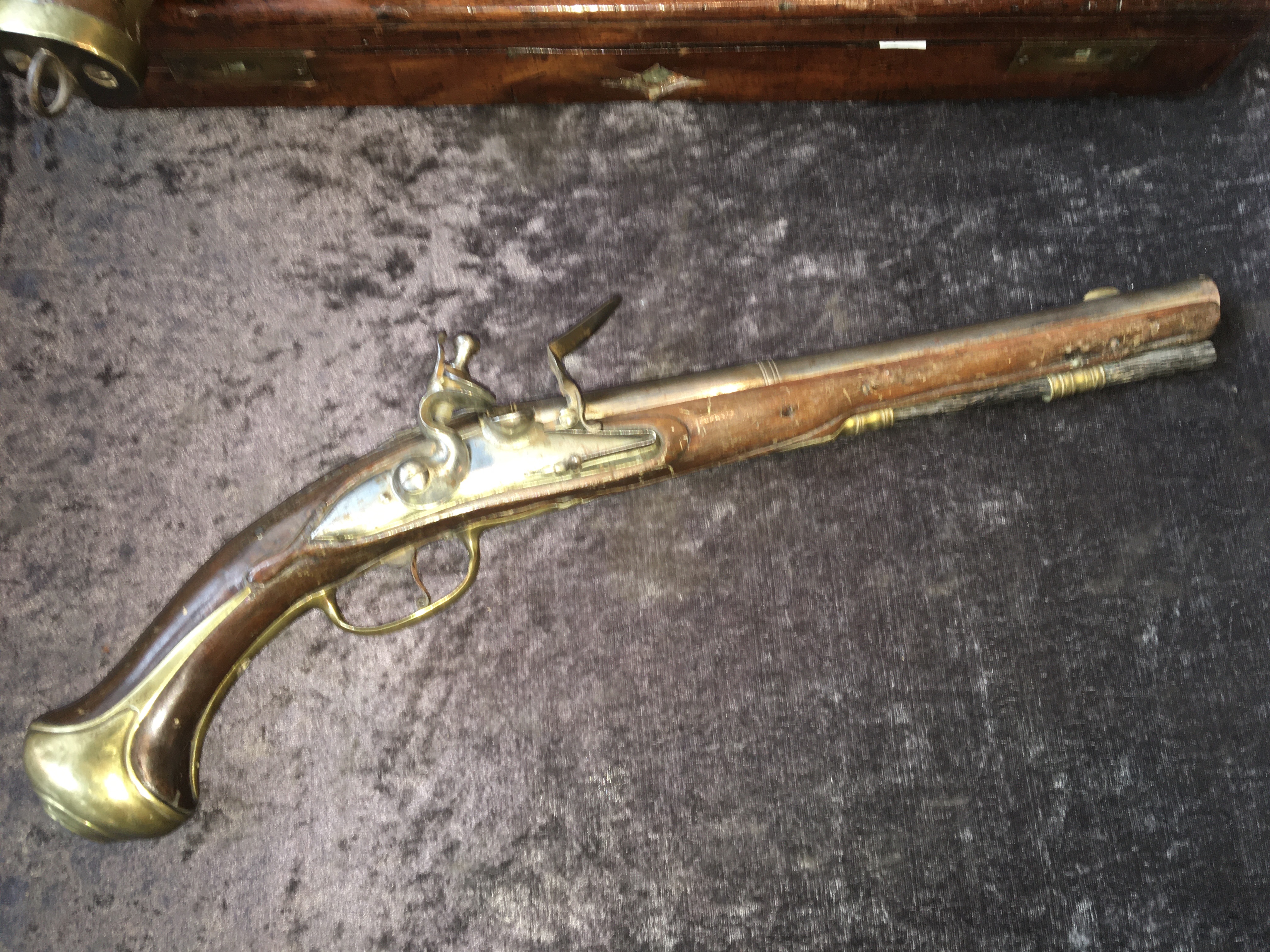
Militär flintlåspistol ca:1760-70.
  • Nation : -
  • Local Price : 7,000 kr
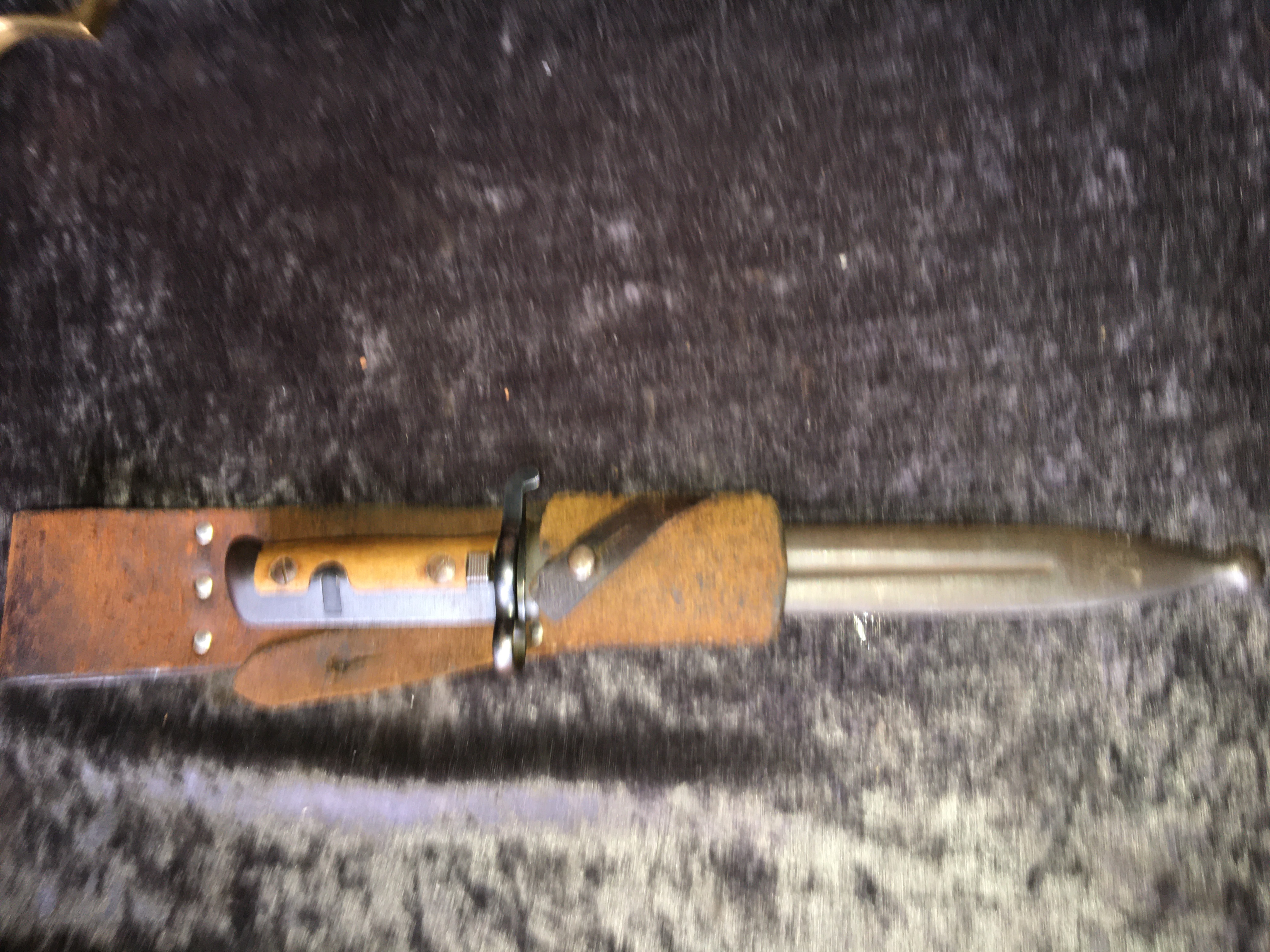
Sv-Norsk bajonett för Norska polistrupperna m/44.
  • Nation : British
  • Local Price : £545.00
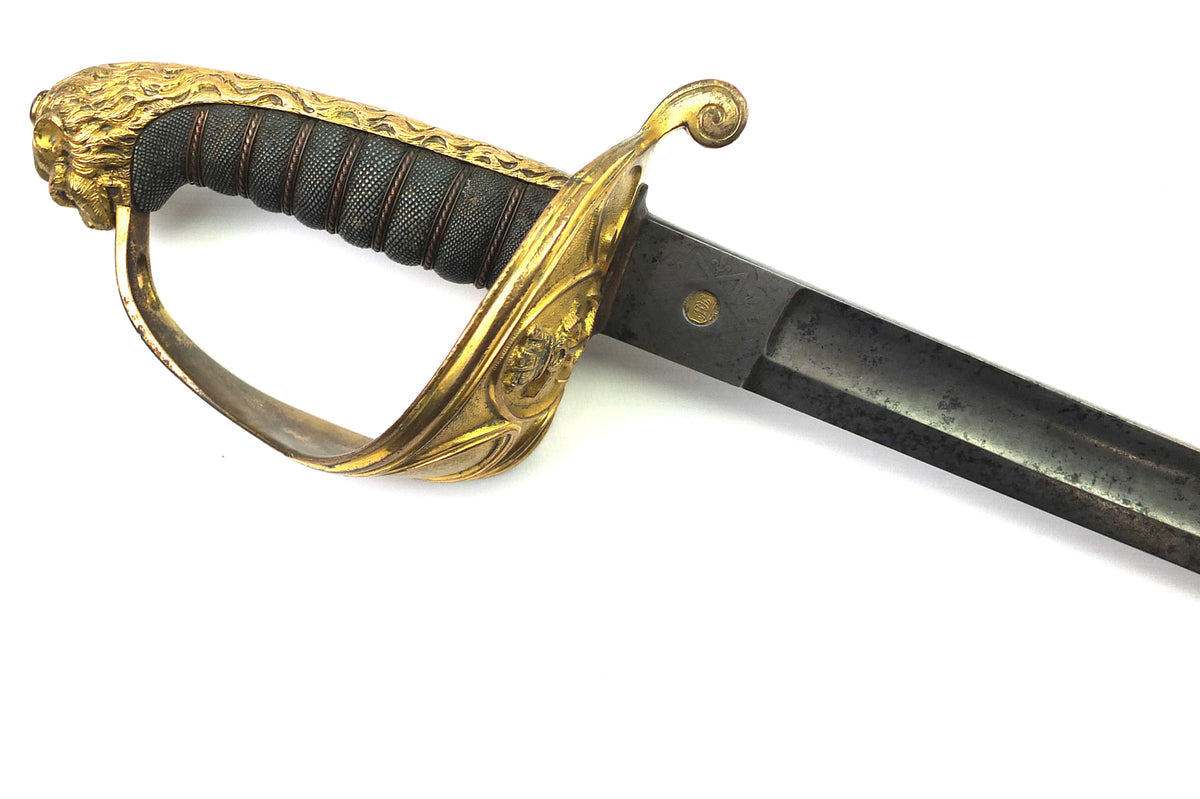
Naval Royal Dockyard Battalion Sword 1827, Rare. Ref X3213. A Rare 1827 Naval Royal Dockyard Battalion Sword. 39&157; overall, 32&157; slightly curved fullered blade engraved with crowned fouled anchor, ´Royal Dockyard Battalion´ with foliage & acorns, & ´Henry Wilkinson Pall Mall London´ to one side, the other with foliage, royal coat of arms & proof mark to forte. Solid gilt half basket hilt with crowned fouled anchor, folding side guard lion´s head pommel, the backstrap with full length lion´s mane. Black fish skin grip with twisted gilt wire. Circa 1847&194;&160; A rare sword in good condition, lacking scabbard.&194;&160; Royal Dockyard Battalion´s formed in 1847 from Dockyard staff and disbanded in about 1857.&194;&160; &194;&160; &194;&160; &194;&160; &194;&160; &194;&160; &194;&160; &194;&160; &194;&160; &194;&160; &194;&160; &194;&160; &194;&160; &194;&160; &194;&160; &194;&160; &194;&160; &194;&160; &194;&160; &194;&160; &194;&160; &194;&160; &194;&160; &194;&160;&194;&160;&194;&160;&194;&160;&194;&160;&194;&160;&194;&160;&194;&160;&194;&160;&194;&160;&194;&160;&194;&160;&194;&160;&194;&160;&194;&160;&194;&160;&194;&160;&194;&160;&194;&160;&194;&160;&194;&160;&194;&160;&194;&160;&194;&160;&194;&160;&194;&160;&194;&160;&194;&160;&194;&160;&194;&160;&194;&160;&194;&160;&194;&160;&194;&160;&194;&160;&194;&160;&194;&160;&194;&160;&194;&160;&194;&160;&194;&160;&194;&160;&194;&160;&194;&160;&194;&160;&194;&160;&194;&160;&194;&160;&194;&160;&194;&160;&194;&160;&194;&160;&194;&160;&194;&160;&194;&160;&194;&160;&194;&160;&194;&160;&194;&160;&194;&160;&194;&160;&194;&160;&194;&160;&194;&160;&194;&160;&194;&160;&194;&160;&194;&160;&194;&160;&194;&160;&194;&160;&194;&160;&194;&160;&194;&160;&194;&160;&194;&160;&194;&160;&194;&160;&194;&160;&194;&160;&194;&160;&194;&160;&194;&160;&194;&160;&194;&160;&194;&160;&194;&160;&194;&160;&194;&160;&194;&160;&194;&160;&194;&160;&194;&160;&194;&160;&194;&160;&194;&160;&194;&160;&194;&160;&194;&160;&194;&160;&194;&160;&194;&160;&194;&160;&194;&160;&194;&160;&194;&160;&194;&160;&194;&160;&194;&160;&194;&160;&194;&160;&194;&160;&194;&160;&194;&160;&194;&160;&194;&160;&194;&160;&194;&160;&194;&160;&194;&160;&194;&160;&194;&160;&194;&160;&194;&160;&194;&160;&194;&160;&194;&160;&194;&160;&194;&160;&194;&160;&194;&160;&194;&160;&194;&160;&194;&160;&194;&160; Images courtesy of West Street Antiques (https://antiquearmsandarmour.com/)
Page 87 of 161