
Show

Forgot your password?

Error message here!

Error message here!

Error message here!

Error message here!

Show Error message here!

Show Error message here!

Lost your password? Please enter your email address. You will receive a link to create a new password.

Error message here!

Back to log-in

Close

For Sale

The following items are listed by for sale by users of the site and dealers. They are in no way endorsed or guaranteed by www.antiquearmsresearch.com

Add a Classified Item
to

Clicking on the sword will take you through to the relevant classified item or dealer site.
Don't miss out! - Do you want to be kept informed weekly of new aditions? Just join our weekly update list.

You can also receive regular email notifcations when items match your keywords. To recieve them just register or logon at the top right of this page.

Page 93 of 161
  • Nation : British
  • Local Price : £495.00 GBP
Scottish Cross Hilt Officer's Sword. A GVR Scottish field service cross hilt infantry officer's sword, retailed by Marshall and Aitken, Edinburgh, in its original field service scabbard."
  • Nation : British
  • Local Price : £495.00 GBP
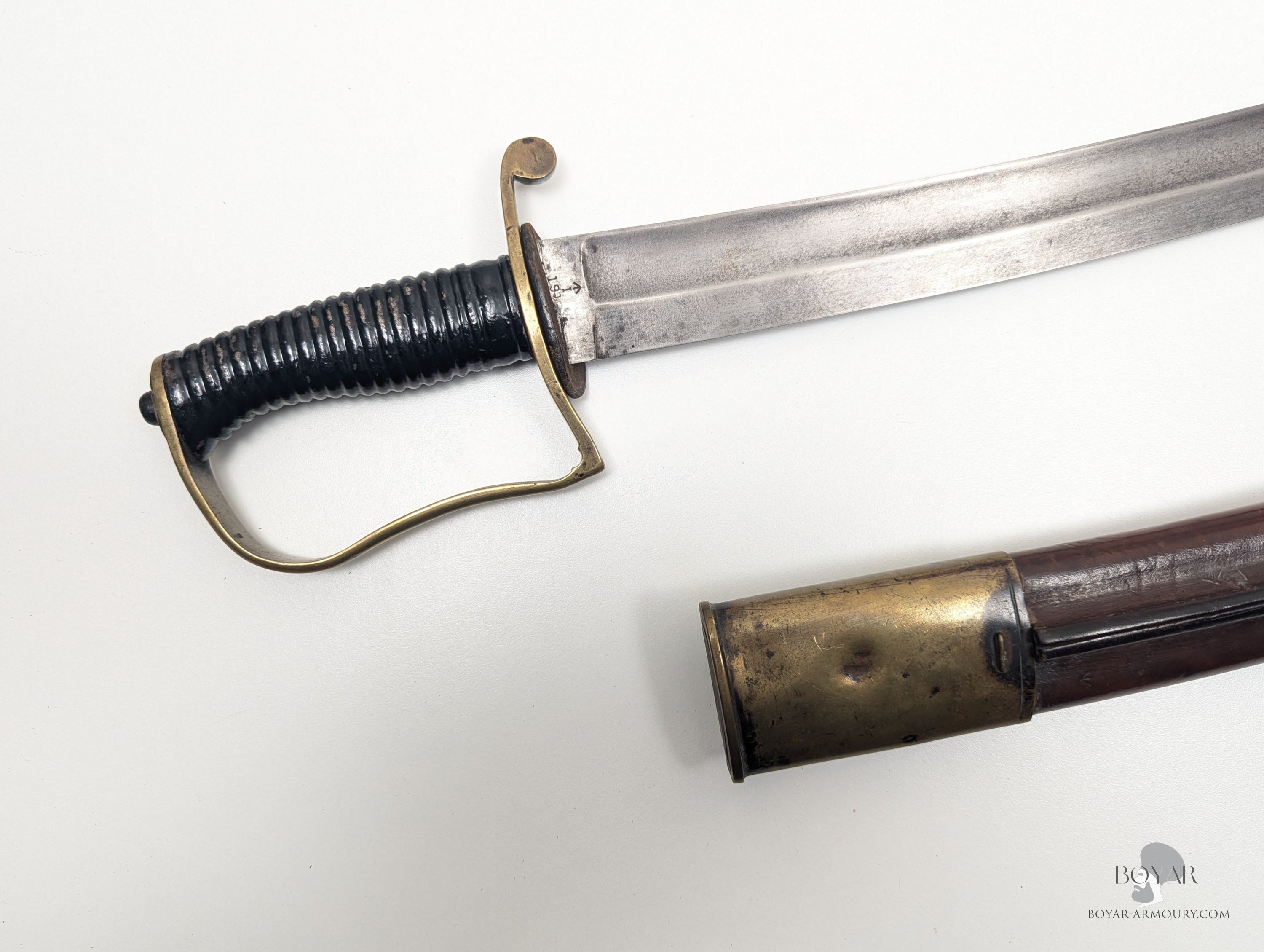
Victorian 1896 Pattern Mountain Battery Sabre, Indian Army. A Victorian 1896 Pattern Indian Mountain Battery sabre, complete with Indian Army ordnance marks and maker marks."
  • Nation : -
  • Local Price : £495.00
18th Century Silver Hilted Short Sword. Hanger. #2509004. This early to mid-18th Century, silver hilted hunting sword/infantry hanger was most likely made in Solingen, Germany. It could have been used anywhere in Europe and indeed, the world. Short swords like these were a favourite of both naval and infantry officers. Many swords like this, often referred to as cuttoes, saw service on both sides during the American War for independence (1775-1783).The 620mm double-edged blade has twin fullers, running from the ricasso for almost half the blades’ length. The blade terminates in a spear point. The forward half of the blade has a hexagonal cross section. The blade is in great condition, with tiny scattered patches of shallow pitting. There are some small contact nicks in the cutting edges and the blade remains sharp.The ricasso bears a faint, hard to read manufacturers name.The square shaped knuckle bow and faceted pommel cap and bolster are made of silver, a high-status and valuable metal in the 18th Century. The faceted hardwood grip is inlaid with decorative bands of twisted silver wire. The hilt is in very good condition and the blade is firm.The sword is complete with its original leather scabbard with integral frog. The leather has shrunk slightly, so that the point of the blade shows at the very tip of the scabbard. The stitching is intact and tight and the blade sheathes and draws smoothy.This is an excellent and scarce example of an 18th Century silver hilted short sword. Was: £495.00Now:
  • Nation : British
  • Local Price : £495.00
Scottish Dirk. #2508007. This is a large Scottish dirk, which I believe dates to the 19th Century. The blade has been made from a re-profiled late 18th Century sabre, something like a 1788 or 1796 cavalry sabre. It is likely that the piece was made by a town smith as opposed to being more commercially produced.The 420mm single-edged blade has a broad, shallow fuller that merges into the narrow, double-edged spear point. The blade is double edged for the final 80mm and has pitting along its length. The broad blade is 37mm wide at the ricasso and the spine is 10mm thick. I have cleaned the blade as it was very rusty when I acquitted the piece and the blade has been coated with Renaissance Wax to prevent the rust from returning. The patina and pitting cover the whole blade, including the cutting edge and the spine, indicating that the re-working of the blade was carried out some considerable time ago. The position of the nick in the cutting edge suggests that it happened during the blade’s life as a dirk, as opposed to its life as a sabre. A contact nick this close to the base of a sabre blade would be unlikely.The blade is set into a stag antler grip, with a brass or bronze (before cleaning I believed the metalwork to be iron because of its dark colour) bolster and a scalloped pommel piece. The scallop-edged disk is cut with the cross of St. Andrew (Saltire) and has a hand forged pommel nut through which the tang is peened. The brass/bronze retains a great patina and the blade is firm in the hilt.This is a large and interesting Scottish dirk, probably locally made and dating to the early or mid-19th Century. Was: £495.00Now:
  • Nation : British
  • Local Price : £495.00
British Royal Garrison Artillery Staff Sergeants Sword. 1915. #2509006. This 1856 pattern Royal Artillery staff sergeant's sword is something of an anomaly. The sword is of the type issued to Staff Sergeants and is stamped with an Enfield inspection stamp and the Government armoury proof mark. However, it is engraved with an inscription to 2nd Lieutenant Baron Collingwood Seymour Underhill of the Royal Garrison Artillery. It is likely that it was issued to the yound 2nd Lieutenant for dress purposes in his role as a trainer of signalling and was retained by him after the war at which point he had his name and date of commission engraved on the blade.The 860mm single-edged blade has a flat spine and wide single fuller on both sides, tapering to a double-edged spear point. The blade is double-edged for the final 260mm and retains its fighting edge.The blade is etched on one side with winged lightning bolts surmounted by the words, Royal Artillery. Foliate and floral scrollwork capped by a trefoil arch completes the etching. The obverse is etched with similar scrollwork surrounding a rayed crown and the royal coat of arms above the Flowers of the Union tied with a ribbon etched with “UBIQUE,” (everywhere) and a field gun above the motto, “Quo fas et gloria ducunt.” (Where right and glory lead).The long, Staff Sergeants pattern ricasso is stamped with the makers mark of Sanderson Brothers and Newbould Ltd, of Sheffield, England (SB & NLd, in use from 1890). Above the maker’s mark are an Enfield armoury inspection/acceptance stamp and a government proof (bend test) mark. The obverse ricasso is blank.A cartouche on the blade is engraved with the dedication, “B. C. S. Underhill. 2/1 S. M. War. RGA. 1915.” Baron Collingwood Seymour Underhill was commissioned as 2nd Lieutenant in the South Midland (Warwick) battalion of the Royal Garrison Artillery in 1915.The blade and etching are in excellent condition. The etching is clear and the blade retains its polish with only a few very minor and tiny spots of tarnish.The 3-bar steel hilt is in in good condition. The grip is in good condition with use-related wear and fading. The twisted wire binding is intact. The blade is firm in the hilt.The 1901 pattern brown leather covered scabbard in in good condition and remains strong with the stitching intact. The tip of the frog strap is absent and there are age and use related scuffs and marks. The sword sheaths and draws smoothly and is held firmly in the scabbard.This is an excellent example of a named Royal Garrison Artillery staff sergeant’s sword. Was: £495.00Now:
  • Nation : British
  • Local Price : £495.00
C1760 English Or European Silver Plated Hilt Court / Diplomatic Small Sword With Etched Indistinct Letters Within The Blade Fullers. ED 2488. -. The small sword (also court sword, French: épée de cour or dress sword) is a light one-handed sword designed for thrusting which evolved out of the longer and heavier rapier of the late Renaissance. The height of the small sword’s popularity was between mid-17th and late 18th century. It is thought to have appeared in France and spread quickly across the rest of Europe. The small sword was the immediate predecessor of the French duelling sword (from which the épée developed. This is an excellent original C1760 Court / Diplomatic small sword (see pages 270 to 282 of Wither’s book ‘World Swords’ where many variants of small sword are illustrated. It has a brass hilt with part bowl guard and knuckle bow. There are traces of original silver plating silver plating. The urn chaped pommel has a ball top. The slim 28 ¼” blade is straight and undamaged and has just staining consistent with age. The fullers on either side have indistinct etched lettering within. The blade has its original hilt washer. The sword measures 34 ¾” overall. As is common our example is without scabbard. The price for this attractive Court / Diplomatic small sword worthy of further research includes UK delivery. ED 2488.
  • Nation : -
  • Local Price : 685.00 USD
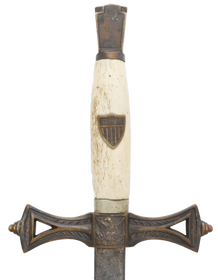
RARE/UNIQUE KEYSTONE GUARD SECRET SOCIETY SWORD C.1880. The Keystone Guard was a secret (fraternal) society established in Athens, Pennsylvania in the second half of the 19th century, the "Golden Age of Fraternalism" when such societies gained their greatest enrollment. Its creation date is stated as “roughly 1870” and the style and craftsmanship on this sword dates it to that early, 1870-80 period. It was dissolved by 1920. This sword is the only example from that organization that we have ever seen including focused research. It is made to military standard, unplated, owing to its proximity to the Civil War. Hand crafted throughout, the bone grip mounts an engraved stars and bars shield and the pommel is of the iconic key stone form. The 29 3/8” blade, otherwise unmarked, bears foliage and the owner's name with COMMANDER opposite (both faint). The copper scabbard is finely hand engraved with KEY STONE over the symbol and COMMANDER below. Additional crossed flags, serpentine and other symbols follow. The hilt and scabbard show a fine dark age storage film, easily cleaned but absolutely adding to its charm.
  • Nation : Belgian
  • Local Price : 6,200 kr
Belgian Tersen bayonet w/1868 serrated.
Page 93 of 161