
Show

Forgot your password?

Error message here!

Error message here!

Error message here!

Error message here!

Show Error message here!

Show Error message here!

Lost your password? Please enter your email address. You will receive a link to create a new password.

Error message here!

Back to log-in

Close

For Sale

The following items are listed by for sale by users of the site and dealers. They are in no way endorsed or guaranteed by www.antiquearmsresearch.com

Add a Classified Item
to

Clicking on the sword will take you through to the relevant classified item or dealer site.
Don't miss out! - Do you want to be kept informed weekly of new aditions? Just join our weekly update list.

You can also receive regular email notifcations when items match your keywords. To recieve them just register or logon at the top right of this page.
Page 95 of 158
  • Nation : American
  • Local Price : £455
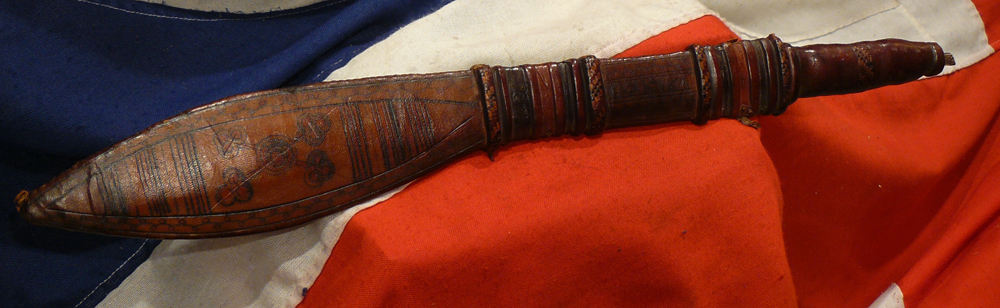
Click and use the code >17969 to search for this item on the dealer website 19th Century, Antique, Mandingo Mandinka Chief´s Slave and Gold Trader´s Sword With Tattooed-Leather Covered Wooden Scabbard
  • Nation : -
  • Local Price : £450.00 GBP
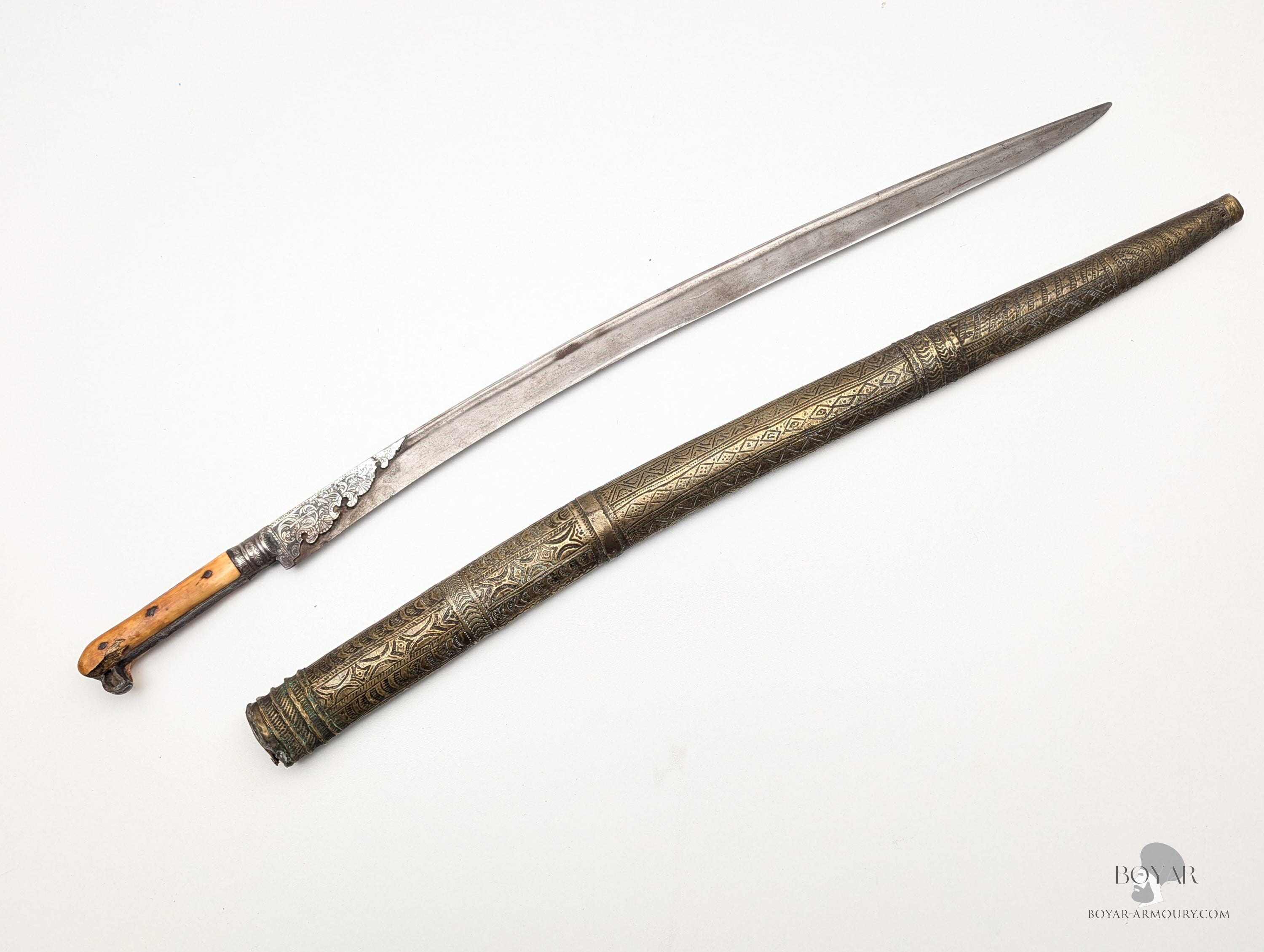
Silver Mounted Greek Yataghan. A good quality silver mounted yataghan, most likely Greek, in its brass scabbard. One side of the hilt missing part of the pommel."
  • Nation : German
  • Local Price : £450.00
Prussian M1816 Infantry Hanger / Sabre. Description Curved hanger blade with single narrow fuller running close to the spine and hatchet point. Cast brass heart-shaped hilt with short quillon and knucklebow, black leather washer, brass grip with diagonal grooves on one side and smooth on the other, round brass pommel. Black leather scabbard with inset brass frog hook and brass button chape. Blade 25 1/8 inches (64.2cm) in length past the washer, the sword 31 inches (78.7cm) overall. The blade is etched at the forte on both sides with the crown and cypher of King Friedrich Wilhelm (Frederick William). Depending on when this blade was made this would be either Friedrich Wilhelm III or IV. A small floral motif is etched below. The knucklebow is stamped with a Prussian unit mark reading &#acute;3: No. 122.28.L.R.&#acute;. The outside of the hilt is stamped with &#acute;1Y.1.6.&#acute;, which may be another unit mark. The M1816 was a near-copy of its predecessor the M1715 infantry sword. The Napoleonic Wars having finally concluded, the Prussian army chose in 1815 to adopt the French infantry saber as standard for their infantry “ the Guards regiments however preferred the old Prussian model and so new stocks were produced. The blade is of the form the English called a &#acute;hanger&#acute; although German sources consider it a sabre. Sturdy and simple to produce, these swords had a long service life, remaining in use longest as a parade weapon with the SchloÃ&159;garde-Kompanie (guards of the royal palaces) until they units were disbanded with the end of the Prussian monarchy in 1918. The blade is bright and clean with only a few tiny spots of patination and no damage to its edge. Two small spots of pitting near the etching on one side. The brass of the hilt has a light, even patina and no major dents or cracks. The leather of the scabbard has some cracking and flaking but is generally in good order, the sword sheathes and draws smoothly.
  • Nation : Swiss
  • Local Price : £450.00
Swiss M1878 Vetterli Sawback Bayonet. Description Straight spear pointed blade with sawback and false edge, with single fuller on one side, the other side completely flat. Steel hilt with upper muzzle ring & foresight notch and lower lobe quillon, beaked steel pommel with locking button and external leaf spring for the locking mechanism. Slab grips of chequered gutta percha (a form of natural rubber) secured by four steel rivets, the leaf spring running through and screwing into the centre of the grip on the fullered side. Brown leather scabbard with steel throat and chape pieces, the throat piece with frog loop, the chape piece with ball finial. Leather frog, its front side black, reverse brown. The blade is stamped at the ricasso with the manufacturer &#acute;S J G Neuhausen&#acute;, and on the hilt with the serial number &#acute;14460&#acute;. The pommel is stamped with &#acute;D&#acute; and the lobe quillon is stamped with a Swiss cross and &#acute;C&#acute;. The frog is stamped with &#acute;J. Schmid 1888&#acute;, probably its manufacture date, and the reverse is stamped with a Swiss cross and &#acute;B&#acute;. The scabbard finial is stamped with a Swiss cross. Thought to have been inspired by the British Elcho bayonet, the Swiss M1878 fitted to the 10.5mm Vetterli repeating rifle. This rifle was introduced in 1869 and originally used a socket bayonet. When the switch to a sword bayonet was ordered, the new model was designed to mount on the right side of the barrel rather than below it, like a socket bayonet, and with unusual projections from the muzzle ring that engaged with the foresight as it locked into place. Its blade is also unusual in that it is flat on one side and with a ground edge on the other. It incorporated the then-popular &#acute;sawback&#acute;, saw teeth cut into the spine of the blade intended to make it useful for field work like cutting brush. The bayonet&#acute;s length is noticeable “ when mounted the rifle and bayonet together are more than 6 feet in length. There are several successor models which used the same blade - the M1878 is the earliest version, produced for only three years, distinguishable by the four rivets used in its grip (reduced to three in the M1881). The blade is bright and clean overall, with only some very small spots of pitting towards the point on the flat side. The saw&#acute;s teeth are unbroken and do not appear heavily used. The grips are in good condition with no cracking, a couple of small chips around the rivets. No dents to the scabbard fittings. Some light dents and occasional scratches to the scabbard leather, its stitching is all intact. The black finish has rubbed on the front of the frog&#acute;s belt loop, but only where the pommel contacts it while sheathed. No retaining strap “ this is a separate leather piece that would thread through the loop on the scabbard&#acute;s throat piece and attach to the buckle on the frog. The scabbard still sits in the frog correctly but can&#acute;t be locked in place with the belt & buckle system.
  • Nation : French
  • Local Price : £450.00
French M1882 Light Cavalry Trooper&#acute;s Sword by Chatellerault, 1883. Description Straight fullered blade with spear point. Black leather washer. Brass three-bar hilt, brass oval pommel cap. Grip of black leather over wood, bound with brass wire. Steel scabbard with single band with hanging ring. The spine of the blade is engraved with &#acute;Mre d&#acute;Armes de Châtt Janvier 1883 Cavrie legere Mle 1882&#acute;, indicating that it is the Light Cavalry Model 1882, and was made at the state arsenal at Chatellerault in January 1883, during the Third Republic. The knucklebow of the hilt is stamped with the serial number &#acute;2861&#acute;, and several poinçons (punch marks). The blade is stamped at the forte on one side with three poinçons, one of a star within a triangle, another of the letter &#acute;R&#acute; within an circle and a third of the letter &#acute;B&#acute; within a circle. The upper band of the scabbard is stamped on one side with the partly legible serial number &#acute;28__&#acute;, which suggests it and the sword are probably a matching, original pair. There are a few scattered stamps on the spine of the scabbard near the throat, including the numbers &#acute;22&#acute; and &#acute;8&#acute;. Created in 1816, the Manufacture de Chatellerault, near Poitier, grew to become a key arms factory for the French state. In the 1830s it took over from the Maubeuge, Charleville and Klingenthal plants, all of these being considered too close to the German border to be relied upon in a war. During the late 19th and early 20th century production of swords at Chatellerault decreased while firearms manufacture massively increased. However, despite increasing use of machine tools and the nearing obsolescence of the sword, the blades continued to be hand-forged until 1916. Production of swords there ended in 1937. The blade is bright with only a few areas of light patination mainly in the fuller. Its unsharpened edge has only one very small nick, its tip is undamaged. The brass hilt and pommel have an even patina with a few spots of darker patination. The grip has some handling wear, the leather covering worn away in places on the ridges of the ribs, exposing the wood core. The wire binding of the grip has mostly been lost, with only two loops remaining at the pommel end. There is a split running along most of the grip, perhaps due to leather shrinkage with age or the lack of wire binding to hold the leather in place. This gap has been filled in with a hard black material matching the black leather. The scabbard is free of dents but is pitted overall, most heavily at the chape end.
  • Nation : Swiss
  • Local Price : £450.00
Swiss m1878 Pioneer Sword. A Swiss Model 1878 Pioneer short sword by Gerbrueder Weyersberg SolingenThe steel sawbacked blade has a fuller on one side of the blade, the front is marked with makers name and Swiss cross and the reverse has the serial number 1349 and the date the date 1883. The handle has black chequered grips secured by 5 brass rivets, brass pommel cap and crossguardIt measures 25" overall with a 19" blade. A scarce Swiss sword in Excellent condition
  • Nation : Japanese
  • Local Price : £450.00
Japanese Model 1899 Type 32 Army NCO Sword. Otsu. #2509011. The Type 32 (Model 1899) had a machined blade and was manufactured at the Tokyo Hohei Kosho Arsenal. The sword saw service during the Russo-Japanese War (1904-1905), World War One (1914-1918) and on into World War Two (1939-1945).Two patterns of the Type 32 were produced. The first pattern, known as ‘Ko,’ was issued to cavalry troopers and had a blade length of around 830mm. The second pattern, known as ‘Otsu,’ was issued to army NCOs and was shorter, with a blade length of around 770mm. This example is an ‘Otsu’ pattern Type 32 infantry NCO’s sword. The 770mm Katana profile blade has a single edge and long, narrow fuller below the flat spine. The slightly curved blade is in good condition with sharpening scratches along the cutting edge. The ricasso is stamped with the serial number 102629.The steel D guard has a crosshatched steel back strap and dove head pommel. The hilt retains its original finish. The crosshatched wooden grip is in good condition. The locking catch is incomplete. The front of the guard bears Tokyo arsenal and inspection stamps.The sword is complete with its blackened steel scabbard with a single hanger-ring. The scabbard is in very good condition. The shoe of the scabbard bears the serial number 102921. The sword sheathes and draws smoothly and is held firmly within the scabbard. This is an increasingly hard to find Imperial Japanese army NCO’s Type 32 sword in good, honest condition.
  • Nation : Swiss
  • Local Price : £450.00
Swiss 1842 Pattern Sawback Pioneer’s Sidearm, Dated 1891 by Wester & Co., Solingen. Description Straight double-edged blade with sawback. Ribbed solid brass hilt with cross guard and oval pommel. Scabbard of black leather-covered wood with brass fittings at throat and chape. Maker&#acute;s marked to the ricasso with &#acute;Wester & Co Solingen&#acute; and on the opposite face stamped with the serial number &#acute;21964&#acute; and date of manufacture &#acute;1891&#acute;. Sidearms with the form of a neoclassical &#acute;gladius&#acute; appear to have originated with the French 1771 &#acute;Eagle Head&#acute; Artillery sword. A series of very similar-looking short swords were subsequently designed, including the French 1816 & 1831 Artillery, the US Model 1832 Foot Artillery, the Swiss 1842 Pioneer&#acute;s, the Russian 1848 Pioneer&#acute;s and the British 1855 Land Transport. While durable and simple to manufacture, they were not particularly useful for combat (the gladius having become obsolete for good reasons) so remained either ceremonial items or in the role of a machete for various field tasks such as clearing brush. Blades with a saw-toothed back were also tried during this same period in an attempt to add functionality as a tool, such as on the British 1871 and 1879 pattern bayonets for the Martini-Henry rifle, and the Pioneer&#acute;s swords of various nations. Such attempts were generally considered failures, as a sawblade needs to be much narrower and longer than a short sword or bayonet to cut efficiently, and the soldiers had trouble sharpening the saw after use. This model combines both fanciful features in one. Blade is mint. Leather washer is present and intact, the leather of the scabbard has minor scuffing consistent with age. The scabbard&#acute;s frog hook is very slightly bent, still intact and usable.
Page 95 of 158