
Show

Forgot your password?

Error message here!

Error message here!

Error message here!

Error message here!

Show Error message here!

Show Error message here!

Lost your password? Please enter your email address. You will receive a link to create a new password.

Error message here!

Back to log-in

Close

For Sale

The following items are listed by for sale by users of the site and dealers. They are in no way endorsed or guaranteed by www.antiquearmsresearch.com

Add a Classified Item
to

Clicking on the sword will take you through to the relevant classified item or dealer site.
Don't miss out! - Do you want to be kept informed weekly of new aditions? Just join our weekly update list.

You can also receive regular email notifcations when items match your keywords. To recieve them just register or logon at the top right of this page.
Page 13 of 111
  • Nation : British
  • Local Price : £3300.00
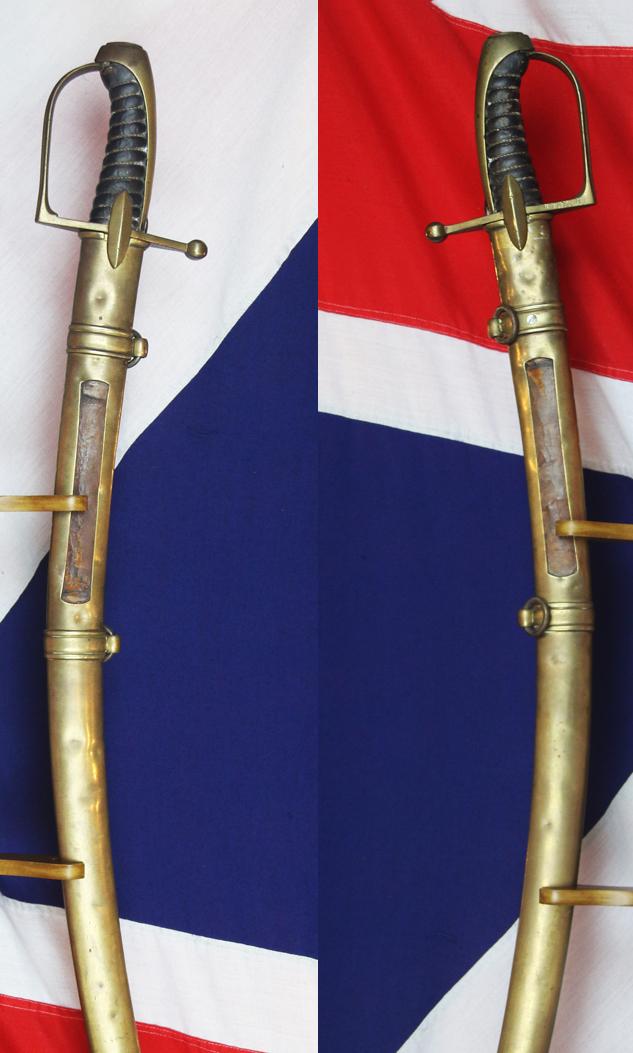
A French Hussar's Light Cavalry Officer's Heavy Grade Sabre, Sabre de Hussard, Late 18th/Early 19th Century Ist Empire Pattern. From the former P.T.Norheim Collection of Finest French Arms A strong robust brass hilt (old bruising in places) with ovoidal langets, rear quillon with faceted button terminal, knuckle-guard with medial ridge, pommel and back-piece in one, and wire-bound leather-covered grip, With curved fullered blade double-edged towards the point and with Coulaux Freres Klingenthal manufactory details along the back at the forte, in original brass scabbard (with some old denting, predominantly up from the chape) lined in brown leather and open along each side at the top, steel shoe, and two rings for suspension 33.75 inch. blade. The word “hussar” identifies the light horsemen and comes from the Hungarian “huszar”. The most famous hussar units were the French regiments of the Napoleonic era. They were employed for scouting and communication purposes, and to screen the movement of the Emperor's corps, like during the advance that allowed the French to flank the Austrian general Mack at Ulm in 1805. The hussars, such as of the 1st Hussars employed at Jena in 1806, are characterized by the ornate Hungarian style uniform, sabretache, sabre and carbine. The hussars also played a prominent role as cavalry in the Napoleonic Wars (1803–1815), serving in campaigns in Austria (1804 & 1809), Prussia (1805 -1806), Poland (1806), Spain (1809 - 1813), Germany (1812), France (1814 - 1815), and Belgium (1815) before being disbanded by the Bourbon Restoration. As light cavalrymen mounted on fast horses, they would be used to fight skirmish battles and for scouting. Most of the great European powers raised hussar regiments. The armies of France, Austria, Prussia, and Russia had included hussar regiments since the mid-18th century. In the case of Britain, four light dragoon regiments were converted to hussars in 1806–1807. Hussars gained notoriety in the Grande Armée after the invasion of Egypt. At the Battle of Salalieh in August 1798, brigade commander Antoine Charles Louis de Lasalle fought "like a demon" and solidified his reputation as a maverick rider upon returning to France and receiving Weapons of Honour. At the ceremony (in a remark often mistakenly attributed to Napoleon), Lasalle quipped "Any hussar who isn't dead at age 30 is a layabout." The hussars of Napoleon's army created the tradition of sabrage, the opening of a champagne bottle with a sabre. Moustaches were universally worn by Napoleonic period hussars, the British hussars were the only moustachioed troops in the British Army – leading to occasional taunts of "foreigner" from their brothers-in-arms. French hussars also wore cadenettes, braids of hair hanging to either side of the face, until the practice was officially proscribed when shorter hair became universal. This sabre is from a private collection of one of the foremost experts and authors of swords in Scandinavia, and chairman of the the Norwegian Weapons Historical Society A famous military commander in Bonaparte's army who began his military career as a hussar was Marshal Ney, who after being employed as a clerk in an iron works joined the 5th Hussars in 1787. He rose through the ranks of the hussars in the wars of Belgium and the Rhineland (1794–1798) fighting against the forces of Austria and Prussia before receiving his marshal's baton in 1804 after the Emperor Napoleon's coronation. On the French Revolution, it was numbered as the 5th Hussar Regiment during the army reorganisation of 1 January 1791, as the fifth oldest cavalry unit in the French army, before being promoted to 4th Hussar Regiment in 1793 after the previous holder of that title. In 1814, just before the fall of the First French Empire, it was renamed the régiment des hussards de Monsieur, though it resumed the title of 4th Hussar Regiment during the Hundred Days before being disbanded on the Bourbon Restoration which followed. After Napoleon returned from exile and invaded Belgium, the 4th Hussar Regiment would enter combat at the final battles of Ligny, and Waterloo, in which Napoleon would be defeated.
  • Nation : British
  • Local Price : £3,250.00
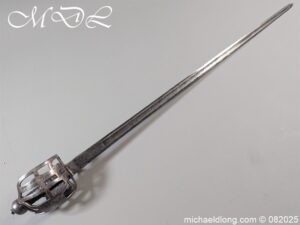
English Dragoon Basket Hilted Sword c 1740. English Dragoon Basket Hilted Sword c 1740 good solid basket with dome pommel and raised tang button, the grip leather bound secured with turks heads top and bottom. The basket is engraved with 1 over 8 however other marks seem to have be removed which may indicate a battle field pick up please see images. The blade single edged with double fullers again with stamps which have been obscured near the hilt. Overall length 42 inch the blade 36 inch for reference please see British Basket Hilted Swords by Mazansky pages 94 and 95
  • Nation : British
  • Local Price : £3250
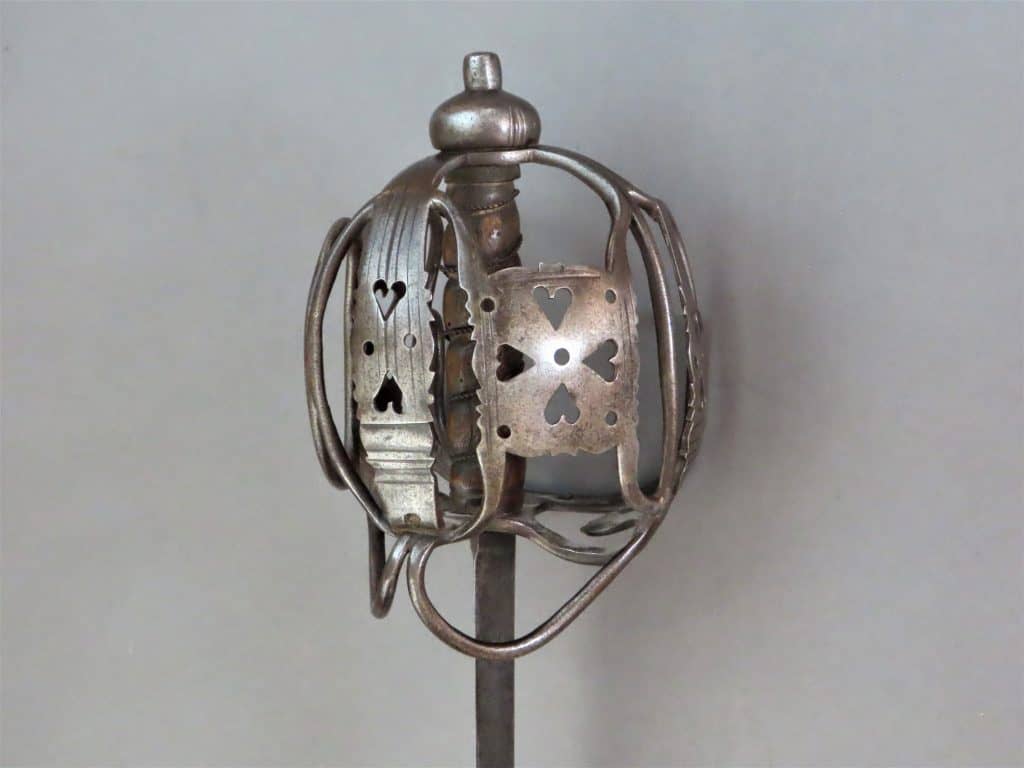
Mid-18th Century British Dragoon Basket Hilted Sword. An impressive example of a horseman's basket hilted back sword made for an Officer, or Trooper, of a North British / Scottish Regiment of Dragoons towards the middle and third quarter of the 18th century. These swords were issued by the Board of Ordnance to British regiments and were manufactured in the Scottish manner. They were first issued in the second quarter of the 18th century and were used during the Jacobite Rebellion of 1745, Britain’s wars in Europe and the American Revolutionary War. The sword is a rare example of one that retains its remarkable full length blade of 38 inches (just over 96 cm) designed mainly for striking downwards at opposing infantry soldiers with greater reach than the more usual blade lengths of the time could afford. Although many swords of this type are mounted with blades of shorter length, the majority of those that were originally made with this longest type were cut down during the working lives of the swords. This is a rare survivor with its metal parts in extremely well preserved and undamaged condition as visible in the photographs. The fully formed basket is pierced with flanged hearts and circles in the main front and side panel guards which are also finely fretted at the edges with chevrons and merlons. One of the more usual frontal guard plates has been replaced in the hilt design with an oval ring in the “horseman” fashion. The arms of the guard are forged onto a circle of iron into which the base of the bun shaped pommel sits. The pronounced button is integral with the pommel and not of separate manufacture. The original spirally fluted grip is of hardwood and has its shagreen cover but retains its wire binding. The robust single-edged blade has a thick spine and is double edged for the last 17.5 inches (44.25 cm) towards the point. It has a short ricasso and two fullers which commence 4.25 inches from the hilt. One wide broad fuller runs down the middle of the blade to the point and a second narrower fuller runs just underneath the spine to where the blade becomes double edged. Overall the sword is in fine and original condition. For a further example of this sword type see Cyril Mazansky, British Basket-Hilted Swords, Boydell Press / Royal Armouries, 2005, plate F1e page 97 for a sword in the National Museums of Scotland, collection reference LA33.
  • Nation : French
  • Local Price : £3,250.00
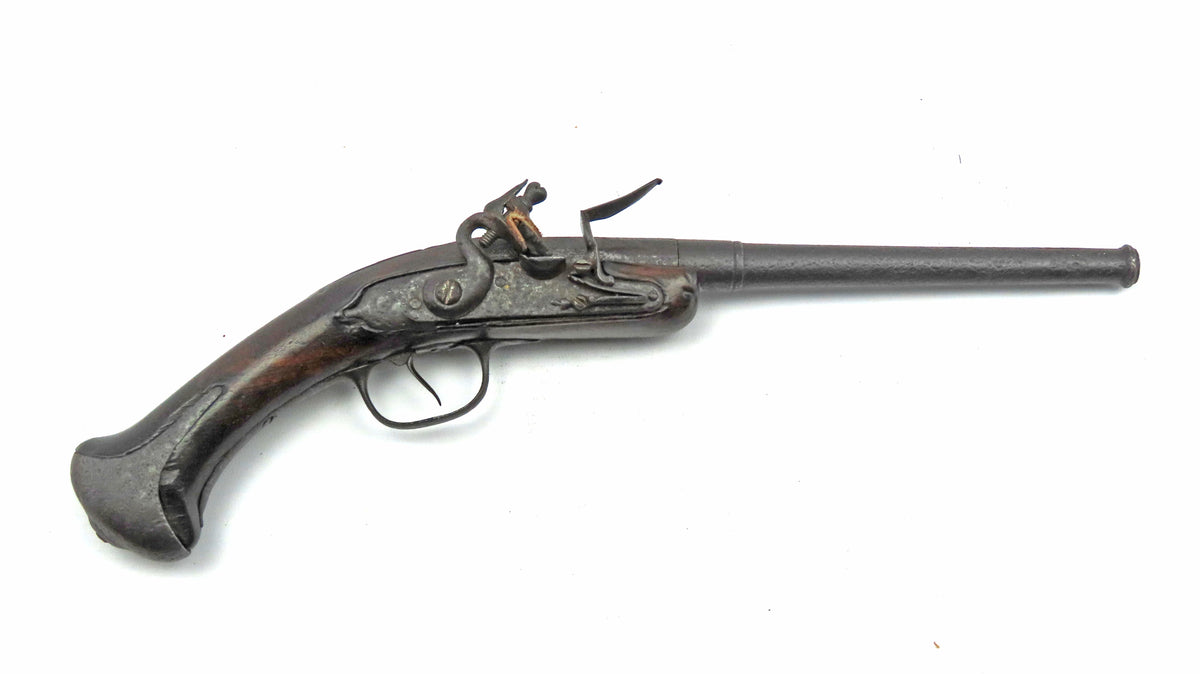
French Flintlock Long Barrelled Rifled Pistol. Ref X3391. A French&194;&160;Flintlock Long Barrelled Rifled Pistol. 15 &194;&190;&157; overall, 6 &194;&190;&157; 70 bore turn off rifled three stage cannon barrel, plain octagonal breech and tang, rounded bevelled &194;&160;cock, figured half stock with apron around the barrel tang. Iron mounts comprising sideplate, spurred pommel of flattened ovoidal form, and trigger guard. Circa 1670 Rare early pistol in aged condition, old rusting to metal parts, stock with chips and a split. &194;&160; &194;&160; &194;&160; &194;&160; &194;&160; &194;&160; &194;&160; &194;&160; &194;&160; &194;&160; &194;&160; &194;&160; &194;&160; &194;&160; &194;&160; &194;&160; &194;&160; &194;&160; &194;&160; &194;&160; &194;&160; &194;&160; &194;&160; &194;&160; &194;&160; &194;&160; &194;&160; &194;&160; &194;&160; &194;&160; &194;&160; &194;&160; &194;&160; &194;&160; &194;&160; &194;&160; &194;&160; &194;&160; &194;&160; &194;&160; &194;&160; &194;&160; &194;&160; &194;&160; &194;&160; &194;&160; &194;&160; &194;&160; &194;&160; &194;&160; &194;&160; &194;&160; &194;&160; &194;&160; &194;&160; &194;&160; &194;&160; &194;&160; &194;&160; &194;&160; &194;&160; &194;&160; &194;&160; &194;&160; &194;&160; &194;&160; &194;&160; &194;&160; &194;&160; &194;&160; &194;&160; &194;&160; &194;&160; &194;&160; &194;&160; &194;&160; &194;&160; &194;&160; &194;&160; &194;&160; &194;&160; &194;&160; &194;&160; &194;&160; &194;&160; &194;&160; &194;&160; &194;&160; &194;&160; &194;&160; &194;&160; &194;&160; &194;&160; &194;&160; &194;&160; &194;&160; &194;&160; &194;&160; Images courtesy of West Street Antiques (https://antiquearmsandarmour.com/)
  • Nation : British
  • Local Price : £3,250.00
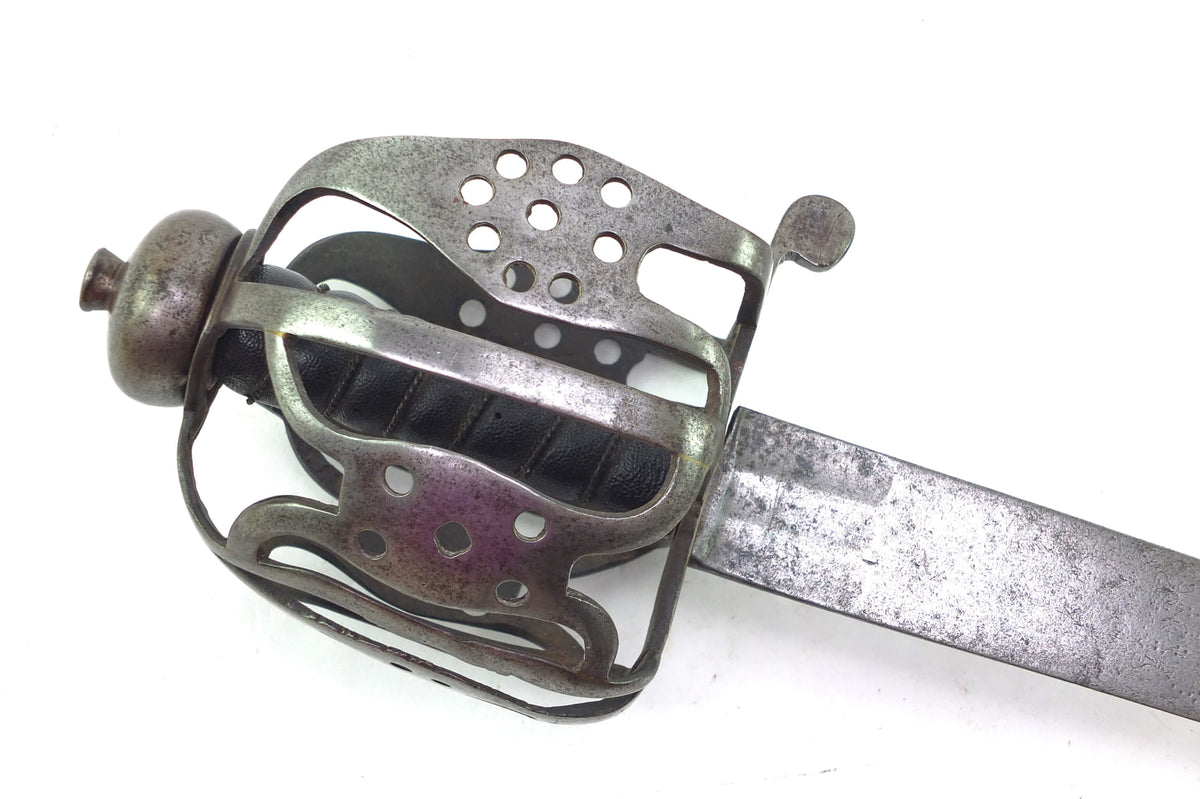
Basket Hilted Sword Royal Horseguards, rare. Ref 9215. A Rare Royal Horseguards Basket Hilted Sword. 41&157; overall, 35 1/2&157; broad blade with twin fullers with GR crown to one side and ´Harvey´ engraved on the other. Basket hilt welded from pierced panels and straps, bun shaped pommel, leather grip with twisted wire. No scabbard Circa 1755&194;&160; An attractive large sword in good condition, blade engraving faint.&194;&160;&194;&160; Provenance Robert E Brooker Jr Collection author of British Military Pistols 1603-1888.&194;&160; Images courtesy of West Street Antiques (https://antiquearmsandarmour.com/)
  • Nation : British
  • Local Price : £3250
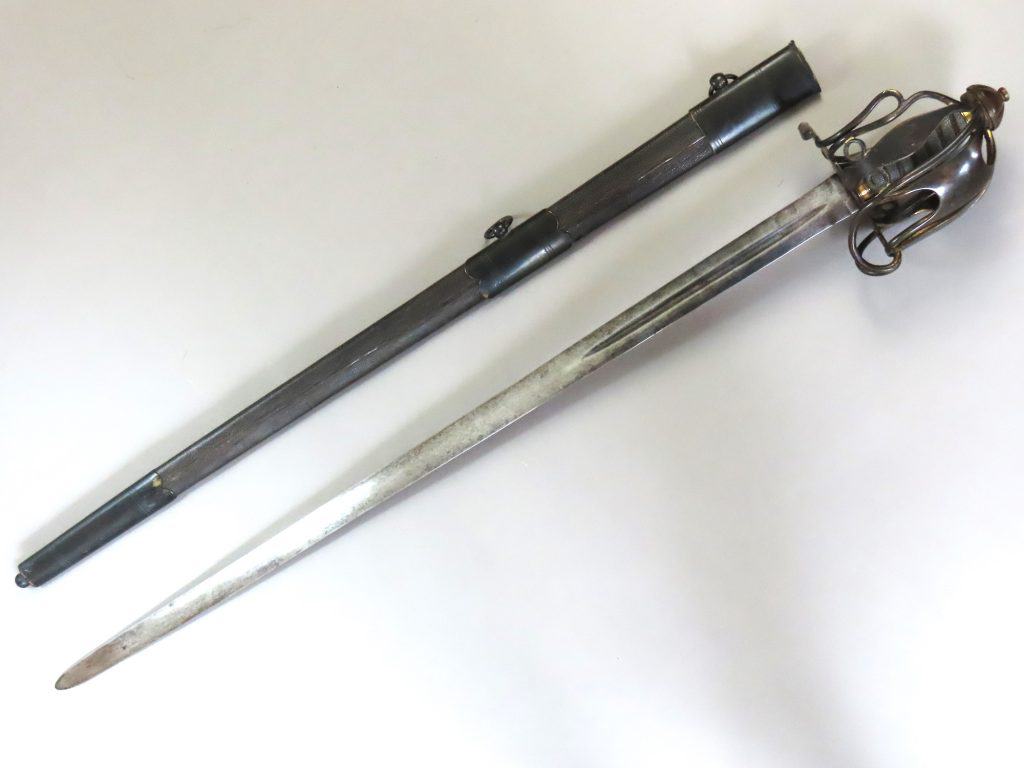
Fine 1798 Pattern Scottish Highland Infantry Officers’ Sword with Original Scabbard. A fine example of the distinctive basket hilted sword introduced for Scottish Infantry officers in Highland Regiments in 1798. It was replaced by the regulation steel basket hilt 1828 pattern three decades later. The sword type was used throughout the Napoleonic War period. This sword is in fine original uncleaned condition and retains its scabbard. The bronze hilt and scabbard mounts were once covered with a gilt finish much of which has now worn away or is hidden under the patina. An inscription on the knucklebow reads “UNION LODGE NO 555 Carlisle”. It would seem that at some time the sword was gifted to the Masonic Lodge in Carlisle. Carlisle is an English town near the Scottish border. The hilts of these swords were most usually made of gilt copper, bronze or brass. The hilt of this sword is of gilt bronze and made of rounded bars and flattened plates in the usual manner with forward loop guards and a swollen solid wrist guard terminal extending from the rear quillon. The upper terminals of the guard arms are fixed onto a ring inside which the stem of the mushroom shaped pommel is fitted. The pommel is dome-shaped with a large separate waisted pommel button on top from which four sets of decorative grooves flanked by narrower lines radiate to the pommel edge. The double-edged gently tapering blade is 32.75 inches (83 cm) long and in fine condition. Typically it is of lenticular section with a short ricasso. A central fuller commences a short distance from the hilt on each side and is 9 inches (23 cm) long. The blade is unmarked and probably a German import which was the norm for this sword type and most probably of Solingen manufacture. The grip is of spirally grooved wood covered with shagreen held in place with thin ropes of twisted copper wire flanked with plainer thinner wire now coloured with age. It is mounted with gilt bronze ferrules top and bottom which are incised with decorative lines. The scabbard is in fine condition made with a wooden core covered with granulated leather stitched along the middle on one side. The mouthpiece and middle band retain their ring carrying mounts. The chape has a knopped terminal. For other examples of the 1798 type see: Harvey J S Withers, “The Scottish Sword 1600-1945”, Paladin Press, 2009, pages 13 to 151 and Cyril Mazansky, “British Basket-Hilted Swords”, Boydell Press, 2005, pages 131 to 133.
  • Nation : British
  • Local Price : £4,500.00
A Brass Barrelled Flintlock Blunderbuss by H.W. Mortimer, London, Circa 1780.. A Brass Barrelled Flintlock Blunderbuss by H.W. Mortimer, London, Circa 1780. With belled brass barrel, engraved ‘HAPPY IS HE THAT ESCAPES ME’ around the muzzle, and engraved ‘H.W. MORTIMER LONDON, GUN MAKER TO HIS MAJESTY’ along the top flat and stamped with London proofs and Mortimers barrel smith mark, steel tang fitted with bayonet release catch, stepped bevelled lock signed ‘H.W. MORTIMER’ fitted with sliding safety catch and decorated with foliage, full-stocked in walnut, brass mounts comprising engraved brass escutcheon, engraved butt plate and three-screw side-plate engraved with martial trophy, and trigger guard with pineapple finial, and brass ramrod pipes with horn tipped ramrod (some damage to head). MORTIMER Harvey Walklate Son of Samuel Mortimer, born 1753. Apprenticed to father, 1772; free of Farriers Co., 1782; elected Assistant, 1807. Gunmaker, at Mr Greens ironmonger, 6 Kings Street., Lincolns Inn Fields, 1779; 89 Fleet Street., 1782-99. Appointed Gunmaker to George III, 1783. Contractor to East India Co., 1796-1806. Specialised in repeating pistols and gold mounted guns for the Eastern market. Advertised For the Inspection of the Curious, just finished, Three pair of Elegant Pistols, mounted in solid gold value 547 intended as a present to a foreign Prince, 1784 (Morning Herald, 20 August). Registered mark as small worker at Goldsmiths Hall, 1798. Made gold-mounted firearms set with diamonds for the U.S. Government as present for Bey of Tunis, 1801-2. Member of Law Association Volunteers, provided their muskets, 1803. His own musket in Inns of Court Museum, London. Became H. W. Mortimer, Son & T. Mortimer. Retired, 1811. Died 1819. Howard L. Blackmore (1986) Gunmakers Of London, 1350-1850. George Shumway Publisher. Dimensions: Bore: N/A Barrel Length: 14 Inches (35.56 cm) Overall Length: 29.5 Inches (74.93 cm)
  • Nation : British
  • Local Price : 4,500.00 USD
AN EXTREMELY RARE SCOTTISH PLUG BAYONET C.1690. This example, with 9" blade, belongs to a group of daggers with similar blades and guards, decorated in silver as is this one, many of which bear Jacobite mottos. They have spatulate profile reeded bog oak grips. A very few, as this one are mounted as plug bayonets. The hilt is darkly grained bog oak with a silver ferrule and silver flower head disk at the top. The Jacobite Rebellion came at a time when the plug bayonet had reached its greatest popularity and this is the Scottish separatists rendition. Provenance: J. F. R. Winsbury Collection
Page 13 of 111