
Show

Forgot your password?

Error message here!

Error message here!

Error message here!

Error message here!

Show Error message here!

Show Error message here!

Lost your password? Please enter your email address. You will receive a link to create a new password.

Error message here!

Back to log-in

Close

For Sale

The following items are listed by for sale by users of the site and dealers. They are in no way endorsed or guaranteed by www.antiquearmsresearch.com

Add a Classified Item
to

Clicking on the sword will take you through to the relevant classified item or dealer site.
Don't miss out! - Do you want to be kept informed weekly of new aditions? Just join our weekly update list.

You can also receive regular email notifcations when items match your keywords. To recieve them just register or logon at the top right of this page.
Page 1 of 155
  • Nation : East India Company
  • Local Price : £38995.00
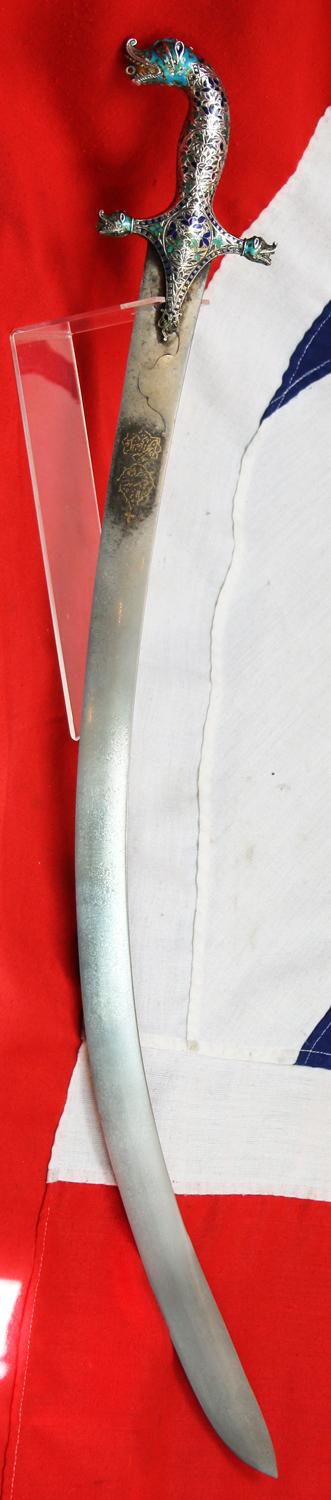
Fabulous Museum Grade Sword 18th Century Damascus Wootz Steel, Mohammed's Ladder Pattern, & Stunning Solid Silver & Enamel Makara Hilt, The 'Palace of the Nawab of Lucknow’. Probably One of The Most Beautiful & Finest Indian Princely Royal Swords. This fabulous royal grade solid silver and enamel sword, with Lucknow distinctive enamel work of flowering plants interspersed with architectural vignettes, has just returned from a museum grade blade polish to reveal its obscured {through natural age} finest, crucible steel wootz Damascus blade, in the pattern of Mohammed's Ladder. Unsurprisingly, it now looks as fine and beautiful as it was when last used in the 18th & 19th century by such as the King of Oudh {Lucknow} Ghasi-ud-din, Haidar Shah The ‘Mohammed’s Ladder’ Kirk Narduban Crucible ‘Wootz Damascus’ steel blade is truly breathtaking. The Ladder of Mohammed is said to have enabled Mohammed to travel through the heavens, meeting various prophets and gaining access to the different levels of paradise. Muhammad's ladder thus symbolizes the connection between the terrestrial and spiritual worlds, representing spiritual elevation and proximity to God. Which ultimately means, to many, this is the most desirable and likely rarest of all the early Indo-Persian crucible wootz Damascus steel blade designs, being of such a spiritual significance, as well as stunningly beautiful. Intriguingly it is still contentious, to specialist academics, as to how it was even made, as there is no clear agreed evidence or knowledge as to its extraordinary construction. There are two trains of thought but no undeniable agreement.. The museum grade conservation polish goes up to the gold cartouche, at the base of the hilt, and around the hilt langets. The small area of the gold cartouche has been left ‘as is’ intentionally. The potential very high risk of damage being created to the gold calligraphy by attempting to polish within the gold seal would be extremely dangerous to its integrity. It is only responsible to not take any even remote chance of damage to this fabulous and historical rare treasure. A near identical pair to our sword, is another magnificent and rare example, Makara enamel hilted crucible steel bladed sword, is an exhibit in the world renown Getty Museum Collection in America {see a photo of the pair together side by side by comparison in the gallery}. Occasionally, surviving Lucknow swords of the silver and enamel Goat Head pattern can be found, used by lesser nobles of the Shah's court, but the mythical Makara silver and enamel hilted swords, apparently, were reserved for the Shah's sole and personal use, especially with the Mohommed's ladder blade. A magnificent work of art, and the sword of a prince or king. It has a fabulous vibrant hues of brilliant blue and green through a painstaking champlevé and basse-taille enameling process. This process involves fusing coloured glass to metal at extraordinarily high temperatures to create a striking and durable outer layer that can withstand the test of time. This distinctive usage of blues and greens on the piece reinforces its origins in Lucknow, a renowned centre for the production of such sophisticated enamel artifacts. The fabulous wootz Mahommed's Ladder Kirk Narduban pattern Damascus blade, with a gold inscription and gold cartouches. In very good condition for age, the polychrome enamels are inlaid into the solid silver hilt, that is further decorated with three heads of the mythical beast, the Makara, including the pommel and both quillon ends, with just very minor enamel surface losses. One of the finest Lucknow Damascus swords you could find today, from the one time rulers of Lucknow, and most likely originated from the palace of the Nawab of Lucknow. A Nawab was a Sovereign Prince and Governor of the Moghul Empire. An almost identical princely form of Lucknow Makara enamel silver hilted sword is in the Getty Research Institute, in LA, California. Centuries ago Lucknow emerged as one of the most important centres in the world for courtly crafts such as fine enamelling on silver. It was the capital of the state of Oudh which was established in 1750. The flourishing arts scene was largely on account of the patronage of the local, supremely wealthy Nawabs of Oudh. By the mid-19th century, Lucknow was India's largest and wealthiest city. Lucknow Moghul daggers and swords, especially with Damascus blades, are considered to be some of the most valuable and desirable in the world of antique weaponry art. Representations of such are in the finest collections, such as the British Royal Collection, The British Museum and the Getty Museum. The mythical Makara; Dwelling in the Indian Ocean, the Makara is traditionally looked upon as a powerful deity, which was capable of harming or guarding seafarers, depending upon its whims. Many scholars naturally assume that the tales of the Makara are nothing more than myths based upon ancient eyewitness accounts of Indian elephants swimming off the coast of India, as they are sometimes known to do. Until 1719, the subah of Awadh was a province of the Mughal Empire administered by a Governor appointed by the Emperor. Persian adventurer Saadat Khan, also known as Burhan-ul-Mulk, was appointed Nizam of Awadh in 1722 and established his court in Faizabad, near Lucknow. Many independent kingdoms, such as Awadh, were established as the Mughal Empire disintegrated. The third Nawab, Shuja-ud-Daula (r. 1753-1775), fell out with the British after aiding the fugitive Nawab of Bengal, Mir Qasim. Roundly defeated at the Battle of Buxar by the East India Company, he was forced to pay heavy penalties and surrender parts of his territory. Awadh's capital, Lucknow rose to prominence when Asaf-ud-Daula, the fourth Nawab, shifted his court to the city from Faizabad in 1775. The British East India Company appointed a resident (ambassador) in 1773 and by early 19th century gained control of more territory and authority in the state. They were, however, disinclined to capture Awadh outright and come face to face with the Maratha Empire and the remnants of the Mughal Empire. In 1798, the fifth Nawab Wazir Ali Khan alienated both his people and the British and was forced to abdicate. The British then helped Saadat Ali Khan take the throne. He became a puppet king, and in a treaty of 1801, yielded large part of Awadh to the East India Company while also agreeing to disband his own troops in favour of a hugely expensive, British-controlled army. This treaty effectively made the state of Awadh a vassal of the East India Company, although it continued to be part of the Mughal Empire in name until 1819. The treaty of 1801 proved a beneficial arrangement for the East India Company as they gained access to Awadh's vast treasuries, repeatedly digging into them for loans at reduced rates. In addition, the revenues from running Awadh's armed forces brought them useful returns while the territory acted as a buffer state. The Nawabs were ceremonial kings, busy with pomp and show. By the mid-nineteenth century, however, the British had grown impatient with the arrangement and demanded direct control over Awadh. In 1856 the East India Company first moved its troops to the border, then annexed the state for alleged maladministration. Awadh was placed under a chief commissioner Sir Henry Lawrence. Wajid Ali Shah, the then Nawab, was imprisoned, then exiled by the East India Company to Calcutta. In the subsequent Indian Rebellion of 1857, his 14-year-old son Birjis Qadra, whose mother was Begum Hazrat Mahal, was crowned ruler. Following the rebellion's defeat, Begum Hazrat Mahal and other rebel leaders sought asylum in Nepal. Ghazi-ud-Din Haidar Shah became Nawab Wazir of Oudh on 11 July 1814 after the death of his father. In 1818, under the influence of Warren Hastings, the British Governor of the Presidency of Fort William (Bengal), he declared himself as the independent Padshah-i-Awadh (King of Oudh). This sword would likely have been part of his treasure. The story of the the wonders of the creating of these blade goes back at least 2400 years. The possibly first indirect reference to crucible steel appears in the writing of Ctesias of Cnidu, a Greek physician at the court of the Persian King Artaxerxes II (404 BC - 398/397 BC) he wrote several (lost) books about Persia and India. St. Photios the Great (Ecumenical Patriarch of Constantinople from 858 to 867 and from 877 to 886) quoted from Ctesias books in the 9th century AD or about 1300 years later. From this we know of two wonderful if not magical swords of (maybe) Indian iron that Artaxerxes gave to Ctesias. Going back 1700 years. Such as was written by Zosimos (a. 350 AD - ca. 420 AD) who was born in Panoplis (present-day Akhmim in the south of Egypt). He worked as an early alchemist in Alexandria and has written in fine detail. Some of his writings have survived. As far as crucible steel is concerned, he states: "The tempering of Indian Iron: Take 4 pounds of soft iron, and the skins of myrobalans, called elileg, 15 parts; belileg, 4 parts; and two parts of glassmakers magnesia. Then place it into a crucible amd make it level. .... Put on the charcoal and blow the fire until the iron becomes molten and the ingredients become united with it. ... Such is the premier and royal operation, which is practiced today and by means of which they make marvellous swords. It was discovered by the Indians and exploited by the Persians". Two paintings in the gallery {for historical information only}; 1} Ghasi-ud-din, Haidar Shah Nawab of Oudh (in power from 1814 to 1818), and was subsequently made the first King of Oudh (1818-27). Its possible he may be holding this sword when he sat for this portrait in 1818 2} The Procession of Ghazi ud-Din Haider Shah through Lucknow No scabbard.
  • Nation : British
  • Local Price : £36950.00
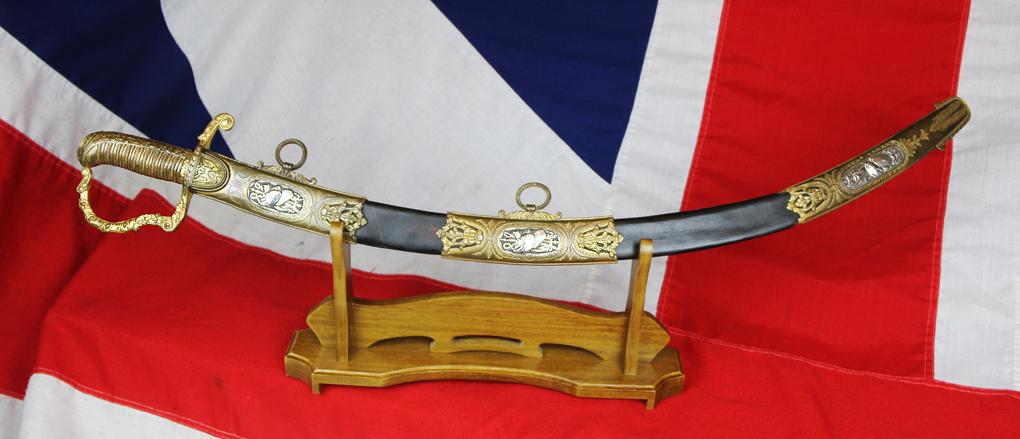
Most Incredible & Finest Quality King George IIIrd Napoleonic Wars Scottish Presentation Sword, Presented In The Months Following the Battle of Trafalgar The Regiment of Midlothian Infantry, East Midlothian, By the Officer's & Men of The New Battle Co.. This is a magnificent ‘royal grade’ museum piece, a sublime quality presentation sword, made with the finest copper-gilt mounts, silver panels, and a stunning blue and gilt blade with deluxe engraving and etched presentation panel. A sword of the highest rank, commissioned to be hand made by Mr Phillip Rundell & Mr George Bridge, partners of their company of personal goldsmiths to King George IIIrd, and one of the worlds finest makers of objects of magnificence, including the British Crown Jewels, universally recognised as the finest, and most valuable by far, suite of royal regalia in the world. Formerly in the world famous Smithsonian Collection in Washington, America, sold by them over 25 years ago to raise an urgent need of funds. In the days it was commissioned it would have been made for the equivalent and likely same cost of the £100 Lloyds Patriotic Fund Presentation Swords, that were presented to the heroes of the Royal Navy, such as that fought at Trafalger etc. Bearing in mind the value of £100 in 1806 was a simply remarkable sum, for example only 6% of the families in Britain had a total income of £100 in an entire year in 1806, an equivalent today of around £80,000. Presentation inscription motto etched onto the blade reads; ‘Into whose hand this sword is put, It’s hop’t will not fear Buonaparte, So draw me out I shine so clear and if I strike my foes may fear” This fabulous sword, was made by Philip Rundell and George Bridge whose company later made The British Imperial State Crown, the most famous and important royal crown of state ever made, and last used by her Majesty Queen Elizabeth II for her coronation in 1953. This wondrous sword was formerly from the Smithsonian Collection in Washington, and is remarkably similar to the most valuable and highest quality presentation British swords of the Napoleonic Wars, the Lloyds Patriotic Fund sabres, that today can fetch up to £220,000, considerably more than they were achieving 40 years ago when we sold a fine £100 pound Lloyds sword, and even 20 years ago when we sold our last Lloyds £100 pound sword. This sword's makers were King George IIIrds personal goldsmiths, and made the Irish Crown Jewels in 1830, and Queen Victoria's Imperial State Crown " expressly made for the solemnity of the Coronation" That was last used by Her Majesty Queen Elizabeth IInd for her coronation. This spectacular sword is inscribed that its bearer should fight Napoleon Bonaparte without fear, but his foes The French will fear its startling brightness and beauty. It has a sharply curved blade, decorated with stands of arms, a crowned GR cypher, the king's Royal arms, a figure of Britannia, and the motto see photo in the gallery and another further Scottish regimental presentation panel on the opposing side of the blade see photo. The dedication reads; Presented by the New battle company of The Eastern Regt. of Midlothian Volunteer Infantry, to David Wight Esq, their Captain as a Mark of their Regard and Esteem, 1806 It has a superbly detailed classically styled stirrup hilt decorated with acanthus scrolls, oak leaves and acorns, with the langets decorated with stands of arms, it has a copper gilt simulated wire and ribbon bound grip, contained in its ornately mounted silver and copper gilt leather scabbard, each mount finely engraved and decorated with acanthus leaf bouquets and featuring a central oval silver plaque decorated with stands of arms, the upper mount with maker's panel. This amazing sword was formerly in the collection of the Smithsonian in Washington, USA, bequeathed to them by a famed American collector of Napoleonic arms, which they sold for the benefit of the Smithsonian's funds over 25 years ago. Blade 75 cm approx. Maker marked by Philip Rundell and George Bridge of London. The firm was appointed as one of the goldsmiths and jewellers to the king in 1797 and Principal Royal Goldsmiths & Jewellers in 1804, and the firm held the Royal Warrant until 1843. They served four monarchs: George III, George IV, William IV and Victoria. After the Congress of Vienna (1814–1815), the firm prepared 22 snuff-boxes to a value of 1000 guineas each to be given as diplomatic gifts. In 1830–1831, the firm created the Irish Crown Jewels from 394 precious stones taken from the English Crown Jewels of Queen Charlotte and the Order of the Bath star of her husband George III, and Queen Victoria's Imperial State Crown for her coronation. Despite the incredible success of the Battle of Trafalgar, and the routing of Napoleon’s French and Spanish fleet by Admiral Nelson, concern was still great amongst the people of Britain, in fact it was never greater, of the fear that Bonaparte would continue his efforts to confound and attempt to conquer Britain and its empire, and thus to create his own empire controlling all of Europe And Russia. Rundells quality of workmanship was so fine and renowned throughout the world that there are over 100 items by Rundells in the Royal collection alone. This wonderful sword was obviously worn with pride by its recipient officer, thus the blade shows commensurate signs of light surface wear as to be expected. We can, if required, commission a contemporary, bespoke glazed & framed display cabinet made by our local specialist artisan. Perfectly suitable for table or wall mounting. With several options of wood framing types, such as gilt, black or silver, also with coloured velvet backing options, and a suitably engraved brass plaque if required. The scabbard has a blank silver panel on the inner throat mount that could have been presentation engraved but hasn't been
  • Nation : German
  • Local Price : 35000.00 USD
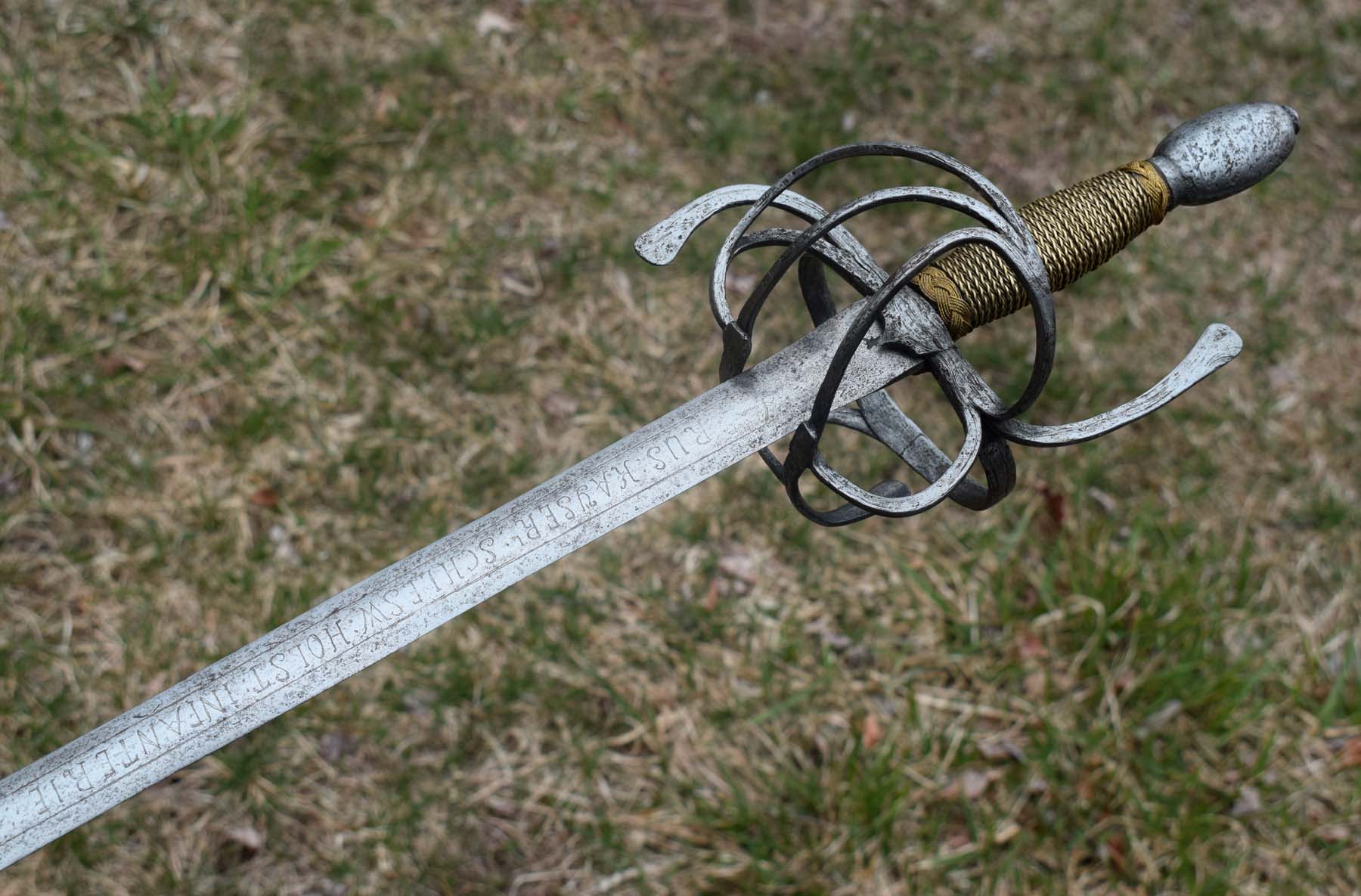
Very Important C 1600 Saxon Rapier From The Army Of Peter Iii Of Russia!. PLEASE READ FRAMED DESCRIPTION OF THIS AMAZING RAPIER! This great, great rarity is said to have descended in German family since the 19th century. It was professionally cleaned and the grip re-wrapped in the late 20th century. Printed description along with several 8.5” x 11” color prints of Peter III accompany the rapier. Very serious inquiries only. Please state full name and location if you would like a response.
  • Nation : British
  • Local Price : £25000
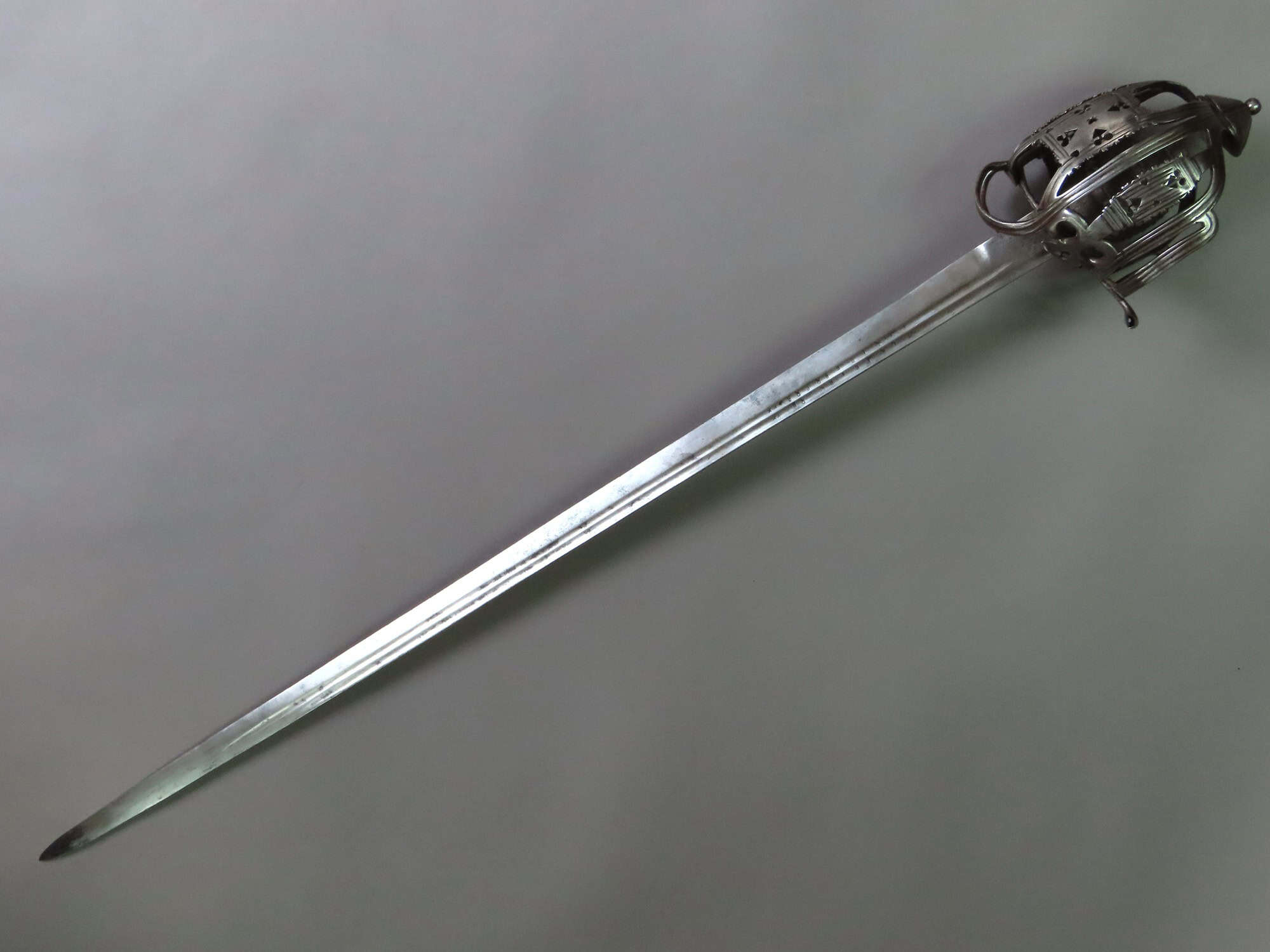
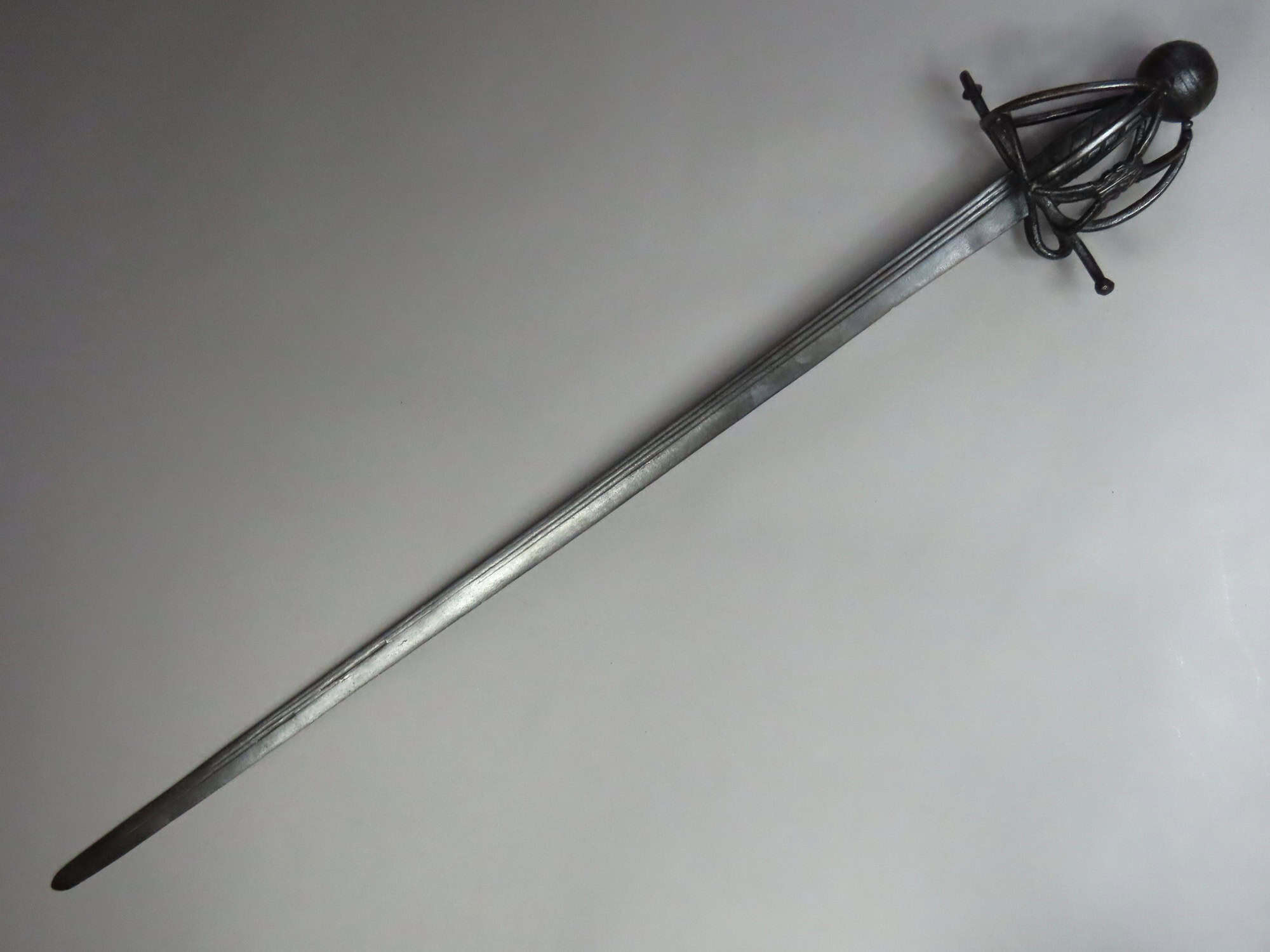
Fine and Rare English Basket Hilted Sword dating to circa 1550. A fine and rare example of the earliest form of Anglo-Scottish basket hilted sword dating to the middle of the 16th century. The sword is part of a rare group first to be formed with fully developed structurally symmetrical basket hilts. Few have survived to the present day and this example is unusual because of its wonderful original condition, even retaining its original grip, and a smooth aged dark undisturbed patination all over. The knucklebow vertically bisects the hilt into two mirrored halves. As such this sword represents the end of asymmetrical basket hilt evolution in the late medieval period from earlier simple cruciform hilted swords and the beginning of the early modern era of the basket hilted sword. From this hilt structure the more typical English and Scottish basket hilts evolved in the later 16th century and thereafter.
  • Nation : -
  • Local Price : £23,950.00
Flintlock Seven Barrelled Goose Rifle by Henry Nock. Flintlock Seven Barrelled Goose Rifle by Henry Nock 65 bore. With twist sighted barrels cut with, silver fore-sight and fixed rear with two additional pop up, shaped breech block with gold line and gold-lined touch-hole, finely engraved grooved tang, the lock with rainproof pan and engraved H Nock. Figured walnut half-stock, chequered grip please note small age crack between lock and trigger guard please see image, engraved iron mounts, brass-tipped steel ramrod, together with its wooden-handled iron mould for fourteen balls.
  • Nation : American
  • Local Price : 25000.00 USD
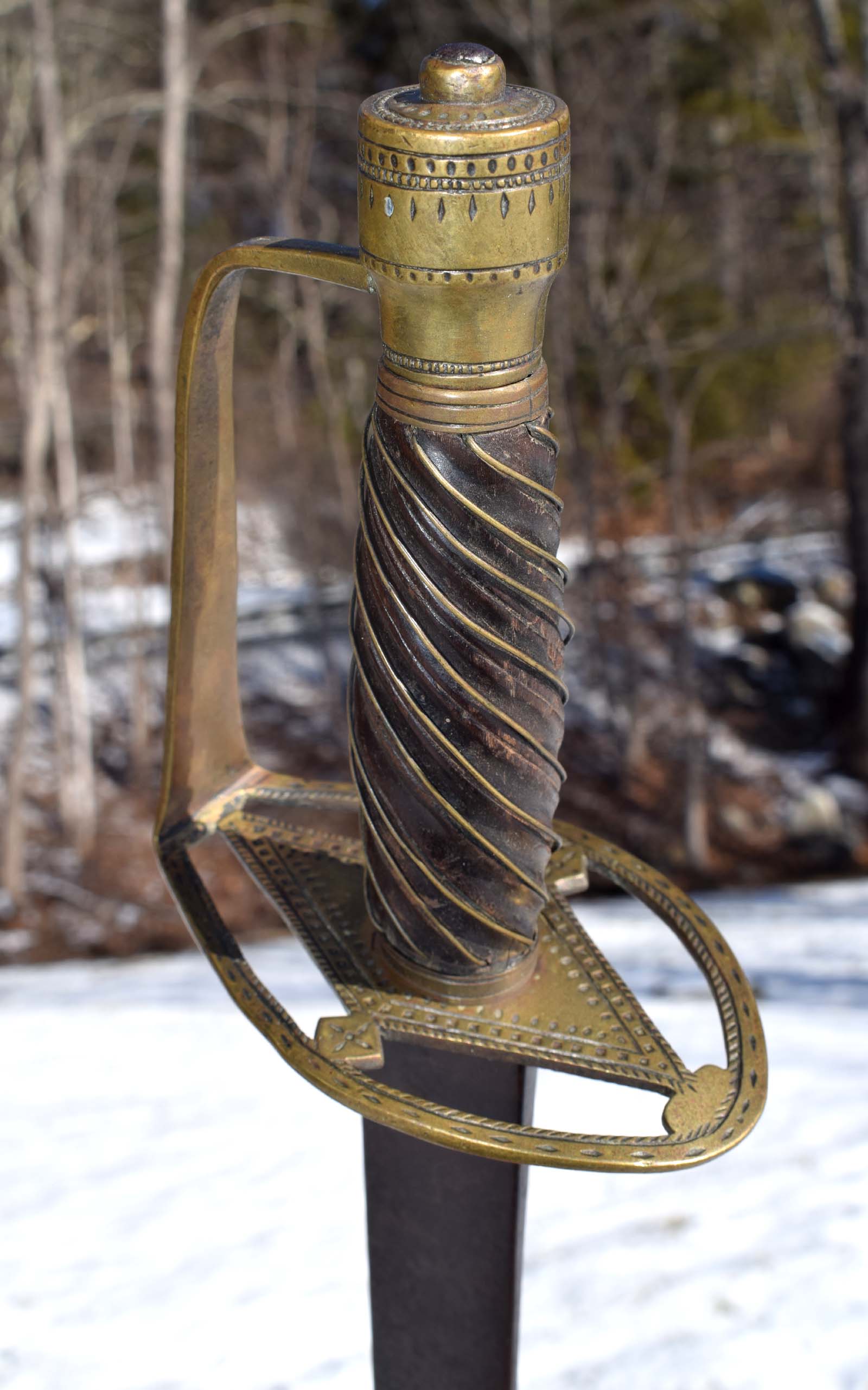
Ex Rare American Revolution Signed Horseman’s Saber, Ex Flayderman Coll.. Here is the rarest of the rare when it comes to American Revolutionary War horseman’s sabers! It is the only recorded example of a horseman’s sword attributed to Pennsylvania cutler Josiah Wood and struck deeply with his mark on the blade’s ricasso. Ex Norman Flayderman collection and pictured in the most important reference for American Rev War swords; “Swords and Blades of the American Revolution”, by George Neumann, plate 314s. Josiah Wood contracted with the Committee of Safety for production of pikes during the Revolution. He is recorded in “Arms Makers of Colonial America” by Whisker, page 205. The Wood saber is constructed in the usual Rev War era 4 slot guard pattern, but the side bars are not straight, they are diamond shaped and the entire hilt is profusely decorated all over with 100’s of tiny differing punches. It is highlighted by the beautiful, tall decorated pommel. The original, twist carved, walnut grip is completely intact (no damage or cracking) as is the original brass grip wire (now slightly loose from natural wood grip shrinkage). The plain, flat, curved blade measures 33” and is deeply struck at the ricasso with Josiah Wood’s mark. It is in untouched, uncleaned condition with a deep aged patina. Only some mild pitting near tip. Sword is in overall excellent original condition! Signed American Rev War sabers are extreme rarities. A James Potter, NY horseman’s saber now brings about $25,000. Our Josiah Wood saber is considerably rarer (and absolutely gorgeous) compared to the plain black, non decorated Potter sabers. When you take into consideration that there are an estimated 30 + surviving examples of the James Potter sabers and only one known example of the Josiah Wood saber there is no comparison! This is truly the rarest of the rare! For the most advanced American Revolutionary collection or museum. If you want the best of the best and the rarest of the rare, here it is! Serious inquires only. Please state full name and location if you would like a response. We are only asking 25K on this great, museum quality, signed American Revolutionary War horseman's saber. About the same as the going price of a common James Potter horseman's saber. Don't let this pass you by. He who hesitates is lost! Be sure to check out our other listings for more great swords, arms and armor! Our direct email address is: [email protected]
  • Nation : British
  • Local Price : £15000
exceptional cased suite of edged weapons of Lieutenant Wyndham Neave of the 71st Highland Light Infantry killed in action in 1858 in the Indian Mutiny. Lieutenant Wyndham Neave of the 71st Highland Light Infantry was killed at Morar during the advance of the forces of Sir Hugh Rose against rebels at Gwalior in Central India on 16th June 1858 in the Indian Mutiny. This is his weapons set which was cased for display, probably in India, then returned to his family in England after his death. The weapons are a unique snapshot of an officer’s dress and field edged weapons of the time and are in exceptional condition. The case is a fine example of the cabinet maker’s craft. Lt Neave was born on 21st November 1834, the 4th son of Sir Richard Digby Neave, 3rd Baronet (1793–1868), who was an English artist and author. Kaye & Malleson’s History of the Indian Mutiny 1857-8, describes the action in which Lt Neave was killed as follows: “The main body of the enemy, driven through the cantonments, fell back on a dry nullah (a steep sided watercourse) with high banks, running round a village, which they had also occupied. Here they maintained a desperate hand-to-hand struggle with the British. The 71st Highlanders suffered severely, Lieutenant Neave, whilst leading them, falling mortally wounded; nor was it till the nullah was nearly choked with dead that the village was carried”. In a more personal account Lieutenant John Lightfoot of the Bombay Horse Artillery described the action as follows in a letter to his father: “Just at this time there came a cheer from the rear and up came the 71st at the double, I ceased firing and they rushed past straight at the nullah, the rebels did not wait for their approach but, throwing down their muskets they drew their swords and waving them over their heads, dashed forward to meet the 71st, young Neave son of Sir Digby Neave was killed at the first onset, but not a rebel escaped. They were killed to a man!' Besides Lieutenant Neave, the 71st had four men killed and five men wounded, four of those severely”. The set consists of Lt Neave’s dress basket hilted broadsword, his field service sword, dress dirk and shoulder belt plate, all notable for their excellent quality and fine condition. The set is contained in purpose built contemporary fitted mahogany case with two locks fitted to each side. When the top lid is lifted off a second glazed lid is revealed through which the items may be viewed. This can also be lifted off to access the items by hand which are seated in shaped hard lined apertures lined with plum coloured velvet. The Scottish basket hilted broad sword is by Henry Wilkinson and not numbered. Henry Wilkinson began their numbering system in 1854 which dates the production of this sword to circa 1848-1854. The regulation pattern straight blade is 32.25 inches (82cm) long and profusely etched with fine designs. The pronounced ricasso has a deep fuller near to each blunt edge and further along the blade two central fullers run in parallel. Inside the ricasso on one side is “HENRY WILKINSON, PALL MALL, LONDON” and on the reverse side a star shaped cartouche with a brass stud inside stamped with “HW” for Henry Wilkinson in raised relief. Just beyond the ricasso on the same side is an ornate cartouche with the owners initials “WN” and crest. Further along on the same side is an elaborate foliate panel which contains the regimental emblem and the numerals “LXXI” for “71”. On the reverse side a similar foliate panel contains the “VR” cypher with a crown above. The regulation basket guard is pierced with hearts and circles, mounted with a fluted bun-shaped pommel with button, wooden spirally grooved grip covered with black shagreen bound with silver wire, and retaining its red fringe and scarlet cloth faced buff leather liner with blue silken hem. The sword retains  its polished finish. The sword is contained in its black leather scabbard with three matching steel mounts with linear engraving, the top locket with suspension ring and frog stud and middle mount with suspension ring. The sword is in fine condition with a few insignificant age related blemishes. The field service sword is also by Henry Wilkinson punched with the number 6596 for 1855. The slightly curved fullered blade is 32.25 inches (82 cm) long and contained in its steel scabbard also punched with the same number. The forte is marked same as the basket hilted sword with “HENRY WILKINSON, PALL MALL, LONDON” and with a star and brass roundel punched with HW in raised relief on the reverse side. On one side within a panel of etched thistles is the “VR” cypher with crown above and “HIGHLAND” with a bugle below with the number “71” inside its loop then “LT INFANTRY” below. On the reverse side between panels of thistles the battle honours of the regiment are detailed within a scroll design beginning with “PENINSULA” and “WATERLOO” then ending with  “HINDOOSTAN”. The blade retains its polished finish. The steel hilt is mounted with a scrolled wrist guard and typically pierced with foliate designs and engraved with leaf-like scrolls. The pommel is domed and cut with radiating flutes. The wooden grip is covered with black shagreen, and bound with silver wire. The dress dirk is exceptional and of robust size mounted with ebony grip and  deeply chased Ormolu mounts. The leaf shaped blade measures just over 13 inches (just over 33 cm) and the dirk 19 inches overall length (just over 48 cm). It measures just under 20.5 inches (52 cm) when measured end to end in its scabbard. The baluster shaped dirk grip is cut with a Scottish military bonnet and crossed swords between the haunches to the front and with a thistle on the reverse in raised relief. The middle section is cut with a decorative basket weave pattern highlighted with gilt brass studs at the intersections at the front and with ridges of longitudinal lines to the rear which extend upwards to the back of the canted pommel. The pommel band and mouthpiece are of cast brass with a flowing band of thistles and leaves in raised relief. The grips of the knife and fork are cut with basket weave all over with studs at the intersections. The pommels are canted and the bands are of similar form to the dirk. At the base of the knife and fork grips a tapering ferrule holds in place a blued clip of sprung steel which holds in place each item when sheathed. The dirk, knife and fork are mounted with pommel stones cut in a multi-faceted manner around the edges with flat tops and a slight rose pink hue in background colour. The black patent leather scabbard mouthpiece is mounted with a bugle with “71” inside the loop and a crown above. The front of the knife mouthpiece, the fork mouthpiece, and the chape are mounted with thistles in raised relief. The blade is scalloped along its back edge for over half its length after which it is double edged. A deep fuller runs underneath this part of the blade for the same length, and underneath this a wider, shallower fuller extends for the same length along each side. Viewed from the hilt towards the tip on one side, the blade is etched with a panel of bordered interlace above which in floral script are the letters “HLI” for the Highland Light Infantry. Above this the regimental motto “NEMO ME IMPUNE LACASSET” is clear. The next etched design is a bugle with “71” inside its loop with a thistle above, followed by a stand of arms, and a further thistle beyond. On the reverse side the first panel contains the name of the retailer / maker “JONES, 6 REGENT ST, LONDON” with the “VR” cypher above in the same script as the “HLI” script on the first side. Above this, where the motto is place on the first side is “HIGHLAND LIGHT INFANTRY” with the bugle and “71” inside its loop. Along the rest of the blade the battle honours also represented on the field service sword are repeated in a panel beginning with “WATERLOO” and ending with “HINDOOSTAN” with a thistle above. The dirk is in fine condition retaining almost all of its original finish and exhibiting almost no wear. The dirk retains its braid suspension strap. A shoulder-belt plate for an officer of the 71st is also accommodated in the case. This has a copper-gilt stippled ground with the silver applied regimental device of “71” within a bugle loop. It retains its hook, stud fittings on the reverse and its original leather backing.
  • Nation : German
  • Local Price : $16,995.00
Exceptional German Hand-and-a-Half Sword, 2nd Quarter 16th C. Featuring hilt of blackened hand-forged iron with elaborate guard of round-section bars forming horizontally recurved quillons with 6-pronged finials. Side ring with bars looping down and outward from the center, with checkered band joining them in the middle and ending with serpent head finials. Large pas d’ane with bars extending perpendicular to the blade and ending in 6-prong finials; the reverse with looping bars extending from the lower end of the pas d’ane and crossing to connect with the quillon on one and and forming a thumb ring on the other where it joins the quillon block. Two-stage wood grip with original leather wrap and very old museum label on the reverse; writhen vase-shaped pommel with checkered round button. Doubled-edged 37 3/8” (97.5 cm) blade of hexagonal section; the ricasso stamped with a maker’s mark on each side and the upper third with a line-bordered design of interlocking jagged-edged ovals on both sides, ending with a large anchor mark. Appears to be totally untouched and original; the blade sharp with scattered light to moderate pitting. Guard with two attached numbered metal collection tags. Grip showing great age with minor losses, cracks, and flaking. Very fine quality, with intricate and unique design, showing great age. Overall length 44 1/4” (112 cm).
Page 1 of 155