
Show

Forgot your password?

Error message here!

Error message here!

Error message here!

Error message here!

Show Error message here!

Show Error message here!

Lost your password? Please enter your email address. You will receive a link to create a new password.

Error message here!

Back to log-in

Close

For Sale

The following items are listed by for sale by users of the site and dealers. They are in no way endorsed or guaranteed by www.antiquearmsresearch.com

Add a Classified Item
to

Clicking on the sword will take you through to the relevant classified item or dealer site.
Don't miss out! - Do you want to be kept informed weekly of new aditions? Just join our weekly update list.

You can also receive regular email notifcations when items match your keywords. To recieve them just register or logon at the top right of this page.
Page 27 of 155
  • Nation : British
  • Local Price : £2750
Click and use the code >22069 to search for this item on the dealer website Simply Stunning Ancient & Historical Era Greek Leaf Shaped Bronze Sword With a Distinctive Blood Channel. From the Most Iconic Period Of Ancient Greek Classical History. Around 3200 Years Old
  • Nation : German
  • Local Price : $2695.00
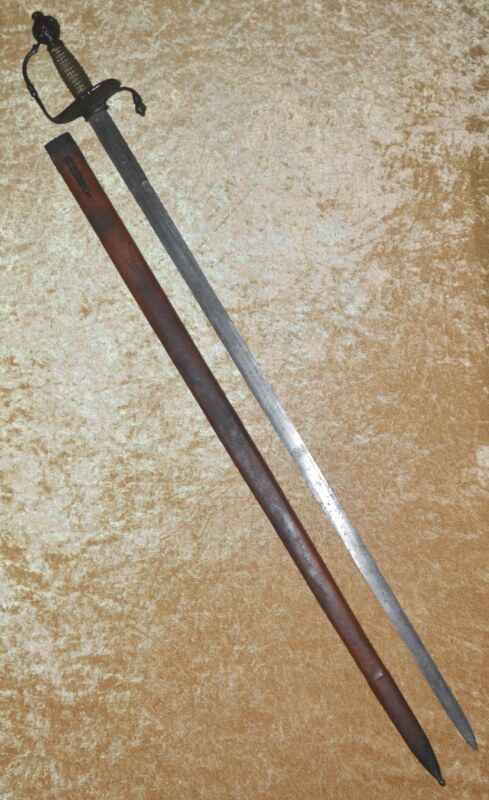
German Officer’s Broadsword with Scabbard, ca. 1680. Blackened hilt featuring single oblong side ring filled with a pierced plate embossed with acanthus design. Down-turned reverse quillon with lobed finial chiseled with acanthus design. Knuckle bow with central double knob joined to the pommel. Pommel with button and chiseled ensuite with acanthus design. Grip wrapped with three sizes of single strand and twisted brass wire and finished with braided turks heads top and bottom. Double- edged 33 1/4″ blade of hexagonal-section; the long ricasso stamped “JOANNE” on one side and “MARTINEZ” on the other inside an engraved border. Blade shows lamination, pitting, and a number of nicks from blade strikes primarily on the lower half. In its restored leather covered wood scabbard with blackened iron mounts. Overall length 38 ½”, not including scabbard.
  • Nation : British
  • Local Price : £2,695.00
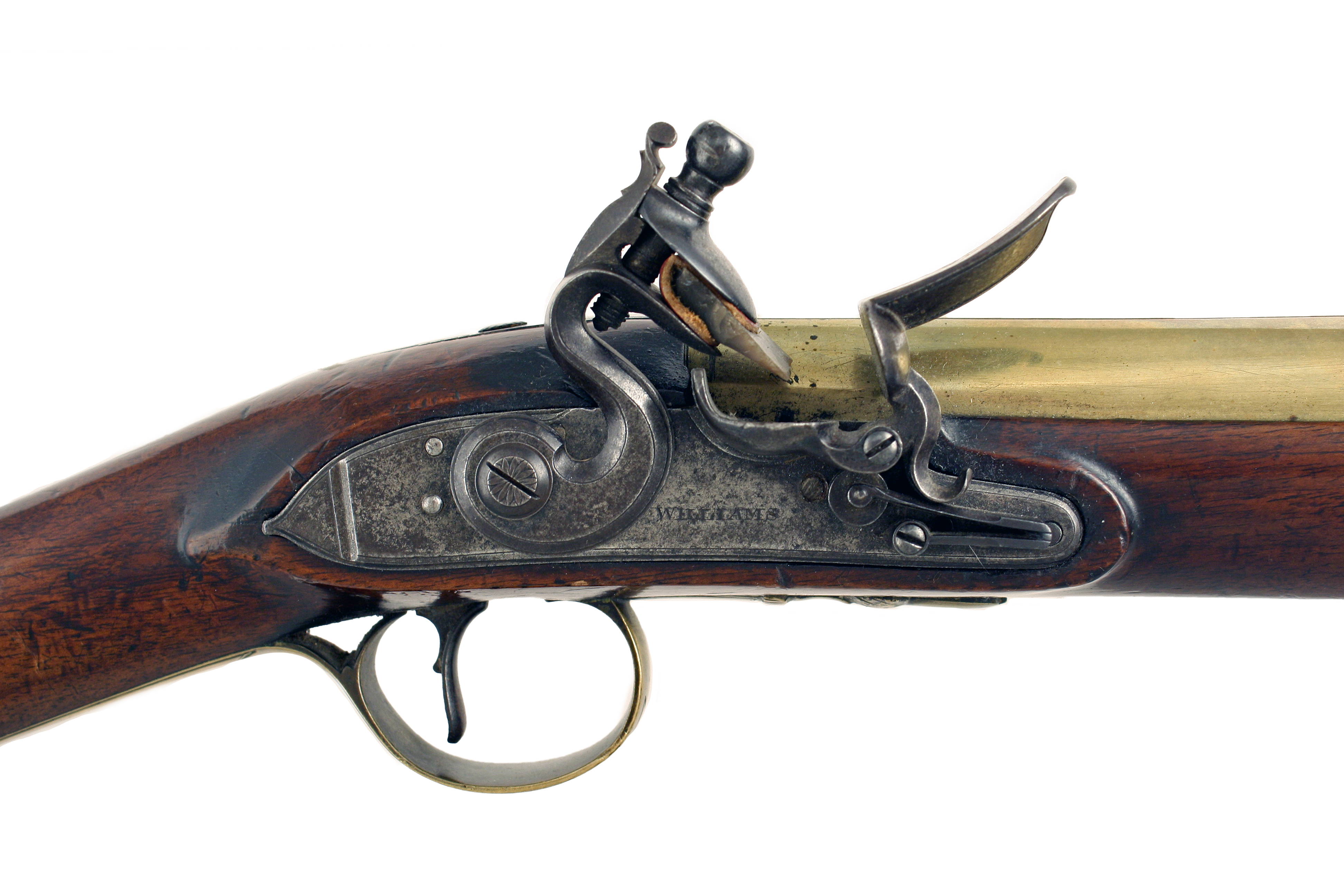
Charleville Naval Musket Pattern 1777 Corrected Year IX, rare. Ref X3415. A Rare French Charleville Naval Musket Pattern 1777 Corrected Year IX. 53&157; overall, 37 1/2&157; barrel in .69 calibre, barrel breech with inspector´s mark & dated 1814. Rounded lock plate with ring neck cock, brass pan. Lockplate marked ´Manufre. Imple de St.Etienne´ with inspector´s mark. Walnut full stock with scalloped butt, with iron & brass furniture comprising flat iron butt plate, trigger guard of iron & brass with sling swivel & finger ridges, 2 sprung brass barrel bands middle one with sling swivel, fore end band & side plate. Tulip ended ramrod & socket bayonet.Dated 1814.&194;&160; In good condition, barrel slightly shortened by about 2&157;, metal work in good condition, a few old wood worm holes.&194;&160; &194;&160; &194;&160; &194;&160; &194;&160; &194;&160; &194;&160; &194;&160; &194;&160; &194;&160; &194;&160; &194;&160; &194;&160; &194;&160; &194;&160; &194;&160; See ´French Military Small Arms´ by D. Bianchi pages 82-84 and ´Borders Away II Firearms in the Age of Sail´ by W. Gilkerson, page 181 Images courtesy of West Street Antiques (https://antiquearmsandarmour.com/)
  • Nation : British
  • Local Price : £2650
Click and use the code >26056 to search for this item on the dealer website Simply Wonderful Original Trojan War Period Full Length Bronze Sword Blade, 21 Inches Long. Circa 1200 B.C.Archean Greeks, the Mycenean Greeks, The Trojans & The Hitites. From The Warring Times Of Menalaus King of Sparta & King Agamemnon
  • Nation : -
  • Local Price : £2,650.00
Seaforth Highlander Duke of Sutherland Sword. Seaforth Highlanders 5th Battalion officers sword belonging to 5th Duke of Sutherland who was a captain between 1910 and 1912 becoming Honorary Colonel in 1914. Regulation basket hilted sword in good condition complete with liner and fringe. The blade is super condition and well etched with G R V and crown to one side the reverse with regimental details as follows Seaforth Highlanders 5th The Sutherland and Caithness Highland Battalion plus the single letter S Retailers details Davies and Sons London and complete with matching scabbard which does show age wear between the ring mounts sold with research
  • Nation : British
  • Local Price : £2,595.00
2nd Lifeguards Troopers Pattern 1848 Sword, very rare. Ref X3399. A Very Rare 2nd Lifeguards Troopers Pattern 1848 Sword. 46&157; overall, 39&157; broad straight single edged blade with wide fuller, engraved ´Hamburger Rogers Co 30 King St, Cov Garden London´. Steel honeysuckle pattern bowl guard. Eared backstrap, brass domed pommel and shaped wooden grip with fish skin cover and twisted brass wire. In its original iron scabbard with broad rounded bands with two suspension rings, engraved ´2nd LG 2´. Circa 1850 A very rare sword in fine condition.&194;&160;&194;&160; See ´British Cavalry Sword 1788-1912´ by R Deller page 189-93.&194;&160;&194;&160; Hamburger Rogers & Co 1840-1917 30 King Street Covent Garden. Images courtesy of West Street Antiques (https://antiquearmsandarmour.com/)
  • Nation : Chinese
  • Local Price : £2595
Click and use the code >24304 to search for this item on the dealer website Archaic Chinese Warrior´s Bronze Sword, Around 2,300 to 2,800 Years Old, From the Zhou Dynasty to the Qin Dynasty, Including the Period of the Great Military Doctrine ´The Art of War´ by General Sun-Tzu
  • Nation : British
  • Local Price : £2575
Rare Scottish 1798 Pattern Officers’ Basket Hilted sword with Paktong / Nickel Hilt. A rare example of the distinctive basket hilted sword introduced for Scottish Infantry officers in Highland Regiments in 1798. It was replaced by the regulation steel basket hilt 1828 pattern three decades later. The sword type was used throughout the Napoleonic War period. The hilts of these swords were most usually made of gilt copper, bronze or brass. This sword is a rare example in that the hilt is made from a lighter coloured nickel-based alloy. The use of nickel alloy in the production of weapons and tableware was increasing in the early 19th century as a substitute for silver, variously called Tutenag, Paktong, German Silver etc, but is rare in the production of sword hilts at this time, although some made from imported Chinese Paktong are known (for an example see an English Georgian Slot Hilt Hanger of the late 18th century mounted with a Paktong hilt sold by C&T Auctioneers and Valuers Ltd, Royal Tunbridge Wells, UK, lot 119, 1st November, 2017).  A further nickel-based hilt of Scottish 1798 pattern that we are aware of is detailed in note 1 below. The basket guard is made of rounded bars and flattened plates in the usual manner with forward loop guards and a swollen wrist guard terminal to the rear quillon. The upper terminals of the guard arms are fixed onto a ring inside which the stem of the mushroom shaped pommel is fitted. The pommel is dome-shaped on top with a protruding integral waisted pommel button.  The double-edged gently tapering blade is 32.5 inches (just over 82 cm) long. It is of lenticular section with a short ricasso. A central fuller commences a short distance from the hilt on each side and is 9.5 inches (24 cm) long. The blade is unmarked and probably a German import which is a common occurrence on swords of this type and most usually of Solingen manufacture. The grip is of spirally grooved wood covered with shagreen held in place with thin strands of twisted copper wire now coloured with age. It is mounted with an alloy ferrule at the base of similar colour to the hilt and retains a red woollen fringe at the top plus its leather liner stitched with red cloth on the outside and bound with blue silk ribbon at the hem.  The materials used for 1798 pattern hilts were less robust than iron and as a result  were susceptible to damage. Many surviving and published examples have bars missing, are out of shape and often with repairs. This sword is a good example. The blade has just small patches of blackened age-related staining in places and the hilt has kept its shape without damage or repairs. Note 1: For other examples of the 1798 type see: Harvey J S Withers, “The Scottish Sword 1600-1945”, Paladin Press, 2009, particularly page 144 for a 1798 Pattern described as: “An unusual piece. The basket appears to be manufactured from a combination of white metal and brass (mixed together)”. The pommel, blade ricasso, grip shape and binding, plus the basal ferrule, liner and fringe, are more than coincidentally similar to our sword, indicating that both may have been made in the same batch by the same maker.
Page 27 of 155