
Show

Forgot your password?

Error message here!

Error message here!

Error message here!

Error message here!

Show Error message here!

Show Error message here!

Lost your password? Please enter your email address. You will receive a link to create a new password.

Error message here!

Back to log-in

Close

For Sale

The following items are listed by for sale by users of the site and dealers. They are in no way endorsed or guaranteed by www.antiquearmsresearch.com

Add a Classified Item
to

Clicking on the sword will take you through to the relevant classified item or dealer site.
Don't miss out! - Do you want to be kept informed weekly of new aditions? Just join our weekly update list.

You can also receive regular email notifcations when items match your keywords. To recieve them just register or logon at the top right of this page.
Page 29 of 124
  • Nation : British
  • Local Price : £1895.00
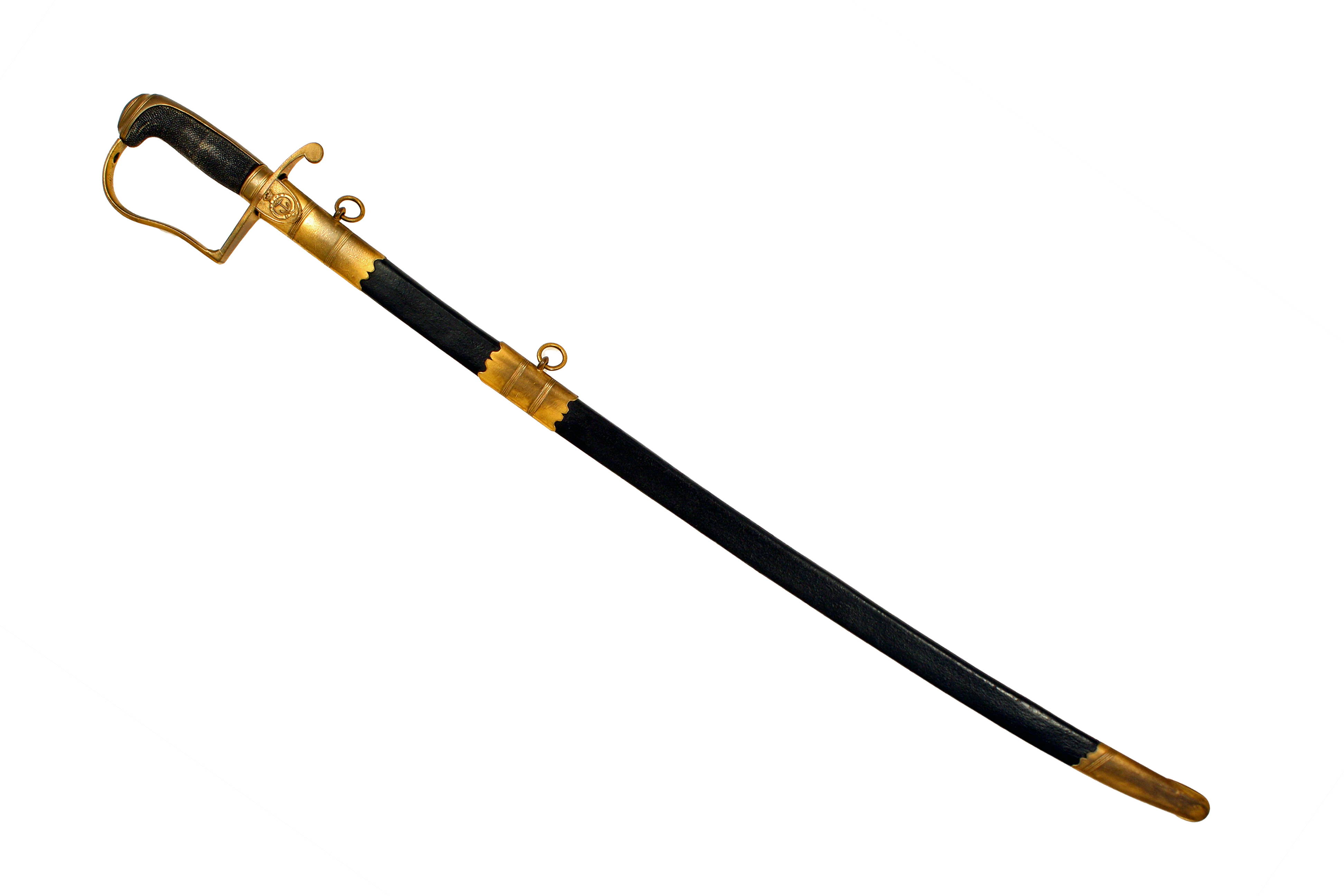
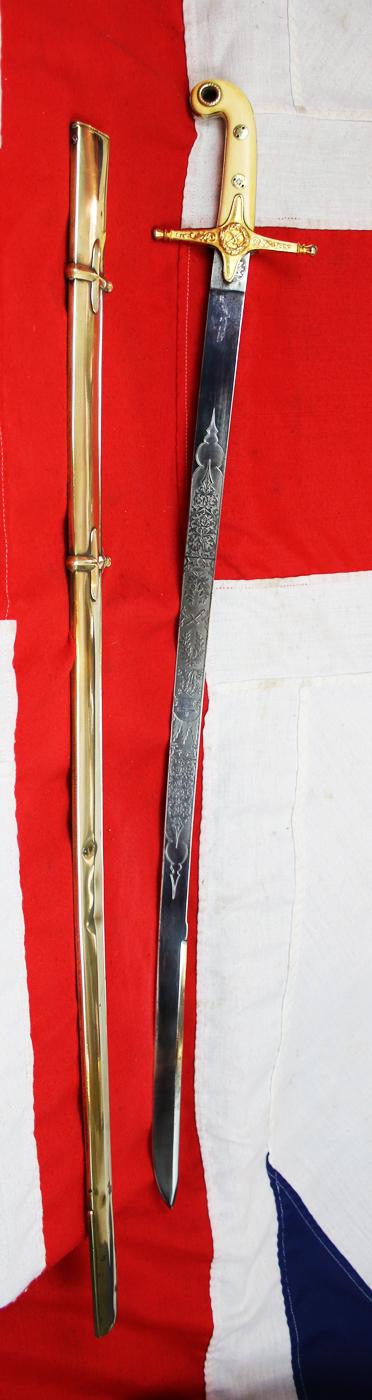
An Absolutely Superb & Stunning, Fully Provenanced, Victorian, British Generals Wilkinson Sword Of The Commander of the Grenadier Guards In The Crimean War At Alma, Sevastopol, and The Battle of Inkerman, In the Guards Brigade. The sword is as close to mint for its age that you could possibly get. The fabulous hilt has all its original mercurial fire gilt, and in the centre of the quillon it has the crossed sword and field marshal's baton symbol of a British general. the blade has remarkably beautiful, full, deluxe etching for a general of the army, with royal cypher of Queen Victoria, florid scrolls, and again the crossed swords and field marshal's baton generals symbol. Overall in superb condition. Only the all brass scabbard has signs of its long service use by way of a few dings and dents. Commissioned from Wilkinson Sword Co. for General Thomas Wood who commanded the 3rd batallion Grenadier Guards In the Crimean War in his capacity as colonel of the regiment. The 3rd Battalion Grenadier Guards served in the Crimea (1854–1856) as part of the 1st Guards Brigade, participating in major actions including the battles of Alma, Sevastopol, and the Battle of Inkerman, where they famously defended the Sandbag Battery. Four members earned the Victoria Cross during the campaign, and they were noted for carrying their colours into action at Inkerman. Battle of the Alma (Sept 1854): The battalion was part of Lord Raglan’s army that stormed the heights, marking their entry into the campaign. Battle of Inkerman (Nov 1854): Known as the "Soldiers' Battle," the 3rd Battalion, along with the Scots Fusilier Guards, held the Sandbag Battery against overwhelming Russian numbers in thick fog, holding their ground despite immense losses. Siege of Sevastopol (1854–1855): Participated in the long siege of the Russian fortress until its fall in September 1855. At least four members won the Victoria Cross for bravery, including Major Sir Charles Russell, who led a charge to the Sandbag Battery, and Private Anthony Palmer. The 3rd Battalion was the only unit in the brigade to carry its colours into the fight at Inkerman, with Ensign and Lieutenant Charles Napier Sturt severely wounded while bearing the regimental colour. : The Brigade of Guards lost roughly half its men during the Battle of Inkerman. Cholera, scurvy, and the extreme cold caused more deaths than direct combat. When the troops returned and were reviewed by Queen Victoria, she was shocked by their appearance, noting they were "quite broken down". The 3rd Battalion’s actions at Inkerman are still honored today by The Inkerman Company of the Grenadier Guards. The sword bears the Wilkinson Sword Co. marks and serial number 8756 relating to him, from Wilkinson's records, as the commissioner and the owner of this fabulous bespoke British General's sword. 5th November 1854 On this day, amidst the fog and chaos of the Crimean War, The 3rd Battalion stood resolute at the Battle of Inkerman. Facing overwhelming Russian forces in brutal close-quarters combat, the Guards held their ground on Kit Spur and at the Sand-Bag Battery, demonstrating unmatched courage, discipline, and brotherhood. It was during this “Soldiers’ Battle” that three Grenadiers earned the Victoria Cross for extraordinary bravery: Picture in the gallery of General Woods full portrait painting in his uniform in his capacity as Colonel of the Grenadier Guards prior to the Crimean War. Ivory Declaration Submission Antique ivory, 'worked' declaration submitted, but we can only sell this sword within the commonwealth it is not allowed for export to America. Ivory, however old cannot be imported into the USA.
  • Nation : British
  • Local Price : £1875
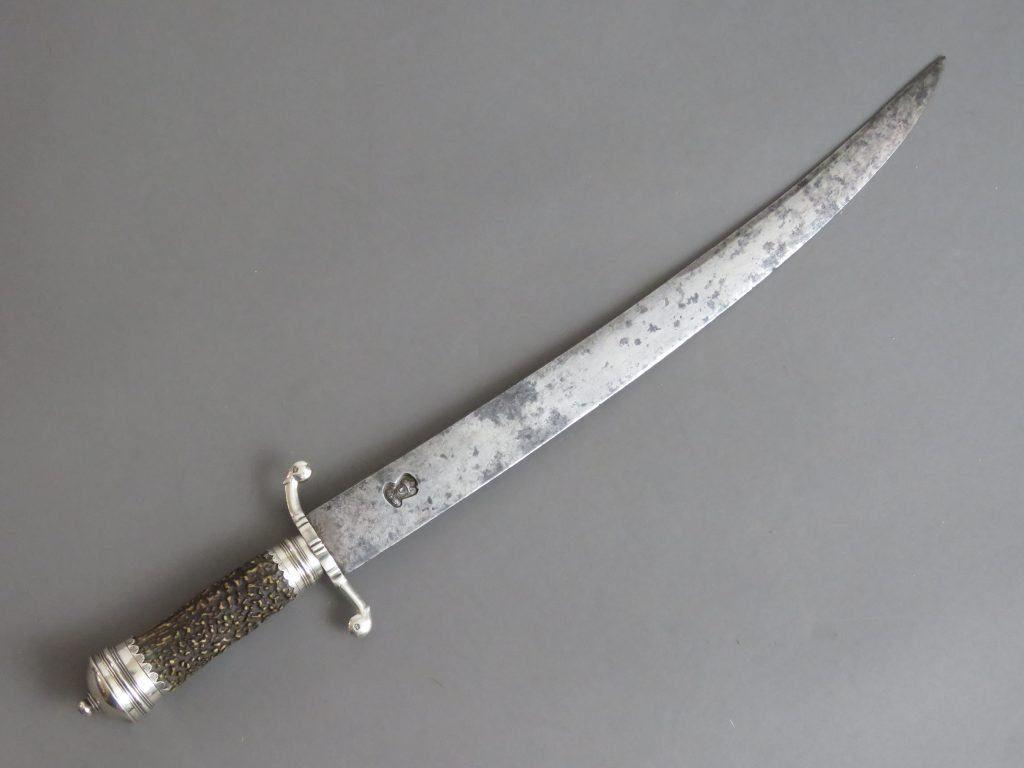
Late 17th century English Silver Mounted Hanger with the Maker’s Mark “WL” for William Lutwich of London. An English silver mounted hanger comprehensively stamped with the maker’s mark “WL” most likely for the silversmith William Lutwich of London. This is a fine example in unusually good condition.  The small mark consists of the letters in raised relief inside a shield with a pellet above and below. In the 17th and 18th centuries when swords were a popular weapon for gentlemen, hangers were a robust secondary side arm used for self defense when hunting and travelling. They were also used in parts of the British Army and Navy. Hangers appear in some military portraits of the time. Towards the end of their popular use, they were slimmed down and refined for wear as a gentleman’s fashion accessory. The high quality and expensive hanger described here, with its robust blade, was most likely a gentleman’s weapon made for use rather than decoration. The hanger dates to between 1691, when Lutwich was “made free” of his guild and able to practice in his own right, and 1697, which is the date of the advent of the Higher, or “Britannia”, Standard for silver, when smiths were required to use a new stamp bearing the first two initials of their surnames. When the requirements for punch marks changed again in 1720 with the arrival of the Sterling Silver Standard, many makers reverted to recording their initials but in bolder type accompanied by date and hallmark stamps. By this date the styles adopted for hangers had changed so there no doubt that this hanger is a late  17th century example. On this hilt the quillon terminals are stamped as are the base ferrule to the grip and the pommel. This comprehensive marking was also a historic practice by the turn of the century. The cross guard of this sword is comprised of a bold faceted block with horizontal quillons swollen at the vertically counter curved terminals. The grip is of stag antler with a plain ribbed ferrule at its base and scalloped edge. The pommel cap has a ribbed neck beneath with scalloped edge formed in the same manner as the basal ferrule. The plain dome formed on top has a pronounced tang button in the centre. The slightly curved robust single edged blade is just over 16 inches long (40.5 cm).  It becomes double edged from just over two thirds of the way along to the tip. The blade is deeply struck on both sides at the forte with a moustachioed King’s head mark on each side. The full length of the hanger is just over 21.5 inches (54.5 cm) long. The hanger is in fine condition. A stamp recorded by William Lutwich at Goldsmiths’ Hall is shown in Grimwade number 1967 page 144. This mark has the same shaped depressed shield and letters WL incuse as do the marks on our hanger. However, the stamp in Grimwade has a crown above the letters whereas the marks on our  hanger have a pellet above and below. It is not known when the mark in Grimwade was recorded but smiths did use and record variants of their marks over time many of which are now lost. For further information on English silver hilted swords and hangers see Leslie Southwick, “London Silver – Hilted Swords, Their makers, suppliers & allied traders, with directory”,  2001, Royal Armouries. For a very similar example with the maker’s mark of Richard Fuller, circa 1690, see the same publication page 277, plate 18.
  • Nation : US
  • Local Price : £2575.00
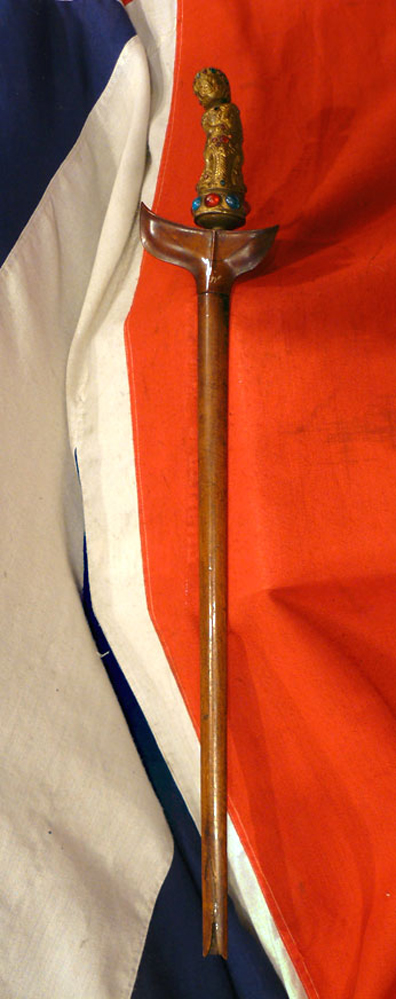
Most Scarce, Rare & Stunning, Antique Balinese Ceremonial Executioner's Keris Complete With Original Gold Alloy & Cabouchon Decorated Hilt Depicting Bayu Seated On a Rock. The Hindu God of Wind, 17th to 18th Century Blade Likely Made From Meteorite Steel. Not only a rare and beautiful example of an antique Indonesian traditional weapon of high status, it is a stunning work of art, with a spectacular hilt that is a gilt alloy representational figure of Bayu, seated on a rock, the Hindu god of wind, with his right hand holding the flask with life-elixir, the left, a part of his shawl, and his face has the traditional ferocious expression with bulging eyes, and similarly it is studded with extravagant coloured glass cabouchon beads. It is very rare to see such fine object d'art still mounted upon their blades, as they all once were. In the 19th century it was very usual to removed tsuch hilts from their knives and mount them for cabinet display. the very few that still survive are mounted as such, and it is incredibly rare to to find one still complete and in one piece. It has a very nice, very long blade, of the traditionally Balinese ceremonial executioner's form. In many parts of Indonesia, the long straight bladed kris used to be the weapon of choice for ceremonial execution. The executioner's kris had a long, straight, slender blade exactly as this fine piece. The condemned knelt before the executioner, who placed a wad of cotton or similar material on the subject's shoulder or clavicle area. The blade was thrust through the padding, piercing the subclavian artery and the heart. Upon withdrawal, the cotton wiped the blade clean. Death came within seconds. This is stunningly nice piece and a most unusually seen variation of these interesting weapons, called the Kris or Keris. Fine, Indonesian antique, gold coloured metal sword hilts of Bayu, studded with glass beads such as this, are rare and highly collectable, and they occasionally appear, on the collector's market, frequently mounted on a base, without their blades, and sold as Asian Object D'art. In Sale No.2501, lot 601, at Christie's, in their sale of Asian Ceramics and Works of Art, on the 8 May 2001, in Amsterdam, a wooden pedestal mounted gold alloy figure of this very type and kind, also studded with similar glass beads. It sold at auction 24 years ago for $9,390 US Dollars. But, it no longer complete with its original kris knife Every single item from The Lanes Armoury, Britain's famous, favourite, and oldest original Armoury Antique store, is accompanied by our unique Certificate of Authenticity. Part of our continued dedication to maintain the standards forged by us over the past 100 years of our family’s trading, and thus, it is a lifetime guarantee
  • Nation : Unknown
  • Local Price : £1,850.00
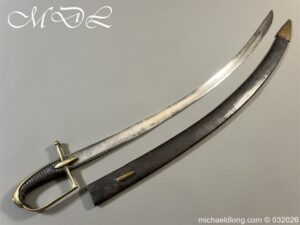
A Scarce Customs Officers Sword.. A Scarce Customs Officers Sowrd. With slightly curved pipe-backed single edged blade, etched with Customs coat of arms on both sides and ‘Salter Sword Cutler, 73 Strand London’. Gilt brass stirrup hilt with customs anchor in a wreath on both lancets, with stepped pommel, fish-skin grip, in its original leather covered scabbard with gilt brass mounts. Notes: A rare sword for Commanders and Lieutenants. Salter was sword supplier to Admiral Nelson and later Lord Exmouth. Dimensions: Blade Length: 30 Inches (76 cm) Overall Length: 34.5 Inches (87.50 cm)
  • Nation : British
  • Local Price : £1,850.00
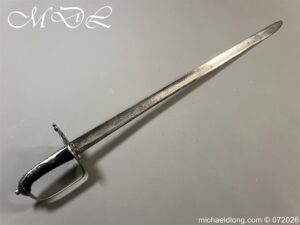
Scottish 71st Highland Light Infantry officers Sword. Scottish 71st Highland Light Infantry officers Sword by Wilkinson sword number 5659 dating it to 1855. This sword is one of 28 made for 71st Highland Light Infantry numbers 5645 to 5680 “ 5 had defective blades, in 1854 the 71st had 28 officers. The sword is regulation P1821 Light Cavalry, 3 bar hilt with fish skin grip and chequered pommel. The blade with a small amount of engraving towards the hilt and makers details Henry Wilkinson the spine and throat of the scabbard both number 5659. The sword is complete with steel scabbard, dress knot and a copy of a photograph of Viscount Kirkwall Capt 71st Highlanders Crimean War wearing this pattern of sword.
  • Nation : British
  • Local Price : £1,850.00
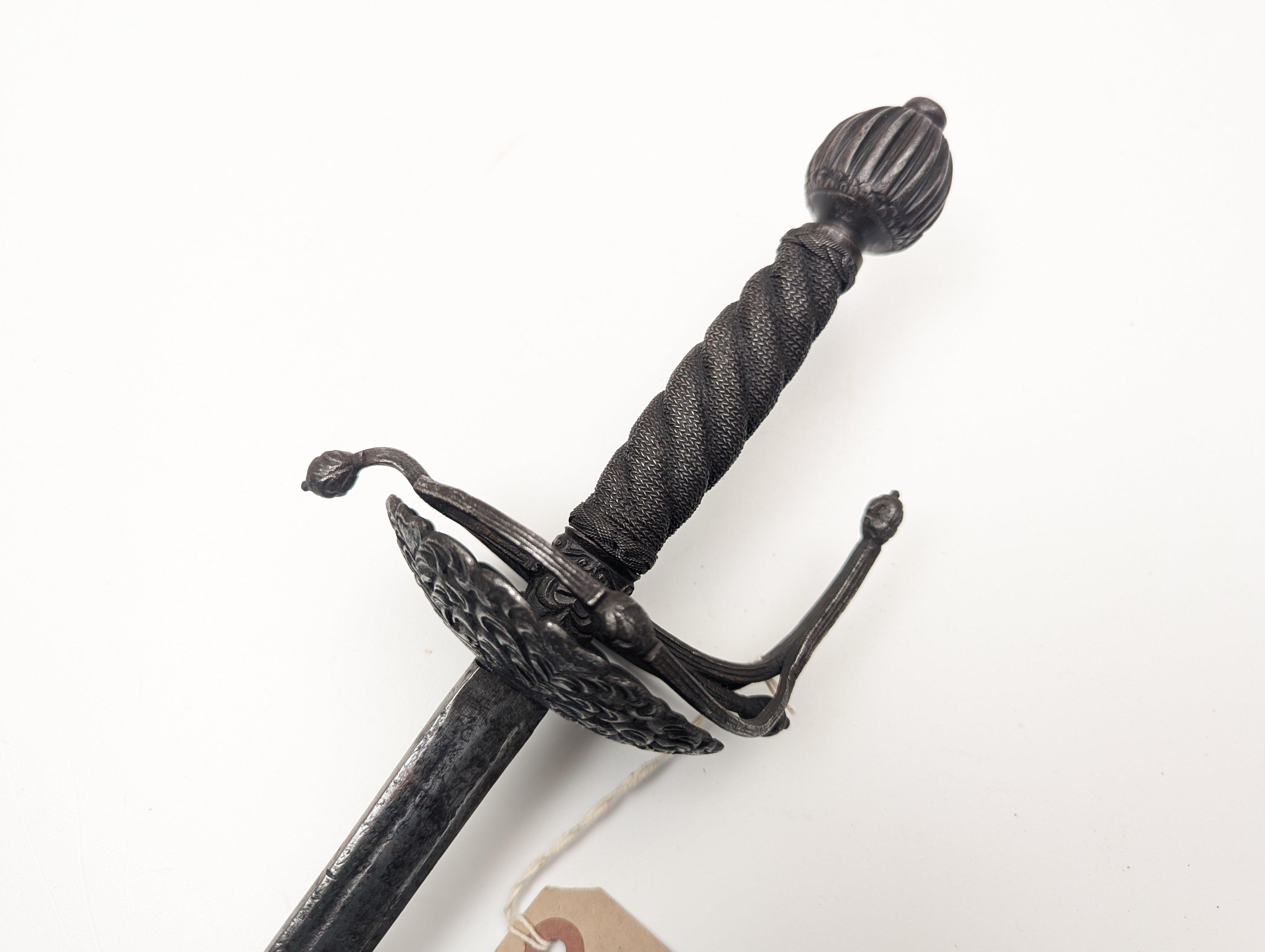
English Dish Hilt Rapier, 17th century. Origin: United Kingdom, Culture: British, Period: 17th Century. English Dish Hilt Rapier, 17th century. A high quality example with a full size blade (87cm blade, 105cm overall). The blade has several pieces of text that have yet to be researched. The dish, grip, and pommel are of the highest quality. I believe there is a missing section that would have connected the knuckle guard
  • Nation : French
  • Local Price : £1,850.00
French Hussar sabre – model ANIV – 1795/6. French Hussar sabre – model ANIV – 1795/6. The stamps indicate it was made between 1795-1803 so Consular period. This sword was originally part of the Geoff Worrall&#acute;s collection and due to the leather scabbard could have possibly been supplied by the French to America for the War of Independence. Regulation pattern sword with brass hilt and ribbed leather grip, curved single edged blade with wide fuller. The scabbard leather stitched with brass frog and drag note drag is a period replacement and a hairline crack in cross guard please see images. Overall length 92cm the blade 94cm
  • Nation : British
  • Local Price : £1,850.00
Austrian Model 1769 Heavy Cavalry Pallasch. Austrian Model 1769 Heavy Cavalry Pallasch, it is best known as the direct prototype for the British Pattern 1796 Heavy Cavalry Trooper’s Sword. Pierced disk hilt ripped leather bound grip with raised pommel tang, The straight single edged blade engraved with Austrian eagle to both side and N 25 to one, very rare sword no scabbard overall length 40 inch the blade 33.5 inches
Page 29 of 124