
Show

Forgot your password?

Error message here!

Error message here!

Error message here!

Error message here!

Show Error message here!

Show Error message here!

Lost your password? Please enter your email address. You will receive a link to create a new password.

Error message here!

Back to log-in

Close

For Sale

The following items are listed by for sale by users of the site and dealers. They are in no way endorsed or guaranteed by www.antiquearmsresearch.com

Add a Classified Item
to

Clicking on the sword will take you through to the relevant classified item or dealer site.
Don't miss out! - Do you want to be kept informed weekly of new aditions? Just join our weekly update list.

You can also receive regular email notifcations when items match your keywords. To recieve them just register or logon at the top right of this page.

Page 34 of 160
  • Nation : German
  • Local Price : $1995.00
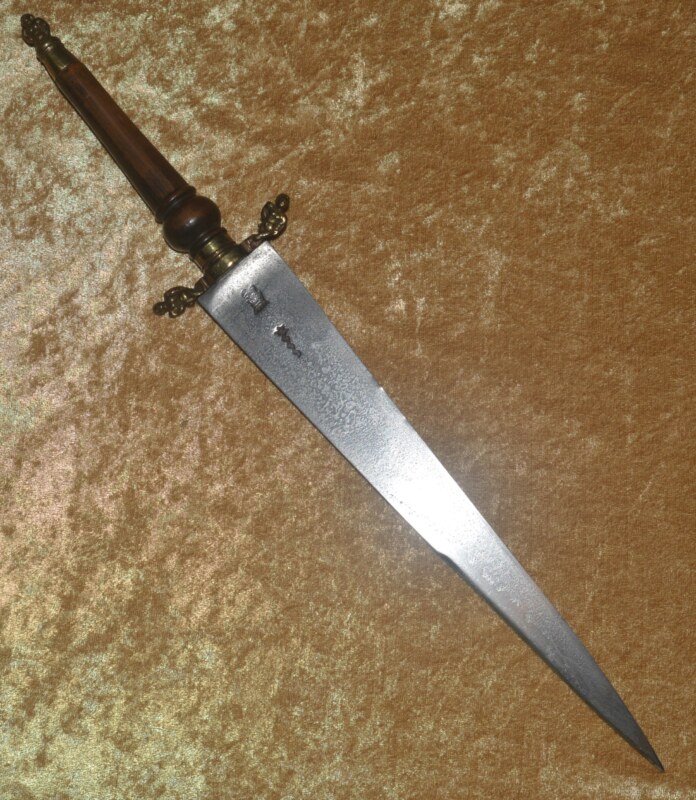
German Knightly Dagger, ca. 1540. Featuring 10 5/8” (27 cm) blade of flattened diamond section, tapering to a sharp point. Vertically fluted quillon block and down-turned quillions with button finials, chiseled ensuite. Guard is fused to the blade by corrosion. Fluted stopper-shaped pommel with button (loose), retaining what appears to be remnants of its original grip inside the cavity. In excavated condition, lacking grip, with scattered moderate to heavy pitting and dark patina. Possibly a river find, as it is in generally better condition than most ground finds. Overall length 16 1/4” (41.3 cm). Provenance: Hermann Historica, Munich, Oct. 11, 2023, Lot 1145
  • Nation : -
  • Local Price : 2,750.00 USD
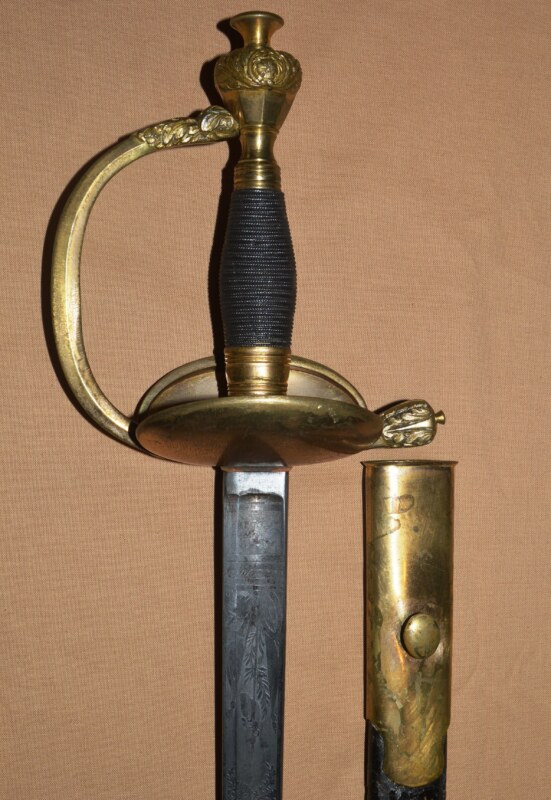
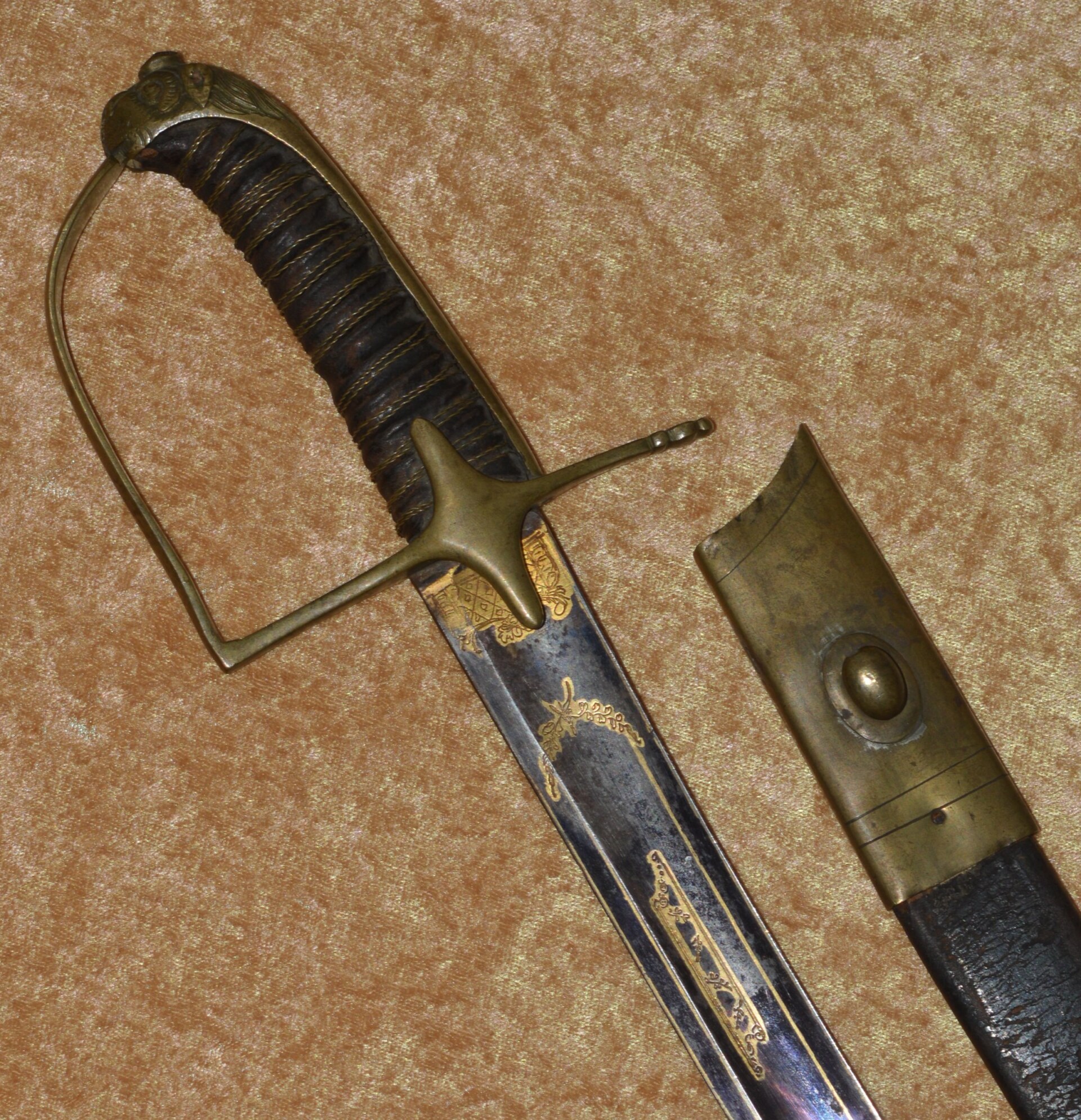
US M.1832 GENERAL OFFICER’S SWORD. An exceptional example of a rare pattern is Peterson #113. Gilt hilt with boat-shaped guard. The guard edge and knuckle bow with the beaded motif. Olive-shaped pommel secured with a nut. Silver sheet simulating wire wrap to the grip. 30 ½” broad d.e. blade decorated with naturalistic foliage, potted foliate display, Eagle with motto ribbon, arms display with crossed cannons, draped vignette, and Indian headdress with star band. Exceptional condition throughout. The decoration is uniform and complete. Hilt with near-all heavy gold overlay, the left edge of the guard, and the pommel top are only weak/worn from being worn and resting the hand on the pommel. Just the second example we have ever offered and the best we have seen.
  • Nation : Italian
  • Local Price : £1980
Italian Schiavona dating to circa 1740. A Venetian Schiavona dating to the early 18th century. The hilt is a typical representation of the distinctive design of the Schiavona guard, consisting of a complex trellis of delicately formed flattened bars swollen in the middle with rounded and well finished edges. This style of basket hilted sword is unique to northern Italy and particularly the territories held by the Venetian Republic throughout the early modern period which was also a powerful naval force in the eastern Mediterranean. The angled rear quillon terminates in a globular finial. The brass pommel is fashioned in the typical cat's head shape with integral button and waisted collar beneath and is finished with a grotesque mask on each side. The knuckle bow terminates at the top with a knopped loop secured to the forward pommel ear. The wooden grip is covered with an attractive brass wire binding and mounted with brass ferrules top and bottom. Typically, the hilt is asymmetrical and is made for a right-handed user indicated by the position of the thumb loop inside the basket guard. The guard is most complex and decorative on the outside where it protects the upper hand of the user, whereas the inner face, less visible and less important for defence, consists of fewer bars which creates a lightweight but strong structure for the hilt. The single edged blade has a single broad fuller extending from the end of a short ricasso near the hilt to the tip. The blade is just over 31.25 inches (79.5 cm) long and in total the sword is just under 37 inches (94 cm) long. The sword is in good russet condition covered with an attractive and consistent brown patina with minor patches of light pitting on some parts of the hilt.
  • Nation : British
  • Local Price : £1975
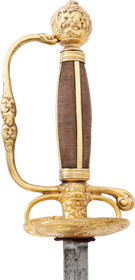
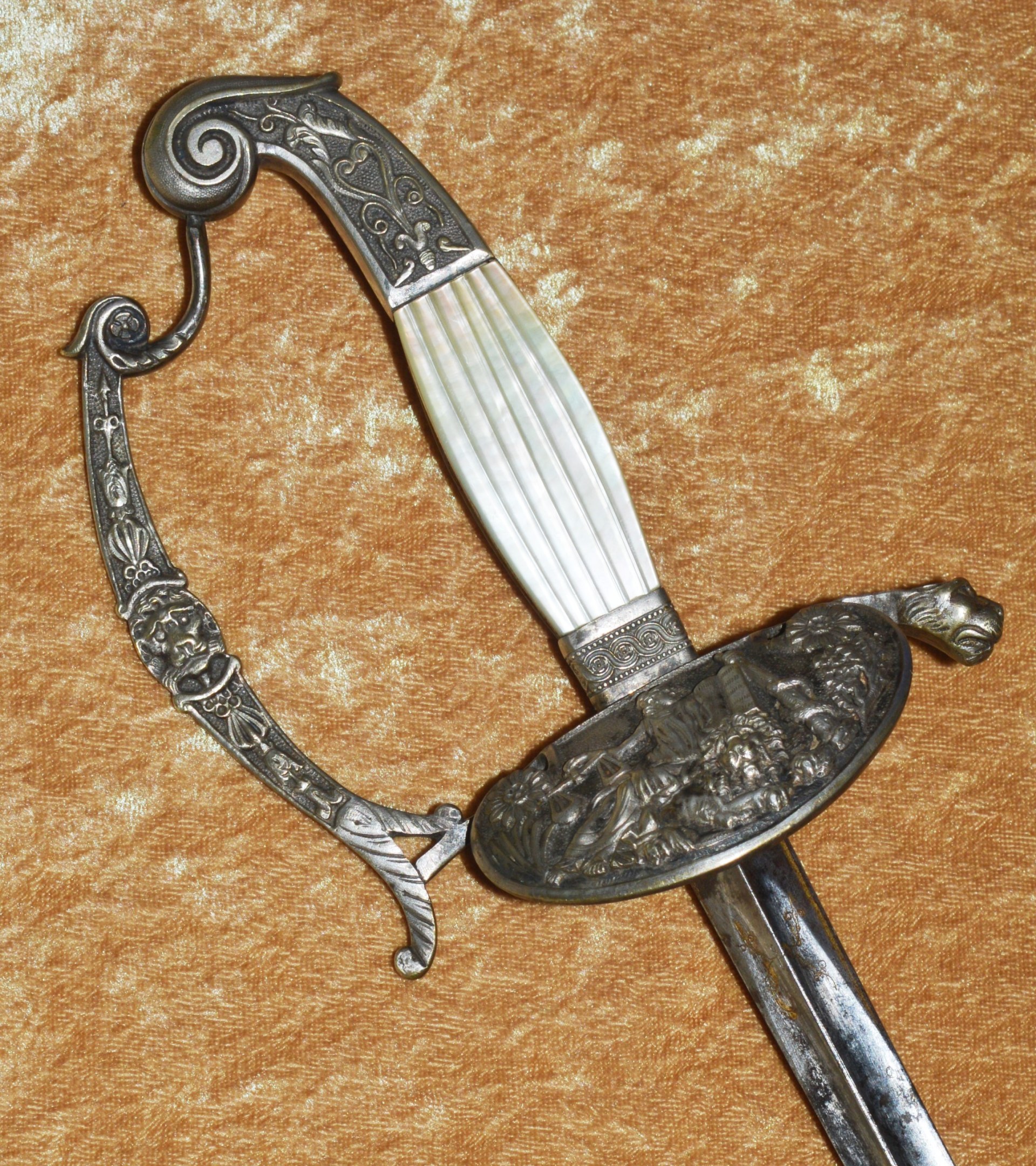
English Silver Hilted Small Sword by John Radborn of London Hallmarked for 1767 / 1768. An English silver hilted small sword by John Radborn of London with hallmarks for 1767 / 1768.  The hilt is mounted with a dish guard which is exquisitely pierced and chased with rococo foliate scrolls between curling tendrils on both sides of filigree delicacy. The design is the common theme on the other major silver components of the hilt which attests to the homogeneity of the parts. The sword is well-balanced in  hand and the silver hilt is, unusually, in excellent condition having experienced almost no wear, and has maintained its shape without damage or repair.  The sword is mounted with a tapering hollow ground triangular section blade. The hilt is an example of the high standards of design and execution required of the 18th century London silver hilt maker, as well as an example of one of the most effective weapons of the 17th and 18th centuries, which at this time was at the pinnacle of its evolution. Silver hilted small swords were fashionable attire for gentlemen. Mostly worn for effect, someone wearing such a sword was also announcing to the world that he was able to use it. Despite the stylish and often delicate appearance of these swords they were formidable dueling weapons. The sword hilt is in excellent crisp condition without losses or repairs and has maintained its original pleasing profile. The shallow dish guard has a strengthened rim shaped as four crescents on the outside which supports the  chased foliate designs within. The ricasso, pas d' ane rings, knuckle bow, quillon and pommel are pierced and chased in the same decorative style as the dish guard. The stamped maker's mark of “I R” is present on one side of the knucklebow near the pommel in raised relief inside a depressed rectangle, accompanied by the crowned leopard's head assay mark, the royal lion passant purity and date marks. The baluster shaped rounded rectangular section grip is covered with spirally wrapped bevelled silver strip, separated by wrapped silver twisted wire, flanked by thinner ropes on either side. Silver cap terminals are present top and bottom of the grip engraved with scallops on each side. The tapering, hollow ground, stiff, triangular section blade is in good mottled condition and retains evidence of its original engraved foliate panels near the hilt. John Radborn was one of the most gifted silver hilt makers and sword cutlers of his time.  He worked in the New Street precinct of the City of London for all of his professional life. He is first recorded when he was indentured to the cutler Nathaniel Young in 1737.  On the death of Young in 1742 he was turned over to John Smith for the remainder of his term and was sworn free of the Cutlers' Company by servitude in 1745 when he probably entered his first mark at Goldsmiths Hall which is now lost. His first surviving mark was entered in 1762. On moving address in 1769 Radborn entered another mark which was very similar to the last to confirm the move. He was admitted as a pensioner of the Cutlers' Company in 1776 and died in 1780. For further information on John Radborn see Leslie Southwick “London Silver-Hilted Swords”, their makers, suppliers and allied traders, with directory, 2001, Royal Armouries, and particularly page 206 for the biography and examples of his work in plates 46, 66, 72-3, 74 and colour plate 3. The blade is just under 33.25 inches (just over 84.5 cm) long and the overall length of the sword is just under 40 inches (101.5 cm).
  • Nation : British
  • Local Price : £1975
Click and use the code >22086 to search for this item on the dealer website Wonderful Circa 3000 Year Old Original Sword From the Time of the Ancient Greek ´Heroic Age´ Such as The Era of The Seige of Troy and The Trojan War
  • Nation : British
  • Local Price : £1,950.00
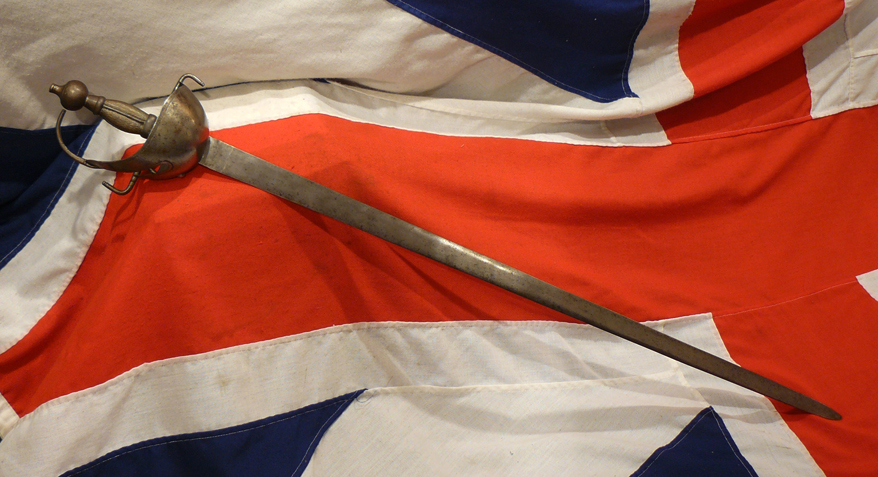
English Military Small Sword by John Hillman c 1764. English Small Sword by John Hillman c 1764 Pierced steel hilt with stunning detail including trophies of arms indicating this was produced for a military officer and floral designs please see detailed images. The silver wrapped hilt is complete with no damage and the whole sword is tight no loose parts, the etched colichemarde blade hollow ground 29.75 inch long. John Hillman is recorded to have worked in New Bond Street London 1764 and the sword is complete with top and middle scabbard mounts which is engraved with Hillman Bond Street although faint.
  • Nation : British
  • Local Price : £1950
English Silver Hilted Hunting Hanger by John Carman (I) Hallmarked for 1740 / 1741. An English Silver Hilted Hunting Hanger with London Hallmarks for the year 1740 / 1741, made by the silver smith and cutler, John Carman (I) of The City of London. This plain but elegant hanger was a gentleman's weapon. The most distinctive feature of the hilt is the large convex scallop-shaped shell guard with its moulded edge which emanates from the cross guard at the front and extends parallel to the blade towards its point. The knuckle bow is clearly marked midway along one side with incuse stamps for the date, the royal lion passant, the crowned leopard’s head assay mark and the makers mark of “J C”.  The leopard’s head and lion stamps are repeated underneath the hilt. This maker’s mark is most certainly that of the London cutler and silver hilted sword maker John Carman (I). The top of the knuckle bow is secured into the pommel cap with a terminal hook of usual form. The pommel cap has an integral ribbed button on top and is grooved at the side in similar style to the base ferrule of the grip. The attractive grip is formed from four plates of natural horn. The curved, single edged blade broadens slightly at the tip and is 25 inches (63.5 cm) long. It has a short ricasso and a single fuller which extends from the hilt underneath the spine of the blade and terminates almost at the tip. The blade on each side is marked with the talismanic date 1555. The  numbers are separated in the middle by an orb mark with a cross attached either side. The word “S A H A G V M” appears inside the fuller on each side. This mark appears with variants on a number of blades in the 17th and 18th centuries mounted on Dutch and English swords and were probably made in Solingen. During the 17th and 18th centuries, when swords were a popular weapon for gentlemen, hunting swords and hangers were a robust, shorter, secondary side arm used for self defence when walking about town and travelling in general. Although referred to as “hunting” weapons, they probably had minimal use in hunting. Self defence in crowded areas, and in the tight confines of dangerous alleyways in cities, required a weapon which was shorter than a full length sword for close-in use in these confined spaces. The blade of this weapon is a fighting blade which would probably have been impractical to use in a hunting environment and further outlines the misnomer of the term “hunting” when  generally applied to these swords. The date of this hanger shows that John Carman (I) made it shortly before his death in 1741. Unfortunately the signature mark is no longer available to us in the records at Goldsmiths’ Hall. The Smallworkers’ Book of 1739 – 1757 which might have recorded this mark, plus many others struck between these dates, is now lost. John Carman (I) had a son who was also a silver hilted sword maker and cutler.  He is recorded from 1721 when he was born until 1664 when he died. He was indentured to his father, and sworn free by servitude of the Cutlers’ Company in 1743. It is likely that he registered a mark then, or shortly after, possibly prompted by the death of his father and the resulting need for stability in the business.  Given these circumstances John Carman (II) could not have had his own name mark registered at Goldsmiths’ Hall and be making swords in his own right before 1743. Hence the mark is of Carman (I) given the absence of any other recorded makers with names that may have marked in this manner at this date. The above reference work borrows from Leslie Southwick, “London Silver – Hilted Swords, Their makers, suppliers & allied traders, with directory”,  2001, Royal Armouries. The sword overall is in good condition. The total length is 30.25 inches (79.5 cm).
  • Nation : British
  • Local Price : £1,950.00
Wilkinson Sword VC Officer&#acute;s Sword – Thomas Colclough Watson. Wilkinson Sword VC winners Officer&#acute;s Sword belonging to Thomas Colclough Watson Victorian Engineers officer&#acute;s sword number 35643 regulation sword with steel guard with VR and crown and fisk skin grip. The blade with owner&#acute;s initials J C W Royal Engineers regimental badge and maker marked. It is complete with steel scabbard and is sold with a copy of the Wilkinson Sword register. Notes: Watson was 30 years old, and a lieutenant in the Corps of Royal Engineers, British Army, attached to the Bengal Engineers, British Indian Army during the First Mohmand Campaign in British India when, on the night of 16/17 September 1897 in the Mamund Valley, North-West India, Lieutenant Watson and James Morris Colquhoun Colvin collected a party of volunteers (including James Smith) and led them into the dark and burning village of Bilot, to try to dislodge the enemy who were inflicting losses on British troops. After being wounded and driven back by very heavy fire at close quarters, Lieutenant Watson made a second attempt to clear the village and only gave up after a second repulse and being again severely wounded. An account mentioning him is given in Winston Churchill’s “The Story of the Malakand Field Campaign”.
Page 34 of 160