
Show

Forgot your password?

Error message here!

Error message here!

Error message here!

Error message here!

Show Error message here!

Show Error message here!

Lost your password? Please enter your email address. You will receive a link to create a new password.

Error message here!

Back to log-in

Close

For Sale

The following items are listed by for sale by users of the site and dealers. They are in no way endorsed or guaranteed by www.antiquearmsresearch.com

Add a Classified Item
to

Clicking on the sword will take you through to the relevant classified item or dealer site.
Don't miss out! - Do you want to be kept informed weekly of new aditions? Just join our weekly update list.

You can also receive regular email notifcations when items match your keywords. To recieve them just register or logon at the top right of this page.

Page 46 of 118
  • Nation : British
  • Local Price : £1,050.00
British WW1 1907 Pattern Bayonet with Early Hooked Quillon, 2nd Battalion Loyal Lancashire Regiment, East African Campaign. Straight single-fullered knife blade, steel hilt with muzzle ring and distinctive forward-curving lower quillon, wood slab grips secured by two screws, steel beaked pommel with locking button. Brown leather No. 1 Mk 2 scabbard with steel locket & teardrop frog stud and steel chape piece. Brown leather 1914 Pattern frog with buckled retaining strap and rear strap to attach a helve carrier. This bayonet is still in its original configuration with hooked lower quillon and no oil hole: the quillon was ordered to be removed from new production bayonets in October 1913 and existing examples were often removed by grinding during repair. The ricasso is stamped on one side with a crown over 1907 (the pattern), 11 ‘10, indicating the manufacture date to be November 1910 and the maker’s mark ‘EFD’ for the Royal Small Arms Factory at Enfield. It is stamped on the other side with a ‘broad arrow’ War Department stores mark, two crown inspection marks with ‘E’ for Enfield, a small stamp made up of another broad arrow over ‘EFD’ over ‘51’, and an ‘X’ indicating that the blade passed a manufacturer’s bending test – this appears to have been double-stamped. The pommel is stamped with ‘2.N.L.’, indicating the 2 nd Battalion, The Loyal North Lancashire Regiment, and the weapon number ‘479’. The scabbard is identically stamped at the throat with ‘479’, confirming that they are an original pair, and next to the staple on the throat and chape pieces with a faint mark that looks like ‘AM’ over ‘OA.12’ – this probably refers to a manufacturer. The leather body of the scabbard is stamped next to the seam with the date ‘13’ as well as ‘1113’, ‘I^M’, (where the ^ is a broad arrow), which I think is an Indian stores mark, and the letter ‘A’. The rear of the frog is faintly, informally marked by poking dots and scratching lines, with what looks like ‘18278’ and ‘F.T.’, which might be a previous owner’s initials and soldier number. The frog is of the British 1914 Pattern (part of the Infantry Equipment, Pattern 1914 set of leather webbing). It retains the strap on its reverse side which could be used to attach the helve carrier for an entrenching tool. The 2 nd Battalion of the Loyal North Lancashire Regiment was one of only two British battalions deployed to East Africa during the First World War, and the only battalion of British regulars (the other being the newly formed 25th Battalion, Royal Fusiliers). At the outbreak of the war it was deployed to Bangalore, India, joining the 27 th (Bangalore) Brigade of the British Indian Army. The Bangalore Brigade was tasked with invading German East Africa via the port of Tanga (in modern-day Tanzania), arriving in November 1914. Despite a substantial numerical advantage this attack, now known as the Battle of Tanga, failed with disproportionate casualties for the invasion force and substantial losses of equipment. The 2 nd Battalion had made better progress than most of the British-Indian force but had to withdraw back to their transport ships, which took them to Mombasa. The German East African forces fought a highly mobile guerilla campaign ranging across what is now Uganda, Kenya, Tanzania, Zambia, Malawi, the Congo, Rwanda, Burundi and Mozambique, under the capable command of Paul von Lettow-Vorbeck. While their strength rose to a peak of 11,000 men at the end of 1915 they remained far outnumbered by British Empire forces, who also had support from Belgian and Portuguese allies. Both sides suffered greatly from supply shortages and disease, and the 2nd Battalion was no exception – it had to be withdrawn from the fight in May 1916 due to ill health among its troops. Early German successes such as Tanga did not translate to long-term advantage, and from 1916 on they were forced out of German East Africa and ground down by the diverse British Empire force, by then under the command of equally capable guerilla fighter Jan Smuts. Their last 1,500 men surrendered in accordance with the Armistice in November 1918. After recuperating in South Africa the 2 nd Battalion was transferred to Egypt in January 1917. It seems to have remained in poor condition and was posted to guard lines of communication. In May 1918 it arrived in France and was attached to the 34 th Division, with which it took part in various battles of the Hundred Days Offensive in the closing stages of the war. The Loyal North Lancashire Regiment became the Loyal Regiment (North Lancashire) from 1921. It was amalgamated with the Lancashire Regiment in 1970 to form the Queen's Lancashire Regiment, which merged with two others in 2006 to form the present-day Duke of Lancaster's Regiment. There is good reason to think that this bayonet was carried by the 2 nd Battalion during their time campaigning in East Africa. We know that before the war the 2 nd Battalion was posted to India and had been there since 1910, the year of this bayonet’s manufacture – before that date it had been in Mauritius so it was certainly away from home when the new bayonet was delivered to them. The scabbard is dated 1913, is probably of Indian manufacture but is identically numbered to the bayonet, suggesting they were brought together in the regimental armoury in 1913 while it was stationed there. This gives the overall picture of pre-war equipment that would have been part of the 2 nd Battalion’s stores in India as of 1914, meaning it is very likely to have been taken with them and carried into the Battle of Tanga and subsequent engagements. The blade is mostly bright, one area of spotted pitting and patination to the spine. The blade retains its blued area at the ricasso. The hilt, exposed tang and pommel have a blued finish. The wood grips have only a couple of dents and some patches of oil staining. The leather scabbard body has light rubbing and surface-level cracking. It is quite flexible, and one should take care to support it once the blade is withdrawn from it. The scabbard fittings are blued, one dent to the chape piece which does not interfere with sheathing and drawing. The frog is in good condition, its leather flexible, some rubbing to the edges on the front side and the retaining strap. One small keyhole-shaped hole to the rear side of the belt loop, just under 1cm long.
  • Nation : German
  • Local Price : £1,450.00
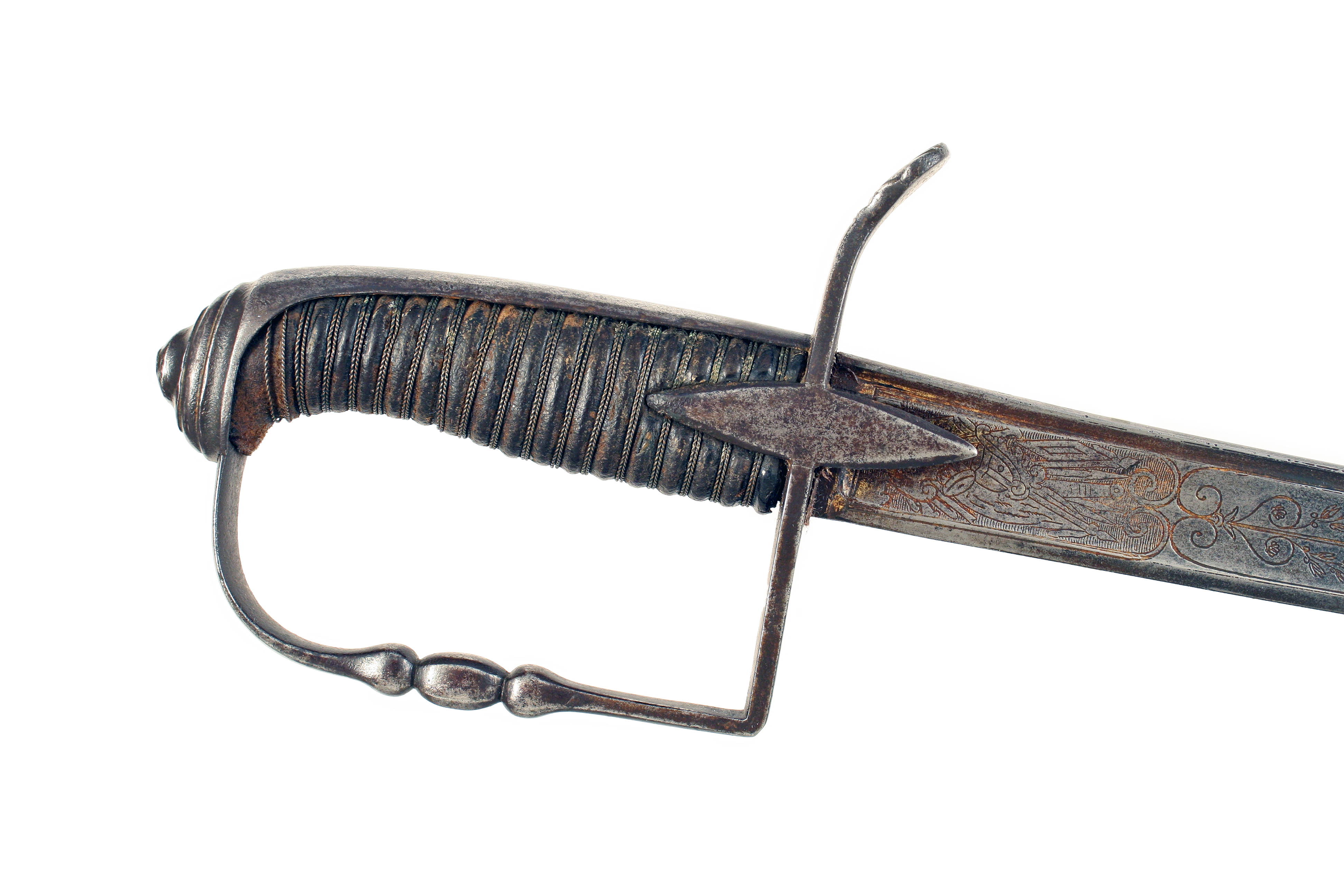
A Prussian Cavalry Officers Sword, Circa 1780.. A Prussian Cavalry Officers Sword, Circa 1780. With slightly curved single edged blade, cut with a narrow fuller running the entire length of the blade and a shallow central fuller engraved with geometric designs and a ‘G’ within a wreath, clipped at the point, the back edge decorated with scrolling foliage at the hilt, D shaped hilt, wire bound grip, in original fluted scabbard. Dimensions: Blade Length: 34.5 Inches (87.65 cm) Overall Length: 40 Inches (101.60 cm)
  • Nation : Unknown
  • Local Price : £1,450.00
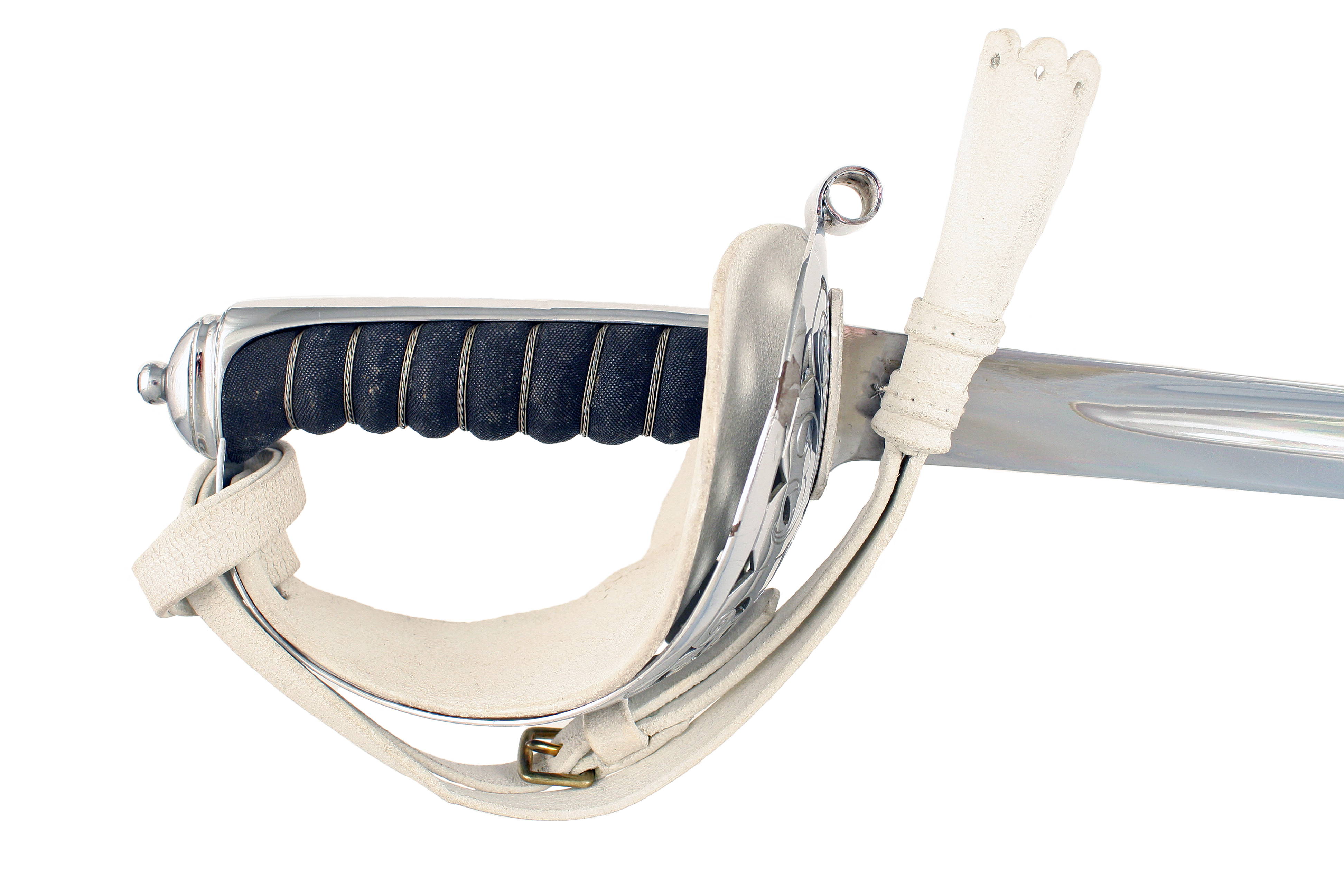
A Superb 1892 Pattern Household Cavalry Troopers Sword. An 1892 Pattern Household Cavalry Troopers Sword. In near mint condition. With unsharpened single edged slightly curved blade, double edged at the point, cut with a central fuller and stamped at the forte with various ordnance stamps and ‘NCO MESS’ with regulation steel hilt pierced with scrolls and a crown over ‘HC’, wire bound fish skin grip, in steel scabbard with two fixed and one loose suspension ring, complete with buff leather hilt liner and sword knot of leather strap and acorn. Dimensions: Blade Length: 34.5 Inches (87.60 cm) Overall Length: 41.5 Inches (105.40 cm)
  • Nation : Unknown
  • Local Price : £1,450.00
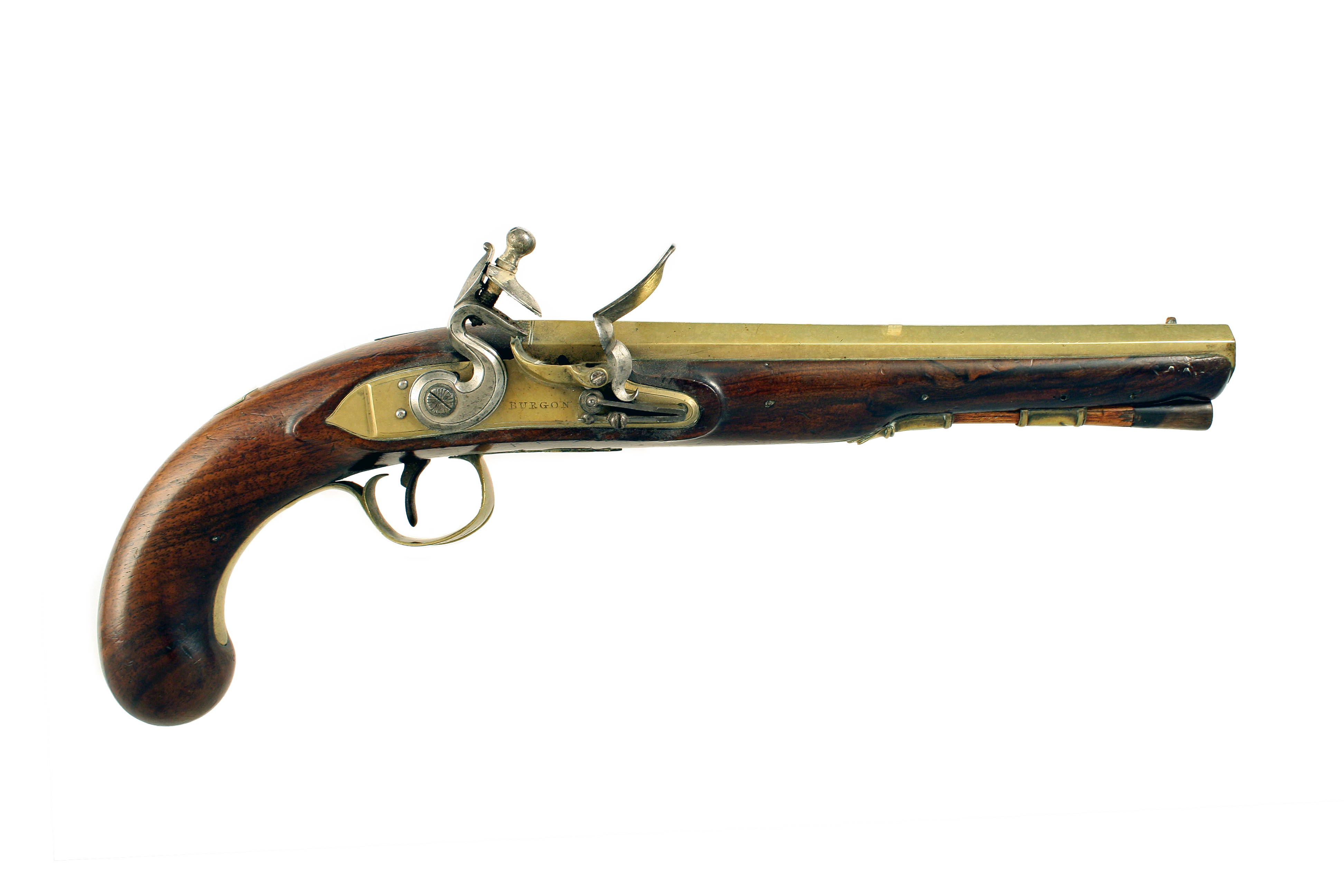
A Good Brass Barrel Flintlock Officers Pistol by Burgon.. A Good Brass Barrel Flintlock Officers Pistol by Burgon. With sighted octagonal barrel, engraved, ‘LONDON’ along the top flat and decorated with a geometric band at the breech, border engraved steel tang decorated with foliage, stepped bevelled brass lock, engraved steel cock, full-stocked in walnut with brass mounts comprising trigger guard engraved with foliage on the bow and pineapple finial, turned ramrod pipes and original horn tipped ramrod with worm. BURGON John. Hardwareman, Cutler, Gunmaker & Gun Flint Dealer, 15-16 Fish St. Hill (Opposite the Monument). 1790-1811. Contractor to Ordnance and Hudson’s Bay Co., from 1790; East India Co. 1796-1822. Howard L. Blackmore (1986) Gunmakers Of London, 1350-1850. George Shumway Publisher. US Dimensions: Bore: 22 Bore Barrel Length: 9 Inches (22.85 cm) Overall Length: 14.5 Inches (36.85 cm)
  • Nation : Unknown
  • Local Price : £1,450.00
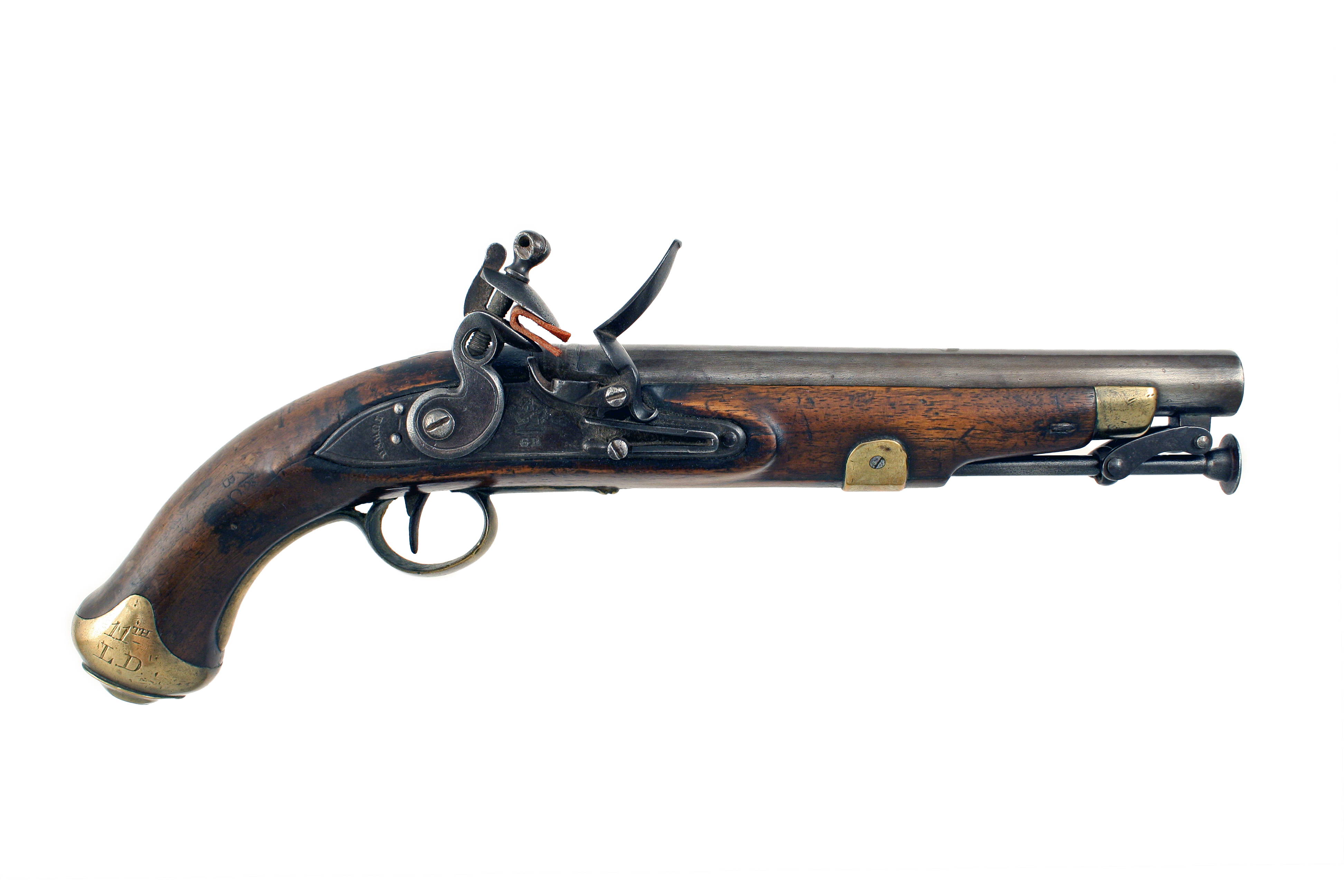
A Flintlock Light Dragoon marked 11th Light Dragoons. New item, description to follow.
  • Nation : British
  • Local Price : £1450.00
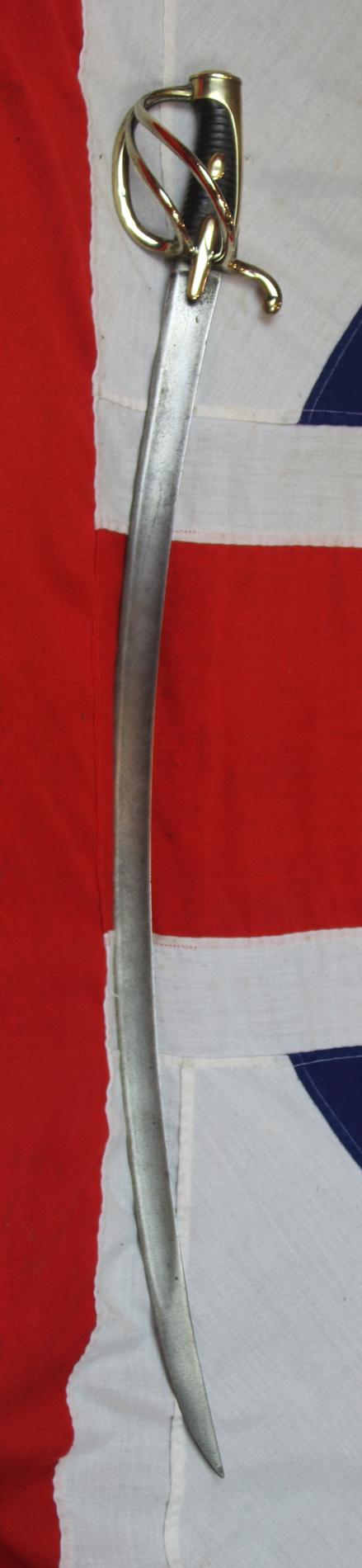
A Very Fine & Rare Original Napoleonic Wars ANXI Light Cavalry Trooper's Sabre. Used by Napoleon's Most Famed Lancers, Hussars, Chasseurs. The Sabre Troupe de Cavalerie Légère Modèle AN XI. Very rare combat sabre for the troop, perfectly homogeneous and authentic to discover in superb state of conservation considering all the battles it experienced during the Napoleonic wars it deserves to find a fine place in a thematic collection. During a parade the sight of the hussars would the women’s hearts made wildly pounding. In combat they rode yelling most unearthly, cursing and brandishing their weapons. They had their own code - that of reckless courage that bordered on a death wish. The hussars were the eyes, ears and … egos of the army. With their look suitably piratical their hair plaited and queued they were one heck of mean buggers. Some regiments were composed of fellows who had a natural longing for a fight (or trouble !) The mutually supporting camaraderie of the hussars was important factor of their esprit de corps. Tactically they were used as scouts and screen for other troops and due to their combativeness were also used in pitched battles. It was not a rare sight to see a hussar in a forefront of a hack-and-slash melee, gripping his reins with his teeth, a pistol in one hand and saber in the other. Three bar guard the pommel back strap piece has a slight tilt forward complete the hilt's elegant form. One unique elements of this sabre is the leather bound, ribbed grip with its brass olive shaped stud. The arsenal markings are on the back of the slightly fulled 34 3/4 inch blade. Hilt stamped stamped by Joseph Innocent Krantz, Chef de Batt'on, the Napoleonic Imperial period sword inspector from 1812, and Jean George Bick's mark of 1812 a controller 1st class. Blade marked, Klingenthal Man Imperial Janvier 1813 {only Janvier 1813 is still easily visible} Joseph Innocent Krantz, Chef de Batt'on, stamp is also on the blade face Referenced in the works of Michel Pétard "Des sabres et des épées - Troupes à cheval de l'Empire à nos jours - Tome Second", pages 137 and 138; long-tailed cap; calf-covered wooden handle with brass olive mount. One of the rare sabres specifically made to re-arm the French cavalry after the catastrophic losses in 1812 in Russia. The disaster of 1812 in Russia It is estimated that 175.000 excellent horses of cavalry and artillery were lost in 1812 in Russia ! The remnants were mounted on Russian and Lithuanian peasant ponies. The rebuilding of the cavalry in 1813 was more difficult than infantry and artillery. Shortages of trained cavalrymen, officers, NCOs and war horses were critical. Promotions were rapidly handed out and temporary squadrons were formed. In the beginning of April 1813 general Bourcier gathered 10.000 battle-hardened veterans from 60 regiments spread across the countryside. The cavalry centres were in the cities of Magdeburg and Metz. Horses were coming from northern Germany. During Armistice was more time to train the young troops and many regiments showed improvements in their maneuvers. But they never reached the level of pre-1812. French Cavalry Under Napoleon. "When I speak of excellent French cavalry, I refer to its impetous bravery, and not to its perfection" - General Jomini Napoleon's Cavalry and Its Leaders "Cavalry is useful before, during and after the battle," wrote Napoleon, and he stressed the need for audacity in its employment and careful training to achieve true discipline. He was also insistent that careful categorization according to role was of great importance... It was some time before the French cavalry reached its full potential, as it had suffered the loss of many officers during the Revolutionary period, but by 1807 it was reaching its prime. The great charges led by Murat at Eylau and Grouchy at Friedland played vital parts in the outcome of these battles." (Chandler - "Dictionary of the Napoleonic Wars" pp 85-86) "Under Napoleon, the French cavalry were, in contrast to the infantry, far more renowned for their action in masses than for their duty as light troops. They were deemed irresistible, and even Napier admits their superiority over the English cavalry of that day. Wellington, to a certain degree, did the same. And strange to say, this irresistible cavalry consisted of such inferior horsemen ... no soldiers are so careless of their horses as the French." ("The Armies of Europe" in Putnam's Monthly, No. XXXII, published in 1855). Used in such battles as; In the Battle of Lützen (German: Schlacht von Großgörschen, 2 May 1813), Napoleon I of France defeated an allied army of the Sixth Coalition. The Russian commander, Prince Peter Wittgenstein, attempting to forestall Napoleon's capture of Leipzig, attacked the French right wing near Lützen, Saxony-Anhalt, Germany, surprising Napoleon. Recovering quickly, Napoleon ordered a double envelopment of the allies. After a day of heavy fighting, the imminent encirclement of his army prompted Wittgenstein to retreat. Due to a shortage of cavalry, the French did not pursue. The two armies would clash again in the Battle of Bautzen three weeks later. The Battle of Vitoria in North-Eastern Spain, to the South of Bilbao and near the French border. Wellington’s army comprised 52,000 British and 28,000 Portuguese troops. An army of 25,000 Spanish troops co-operated in the campaign. Wellington’s army had 90 guns. The French army, drawn from the Army of the South, the Army of the Centre and the Army of Portugal, comprised 50,000 troops (including 7,000 cavalry), with 150 guns. It was Wellington’s decisive defeat of Joseph Bonaparte’s French army on 21st June 1813 in North-Eastern Spain in the Peninsular War The Battle of Leipzig, also known as the Battle of the Nations, was fought from 16 to 19 October 1813 at Leipzig, Saxony. The Coalition armies of Austria, Prussia, Sweden, and Russia, led by Tsar Alexander I and Karl von Schwarzenberg, decisively defeated the Grande Armée of French Emperor Napoleon Bonaparte. Napoleon's army also contained Polish and Italian troops, as well as Germans from the Confederation of the Rhine (mainly Saxony and Württemberg). The battle was the culmination of the German Campaign of 1813 and involved 560,000 soldiers, 2,200 artillery pieces, the expenditure of 400,000 rounds of artillery ammunition, and 133,000 casualties, making it the largest battle of the Napoleonic Wars, and the largest battle in Europe prior to World War I. The War of One Hundred Days, culminating in Quatre Bras and Waterloo. This fabulous sabre was almost certainly a trophy of war from Waterloo, and any or all of the the previously listed battles it would likely have seen service within. After the fighting at Quatre Bras (16 June 1815) the two opposing commanders Marshal Ney and the Duke of Wellington initially held their ground while they obtained information about what had happened at the larger Battle of Ligny. They received intelligence that the Prussian army under the command of Prince Blücher had been defeated by the French Army of the North under the command of Napoleon Bonaparte. Upon receiving this news Wellington organised the retreat of the Anglo-allied army to a place he had identified a year before as the best place in Belgium for him to be able to employ his reverse slope tactics when fighting a major battle: the escarpment close to the village of Waterloo. On the 17th, aided by thunderstorms and torrential rain and before the arrival of Napoleon, Wellington's army successfully extricated itself from Quatre Bras and passed through the defile of Genappe. The infantry marched ahead and were screened by a large cavalry rearguard. The French harried Wellington's army, but were unable to inflict any substantial casualties before night fell and Wellington's men were ensconced in bivouacs on the plain of Mont-Saint-Jean. As with all our items it comes complete with our certificate of authenticity Without scabbard
  • Nation : American
  • Local Price : 1,450.00 USD
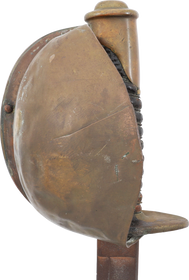
CONFEDERATE CUTLASS. Adapted from a captured Union 1860 pattern cavalry saber and patterned after the US model 1860 cutlass, probably by a ship's blacksmith. The blade with MANSFIELD AND LAMB maker's mark to the ricasso and US 1865 opposite. The blade shortened to 24 ¾” with the point reshaped and thinned appropriately. The hilt with the side bars removed and replaced with a brass semi bowl guard. Original wire wrapped leather covered grip, well worn. The hilt with dark patina. The blade with surface rusting which would clean easily, but should be left to preserve the character. The Confederate Navy protected Confederate harbors and engaged with the Union at blockaded ports to draw off gunships allowing blockade runner to dock. As well, the Confederate Navy sailed the globe disrupting supply ships headed to the north. To that end, Jefferson Davis in 1861 declared that the Confederate government would issue letters of marque, to any wishing to aid the South against US shipping, thus establishing privateers under the Confederate flag. The most illustrious of Confederate naval ships was the CSS Shenandoah which traveled as far as Australia and the Indian Ocean, capturing or sinking 38 vessels and remaining active until November of 1865. It was the Shenandoah which fired the last shot (across the bow of a whaler in the Aleutians) of the Civil War.
  • Nation : British
  • Local Price : £1400.00
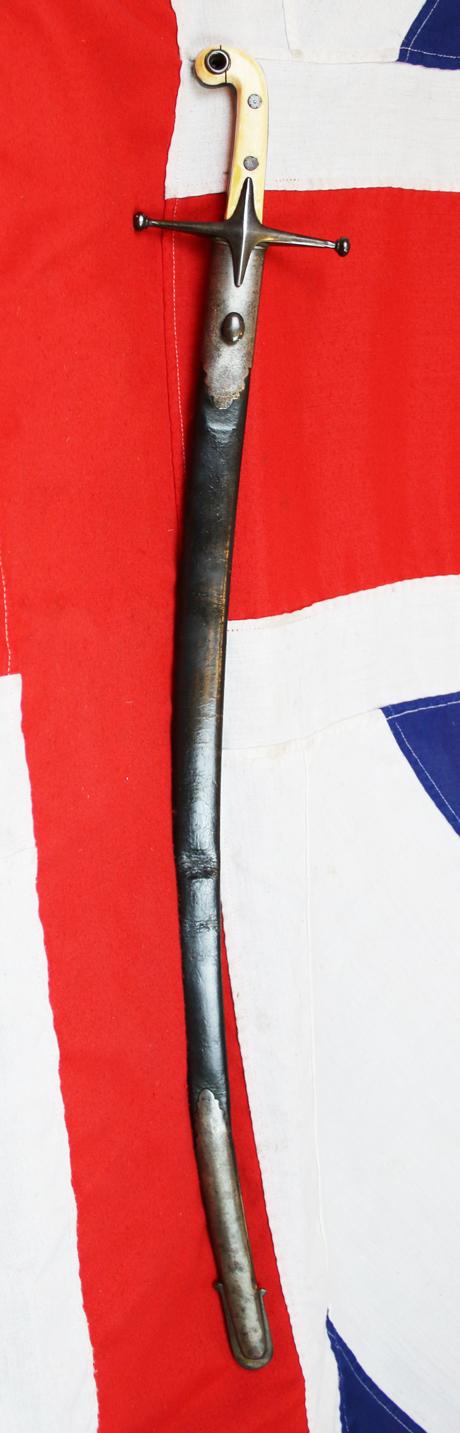
A Wonderful, Original, Napoleonic Wars, British Hussars and Light Dragoon Officer's Sword Circa 1805. In The Traditional Mameluke Style Adopted from the Mamelukes of the Battle of the Nile Campaign. The Favoured Sword Style of Napoleon and Wellington. In these British made versions of the Mameluke sword were in fact so popular for use by officers of both the British and French in the Napoleonic wars that it was formally adopted as the British generals and field marshals pattern of service sword in 1831, In overall superb condition, ivory and steel hilted Hussars sword, with steel mounted leather scabbard, from the Napoleonic Wars. British Hussars in the Napoleonic Wars, converted from light dragoons around 1803–1807, they acted as elite light cavalry for scouting, screening, and shock charges. Renowned for their stylish uniforms (pelisse, busby) and reckless bravery, regiments like the 7th, 10th, and 15th served with distinction in the Peninsula War and at Waterloo, often at the forefront The 15th Hussars (King's): Achieved fame at Sahagún (1808) under Sir John Moore, defeating two French cavalry regiments. They played a significant role at Vitoria (1813) and in the final Waterloo charge (1815). 7th Hussars (Queen's Own): Distinguished themselves at Orthez (1814) and conducted a notable rearguard action at Genappe before fighting at Waterloo. 10th Hussars (Prince of Wales's Own): Played a major role in the 1808–09 retreat to Corunna and was prominent in the 1813–14 battles of Morales and Vitoria. 18th Hussars: Heavily involved in the 1813 Vitoria campaign, where they were known for cutting off King Joseph’s retreat. We show a Portrait of Major Hodge of the 7th Light Dragoons with his same mameluke sword. Before 1815, during the Napoleonic Wars and the Battle of Waterloo, the Mameluke-hilted sword was a fashionable, often personal, choice for British light cavalry officers (such as Hussars) and high-ranking staff officers, rather than a standard 1796 light dragoon officer's sword. The style was adopted following campaigns in Egypt and India, influenced by Napoleon's Mameluke units and it was the personal preference of edged weapon of the Duke of Wellington. Pictures in the gallery of paintings of the Duke of Wellington, with his favoured mameluke sword. And another, held upon his shoulder by Charles Vane, 3rd Marquess of Londonderry, a British Hussar general, with his Mameluke sword of Turkish manufacture ( painted in 1812) All the steel mounts are very good, the hilt ivory is also good with a small north south crack at the pommel area. The leather is good and with a thumb print size bruise to the surface around 2/3rd the way down the scabbard. No scabbard seam stitching present at the reverse side. Ivory Declaration Submission IAntique ivory, 'worked' declaration submitted, but we can only sell this sword within the UK, it is not allowed for export. Ivory, however old cannot be imported into the USA.
Page 46 of 118