
Show

Forgot your password?

Error message here!

Error message here!

Error message here!

Error message here!

Show Error message here!

Show Error message here!

Lost your password? Please enter your email address. You will receive a link to create a new password.

Error message here!

Back to log-in

Close

For Sale

The following items are listed by for sale by users of the site and dealers. They are in no way endorsed or guaranteed by www.antiquearmsresearch.com

Add a Classified Item
to

Clicking on the sword will take you through to the relevant classified item or dealer site.
Don't miss out! - Do you want to be kept informed weekly of new aditions? Just join our weekly update list.

You can also receive regular email notifcations when items match your keywords. To recieve them just register or logon at the top right of this page.
Page 49 of 124
  • Nation : Spanish
  • Local Price : £1,000.00
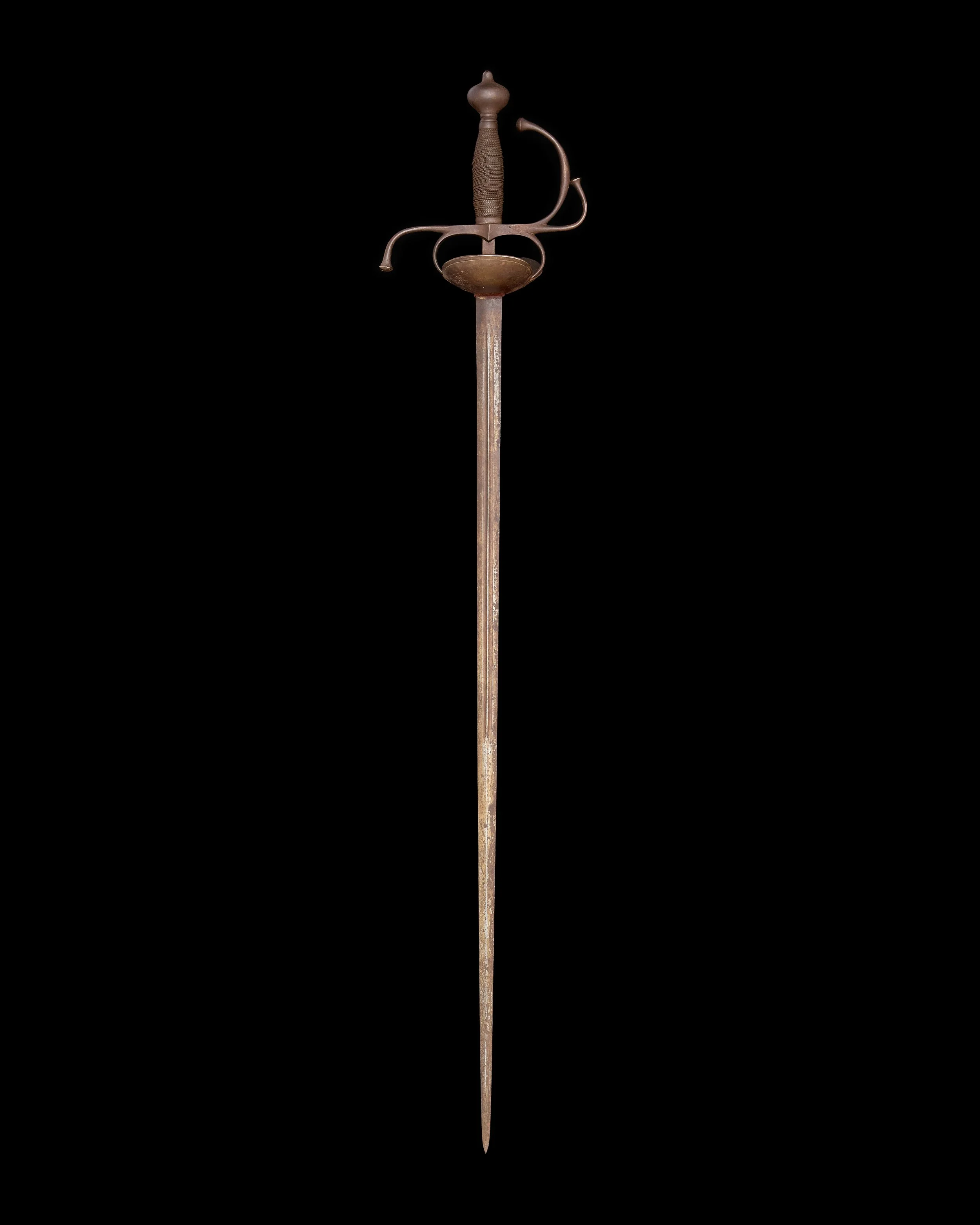
18th century Spanish Rapier. A good example of an early 18th century Spanish Rapier. Twisted wire grip, with an iron bulb pommel and an asymmetric shell guard. Deep double fullers stretching halfway down the blade, with a pleasing overall patina. Overall length 104cm, blade length 84cm. Solid overall with no movement in the blade or guard.Coming from the waning years of rapier production this piece was probably made for the Spanish market, potentially for their colonies in South America, where the rapier continued to enjoy robust popularity.
  • Nation : Chinese
  • Local Price : £1000.00
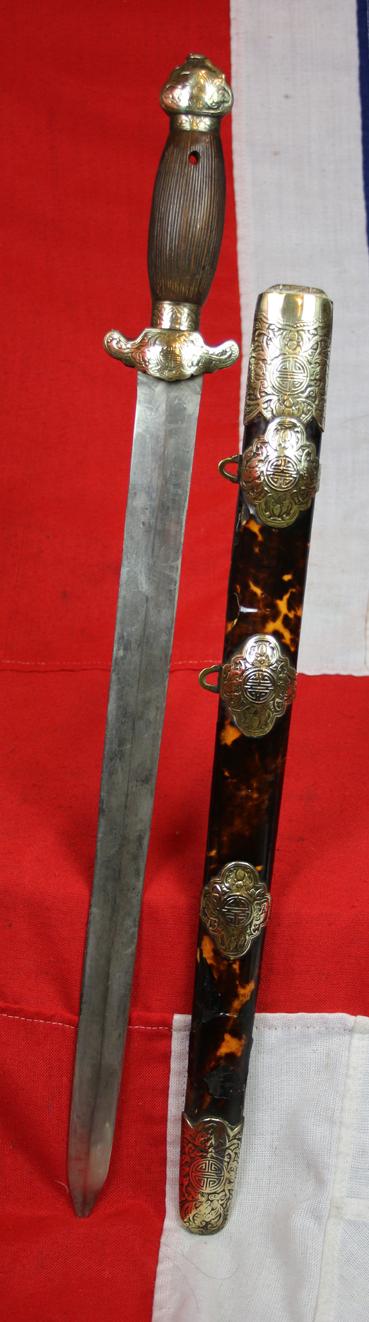
An Antique Ching Dynasty Chinese Small Sword Jian, Late 18th Early 19th century. Near Identical to Admiral Sir James Hanway Plumbridge's Sword in the National Maritime Museum Collection. This sword we acquired only last week due to our another example {now sold} that was shown on our website last week and immediately sold on. A Chinese jian sword, double edged blade lined darkwood grip, tortoishell covered scabbard, with typical stylized brass mounts, typically decorated with a traditional, intricate, bat and seal design. Double edged blade. Overall with stunning original patination that has been now revealed. It has just returned from ten hours of museum grade hand conservation and polishing.Thanks to such extraordinarily successful efforts, this would be a Chinese antique sword that would unlikely be to improve upon. Likely brought back to England as a souvenir of the Opium War period to the Boxer Rebellion. Truly original, antique, Chinese weapons are very scarce indeed, as historically, few swords were ever brought back from China. Porcelain and silk were far more popular and preferable souvenirs and exports for Europeans, and in China, in the mid 20th century, nearly all the surviving antique edged weapons were melted down and destroyed in the era of Mao, under Chairman Mao's Cultural Revolutionary instructions, in order to create new steel. A fabulous example that has breathtaking natural age patina. A near identical sword was once belonging to Admiral Sir James Hanway. His family believed he wore it as a midshipman at the Battle of Trafalgar in 1805. It is on display in the National Maritime Museum, exhibit number; WPN1157. Described as follows Chinese sword, which belonged to Admiral Sir James Hanway Plumbridge (1787-1863). The hilt of the sword consists of a gilt pommel and crosspiece with very short down-turned quillons, and a fluted brown grip. The hilt is ornamented with a design of bats, which are a symbol of good luck. The steel blade is straight and double-edged. The point of the blade has evidently been broken off; it is about an inch too short for the scabbard and is rather roughly ground. The wooden scabbard is covered with lacquered paper actually tortoishell, and has four gilt lockets and a chape, which is ornamented with a design of bats. The two middle lockets are fitted with loops. This sword was offered to the National Maritime Museum as the sword which was worn by Admiral Sir James Hanway Plumbridge when he was a Midshipman at Trafalgar. It is inconceivable that he wore a Chinese weapon at Trafalgar. He probably obtained the sword during one of his three commissions in the East Indies. Admiral Sir James Hanway Plumbridge (1787-1863) entered the Royal Navy on the 6th September 1799 and was a Midshipman in HMS 'Leda' in the expedition to Egypt in 1801. At Trafalgar he was acting 6th Lieutenant in HMS 'Defence', and on the 20th August 1806 he was confirmed in rank. See photos 9 and 10 in the gallery, it shows the admiral's identical Jian sword on display in the National Maritime Museum, the photos are sadly poor quality The two paintings in the gallery are original Chinese gouache of a seated Ching Emperor, and his sword bearer, holding the same type of Jian sword, but with a green tortoiseshell scabbard. The antique Chinese jian is a straight, double-edged sword used in China for over 2,500 years, with the earliest examples dating to the 7th century BC. We actually have some original, ancient jian museum pieces, from this era, acquired by us from the world renown Dove Collection. See them offered for sale within our website. It was a multi-purpose weapon, optimized for thrusting but also capable of cutting and slashing, and was a symbol of status. The design was effective and remained relatively consistent over long periods, with minor variations in length, weight, and balance. The jian's most defining feature is its straight, double-edged blade. While it could be used for both cutting and thrusting, it was often considered more optimized for thrusting than the single-edged dao (sabre). The jian was a symbol of power and status, wielded by the elite and sometimes carried as a symbol of authority. Its use dates back to the Spring and Autumn period, with some of the earliest specimens being the Sword of Goujian. Design variations: The length, balance, and weight of the jian varied significantly across different periods and purposes. It is a crucial tool in traditional Chinese martial arts training. Military use: It was a formidable weapon on the battlefield and, due to its length and reach, was sometimes used like a long spear to favour thrusting techniques. The jian is a significant symbol in Chinese culture and history, frequently appearing in films, historical reenactments, and museum exhibits. Antique jian are valuable as historical artifacts, collectibles, and striking decorative pieces. The jian is a double-edged straight sword used in China for the last 2,500 years. The first Chinese sources that mention the jian date to the 7th century BC during the Spring and Autumn period;47 one of the earliest specimens being the Sword of Goujian. Historical one-handed versions have blades varying from 45 to 80 centimeters (17.7 to 31.5 inches) in length. The weight of an average sword of 70-centimeter (28-inch) blade-length would be in a range of approximately 700 to 900 grams (1.5 to 2 pounds). There are also larger two-handed versions used for training by many styles of Chinese martial arts. In Chinese folklore, it is known as the "Gentleman of Weapons" and is considered one of the four major weapons, along with the gun (staff), qiang (spear), and the dao. The bottom section of the tortoishell has small areas of repair.
  • Nation : French
  • Local Price : $995.00
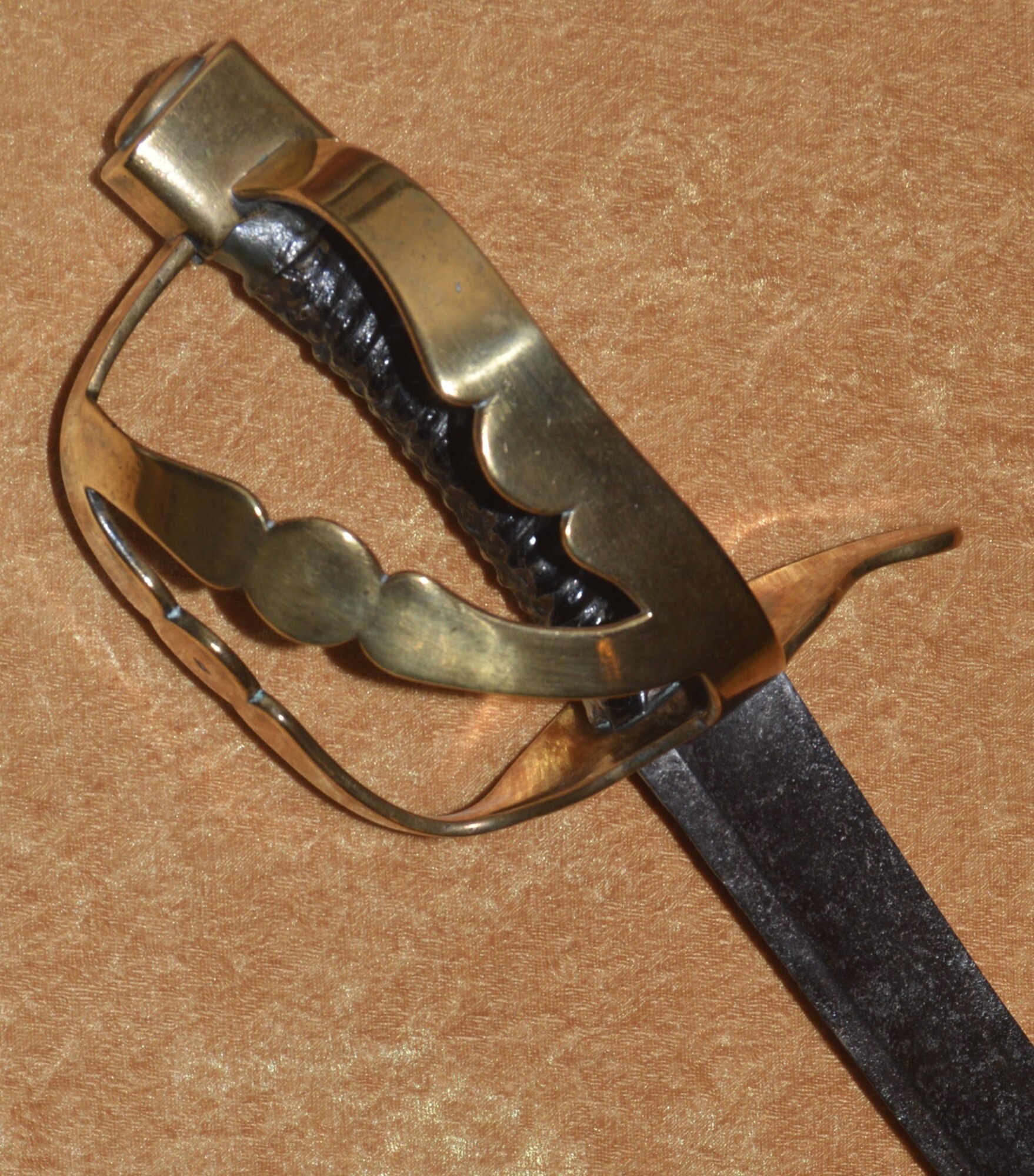
Rare French M1790 Chasseurs a’ Cheval Trooper’s Saber. This rare sword of the French Revolution and First Empire period features the distinctive half basket hilt formed of flat high copper content brass. Broad integral knuckle bow attached to the front of the pommel and stamped with a mark depicting a rooster. Another broad bar set at 90 degrees to the knuckle bow and attached to the side of the pommel, with a broad bar extending diagonally from its base to the upper portion of the knuckle bow. Underside of guard stamped “DUPONT.”. Original leather-bound grip (worn), lacking wire wrap. Curved 36″ single-edged blade with broad fuller extending to within 4 ½” of the point. Blade pitted, with no discernable markings. The guard cleaned in European fashion. From a large European collection of French Napoleonic era firearms and edged weapons. Overall length 42 1/4″. No scabbard. The Chasseurs a’ Cheval were light cavalry also trained to fight on foot.
  • Nation : British
  • Local Price : £995.00
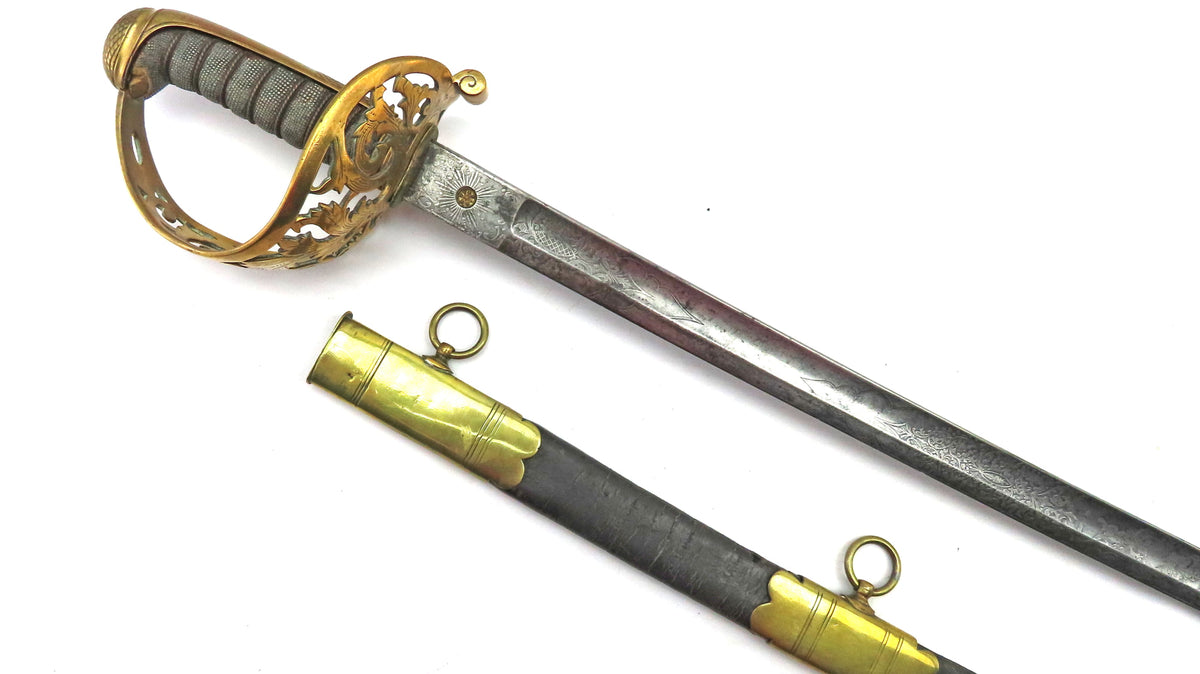
1857 Engineer EIC Officers Sword by Parker Field, rare. Ref 9367. A Rare Pattern 1857 Engineer EIC Officers Sword by Parker Field & Co. 38&157; overall, 32&157; fullered blade deeply etched with foliage & Crown over VR ´Parker Field & Co 233 High Holborn London´ to one side, the other with foliage & Crown over EIC rampant lion & proof mark. Gilt brass hilt, the bowl of open work scrolled form with engraved foliage. Gilt wire bound fish skin grip. In its black leather scabbard with brass mounts. Blade Circa 1845 and re-hilted Circa 1857. Rare sword in quite good condition, pitted towards tip. Scabbard stitching is poor. Parker, Field & Sons. John Field (son-in-law of William Parker) and sons, John William Parker Field & William Shakespeare Field, John Field died 1850, firm run by sons. Gunmaker 233 High Holborn, 1841-76; 122 Leman St., 1877-8; 59 Leman St., 1879-1881; 58 Mansell St., 1851-81; 82 Tavistock St., 1822-26. Contractors to Ordnance from 1841; East India Co. (As John Field & Sons), 1841-50 (as J.W.P. & W.F. Field), 1851-8; Hudson´s Bay Co., 1843-51. Armourers to Metropolitan Police. &194;&160; &194;&160; &194;&160; &194;&160; &194;&160; &194;&160; &194;&160; &194;&160; &194;&160; &194;&160; &194;&160; &194;&160; &194;&160; &194;&160; &194;&160; &194;&160; &194;&160; &194;&160; &194;&160; &194;&160; &194;&160; &194;&160; &194;&160; &194;&160; &194;&160; &194;&160; &194;&160; &194;&160; &194;&160; &194;&160; &194;&160; &194;&160; &194;&160; &194;&160; &194;&160; &194;&160; &194;&160; &194;&160; &194;&160; &194;&160; &194;&160; &194;&160; &194;&160; &194;&160; &194;&160; &194;&160; &194;&160; &194;&160; &194;&160; &194;&160; &194;&160; &194;&160; &194;&160; &194;&160; &194;&160; &194;&160; &194;&160; &194;&160; &194;&160; &194;&160;&194;&160; Images courtesy of West Street Antiques (https://antiquearmsandarmour.com/)
  • Nation : French
  • Local Price : $995.00
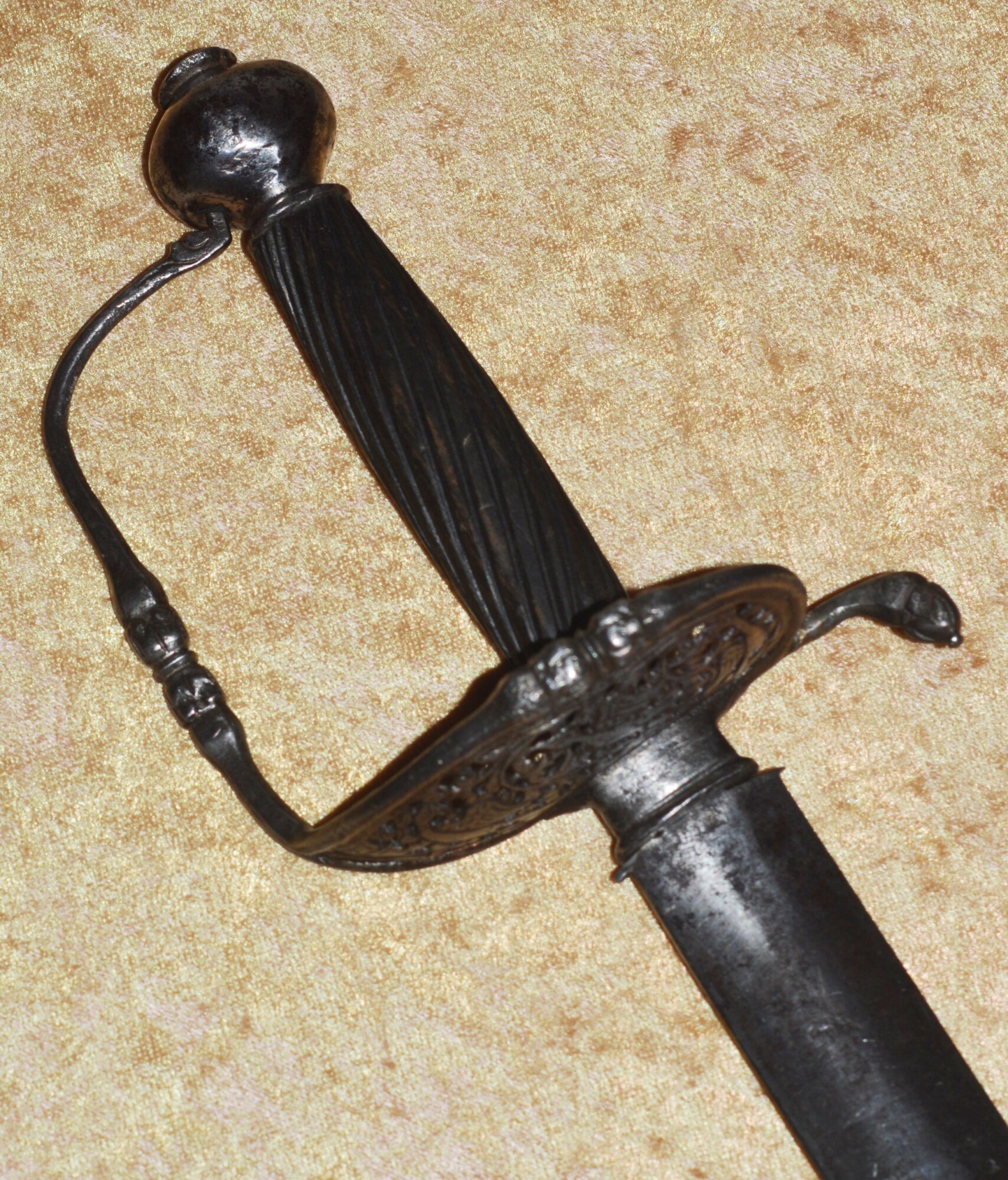
Late 17th C Officer’s Sword, French or German. Steel hilt featuring oval side ring with central chiseled decoration, filled with an inserted plate finely pierced and chiseled with foliage and birds. Single quillon with downturned acorn finial. Knuckle bow chiseled ensuite and joining the ovoid pommel with button. Original spirally carved wood grip (possibly ebony). Broad 26 1/8″ double-edged blade of flattened diamond section with long oval-section ricasso, retaining traces of an engraved design. Very good condition, the metal cleaned and showing patches of light pitting. Overall length 31 5/8″ (80.3 cm).
  • Nation : Austro-Hungarian
  • Local Price : $995.00
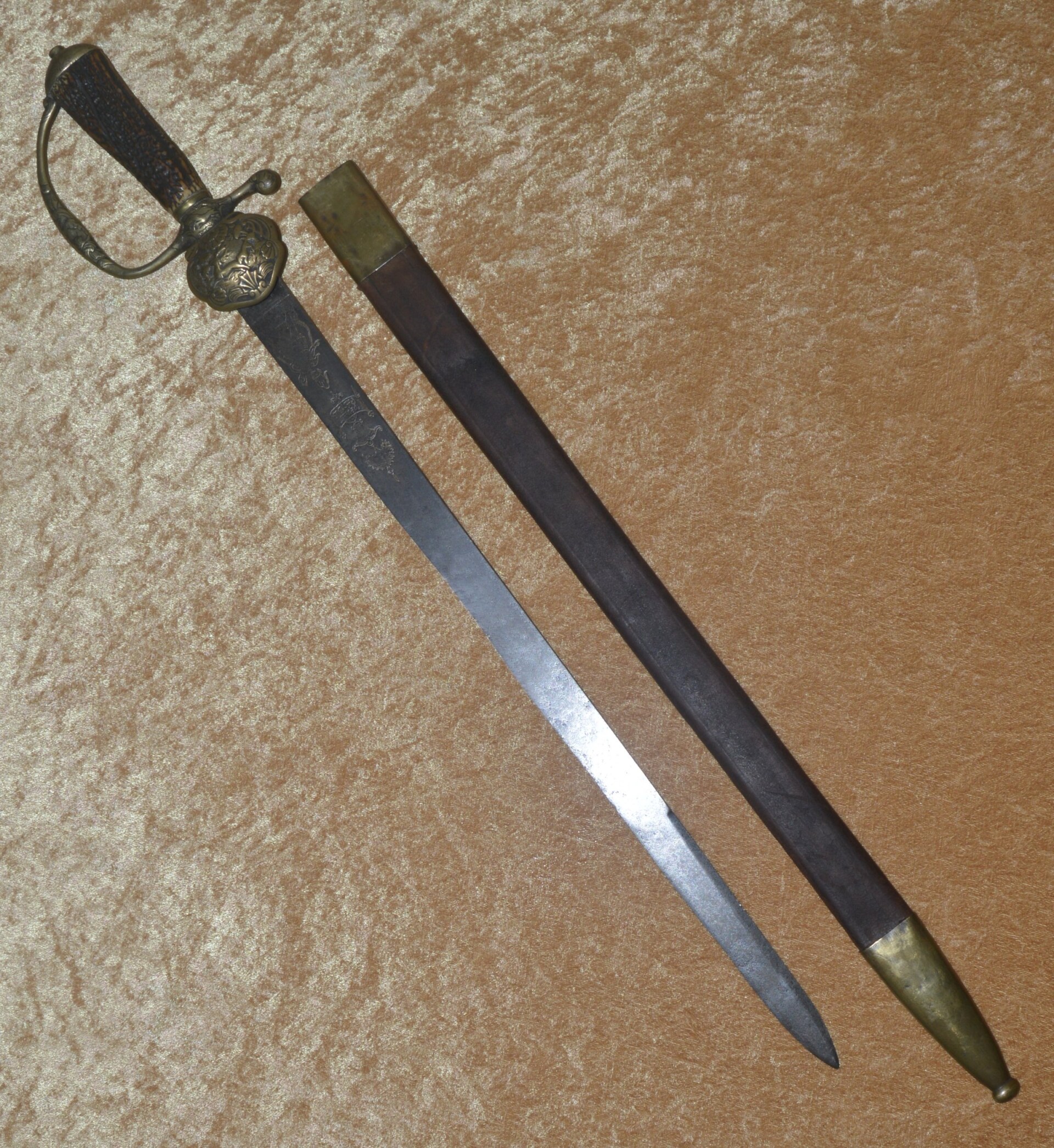
Austro-Hungarian Pandur Hunting Hanger, Mid-18th C. Featuring brass hilt comprising down-turned shell guard depicting a hound chasing a stag in relief, reverse quillon with engraved scroll quillon, knuckle bow with central design, and pommel cap with button; one-piece stag horn grip. Single-edged 21” (53.3 cm) unfullered blade, the last 6” double-edged; with gold-filled engraving in the upper third on both sides depicting a Pandur warrior with decorative banner above, reading “VIVAT PANDUR”. Original brown leather scabbard with brass throat and chape. Very good condition; the brass with pleasing patina; blade showing repeated sharpening, some edge nicks, and light pitting. Overall length 26 1/4” (66.7 cm), not including scabbard. In 1741, Franz Baron von der Trenck raised a corps of Pandurs in Slavonia for service in the War of Austrian Succession (1740-48). These irregular troops had no uniforms, but dressed in Ottoman style. The unit was largely composed of volunteers from the Kingdom of Slavonia and Slavonian Military Frontier. The Pandurs took part in the War of the Austrian Succession, including the First and Second Silesian War. They contributed to the capture or destruction of Zobten am Berge, Strehlen, Klaus Castle, Linz, Deggendorf, Diessenstein Castle, Cham, Cossel Fortress, and Munich. The Pandurs earned a reputation for being brave and audacious, as well as feared and ruthless soldiers, looting and pillaging, but also characterized by disobedience, breaches of military discipline and stubbornness.
  • Nation : Unknown
  • Local Price : £995.00
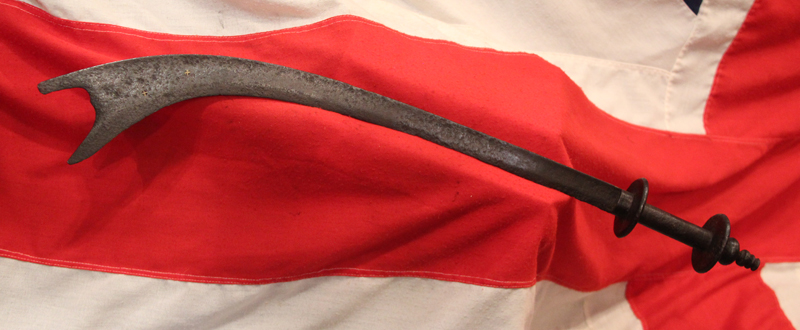
A Superb 17th Century Kora of the Gurkhas of Nepal. The blade has an unusual shaped tip, inlaid with brass cross devices within fine engraved borders and bands, twin disc guards, iron grip, stupa-shaped pommel. The Kora is possibly the oldest form of sword of the Gurkhas and it may well be that their phenomenal military success was largely due to their possession of such a terribly effective weapon." 'Kora,' has an inner cutting edge, with which those who use it skilfully are enabled to cut a foe in two at a single blow." Its appearance reminds of the European Sabre but instead of curving upwards (back) it has a wide tip, a forward curved blade, single edged on its concave side, the latter two characteristic sit shares with the Kukri knife. When used correctly the forward curved blade concentrates the power/energy of the strike to the curved area thus allowing more force to be utilised at the point of contact in each blow. It is designed with its practical application in mind, to chop/slash and not for Classical fencing, yet its usually light enough if the need arises. Like Nepal, the Kora & Kukri are strongly associated with the Gurkhas and was firstly illustrated in Col. William Kirkpatrick's work "An Account of the kingdom of Nepal?" published in London, 1811 based on his travels in 1793 to Nepal. There both the Kukri and Kora is for the first time illustrated to the wider worlds public. The Kora was traditionally used warfare and personal protection, but also played and still plays a function in the religious sphere where it is used to behead sacrificial animals in one blow, otherwise believed to bring bad fortune and the sacrifice is considered useless. Thus both a skilled man and a formidable blade is needed, the Kora certainly passes the criteria!. Photo 9 in the gallery of the Bagbhairab Temple, Kirtipur, Kathmandu, Nepal. they are Koras used from the battle of Kirtipur during the 1760`s. Blade 55cms, overall 70.5cms. Jolly nice condition for age.
  • Nation : German
  • Local Price : $995.00
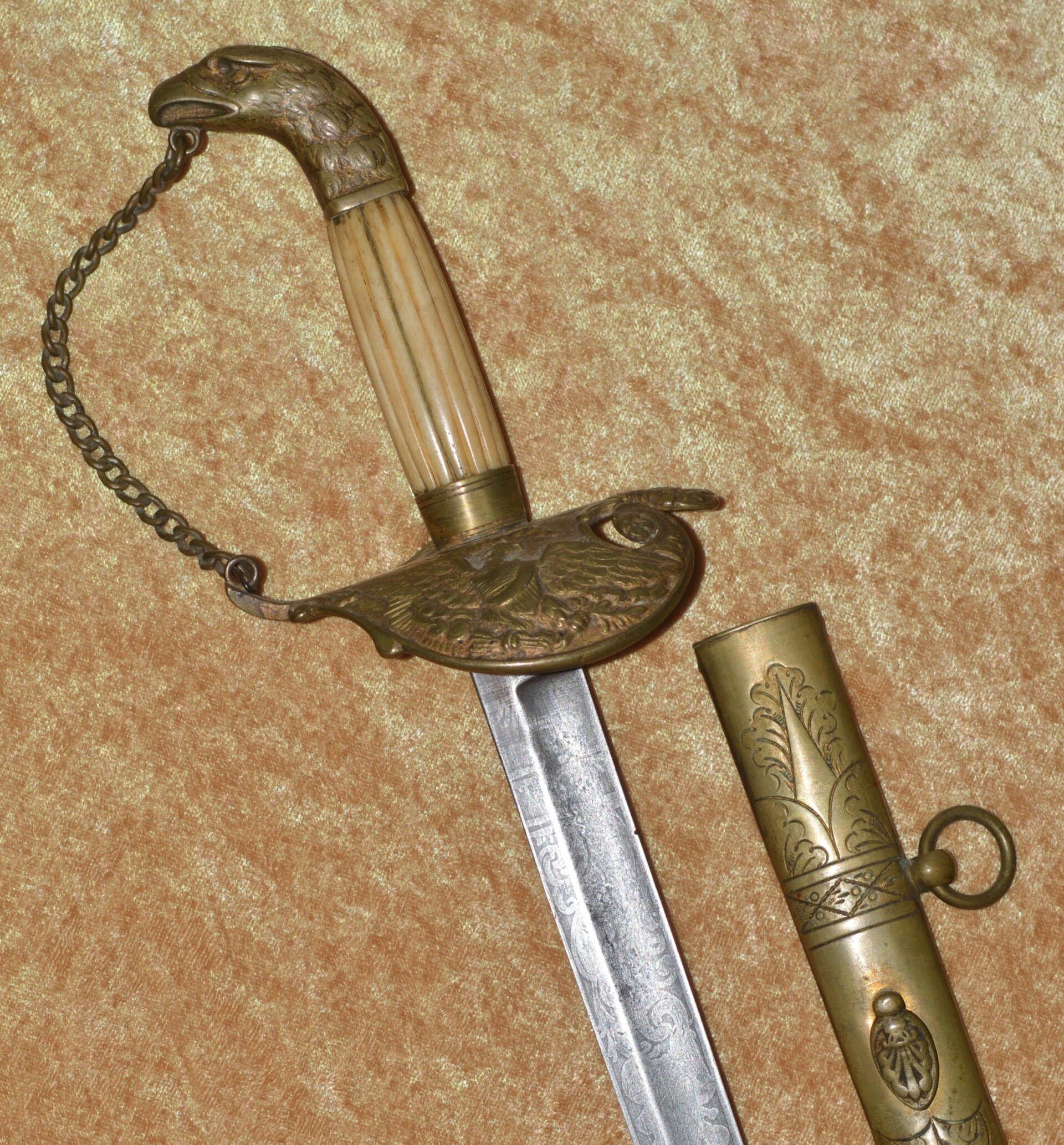
US Eagle Pommel Infantry Officer’s Sword, ca. 1850. Featuring gilt brass hilt, consisting of down-curved asymmetrical shell guard with spread- wing eagle in low relief, small reverse shell-shaped quillon, and chain guard connecting to the Widmann Type IV eagle-head pommel; reeded bone grip. Single-edged 29 1/2″ blade with broad 2/3-length single fuller, the last 13″ double-edged; etched over its upper half with scrolling foliage and stands of arms. Original brass scabbard with two carry rings, with geometric and foliate decoration and frog stud; stamped “HORSTMANN”, with the number “423″ on the reverse. William Widmann (178?-1848), was a German immigrant who came to Philadelphia in 1816. Already trained as a sword cutler, with connections to the Solingen blade market, he set up shop in Philadelphia, where he worked until his death in 1848. After his death, his tooling and patterns were acquired by Philadelphia sword cutler William H. Horstmann (1817-1893). This sword closely follows those produced earlier by Widmann. Horstmann went on to be a major supplier of edged weapons to the Union during the Civil War. Overall length 34 1/4″, not including scabbard. Very good complete and original condition; with gilding remaining in protected areas, the balance with pleasing mustard patina. Bone grip free from chips and cracks; blade with gunmetal gray patina, the etching showing normal wear. Scabbard with a couple small, shallow dents.
Page 49 of 124