
Show

Forgot your password?

Error message here!

Error message here!

Error message here!

Error message here!

Show Error message here!

Show Error message here!

Lost your password? Please enter your email address. You will receive a link to create a new password.

Error message here!

Back to log-in

Close

For Sale

The following items are listed by for sale by users of the site and dealers. They are in no way endorsed or guaranteed by www.antiquearmsresearch.com

Add a Classified Item
to

Clicking on the sword will take you through to the relevant classified item or dealer site.
Don't miss out! - Do you want to be kept informed weekly of new aditions? Just join our weekly update list.

You can also receive regular email notifcations when items match your keywords. To recieve them just register or logon at the top right of this page.

Page 65 of 156
  • Nation : Japanese
  • Local Price : £845.00
**MINT**Late Edo Period Into 20th Century Japanese Samurai Nata Gardener’s Knife With Scabbard, Tasselled Cord & Expert Assessment. Sn 19377:6 19377:6 -. This knife has been examined by Japanese sword expert Bill tag, a copy of his assessment accompanies the knife. In his notes he describes the knife as “A very good quality example in practically mint condition. A very simple forged blade made by an artisan blacksmith with basic 2 or 3 folds to the blade, crudely polished with filed decoration in bright condition crude basic tang never signed. Wood saya & tsuka possibly cherry wood capped with stag horn (antler) and tied withsplit bamboo (decorative0. Not a peasant’s tool too expensive. Well off Samurai Lords and merchants did gardening as a hobby and carried these. This mount is pure folk art by artist in wood and bamboo not signed. Most of them sold off to foreign collectors in the late 19th century”. In his illustrations he describes total length as 13 ¾” and cutting edge as just under 8”. He describes the side knife as having “Stag horn (antler) kodjuka hilt size (of knife) overall 7” unsigned blade”. The price for this Samurai knife with expert assessment includes UK delivery. Sn 19377:6
  • Nation : British
  • Local Price : £845.00
Cavalry Troopers Sword, 1908 Pattern. Ref X3385. A 1908 Pattern Cavalry Troopers Sword. 42 1/2&157; overall, 34 &194;&190;&157; straight and narrow single edged blade with fullers, stamped at the forte with numerous &194;&160;government inspector´s marks, ´EFD ´, & numerous issue and reissue stamps, and ´08´ on the back edge. Steel bowl guard, shaped composition diced grips, with correct buff sword knot. Steel scabbard &194;&160;stamped ´ MOLE´ and ´15´ with numerous issue and reissue stamps, fixed suspension rings either side. Dated 1915. In very good condition.&194;&160;Original chemical brown finish.&194;&160; &194;&160; &194;&160; &194;&160; &194;&160; &194;&160; &194;&160; &194;&160; Images courtesy of West Street Antiques (https://antiquearmsandarmour.com/)
  • Nation : British
  • Local Price : £845.00
WW2 Era British Royal Navy Locker To Capt Jones DSO DSC HMS Walpole Containing A Collection Of Uniform, Dress Sword With Scabbard & Foul Weather Cover, 2 Large Ensign Flags & Ephemera. Sn 19345 -. WW2 Era British Royal Navy Locker To Captain B. Jones DSO DSC HMS Walpole Containing A Collection Of Uniform, Dress Sword With Scabbard & Foul Weather Cover, 2 Large Ensign Flags, Cigarette Lighter, Smoking Pipe, Original Photographs Of Naval Officer’s & Of HMS Walpole. Sn 19345 HMS Walpole was a W-class destroyer of the Royal Navy. The ship was built under the 1916–17 programme in the 10th Destroyer order. Walpole was assigned to the 13th Destroyer Flotilla in the Grand Fleet after completion. she was assigned to the 11th Destroyer Flotilla in September 1939 and served until almost the end of the Second World War. Her role was mostly convoy escort duties, but she took part in two combined arms operations (Operations Amsterdam and Jubilee) and the D-day landings (Operation Neptune). She hit a mine on 6 January 1945 and was subsequently declared a constructive total loss and broken up at Thos. W. Ward Grays, Essex in March 1945. This is a collection of British Naval officer’s dress uniform consisting of dress jacket, trousers & duffle Coat, dress sword, 2 large Ensign flags, cigarette lighter smoking pipe & contemporary original photographs all contained in a Transit locker marked to Captain B. Jones DSO DSC Who Captained HMS Walpole Circa early 1938 – 22 Nov, 1938. The silk lined dress jacket has bullion insignia and all original brass Kings crown fouled anchor buttons. The lining has tears and service wear and minor old stable mothing. It is approx. UK size 38” chest. There are no labels or markings on the jacket. The dress trousers have no tears and are clean. They are approx. UK size 31” leg 38” waist. There are no labels or markings on the trousers. The hooded duffle coat is excellent made of heavy serge material it has a large hood, all of its wood toggle fasteners and neck strap secured by buttons. The inside of the jacket has 2 cloth labels 1 in good condition ‘Bentalls’ a retailer or manufacturer and remnants of another label marked ‘showerproof’ and ‘Medium’ (size approx. UK size 38” chest). The 2 large period RN ensign flags measure approx. 63” x 32”. They both have staining and minor holes consistent with being flown and stored. Their hems have original rope cords with hanging rings. The photographs consist of an original group photo of RN Officers in uniform with some original indistinct ink signatures, a portrait photo of an RN Officer who features in the front centre of the group photo with indistinct ink signature (we do not know if Captain Bond features in either of the photos), a small photo of a seated woman in contemporary dress most likely a wife or relative of one of the Officers & a contemporary photo of HMS Walpole mounted on card. There is also a used wooden smoking pipe and a Novelty gas lighter in the form of a lifebuoy ring with central Dolphin devices. The lever operated lighter has no gas and we have not fuelled it to test it. The RN dress sword has a clean single edged straight blade which is 31½” in length with central fuller (37 ½” overall). The blade is crisply etched with Naval fouled anchor & foliate panels on both sides together with King’s crown The riccaso is marked on one side by the manufacturer or retailer Whittaker (illustrated), the reverse has the ordnance acceptance proof star with inlaid roundel. It has a gilt brass Lion’s head with mane pommel and grip strap & full knuckle guard with the Royal Navy Kings Crown and fouled anchor motif. The sword’s fish skin grip with bullion wire binding is undamaged. The guard has a folding langet which has an indistinct engraved stylised monogram, the langet functions as it should, holding the sword securely in the scabbard. Attached to the guard is its bullion cord and portepee. The sword is complete with its black leather scabbard which has brass mounts and 2 hanging rings. The sword is accompanied by its original black patent leather cover which is worn & has shrunk with age. All are contained in the original Naval officer’s painted pine wood transit locker. The locker with a hinged lid and lock (key absent). The left and right aspects have heavy duty iron carry handles. The top of the lid has white paint lettering ‘Capt B. Jones RN’ and remnants of an original indistinct transit label. Due to size & weight delivery will be by arrangement and at cost. Sn 19345 (on floor under shelves storeroom near bells)
  • Nation : Danish
  • Local Price : 10,600 kr
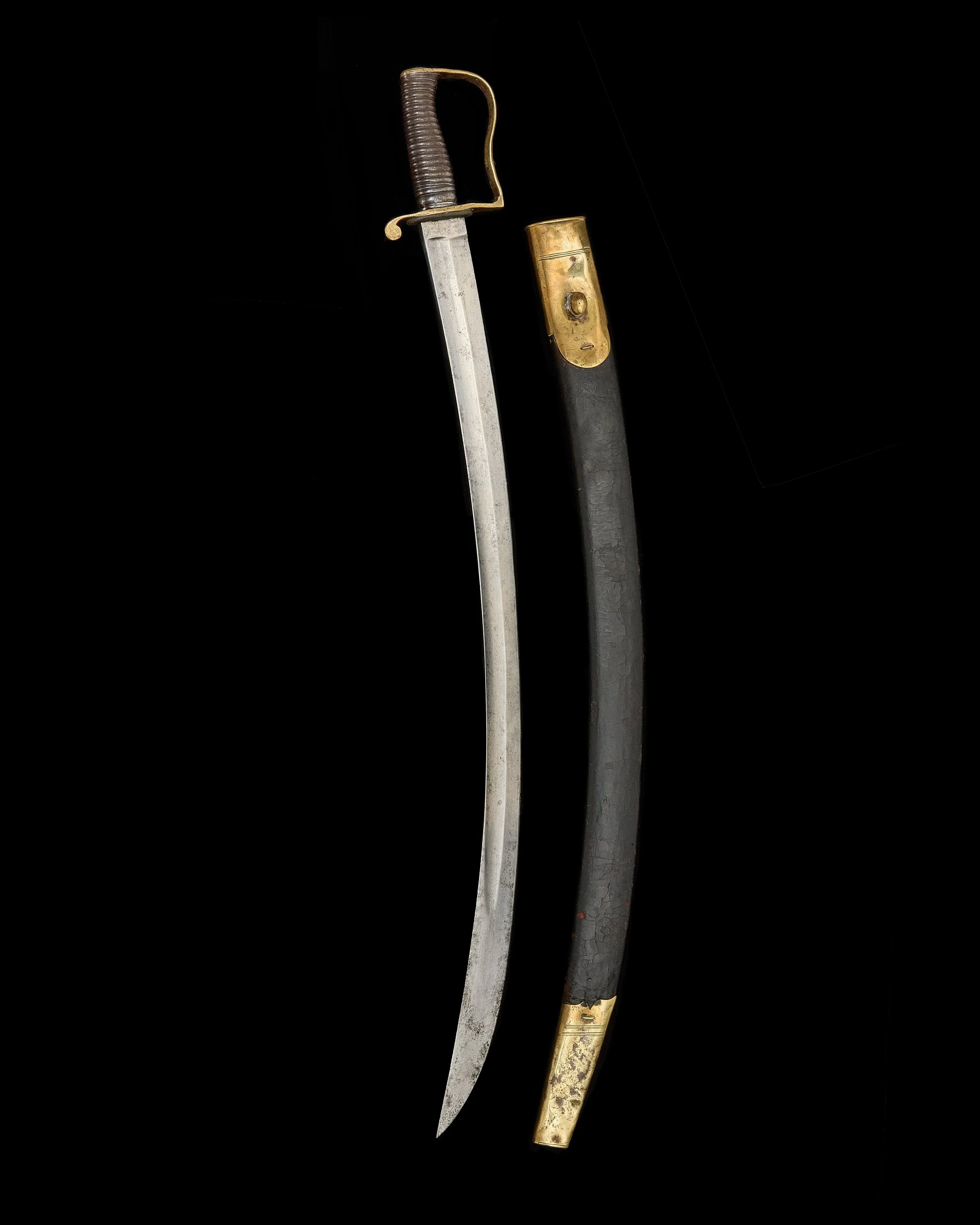
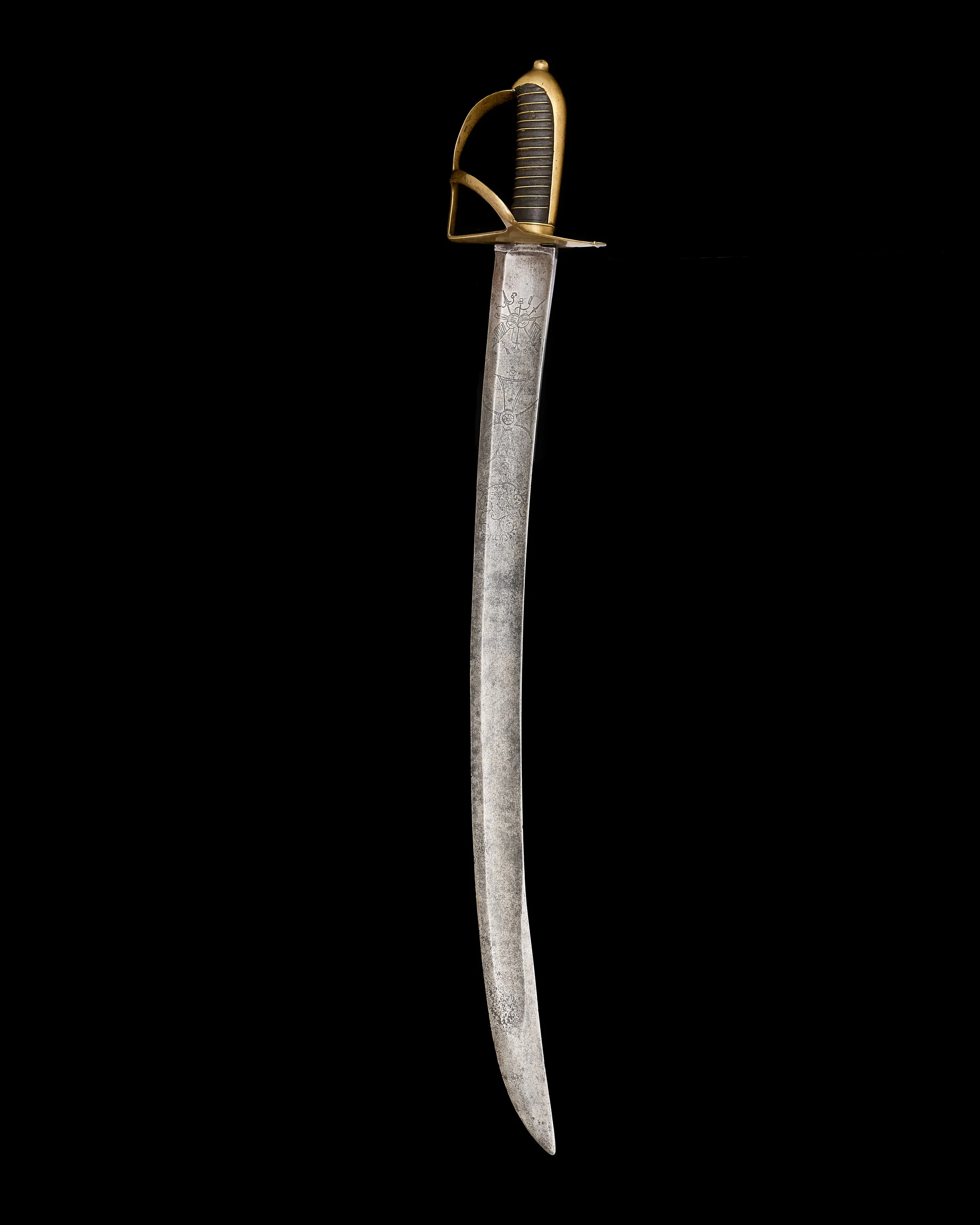
Danish cavalry pallash m/ 1789.
  • Nation : French
  • Local Price : 1,175.00 USD
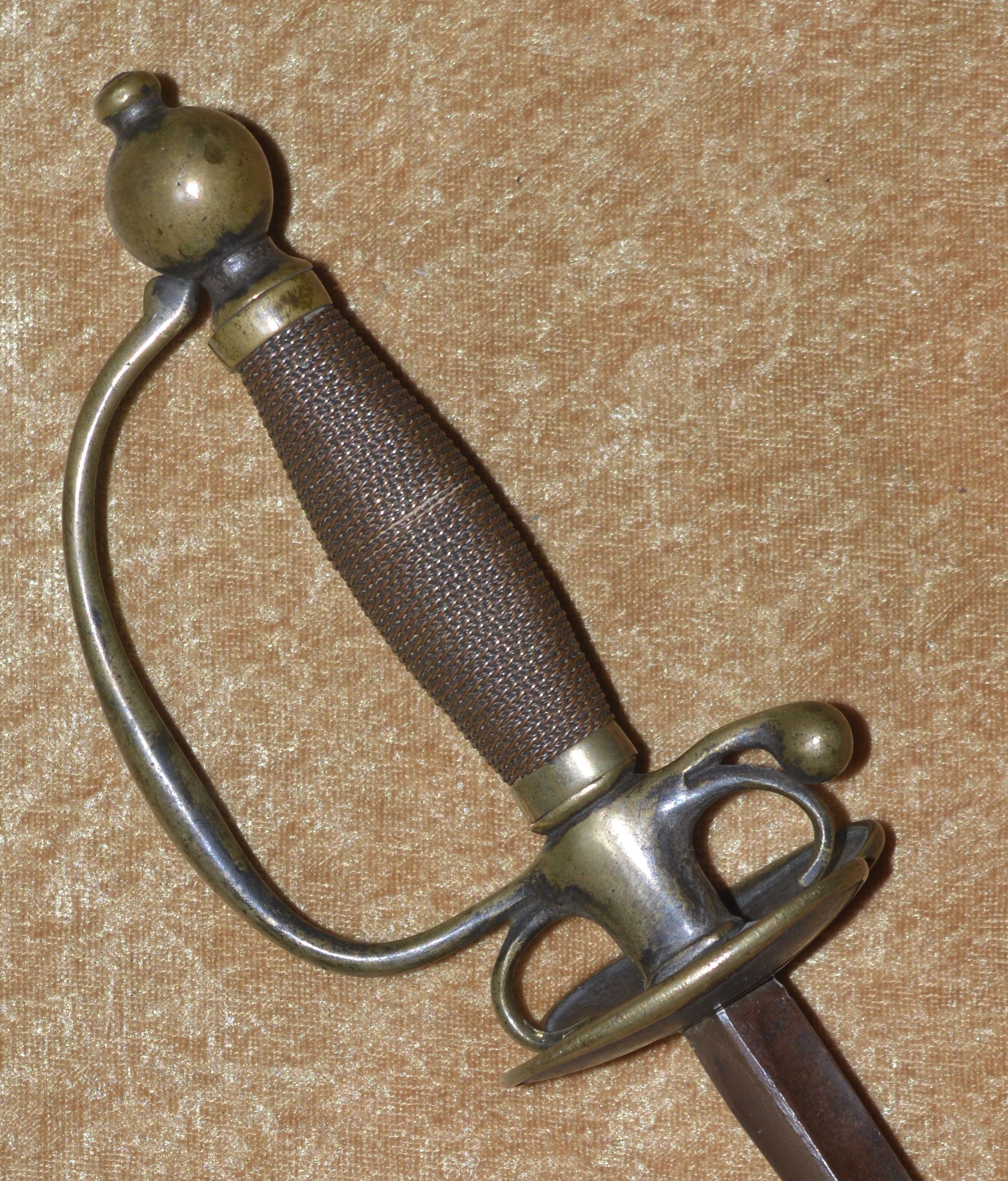
FRENCH NAVAL OFFICER'S SWORD, C.1800-10. Revolution period C.1800-10. See Swords for Sea Service, pl.98. Brass hilt with Liberty cap pommel, flattened knuckle bow and cross guard, and broad beaded edge flattened boat form guard. Copper wire wrapped grip, twisted spiral flanked by straight filler wires, complete and original. Hilt shows good patina with considerable evidence of gold in protected areas. 28 1/4" straight broad fullered blade etched first third with foliage motifs, the base with owner's or maker's initials. Shows smooth gray patina, the etching crisp with some gold inlay remaining. Some small areas of gold wash to the forte.  
  • Nation : -
  • Local Price : 1,175.00 USD
RARE, PROBABLY UNIQUE, EXPERIMENTAL HEAVY CAVALRY SWORD C.1820. Produced for one of the major powers, perhaps Saxony, during the rearming after the Napoleonic Wars. During that period, virtually all of the major world powers analyzed their weapons based on performance during the past war and sought to modernize them based on their experience. Many drew directly on French models and adopted them as standard. This example responds directly to the controversy over the use of heavy cavalry which resulted in renewed popularity of lancers. Cavalry swords, including our own through the Civil War, were used as concussion weapons, able to inflict traumatic wounds cracking bones and flesh without cutting as such. The closing velocity of the cavalry charge approached 60 miles per hour and a sword which cut would be embedded in its victim and lost to its owner. This example attempts to improve on the first impact while preserving the ability to counter strike, by reversing the section of the blade. It has a 35 ½” curved blade with forward (convex) back edge (thick) and the inner curve sharp. The tip is clipped in the Eastern European/Ottoman taste. The faces are slightly concave section and the root is struck with a crisp ordnance mark verifying that it was made in a military arsenal. The hilt is substantial, but quite simple, similar to Starr production and the wood grip scales snap into the grips, probably originally covered in oil cloth or leather. Very rarely, including some Swedish officer's swords, are curved double edged blades encountered. This is the only curved inner edged blade we have ever seen. The ordnance mark is crisp and clear and should allow for identification to the country of its origin.
  • Nation : British
  • Local Price : £825.00
British 1892 Pattern Household Cavalry Trooper’s Sword, Unusual Variant. Description Slightly curved, single fullered blade with spear point, basket guard with pierced foliate &#acute;honeysuckle&#acute; decoration incorporating the cypher &#acute;HC&#acute;, buff leather hilt liner and washer, brass wire-bound shagreen grip, smooth steel backstrap and integral smooth oval pommel. Buff leather sword knot. Steel scabbard with two hanging rings and fixed side loop to the upper band. Blade 32 inches in length (81.3cm), the sword 37¾ inches (95.9cm) overall. The blade is unmarked. The outside of the hilt is stamped with two broad arrows point to point, a mark that was put on War Department equipment that was declared obsolete or to be sold off. The inside of the hilt is stamped near the quillon (under the hilt liner) with &#acute;1 . 08&#acute; above &#acute;4 / 01&#acute; above &#acute;T&#acute; above &#acute;209&#acute;. The first two are most likely issue dates of January 1908 and April 1901, indicating periods this sword was in service. The last number is most likely a serial or rack number. The &#acute;T&#acute; marking is interesting “ see below. Since their inception the regiments of Life Guards and Royal Horse Guards which collectively made up the Household Cavalry carried different swords than the regiments of the regular cavalry. This stemmed from their unique status as bodyguards to the Sovereign, which placed them beyond the effective control of the Army bureaucracy for most of their existence. Until 1882 they designed, ordered and carried swords on their own initiative, not necessarily producing better weapons but enhancing their prestige and elite status. The 1892 Pattern sword for the Household Cavalry was adopted after much discussion of the shortcomings of its predecessor the 1888 Pattern. An intense debate had been ongoing throughout the 1880s of the optimal form for a cavalry sword, which had already resulted in three new models of sword for the regular cavalry in just ten years. It was eventually decided to simply adopt the blade of the then-current 1890 Pattern cavalry trooper&#acute;s sword, paired with essentially the same distinctive Household Cavalry hilt, which had not been particularly criticised. Ironically after all the talk of blade handling and sturdiness, the 1892 Pattern saw no combat. After 1908 the regiments of the Household Cavalry would carry the new 1908 Pattern while in the field, while the 1892 Pattern was retained (in the slightly modified Mk II form introduced in 1902) for parade use only. This was done on the direct request of King Edward VII, who found the 1908 pattern &156;hideous&157;. The use of the 1892 Pattern as their parade sword continues to this day. This example appears to have been modified from a standard 1892 Pattern “ its blade has been reduced in length by 2½ inches from the standard and has also been significantly reduced in breadth by grinding back the edge and the false edge, leaving the fuller roughly central in a blade 2.8cm wide at the shoulder, which rapidly narrows to 2cm along most of the blade&#acute;s length (2.7 on an unmodified example), with a much slenderer point as a result. It has even been reduced in thickness “ the original is 8mm thick along most of its length while this example is 6mm. The removal of material has made the fullers shallower and appears to have removed any previous markings from the blade. Conversion to this extent would have required the sword to be dismantled, and this is shown in its repeened pommel with atypical flat tang button. The changes to the blade allow it to fit into its atypical bespoke scabbard, which is along the lines of the steel parade scabbards used for all infantry officer&#acute;s swords since 1866, but modified with a fixed loop on the top band alongside the two hanging rings, which matches the Household Cavalry&#acute;s hanging configuration. The complex blade conversion has been very well done, and reminds me of very similar conversions done in the early 1900s to make sergeant&#acute;s swords, which also slimmed down 1890 Pattern Cavalry blades in order to fit them into scabbards like those of infantry officers. The parallels are interesting and may suggest some kind of deliberate reuse of old stock across the Army. I can find no reference to an official sword in this configuration, however so why was this sword made? The most logical reason to convert the 1892 Pattern to resemble the infantry sword would be to make it more readily wearable on foot. I think there is a strong possibility therefore that this example is an attempt to create a variant for trumpeters and other bandsmen of the regiments. These men had significantly more dismounted duties than the others, making a shorter sword more practical. At least one example exists of the 1820 Pattern sword for the Life Guards, which is usually more than 37½ inches in the blade and sometimes as much as 38¾, having been shortened to 33 inches, which is thought to have been for these musicians (see p185, The British Cavalry Sword by Dellar). The 1882 Pattern was the first to officially acknowledge this need with two distinct versions of the sword manufactured, one with a 34¾ inch blade for trumpeters and bandsmen, and one with a 38 7/8 inch blade for all other troopers. Notably the short model also had a variant scabbard with two hanging rings, just as this sword does. Officially the scheme of long & short versions was then dropped again in the 1888 Pattern, with a 37½ inch model for all troopers. I doubt that the practical need for a shorter version went away in those few short years, however. Perhaps in practice the bandsmen either used the old short 1882s for their foot duties or, as time passed, produced their own up-to-date short versions by conversion. Might that be the significance of the &#acute;T&#acute; marking on this example “ that it is intended for the regimental Trumpeters? See attached reference of a painting by notable military artist Richard Simkin depicting a trumpeter of the Royal Horse Guards on foot with sword as of 1912. The blade is bright with a high polish overall and only tiny areas of frosting or patination. There is no damage to its edge, which has been sharpened. The hilt including backstrap and pommel is likewise bright and clean. The knot and washer have some small areas of staining, the liner is clean. The buff leather pieces are so good that they may be later replacements, but this is difficult to judge. The wire binding of the grip is all intact and there are no losses or visible handling wear to the shagreen. The scabbard has some light patination and polishing marks.
  • Nation : British
  • Local Price : £825.00
British 1844 ’Deakin’ or ’Dundas’ Variant Cutlass, Indian Service Marks. Description Curved unfullered spear-pointed blade, steel basket hilt, smooth cast iron grip with finger grooves, painted black. Thin flat teardrop-shaped pommel cap. No washer. Black leather scabbard with copper frog stud and brass chape piece, the chape piece painted black. Blade 29 inches in length (73.7cm), 1 3/8 inches wide at the shoulder (3.6cm), the cutlass 34 inches overall (86.4cm). The blade is stamped at the ricasso on one side with a broad arrow above &#acute;I&#acute;, which is an Indian government stores mark. The spine of the blade is stamped with &#acute;1844&#acute;, presumably the production date. The outside of the hilt is stamped with &#acute;4 1853 GA&#acute;. 1853 is probably the issue date, GA probably indicates a unit, although I am unsure what unit this may be. The hilt is stamped next to the knot slit with &#acute;40&#acute;, probably a rack number. The leather of the scabbard is stamped on the rear side next to the seam with &#acute;BO&#acute; and a broad arrow, the ownership stamp of the (British) Board of Ordnance, as well as &#acute;1844&#acute;, again presumably the production date. This cutlass is sometimes referred to as the &#acute;Deakin patent&#acute; model, although only a few carry a maker&#acute;s mark. The September 2018 issue of the Naval Historical Review (published by the Naval Historical Society of Australia) does illustrate an example marked to Deakin, but there is also an example in the Royal Armouries (Item IX.5449) marked to Hadley. I have not yet seen any material proving that this was a Deakin design. It is also sometimes called the &#acute;Dundas&#acute; cutlass, although this seems to derive solely from the finger grooves on its grip, which superficially resemble the grooves found on the circa 1845 Royal Artillery &#acute;Dundas&#acute; sidearm. Examples of the cutlass have been seen with brass and steel grips, and both straight and curved blades (steel and curved being more common), although the form of the hilt and grip is reasonably consistent. Lists of standard Royal Navy cutlasses do not include it, although a few sources note it as an &#acute;experimental&#acute; type. There do not appear to be any records of it being formally designed and commissioned by the Board of Ordnance, even as an experiment, but examples like this one exist which have clear Board of Ordnance markings and other British government ownership and issue stamps, strongly suggesting that it did see official usage with the Royal Navy in some capacity - perhaps a commercial type purchased off the market to supplement official production? Its blade is clearly made to the same specification as the official 1845 Pattern cutlass, with matching length, curvature etc. I have not seen any other example with a manufacture date “ this one being made in 1844 is interesting as the first large-scale orders of the 1845 Pattern was also in production during that year “ the work was parcelled out to many different manufacturers who evidently used the design for their own non-standard versions. The blade has some pitting overall, diminishing towards the point. Some pitting impacts the edge at the foible but there are no nicks. The tip has fractionally worn (<1mm). The outside of the guard seems to have been roughly cleaned/polished in the past, leaving polishing marks. Some deeper pitting remains, as well as patination in places. The inside of the guard has dark even patination, pitting in places, and some traces of black paint near the grip (runoff from painting?) The grip retains much of its original black paint with some rubbing at the backstrap exposing patinated iron. There is a crack running the full circumference of the grip, which I assume runs all the way through dividing the grip into two pieces. However, despite this the grip is completely solid and firm in the hand with no movement whatsoever. The leather of the scabbard has some rubbing and knocks but remains strong with no losses to its stitching (possibly a repair/reinforcement to the stitching at the throat end, although this does not look modern). Some patination to the copper stud. The brass chape piece has some light dents and some rubbing & flaking to its black paint revealing patinated brass, more extensive on the rear side. Assuming there was a leather washer, this has been lost.
Page 65 of 156