
Show

Forgot your password?

Error message here!

Error message here!

Error message here!

Error message here!

Show Error message here!

Show Error message here!

Lost your password? Please enter your email address. You will receive a link to create a new password.

Error message here!

Back to log-in

Close

For Sale

The following items are listed by for sale by users of the site and dealers. They are in no way endorsed or guaranteed by www.antiquearmsresearch.com

Add a Classified Item
to

Clicking on the sword will take you through to the relevant classified item or dealer site.
Don't miss out! - Do you want to be kept informed weekly of new aditions? Just join our weekly update list.

You can also receive regular email notifcations when items match your keywords. To recieve them just register or logon at the top right of this page.

Page 70 of 157
  • Nation : British
  • Local Price : £750.00
English 1751 Pattern Infantry Hanger, North Lincoln Militia, by Samuel Harvey. Description Slightly curved hanger blade with hatchet point, single narrow fuller close to the spine. Cast brass heart-shaped hilt with two side bars, spiral grip and round pommel. No scabbard. Blade length ~24¾ inches (62.8cm), the sword ~30½ inches (77.5cm) overall. The outside of the hilt is engraved with &#acute;M “ LINCOLN “ N “ B&#acute;, indicating issue to the North Battalion of Lincolnshire Militia, aka the North Lincoln Militia and &#acute;4 / 34&#acute;, most likely a rack number. The blade is stamped on both sides with a running fox within which are the initials &#acute;SH&#acute;, indicating the maker Samuel Harvey. It is also stamped at the shoulder on one side with a crown mark, partly obscured by the hilt. This indicates government inspection or ownership and suggests this was part of an officially ordered production run. The &#acute;1751 Pattern&#acute; is not an official pattern of British sword (built to specifications set by the military establishment) but a widely used type that appeared around that date, was purchased officially to some degree and issued to many regiments. In this era colonels of regiments typically controlled procurement of equipment but market availability affected their choices and some larger-scale ordering took place. The 1751 is simple and durable, its blade typical of the British &#acute;hanger&#acute;, and survives in some numbers today considering its age. Almost all examples are marked to a militia unit. The North Lincoln Militia was first raised in 1759, one of many created by the Militia Act of 1757 to respond to the threat posed by France during the Seven Years War. Parish constables drew up lists of all men aged 18 “ 50, with limited exemptions, then drew ballots to select some for three years of compulsory militia service, although men chosen could delegate their role to paid substitutes if they could find & afford them. The county of Lincolnshire had two separate battalions, North and South. Militia units were for home defence only, and could not be sent overseas “ service in practice meant a few weeks of training each year and occasional mustering for duty in keeping public order, almost always outside their home county. Nonetheless, the compulsory system was unpopular and riots broke out in Lincolnshire in 1757 over the Bill&#acute;s passage, some wrongly believing that it meant they would be conscripted into fighting overseas. Several counties delayed implementing the changes for years for fear of similar civil unrest. The Childers Reforms of 1881 attached county militia units to their respective county&#acute;s regiments as their third or fourth battalions “ the North Lincoln Militia accordingly became the 3rd Battalion, Lincolnshire Regiment. This battalion served overseas for the first time in the Boer War. In 1908 all Militia battalions became the Special Reserve. It served as a training unit throughout WW1 supplying trained men to the regular battalions. The 3rd Battalion was disbanded in 1953 as the regiment shrank in size - after a series of amalgamations the lineage of the Royal Lincolnshire Regiment is today maintained by the Royal Anglian Regiment. The firm of Samuel Harvey was established in 1748, and used the mark of the &#acute;running fox&#acute; on both sides of their sword blades. After Samuel&#acute;s death in 1778 the family business was continued by his son and grandson, both of the same name, the last of whom died in 1810. The blade has been sharpened, with numerous nicks to its edge and a rounded tip. It has patches of patination and some spots of light pitting, with heavier pitting at the very tip. The brass hilt and grip are in good condition with even light patination and a few dents. The outer bar has a crack where it joins to the hilt but this is surface-level, it does not run all the way through the bar. The short quillon usually found on this type appears to have been deliberately removed. Slight movement of the hilt side to side, while the grip remains firm.
  • Nation : Japanese
  • Local Price : £750
Click and use the code >19741 to search for this item on the dealer website Ko Tosho School Swordsmith Made Koto Katana Tsuba Circa 1400
  • Nation : American
  • Local Price : £750
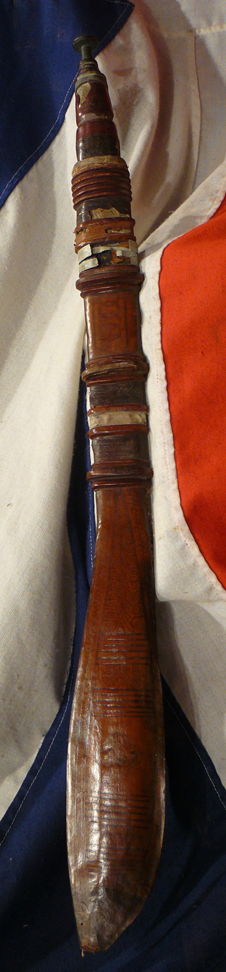
Click and use the code >23573 to search for this item on the dealer website Antique Ethiopian Shotel - Gorode Officer´s Sword Of Emperor Menelik IInd´s Reign, & Then Into Emperor Halie Selassie´s Reign, the Last Ethiopian Emperor
  • Nation : British
  • Local Price : £750
Click and use the code >21275 to search for this item on the dealer website Very Good & Most Rare Victorian &#acute;Colonel-of-Staff&#acute; Hussars Regiments 19th Century, British Army Colonel&#acute;s {Undress} Combat Service Sabretache, in ´Russia Leather´, With Royal Cypher
  • Nation : British
  • Local Price : £750.00
18th Century Shearing Sword. A silver-hilted British Shearing sword, London 1761. With a tapering double-edged blade, silver hilt cast and chased with writhen designs, comprising boat-shell guard, a pair of quillons with scalloped terminals, knuckle-guard struck with marks (rubbed), and spirally-moulded ovoid pommel, and the grip bound with plaited copper alloy wire and ribband between silver collars, 74.7 cm bladeThe handle is marked for William Kinman, (a raised ’WK’ within a shaped cartouche). He was a prominent London silver hilt maker and leading member of the Founders Company of which he was elected Master in 1780The shearing sword was popularised by fencing masters William Hope and Donald Mcbane as a cut and thrust blade, but with out the weight commonly found in the backsword. Only around for a short period, the however had a long service life, before eventually being replaced by the single edged spadroon
  • Nation : American
  • Local Price : £750.00
18th Century French Hunting Hanger. A large, French Silver-Mounted Hanger with Lyon Silver Marks, dating from the mid-18th Century. With a broad fullered single-edged blade double-edged towards the point, a fine patina over the whole blade, with some old pitting towards the tip. The hilt comprising quillon-block cast and chased on each side with a stag beset by a hound in a wooded landscape. Recurved quillons each with lion-head terminal, lion-head pommel cast and chased with two hounds and rococo ornament at the back, and spirally-grooved ivory grip with small, slender old splits and minor damage. Ivory handle requiring a CITES license for UK and exporting outside the EU, cannot be imported into the USA or any country within the EU69.8 cm
  • Nation : American
  • Local Price : £750
Click and use the code >21684 to search for this item on the dealer website Fine and Beautiful Carved Horn Hilted 18th Century Royal Naval Officer´s Hanger Sword, Cutlass or Cuttoe
  • Nation : British
  • Local Price : £750
Click and use the code >23496 to search for this item on the dealer website Fabulous 10th to 12th Century, Crusader Knights Period, Original, Large Reliquary Pectoral Cross Pendant, Crucifix. Possibly Cleaved By a Sword Cut
Page 70 of 157