
Show

Forgot your password?

Error message here!

Error message here!

Error message here!

Error message here!

Show Error message here!

Show Error message here!

Lost your password? Please enter your email address. You will receive a link to create a new password.

Error message here!

Back to log-in

Close

For Sale

The following items are listed by for sale by users of the site and dealers. They are in no way endorsed or guaranteed by www.antiquearmsresearch.com

Add a Classified Item
to

Clicking on the sword will take you through to the relevant classified item or dealer site.
Don't miss out! - Do you want to be kept informed weekly of new aditions? Just join our weekly update list.

You can also receive regular email notifcations when items match your keywords. To recieve them just register or logon at the top right of this page.
Page 75 of 124
  • Nation : Unknown
  • Local Price : £750.00
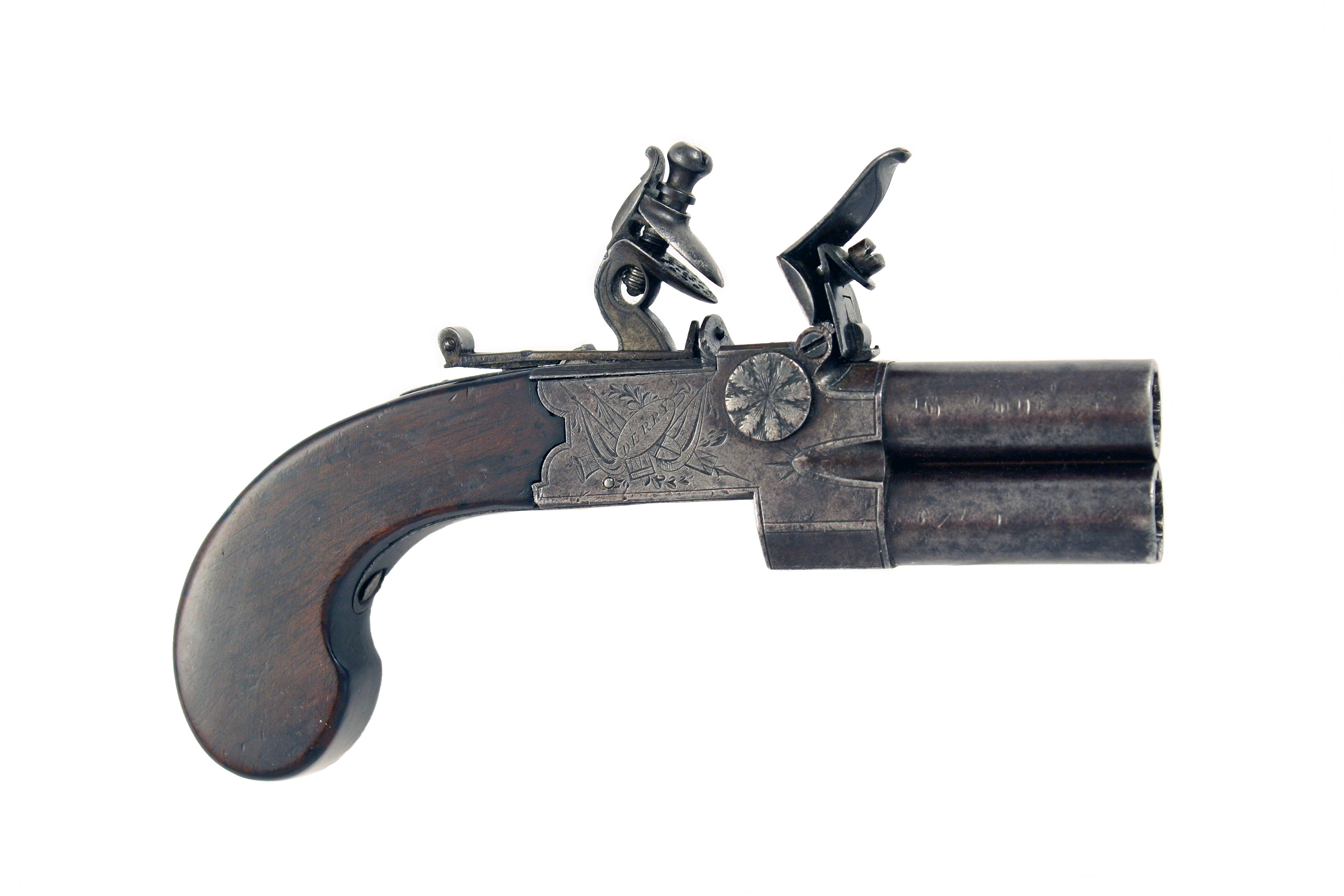
An 80 Bore Flintlock Tap Action Pistol. An 80 Bore Flintlock Tap Action Pistol by Fox & Weatherall of Derby. With round turn-off barrels, stamped with London proofs at the breech and numbered ‘2’ and ‘3’ border engraved box-lock action, signed ‘Fox & Weatherall’ within an oval surrounded by a stand of arms to the left and ‘DERBY’ within an oval to the right, sliding thumb-piece safety catch (slightly raised) slab sided walnut grip, with vacant silver escutcheon. Dimensions: Bore: 80 Bore Barrel Length: 1.5 Inches (3.80 cm) Overall Length: 6 Inches (15.25 cm)
  • Nation : British
  • Local Price : £750.00
English 1751 Pattern Infantry Hanger, 2nd West Riding of Yorkshire Militia, by Samuel Harvey. Slightly curved hanger blade with hatchet point, single narrow fuller close to the spine. Cast brass heart-shaped hilt with two side bars, spiral grip and round pommel. No scabbard. Blade length ~24¾ inches (62.9cm), the sword ~30¼ inches (76.9cm) overall. The outside of the hilt is engraved with ‘YORK – W-R – 2 – D B’, indicating issue to the 2 nd West Riding Militia a.k.a. 2 nd Regiment of West Yorkshire Militia and ‘1 / 31’, most likely a rack number. The blade is stamped on both sides with a running fox within which are the initials ‘SH’, indicating the maker Samuel Harvey. It is also stamped at the shoulder on one side with a crown mark. This indicates government inspection or ownership and suggests this hanger was part of an officially ordered production run. The ‘1751 Pattern’ is not an official pattern of British sword (built to specifications set by the military establishment) but a widely used type that appeared around that date, was purchased officially to some degree and issued to many regiments. In this era colonels of regiments typically controlled procurement of equipment but market availability affected their choices and some larger-scale ordering took place. The 1751 is simple and durable, its blade typical of the British ‘hanger’, and survives in some numbers today considering its age. Almost all examples are marked to a militia unit. The West Riding of Yorkshire Militia was first raised in 1759, one of many created by the Militia Act of 1757 to respond to the threat posed by France during the Seven Years War. Parish constables drew up lists of all men aged 18 – 50, with limited exemptions, then drew ballots to select some for three years of compulsory militia service, although men chosen could delegate their role to paid substitutes if they could find & afford them. Militia units were for home defence only, and could not be sent overseas – service in practice meant a few weeks of training each year and occasional mustering for duty in keeping public order, almost always outside their home county. Nonetheless, the compulsory system was unpopular and riots broke out in Lincolnshire in 1757 over the Bill’s passage, some wrongly believing that it meant they would be conscripted into fighting overseas. Several counties delayed implementing the changes for years for fear of similar civil unrest. There were initially three regiments in the West Riding, but these were reorganized into two full regiments in 1763, the 1 st and 2 nd . The 2 nd regiment, also called the Northern or ‘York Regiment’, was based at York and commanded by Col. William Thornton, who in 1745 had raised the ‘Yorkshire Blues’ militia at his own expense to oppose the Jacobite Rebellion, and fought with them at the battle of Falkirk. Along with their muskets and bayonets the rank and file were armed with ‘Small Hangers, with Brass Hilts, Scabbards, and tanned Leather Waist-Belts’. The 2 nd West Riding only assembled for their annual training until 1778 when it was embodied until the end of the American Revolutionary War in 1783. This pattern of brief periods of embodiment continued with no significant action. In 1853 it became the 21 st , or 2 nd West York Light Infantry. In 1881 the Childers Reforms amalgamated militia and volunteer units with the regulars into larger regiments, attaching the county militia units to their respective county’s regiments as their third or fourth battalions. The regiment therefore became the 3 rd Battalion, The Prince of Wales's Own (West Yorkshire Regiment). It was primarily a training unit during WW1 supplying trained men to the regular battalions, but being based at Whitley Bay was also part of the garrison on the Tyne. The 3 rd Battalion was disbanded in 1953. The lineage of the West Yorkshire Regiment is today maintained by the 2 nd Battalion, Royal Yorkshire Regiment. The firm of Samuel Harvey was established in 1748, and used the mark of the ‘running fox’ on both sides of their sword blades. After Samuel’s death in 1778 the family business was continued by his son and grandson, both of the same name, the last of whom died in 1810. Like other swords of this period the hanger has a low carbon tang and shoulder, forge welded to a higher carbon steel blade, and the differential aging of the two materials can be seen clearly at the transition point. The two pieces were stepped to increase the surface area of the weld: one can see the line of the weld on the spine and the iron surface extends further up the blade on the right face than the left (roughly 2 1/8 inches vs 1 inch). The blade has been sharpened, with a number of nicks to its edge, some shallow notches near the tip. The tip itself is rounded and fractionally bent to the right in its last 3mm. It has patches of patination overall, some light pitting to the iron at the forte of the blade spotted heavier pitting near the tip. The brass parts have moderate patination and a few dents, including a larger one to the pommel. No cracks to the hilt bars. The short quillon usually found on this type has been lost. Slight movement of the hilt side to side, while the grip itself remains firm.
  • Nation : German
  • Local Price : £750.00
Saxon Model 1867 Cavalry Trooper’s Sabre, Garde-Reiter Regiment, 1867-73. Curved single fullered sabre blade with spear point. Brass hilt with side bars. Brass backstrap, integral pommel with tang button and riveted ears. Ribbed grip of black leather over wood. Steel scabbard with two fixed hanging rings. Blade 34 3/8 inches in length, the sword 40 inches overall. The ricasso of the blade is stamped on one side with the manufacturer’s mark ‘P. D. Lüneschloss, Solingen’. It is stamped on the other side with the crown and ‘JR’ cypher of King Johann, who reigned from 1854 to 1873. The outside of the hilt is stamped ‘GR’, for Garde Reiter. The quillon is stamped on one side with a crown proof mark. The Garde-Reiter-Regiment (1. Schweres Regiment) (1 st Royal Saxon Guards Heavy Cavalry) was established in 1680 as a regiment of cuirassiers. It was the senior and premier heavy cavalry regiment of the Kingdom of Saxony, fighting in its wars from the Battle of Vienna through to WW1. The Saxon M1867 cavalry sword used by the enlisted men of the Garde Reiter borrowed much of its design from the Prussian M1852 cavalry officer’s sword, but with a brass hilt. Other Saxon cavalry of the period used the M1867 with a steel hilt. The Garde Reiter Regiment was disbanded in 1919. The outside of the hilt should bear the coat of arms of the Kingdom of Saxony – this has been lost, and one can see the two holes in the hilt where it would be riveted through. Removing the solidly riveted emblem would seem like a strange but deliberate modification. While this is speculative, this might have been done in the republican period for political reasons. The abdication of King Frederick Augustus III in 1918 left a power vacuum which led to several years of political violence in Saxony as left-wing radicals attempted to establish a Soviet Republic, opposed by right-wing forces including the infamous Freikorps, and later the army of the new Weimar Republic. The blade has areas of patination and pitting along its length. Its edge is undamaged, there are a couple of dents to the spine. No leather washer. The inside of the hilt has a dark, even patina, while the outside is brighter brass. Some patches of patination to the backstrap, pommel and ears. Only a short stub remains of the leather finger loop. A patch of leather has been lost from the grip on one3 side at the pommel end, exposing the ribbed wood beneath. Otherwise the grip shows very little handling wear. The scabbard has significant pitting and dark patination overall. It is structurally strong but has a rough texture.
  • Nation : ?
  • Local Price : 745.00 USD
EUROPEAN HUNTING SWORD C.1750-70. Iron mounted hilt with thick recurved scalloped guard and shaped ebony grip with iron base ferrule and pommel cap. 13 7/8” double edged blade, made in this size. The forte with rococo panels of scrolling foliage. Iconic hound and boar/hound and stag motifs beyond. Rarely found in this size (see Swords and Blades of the American Revolution, #97.S) this sword would have served as a side arm for protection in the streets. May well have served in the American or French Revolutions.
  • Nation : ?
  • Local Price : 735.00 USD
EUROPEAN OFFICER’S SWORD C.1800. Napoleonic Wars period, probably from one of the PR confederation German states. Brass hilt with lion head pommel and wire wrapped leather covered grip. 27 ¾” curved broad fullered blade shows smooth glossy patina but for the point area which has a patch of pitting (as shown) each side. Many of the southern German states including Bavaria fought with Napoleon. Others including Mecklenburg-Schwerin, Brunswick and Oldenburg, opposed France early or defected later. A well used veteran of the Napoleonic Wars.
  • Nation : British
  • Local Price : £525.00
1845 Pattern British Infantry Officer Sword. A good, clean example of the 1845 pattern Infantry Officers sword with a Wilkinson style blade. The sword is etched both sides with Royal Crown, VR all surrounded by floral decoration plus brass proof plug. Regulation gilt hilt with VR and crown to centre. Fish skin grip bound with gilt wire, and it unusually retains the leather insert for the guard. The leather scabbard has some wear towards the tip but is otherwise in good order. Originally Retailed by Murray of Exeter.Replacing the old 1822 pattern, the new style of blade was promoted for British officers’ swords by Henry Wilkinson from 1844-45 and it was made official regulation for Army officers in 1845 and for Naval officers in 1846
  • Nation : British
  • Local Price : £525.00
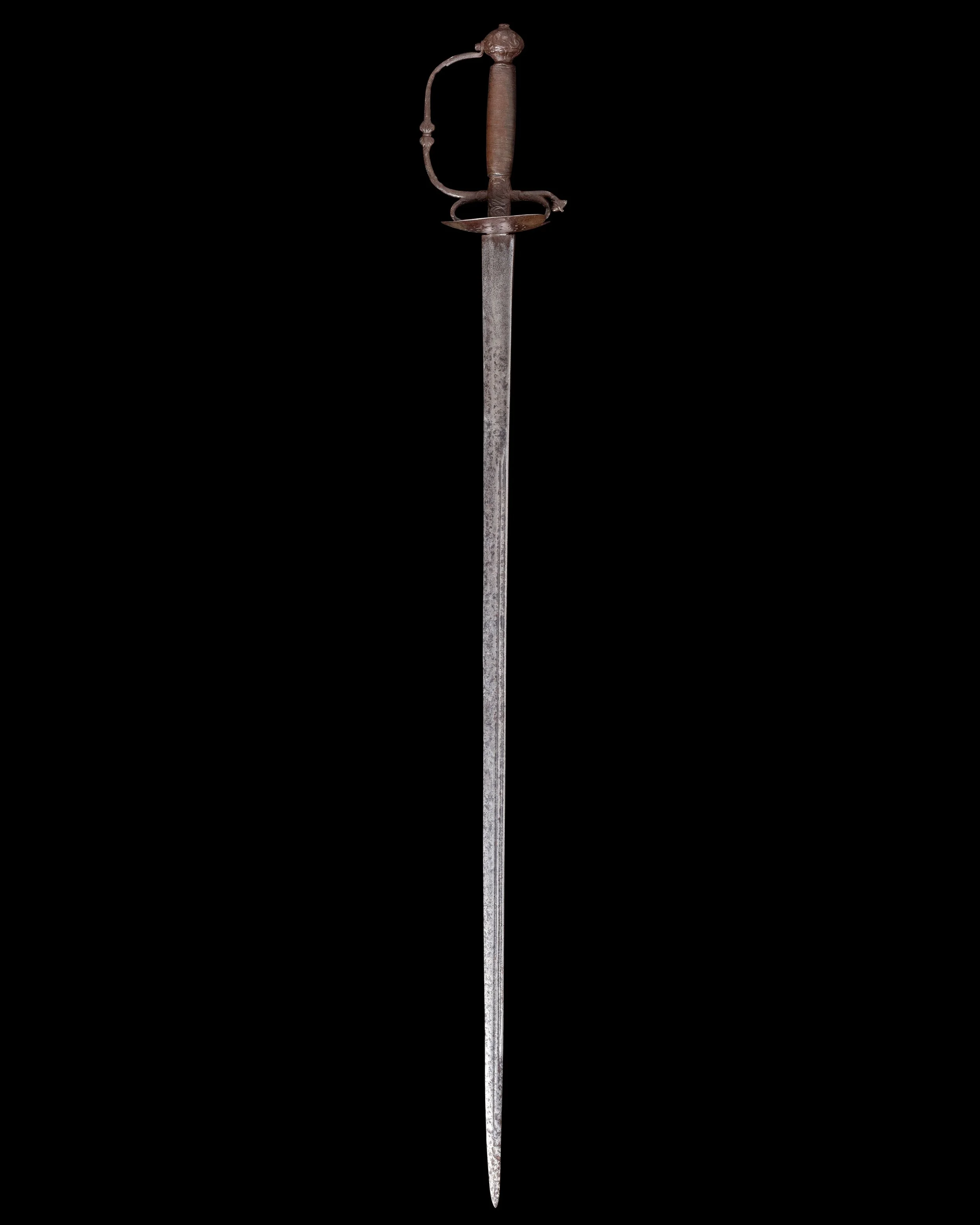
C1760 Steel Hilt Spadroon. Unusual spadroon with a pierced steel shell guard, wire wrapped handle with carved decorations to the pommel and knuckle bow. The 73 cm blade is double fullered, making it quite a light and nimble sword. Spadroons grew in popularity in Britain during the late 17th and 18th century as a light cut and thrust sword for military officers. Eventually being adopted into the official British Army patterns in 1796The handle and guard are solid with no movement, with an even patina over all. The blade has some pitting but is otherwise in good condition.
  • Nation : American
  • Local Price : 725.00 USD
AMERICAN MILITIA CAVALRY OFFICERS SWORD, 1870’S-80’S. Made to the 1872 pattern for US cavalry officers, (Peterson, The American Sword, #86) this example is made without the Eagle and stars and bars shield as normally encountered. These are infrequently encountered, but other examples are known. It is believed that they were made for reunited Southern (Confederate) states which chose to omit the Union decoration. Texas rearmed their militias, including nine cavalry companies, in1870. This example is unmarked with 31 1/4” curved broad fullered blade and brass hilt with wire wrapped leather covered grip. The hilt is excellent for the period. The blade is crisp with bright finish but for a little smooth superficial staining toward the hilt. Iron scabbard undented with raised brown surface oxidation.
Page 75 of 124