
Show

Forgot your password?

Error message here!

Error message here!

Error message here!

Error message here!

Show Error message here!

Show Error message here!

Lost your password? Please enter your email address. You will receive a link to create a new password.

Error message here!

Back to log-in

Close

For Sale

The following items are listed by for sale by users of the site and dealers. They are in no way endorsed or guaranteed by www.antiquearmsresearch.com

Add a Classified Item
to

Clicking on the sword will take you through to the relevant classified item or dealer site.
Don't miss out! - Do you want to be kept informed weekly of new aditions? Just join our weekly update list.

You can also receive regular email notifcations when items match your keywords. To recieve them just register or logon at the top right of this page.
Page 81 of 156
  • Nation : -
  • Local Price : 6,500 kr
Österrikisk Werndl bajonett m/1867.
  • Nation : German
  • Local Price : 6,500 kr
German officer's saber ca: 1870-90.
  • Nation : -
  • Local Price : 6,500 kr
Artilleri officerssabel m/1889.
  • Nation : German
  • Local Price : £500.00
German Flintlock Travelling Pistol. 80 Bore German Flintlock traveling Pistol, Circa 1770. With sighted barrel formed in two stages, with a round barrel and octagonal breech. Flat lock fitted with bolt safety-catch, with a beveled cock and faceted pan. Full stock carved with a bouquet about the tang, iron mounts including ’bird’s head’ pommel with foliate terminal, trigger-guard en suite, sideplate and ramrod-pipe. Rifled barrel with 6 lands and groovesAn interestingly over-engineered pistol commonly carried for self defense
  • Nation : British
  • Local Price : £500.00
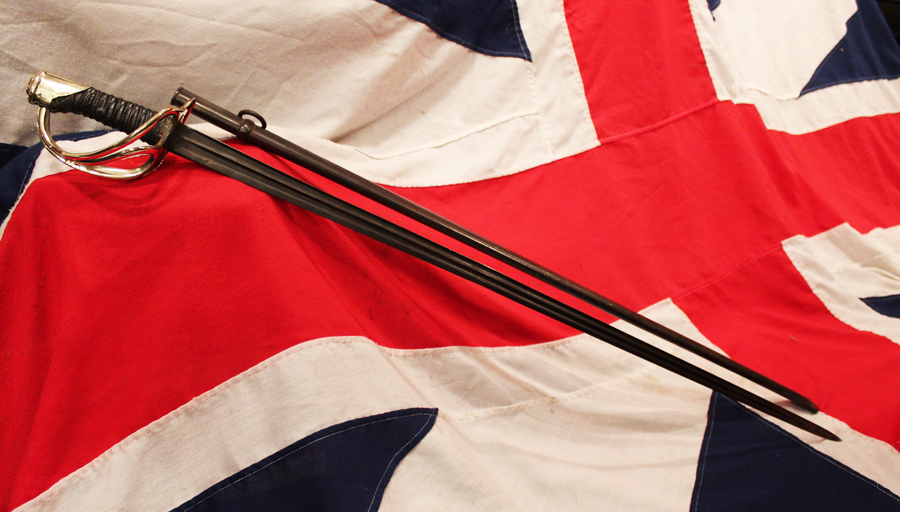
British 1890 Pattern Cavalry Trooper&#acute;s Sword, Duke of Lancaster&#acute;s Own Yeomanry. Description Curved, single fullered blade, ambidextrous basket hilt with pierced Maltese Cross symbol and turned-over edges, black pressed leather grips secured by five steel rivets, brown leather washer. Steel scabbard with fixed opposed hanging rings. Overall length 38 7/8 inches (98.7cm) blade length 33 3/8 inches (84.7cm). Traces of orange-brown paint to the lip of the guard on one side. The spine of the blade is stamped with &#acute;/90&#acute;, indicating that it is an 1890 Pattern, and a crown inspection mark for Enfield. The flat of the blade is stamped at the forte on one side with a broad arrow and &#acute;EFD&#acute;, indicating War Department property made at Enfield, another Enfield inspection mark and an &#acute;X&#acute; indicating that the blade passed a manufacturer&#acute;s bending test. On the other side it is stamped with an issue mark &#acute;97 for 1897, another for 1899, and two further Enfield crown inspection marks. The outside of the guard is stamped near the spine of the blade with another &#acute;EFD&#acute; below a broad arrow. The inside of the guard is stamped with &#acute;8 97&#acute; indicating issue in August 1897, matching that on the blade, and the unit mark &#acute;13 / A.S.C. / 6&#acute;, indicating the Army Service Corps. The exposed tang is stamped near the guard with &#acute;M&#acute; and &#acute;P&#acute;. The scabbard is stamped at the face side of the throat with &#acute;8 1893&#acute;, above &#acute;Y / DLO / 212&#acute;, indicating sword number 212 issued to the Duke of Lancaster&#acute;s Own Yeomanry. The opposite face side is stamped with &#acute;MOLE PATENT&#acute; indicating the manufacturer Mole of Birmingham. The trailing side of the throat piece is stamped with another /90, which probably indicates the pattern rather than manufacture date (which would be rendered &#acute;90). The flat spine of the scabbard body is similarly stamped with a broad arrow and &#acute;WD&#acute;, indicating War Department property, another /90 and a crown inspection mark with &#acute;B&#acute; for Birmingham. The dissimilar maker&#acute;s and unit markings on sword and scabbard suggest that they are a non-original pairing “ whether they were brought together during their service life or later is impossible to tell, though they are in similar condition. The Duke of Lancaster&#acute;s Own Yeomanry was formed in 1828 out of several troops of yeomanry based in the county of Lancashire. Initially named the Lancashire Corps of Yeomanry Cavalry, it was honoured by King William IV with the title &#acute;Duke of Lancaster&#acute;s&#acute; in 1834 “ the Duke of Lancaster being one of the British monarch&#acute;s several titles. In 1893 the DLOY had four squadrons, with its headquarters at Worsley. Together with the Lancashire Hussars it contributed two companies of volunteers to the Boer War, which operated as mounted infantry and earned the regiment&#acute;s first battle honour &#acute;South Africa 1900-02&#acute;. It became part of the Territorial Force in 1908, headquartered in Manchester. Being one of the more senior yeomanry regiments in the TF it was chosen to remain a mounted cavalry unit after WW1. It mobilised as cavalry for WW2 but was abruptly transferred to the Royal Artillery in 1940. After WW2 it became an armoured reconnaissance unit. Its lineage is maintained by B Squadron of the Queen&#acute;s Own Yeomanry. The Army Service Corps (ASC) was responsible for much of the transport and logistics of the British Army, supplying food, water, fuel, clothing and other domestic goods, as well as some technical equipment. Supplying armaments was the responsibility of the Royal Army Ordnance Corps. It was formed in 1888 out of the Commissariat and Transport Department, plus the War Department Fleet and some transport elements from the Royal Engineers.
  • Nation : British
  • Local Price : £500.00
British 1879 Pattern Martini Henry Artillery Carbine Bayonet. Description Straight single-fullered blade with sawback, steel knucklebow hilt with slit for sword knot and muzzle ring. Black pressed leather grips with chequering (technically, knurling), steel pommel with external leaf spring. Black leather scabbard with steel chape and throat with teardrop frog stud. Blade 25 3/4 inches in length, the bayonet 31 1/4 inches overall, muzzle ring 0.65 inches in diameter (1.65cm). The blade is profusely stamped on one side of the ricasso with a crown over &#acute;V.R.&#acute; (Victoria Regina), a Birmingham repair/refurbishment mark of a crown over &#acute;BR&#acute; over &#acute;66&#acute;, seven crown inspection marks with &#acute;E&#acute; indicating the Royal Small Arms Factory at Enfield, and reissue dates &#acute;96. &#acute;97, &#acute;99, &#acute;01, &#acute;02, &#acute;03, &#acute;04, &#acute;05, &#acute;06 for 1896 etc. On the other side it is stamped with a broad arrow atop &#acute;WD&#acute;, meaning War Department property, another crown inspection mark with &#acute;E&#acute; and an &#acute;X&#acute; which indicates that the blade passed a manufacturer&#acute;s bending test. The spine of the blade has another Enfield stamp, a &#acute;W&#acute; and an &#acute;R&#acute;. The exposed tang has another Birmingham repair stamp, &#acute;1&#acute;, &#acute;08&#acute;, &#acute;B&#acute; and &#acute;P&#acute;. The pommel is stamped near the mortise slot with another Enfield crown inspection mark, and near the locking button with serial or rack numbers &#acute;33&#acute; (this later cancelled with strikethroughs) and &#acute;15&#acute;. The leather of the scabbard is stamped next to the seam with a broad arrow, another Birmingham repair mark with &#acute;BR&#acute; over &#acute;44&#acute; and another faint crown inspection mark. On the other side it is stamped with &#acute;W.A.C.&#acute;, the &#acute;C&#acute; double stamped, and another mark which has been cancelled with an ornate strikethrough (a circle and two teardrop shapes). When mounted to a carbine-length Martini Henry rifle the 1879 Pattern bayonet gave a soldier good overall reach, and with its substantial hilt it could also serve as a fighting sword. Its saw-toothed back would have found use in brush-cutting, like other similar designs popular during the 19th century. Production of the bayonets at Enfield continued until 1890. The blade has a bright polished finish with only a few tiny spots of patination. The tip of the blade has been sharpened and may have been reshaped, noting that the blade is about ¼ inches shorter than standard. The sawblade is excellent, with no broken teeth and only the uppermost tooth having any significant tip wear. The leather grips have very little handling wear, a few chips and abrasions to the edges of the scales where they contact the exposed tang. The hilt and steel pieces of the scabbard have a lightly patinated finish overall with some spots of darker patination. The exposed tang and pommel have even moderate patination. The chape piece of the scabbard has some small dents. One fold has occurred in the scabbard leather just above the chape piece, which has resulted in a crease on the front face and a crack to the leather on the rear face which opens slightly with the weight of the chape piece. This does not interfere with sheathing and drawing. Take care to support the scabbard when the blade is unsheathed to prevent the crack opening and propagating.
  • Nation : Dutch
  • Local Price : £500.00
Dutch M1911 Klewang / Marechauseesabel by Hembrug. Description Curved, single-fullered blade with clipped point, steel hilt with pierced openings to form side bars as well as a sword knot slit, wood slab grips secured with three brass rivets, exposed tang. Leather scabbard with riveted leather throat piece incorporating a frog strap, brass button chape reinforced with copper wire. Blade 24¾ inches in length, the klewang 29 5/8 inches overall. The ricasso of the blade is stamped on one side with the maker&#acute;s mark &#acute;Hembrug&#acute;. Based in Zaandam, Holland, this manufacturer held the original Dutch contract for mass production of this pattern. It is stamped on the other side with a crown inspection mark. The inside of the hilt is stamped with another crown inspection mark and the serial number &#acute;566 B&#acute;. The scabbard is stamped on one side next to the seam with the non-matching serial number &#acute;8881 A&#acute; and stamped faintly on the body under the frog strap with what looks like &#acute;AD A&#acute;. These swords were issued to Dutch colonial police and security forces, termed Marechausee, in the Dutch East Indies (now Indonesia). These units were founded in 1890 and deployed in a counter-insurgency role in the Acinese Wars that had been dragging on since 1873. The Acinese guerillas were expert jungle fighters and ambushers, and it was found that European sabers were too cumbersome for close quarters, unsuitable for cutting vegetation (requiring a second blade to be carried) and hard for locally-recruited auxiliaries to wield. The native Acinese ’klewang’ blade was much more suitable, and was unofficially adopted very quickly by the troops. Early designs for Marechausee klewangs used a European-style hilt with a local blade, or a European sword ground into a more suitable shape “ these ideas were used to produce the first standardised klewang in 1898 on the principle of a light, short sword good for both combat and as a tool. This is the M1911, which was the first version to be produced in Europe rather than in the East Indies, and the first to contain all original parts, rather than using repurposed cavalry sword hilts, which were heavier and had a relatively thin tang. Many klewangs were captured during WW2 by the Japanese during their occupation of the East Indies and converted into &#acute;Heiho&#acute; blades “ the blade was shortened and the guard almost completely removed to produce a machete-like tool for use in the jungle. This example survives in its original form as used by the Dutch. The blade retains almost all of its original blueing, with a streak of wear on one side due to sheathing and drawing revealing bright steel, the only other notable spots of rubbing being at the tip and on the corners of the spine. A few small nicks to its edge. The hilt is likewise blued with some rubbing at its edges, some patination on the outside around the sword knot slit, spotted patination and rubbing wear overall on the inside. Some dents to the wood grips, no cracks or chipping. The brass rivets to the grip and scabbard have an even patina. The scabbard is in good condition, with its stitching intact and the leather strong with some flexibility; these did not always fare well in the humid climate they were used in. However, there is some bowing along the length of the scabbard and undulation on the surface of the seam side, that suggests the leather has slightly shrunk. Probably because of this, the klewang fits tightly in the scabbard “ with patience and pressure it will sheath and draw, but take care.
  • Nation : British
  • Local Price : £500.00
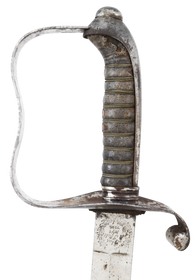
British 1905 Pattern Infantry Staff Sergeant&#acute;s Sword by Enfield, George V Rehilt and Conversion. Description Straight single-fullered spear-pointed blade. Pierced hilt similar in form to the 1897 pattern infantry model, with pierced decoration including the crown and cypher of King George V. Fully chequered backstrap, integral oval pommel with tang button. Wire-bound shagreen grip, brown leather washer. Blade length 32¼ inches, 38 inches overall. Nickel-plated steel infantry parade scabbard with two hanging rings. The blade is stamped at the forte on one side with a broad arrow, indicating War Department property, the maker&#acute;s mark &#acute;EFD&#acute;, indicating the Royal Small Arms Factory at Enfield, a crown inspection stamp with &#acute;E&#acute; for Enfield and an &#acute;X&#acute; indicating that the blade passed a manufacturer&#acute;s bending test. It is stamped on the other side with two further crown inspection stamps for Enfield, the manufacture date &#acute;00, and issue stamps &#acute;01 and &#acute;03. What sets this sword apart is its blade, which on close inspection is not the symmetrical infantry officer&#acute;s model introduced in 1892. Its fuller is wider and runs more along one edge of the blade. Rather than tapering as the blade does it remains about as wide, taking up almost the full width of the blade by the end of the fuller. This suggests that it is in fact not an infantry blade at all, but a modified 1899 Pattern cavalry trooper&#acute;s sword blade. Surplus cavalry blades of this pattern were used to manufacture the 1905 Pattern staff sergeant&#acute;s sword, an uncommon type which is thought to have been brough in to replace swords lost in the Boer War without too much expenditure. Unlike officers who privately purchased and owned their own swords, staff sergeants were issued their swords from regimental stores like a musket or bayonet, and the swords remained government property. In 1912 both the 1898 and 1905 Pattern staff sergeant&#acute;s swords were officially rehilted to replace the old royal cypher with the new one of King George V. This sword may be one of these modified examples, although its modifications have gone much further than rehilting. The blade has been shortened and narrowed (1 inch wide at the shoulder and 5/8 of an inch at the end of the fuller), with material removed from the belly and the false edge. The spine has been slightly narrowed and rounded. This has entirely removed the cutting edges, and a new thinner spear point has been created and profiled, although not sharpened. The overall effect is to bring the blade closer to that of the infantry sword, to such an extent that it now fits in an infantry officer&#acute;s scabbard. This version would certainly have stood out less on parade than the larger scabbard which had to be made for the 1905 Pattern. The issue stamps seen on the blade match those seen on 1899 Pattern swords and suggest that the blade might have seen some use before being used in the conversion “ with the degree of modification even a damaged or training-purpose cavalry blade could have been used. The blade is bright with only very light patination in places and a polished finish. The hilt is undamaged with a light patina. The shagreen of the grip is all intact with very little handling wear, the wire binding is all present with very slight movement to the loops. The ferrule can shift slightly side to side with pressure “ I suspect as a result of the conversion the tang is not quite the right thickness. The scabbard is bright, free of dents with only a few tiny areas of wear to the plating.
Page 81 of 156