
Show

Forgot your password?

Error message here!

Error message here!

Error message here!

Error message here!

Show Error message here!

Show Error message here!

Lost your password? Please enter your email address. You will receive a link to create a new password.

Error message here!

Back to log-in

Close

For Sale

The following items are listed by for sale by users of the site and dealers. They are in no way endorsed or guaranteed by www.antiquearmsresearch.com

Add a Classified Item
to

Clicking on the sword will take you through to the relevant classified item or dealer site.
Don't miss out! - Do you want to be kept informed weekly of new aditions? Just join our weekly update list.

You can also receive regular email notifcations when items match your keywords. To recieve them just register or logon at the top right of this page.
Page 84 of 118
  • Nation : -
  • Local Price : 575.00 USD
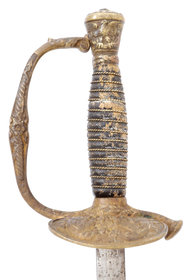
US M.1860 STAFF & FIELD OFFICER’S SWORD. See The American Sword, Peterson #121. Standard pattern carried by Union sergeants in the Civil War. Brass hilt with eagle motif to the pommel and guard. Floral motif knuckle bow. Spirally fluted ray skin grip with twisted wire wrap. 30” double edged diamond section blade with minor finger staining, unmarked. Brass mounted plated scabbard. Good clean example with great Civil War character.
  • Nation : American
  • Local Price : 575.00 USD
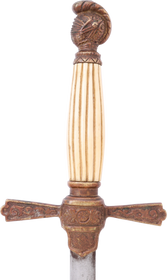
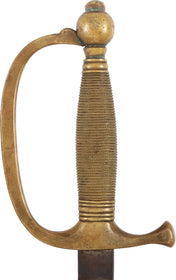
US MILITIA NON-COMMISSIONED OFFICER'S SWORD C.1850. One of the many variants (see The American Sword, Peterson #11 and #12) which were purchased by state militias before, during, and after the Civil War. Type which served extensively in the Civil War as the military was comprised to a great extent of state militias. Used by Southern militias as well as Northern, these were drawn into the Civil War on both sides.  25 3/8" straight double edged blade marked 23 at the base. Brass hilt with cruciform guard and shield form langets, with a plumed helmet pommel and reeded bone grip. Brass mounted steel scabbard, blued and now turned to brown.
  • Nation : American
  • Local Price : 565.00 USD
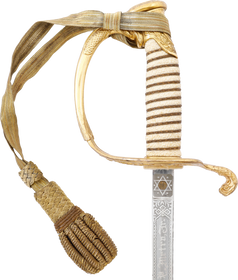
US 1852 PATTERN NAVAL OFFICER’S SWORD. See The American Sword, Peterson #138. Pattern used through the Civil War and current today. This example is from the mid 20th century. Gilt brass hilt with pierced USN guard with virtually all its bright gold surface. Wire wrapped simulated ray skin grip. Original sword knot with gold bullion tassel. 30” broad fullered blade decorated with foliage, USN, eagle, stars & bars, anchor and officer's name. The ricasso with inset proof and German maker's mark, N S MEYER. Crisp and bright.
  • Nation : Russian
  • Local Price : 565.00 USD
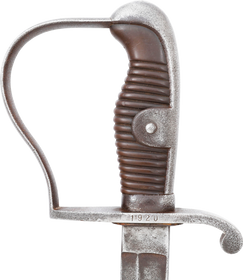
PRUSSIAN M.1873 ARTILLERY SABER. Iron hilt with P form guard and ribbed composition grip. The cross guard with 5 cancelled regimental issue numbers and serial number opposite. 29 3/4” broad fullered blade, with ALEX COPPELL SOLINGEN make's mark to the ricasso. Shown uniform medium gray patina. The back ordnance marks. A well used veteran showing its years of service. 
  • Nation : British
  • Local Price : £400.00
British c1860 Volunteer Lancaster Bayonet. Unfullered pipeback blade with quill point, steel cross hilt with straight lower quillon with round forward-swept finial, and upper quillon projecting from the muzzle ring. Grip slabs of pressed black leather over wood, secured to the exposed tang with four rivets, one of which secures the external leaf spring which actuates the locking catch. Black leather scabbard with steel throat piece with oval frog stud and steel chape piece. Blade 58.9cm (~23 3/16 inches) in length, the bayonet 72.4cm (28½ inches) overall, muzzle ring diameter 20mm. The blade is stamped at the ricasso on one side with the maker’s mark ‘CHAVASSE’, indicating manufacture by Chavasse & Co, Birmingham. The pommel is stamped with the number ‘208’, probably a rack or weapon number. The Lancaster carbine was adopted by the Royal Sappers and Miners (the precursor to the Royal Engineers) in 1855, and came with a bayonet that was unusual for British Army issue, as it used brass for its hilt, pommel and scabbard fittings and had a conspicuously long pipeback blade. Pipeback blades for swords had fallen out of usage on British swords in the 1840s: while they were intended to be stiff in the thrust with a durable point, they were difficult to forge, easily bent and the cutting edge was so thin as to be fragile. The design might have fared better on a bayonet for which thrusting was paramount, and the shorter blade was less likely to flex, but fullered blades were the norm and the Lancaster would be the only British pipeback bayonet. While its looks were striking on parade, the Lancaster bayonet was fragile, requiring more frequent repairs than other models. Despite this issue, sheer decorative appeal meant that the bayonets outlasted the carbines they were made for, being repurposed as parade sidearms for the Royal Army Medical Corps and remaining in service into the early 20 th century. Shortly after the Lancaster’s introduction, growing tensions in Europe raised concerns about Britain’s vulnerability to potential invasion. To bolster national defenses the War Office sanctioned the establishment of ‘Volunteer Corps’ in 1859. These units were somewhat a reinvention of the militia – non-professional soldiers who were expected to provide their own uniform and equipment, train at regular intervals and be ready for mobilisation in case of invasion. Providing their own equipment extended to arms too – some volunteer rifle units were provided with Army surplus but many instead pooled money and purchased weaponry from the commercial market. Volunteer rifle units generally purchased carbines wherever possible, and one option for a bayonet to pair with these was the Lancaster. Its looks may have appealed to volunteer soldiers, or its potential to double as a bayonet and a sidearm. Commercial versions differed from the service model: they usually had steel components instead of brass, and a different scabbard closer to that of the contemporary cutlass bayonets. See British & Commonwealth Bayonets by Skennerton, p123. These were not necessarily fitted to Lancaster carbines – each bayonet would have been hand-fitted and this may have been to the Enfield short rifles or carbines, of which there were multiple models. The blade is unsharpened with no nicks to its edge. Some grinding and polishing marks to the blade, with some spots of patination, some frosting at the hilt end, areas of moderate pitting along the spine and small spots of heavy pitting on the flat of the blade in the pipeback section, some of these contacting the edge. The hilt, pommel, rivets and exposed tang have heavy dark patination and speckled light pitting, moderate pitting to the muzzle ring and upper quillon. The locking button functions well. The leather grips are very good with no apparent wear to the knurling, beside some surface rubbing at the pommel end. One small dent to the exposed tang. The scabbard leather has some surface rubbing and flaking but is generally strong with all of its stitching intact, able to support its own weight. The scabbard throat and chape pieces are heavily patinated with peppered heavy pitting, some small dents to the chape piece which do not interfere with sheathing and drawing.
  • Nation : Indian
  • Local Price : £400.00
US M1873 Entrenching Tool. Flat blade with straight edges leading to a round spadelike point. Steel socket with reinforcing side bars crimped onto the blade. Ribbed wood grip. Tin scabbard covered with brown leather, with brass throat piece secured with brass rivets, the throat piece incorporating a square loop, through which runs a circular steel hanging ring. Blade 8 inches in length, the tool 13¼ inches overall. The wood grip is stamped next to the socket with ‘US’. The leather covering of the scabbard is also stamped on one side near the throat with ‘US’. In the 1860s the US Army had no standard issue entrenching tools, earthworks traditionally being considered the domain of engineers, but experience from the Civil and Indian Wars led commanders to the conclusion that the ability to create one’s own cover, even in the form of a shallow pit, was crucial for troops on the battlefield. The Model 1873 tool was manufactured at the Springfield Armory for use by the US Cavalry – note the metal ring at the scabbard throat which allows it to be attached to a saddle rather than to a man’s belt. Simple and robust, the M1873 was a successful design, and Army field tests showed that seemingly small trowels could provide useful pits and mounds in the unforgivingly flat plains of the central United States. The blade has no edge damage. It has polishing marks and some light scratches, some spots of patination, and a few small spots of light pitting near the tip. The brass throat piece of the scabbard has an even patina, with some small areas of verdigris around its rivets. The steel hanging ring is patinated overall. The wood grips are in good condition, retaining rich colour with no significant handling wear or damage. The leather of the scabbard has some spots of staining and surface rubbing, one small hole near the throat on the reverse side, and one short crack along the central rib of the reverse side, exposing some of the tin core. All the scabbard’s stitching is intact.
  • Nation : British
  • Local Price : £400.00
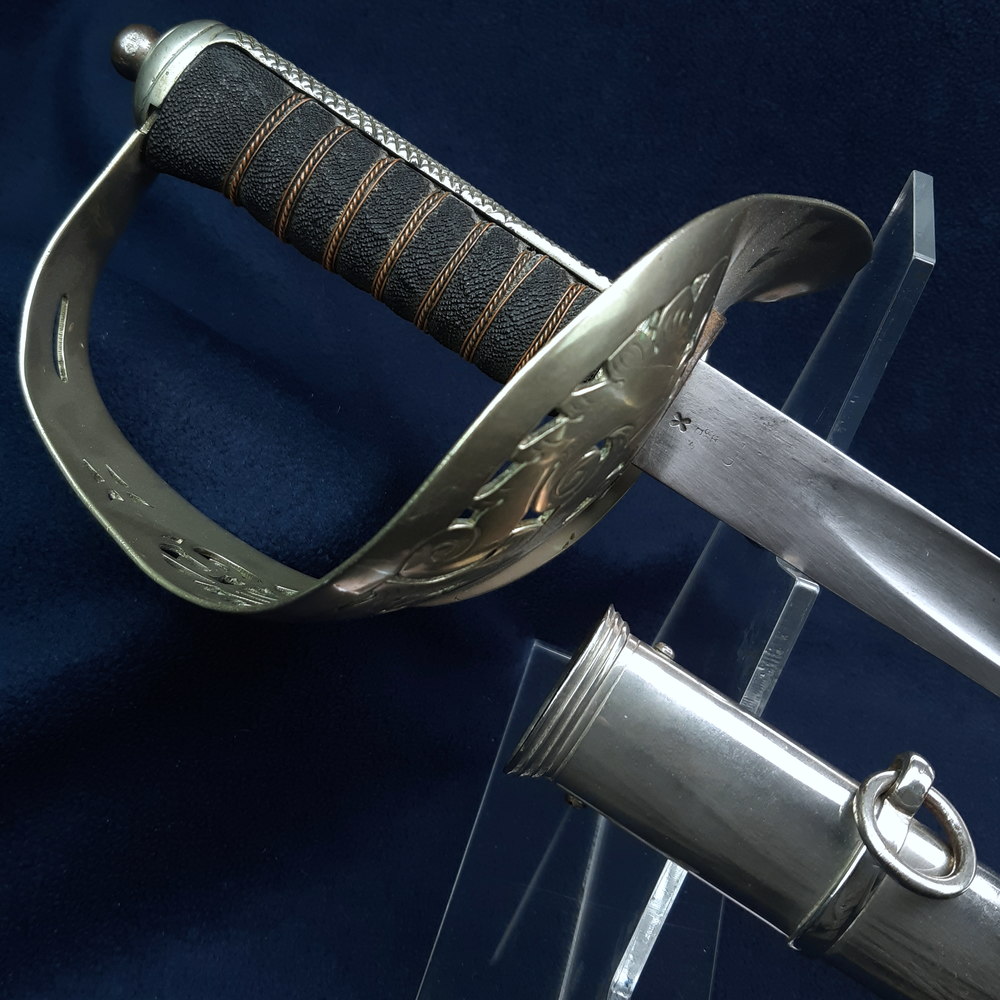
British 1905 Pattern Infantry Staff Sergeant’s Sword by Enfield, 1912 Rehilt and Conversion for George V. Straight single-fullered spear-pointed blade. Hilt similar in form to the 1897 pattern infantry model, with pierced decoration including the crown and cypher of King George V. Fully chequered backstrap, integral oval pommel with tang button. The hilt, ferrule, backstrap and pommel are all non-ferrous metal, probably German silver (copper-nickel-zinc alloy). Wire-bound shagreen grip, brown leather washer. Blade 32¼ inches in length, the sword 38 inches overall. Nickel-plated steel parade scabbard with two hanging rings. The blade is stamped at the forte on one side with a broad arrow, indicating War Department property, the maker’s mark ‘EFD’, indicating the Royal Small Arms Factory at Enfield, a crown inspection stamp with ‘E’ for Enfield and an ‘X’ indicating that the blade passed a manufacturer’s bending test. It is stamped on the other side with two further crown inspection stamps for Enfield, the manufacture date ’00, and issue stamps ’01 and ’03. Unlike officers who privately purchased and owned their own swords, staff sergeants were issued their swords from regimental stores like a musket or bayonet, and the swords remained government property. The 1905 Pattern staff sergeant’s sword was unusual in that it was manufactured using surplus 1899 Pattern cavalry trooper’s sword blades, which is thought to have been done to replace swords lost in the Boer War without too much expenditure. As originally produced the 1905 comprised of an unmodified 1899 Pattern blade fitted with new slab grips secured with rivets and an 1897 type infantry hilt bearing the cypher of Edward VII. In 1912 both the 1898 and 1905 Pattern staff sergeant’s swords were officially rehilted to replace the old royal cypher with the new one of King George V. Having encountered and stocked multiple examples like this one, it is clear to me that other modifications were carried out to many of the 1905 Pattern swords beyond simply replacing the hilt, these modifications tending to bring them closer in form to the infantry officer’s sword (much like the 1898 Pattern sergeant’s sword, which was already a doppelganger of the officer’s model). The blade of this example has been reduced in length by trimming the tip, and narrowed in both width and thickness by grinding the faces, belly and false edge. Some curve has been left in the blade which is unusual for the type, perhaps because this one has been fitted into an artillery scabbard which itself has a slight curvature. For comparison: Original 1899 Pattern cavalry blade: Curved, 33½ inches in length, 1.45 inches wide at the shoulder (due to a flare at the base designed to add strength there specifically), 1.05 inches wide at the midpoint (16.75 inches from shoulder), 0.36 inches thick at the shoulder, 0.275 inches thick at the midpoint This sword’s blade: Slightly curved, 32¼ inches in length, 1.04 inches wide at the shoulder, 0.77 inches wide at the midpoint (16.75 inches from shoulder, ignoring shortening for a more direct comparison), 0.32 inches thick at the shoulder, 0.26 inches thick at the midpoint After this reshaping, which would have required complete reprofiling of the tip, the blade has been left unsharpened and mounted with its new hilt plus a new infantry-style shagreen grip and a standard infantry backstrap. The grip is very distinctive on these swords as it is quite crude compared to contemporary equivalents, lacking for instance grooves for the wire. Possibly the tang is wider than standard requiring something bespoke yet easily fabricated. While the pattern stamp found on the spine of the 1899 Pattern is missing on this example, probably ground off in the conversion, its issue stamps are typical and its modified shape is distinctive. Even with a few manufacturing shortcuts, why the military went to such effort to convert these is an interesting question. My thought is that the 1912 sword would have stood out less on parade than the 1905 Pattern, which needed a larger scabbard and distinctive riveted grip to fit its cavalry blade. Rehilting swords for a new monarch may have become an opportunity for the Army to ‘fix’ the odd-looking and cumbersome 1905 Pattern into something that looked less makeshift, at minimal cost. This rehilt & conversion type is not found in lists of official patterns, but the change is extensive enough that perhaps we ought to consider the 1912 Sergeant’s sword worth noting as a distinct model for collecting purposes. Its features are consistent and it helps explain why the 1905 Pattern staff sergeant’s sword is quite rare today. The blade is bright with only very light patination in places and a polished finish. It is, as mentioned, unsharpened with no edge damage. The tip is fractionally bent to one side. The alloy parts are undamaged and bright with no damage or staining. The shagreen of the grip is all intact with very little handling wear, its wire binding is all present with very slight movement to all loops. The ferrule can shift slightly side to side: I suspect as a result of the conversion the tang is not quite the right thickness for it. The sword is otherwise firm in the hand, solidly peened with no movement to the grip. The scabbard is bright, free of dents with only a few tiny areas of wear to the plating. The sword sheaths and draws smoothly.
  • Nation : -
  • Local Price : 555.00 USD
1840 PATTERN MUSICIAN'S SWORD. German made with HORSTMAN SOLINGEN maker's mark. Undated and not US marked, indicative of militia use.  Very likely fought for the Confederacy. Musicians marched at the head of the attack and were recognized as a stabilizing and stimulating force. Musicians marched at the head of the attack and were recognized as a stabilizing and stimulating force. They were attacked to silence them and a few including Robert Henry Hendershot and John Clem became legends for their bravery on the battlefield. Union musicians were equipped with the 1840 pattern sword and no other weapon. From the famed American Sword Collection of Frank Barnyak.
Page 84 of 118