
Show

Forgot your password?

Error message here!

Error message here!

Error message here!

Error message here!

Show Error message here!

Show Error message here!

Lost your password? Please enter your email address. You will receive a link to create a new password.

Error message here!

Back to log-in

Close

For Sale

The following items are listed by for sale by users of the site and dealers. They are in no way endorsed or guaranteed by www.antiquearmsresearch.com

Add a Classified Item
to

Clicking on the sword will take you through to the relevant classified item or dealer site.
Don't miss out! - Do you want to be kept informed weekly of new aditions? Just join our weekly update list.

You can also receive regular email notifcations when items match your keywords. To recieve them just register or logon at the top right of this page.
Page 89 of 118
  • Nation : American
  • Local Price : 515.00 USD
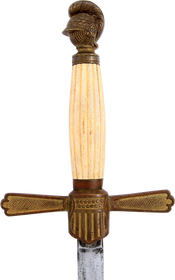
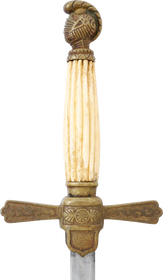
US MILITIA SWORD C.1850. See The American Sword, Peterson #11. Brass hilt with helmet form pommel and straight cross guard with foliage decoration, shows some wear from use and good patina. Reeded bone grip, excellent. 27 1/4" double edged blade with mottled gray patina. Black leather covered iron scabbard lacks about 6” of the leather covering. The balance with wear commensurate with Civil War service and age. At the outbreak of the War, the majority of troops in service of both sides were from state militias.
  • Nation : American
  • Local Price : 515.00 USD
U.S. MILITIA SWORD NON COMISSIONED OFFICER’S SWORD C.1840-50. Surely saw Civil War service as the majority of troops on both sides at the outbreak were militia. Good quality example of the standard pattern (Peterson #11) from the famed Barnyak collection. Crisply detailed hilt with reeded bone grip (no chips). 27 1/2” d.e. blade with maker's mark to the ricasso. Gray original surface and spotty raised rusting. Frank Barnyak was a California gun show promoter who constantly upgraded his collection with the best quality and rarest examples.
  • Nation : American
  • Local Price : 515.00 USD
AMERICAN STATE MILITIA NCO’S SWORD. Probably Civil War. Plated hilt with plumed visored helmet form pommel and “bow tie” guard. Reeded bone grip. 25 7/8” blade of medially fullered double edged fighting form. Plated scabbard with deeply hand-chiseled figure of a semi nude “wild man” standing over a severed head, a saltire and four leaf clover. Well used with the plating well preserved throughout. Swords of this type were produced for state militias, which comprised most of the combatants during the Civil War. The use of plating was not accepted under Federal regulations, but was well established and used extensively in hand guns and other applications. The figures on the scabbard were engraved before plating and evidently custom to the order of the sword's owner. Federal policy was that officers purchased and owned their swords. Militia policies varied and in fact, this sword may have been owned by a commissioned officer. As militias were adequately armed, as least by the end of the Civil War, a pre war or Civil War date is almost certain. After the war, there was a glut of swords and little need to produce them. Worth some research.
  • Nation : German
  • Local Price : 515.00 USD
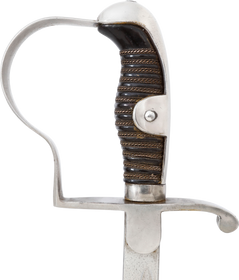
IMPERIAL GERMAN OFFICER’S SWORD. Plated hilt with saddled back strap show in excellent preservation. Wire wrapped black horn (?) grip, excellent. 31 3/4 curved broad fullered single edged blade with the A C maker's mark of Alex Coppel Solingen. Plating complete and bright. Fine example in exceptional preservation.
  • Nation : American
  • Local Price : 510.00 USD
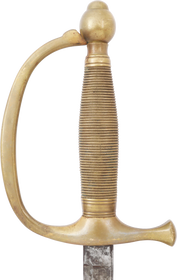
US 1840 PATTERN MUSICIAN'S SWORD. Standard pattern. See The American Sword, Peterson #44 with Ames Mfg Co Chicopee Mass maker's mark to the blade. Reverse with U S GWC (inspector George W Chaplin) 1864 to the blade. The Ames marks particularly well struck for that maker. Hilt with good patina. Blade smooth glossy patina and a few minor edge nicks. Musicians marched at the head of the attack and were recognized as a stabilizing and stimulating force. They were attacked to silence them and a few including Robert Henry Hendershot and John Clem became legends for their bravery on the battlefield. Union musicians were equipped with the 1840 pattern sword and no other weapon. From the famed American Sword Collection of Frank Barnyak.
  • Nation : British
  • Local Price : £365.00
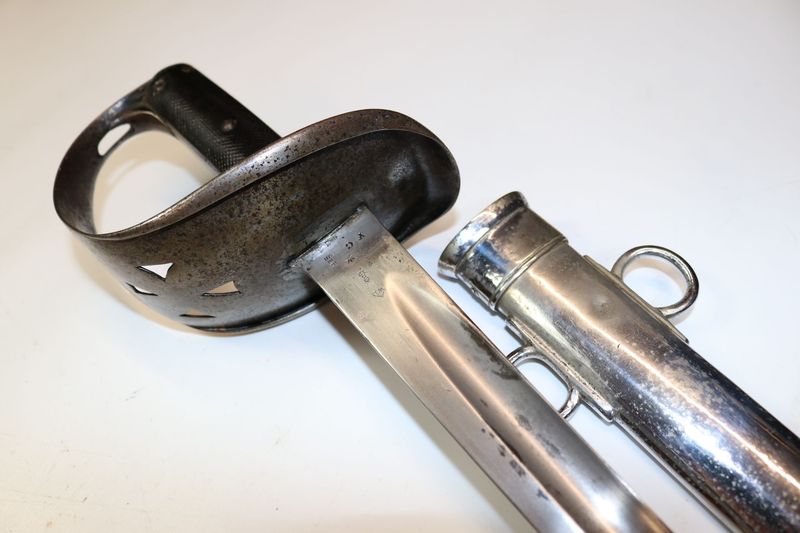
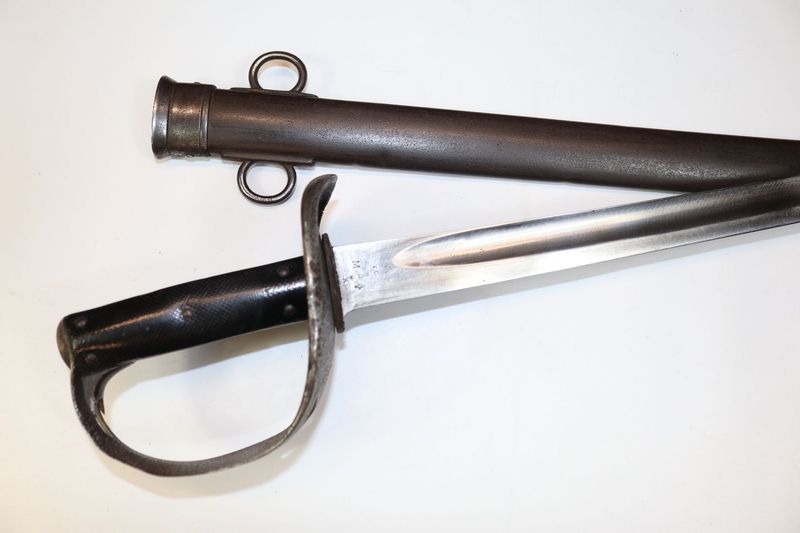
Late-Victorian 1885 Pattern Cavalry Sword by WKC. EL7326 - A good 1885 pattern cavalry sword, made by WKC of Solingen in 1888. With numerous markings to decipher, it is in good condition and complete with unusual nickel plated scabbard.
  • Nation : British
  • Local Price : £360.00
Victorian 1885 Pattern Cavalry Sword by WKC. EL7321 - A good 1885 pattern cavalry sword made by WKC in Solingen in 1887 and with numerous stamps which tell the story of its subsequent service life. Complete in scabbard, which carries a lot of dents from stirrups and steps!
  • Nation : German
  • Local Price : £360.00
Japanese Army Artilleryman’s Short Sword, Second Model, c1886. Straight spear pointed blade with fuller on one side only, the other side flat. Steel crossbar hilt with forward-curving quillons each side, two-piece wood slab grips secured by two steel rivets, steel oval ball pommel. The blade is stamped at the ricasso with two Japanese characters. In 1884 the Imperial Japanese Army directed that rifles were to be withdrawn from Japanese artillerymen and in future short swords were to be issued to them instead. A commission was to be set up to review existing European designs for such swords and produce a new design based upon them, with stocks of Enfield rifle bayonets issued temporarily while this was carried out. This was characteristic of the Meiji period in which Japan deliberately absorbed Western ideas on military organization and equipment, seeking to achieve parity in technology and tactics. Multiple models of short sword emerged from this process – the version which was probably the first to be introduced (Kō) is referred to in sources as 砲兵刀 (Artillery Sword). It had a cast brass hilt and grip, and a black leather scabbard with brass throat and chape pieces, showing clear influence from the German faschinenmesser sidearms of the 19 th century, particularly the M1852. The machine-made blade fullered only on one side is also very European, reminding me of the Vetterli bayonet, Saxon artillery sidearms or various Austrian models. This is the second version (Otsu), probably introduced in 1886. It used the same blade but generally deviated from the German style, replacing the grip with wood and all other brass parts with steel. This would have been lighter and the simple steel ball pommel may have been intended to substitute for a hammer. Some sources suggest this type was initially introduced for the use of military police, referring to it as 憲兵刀 (MP Sword), but it does not appear to have been issued in this role and was probably also given to artillery in practice. A third type (Hei) exists with a smooth, non-riveted wood grip and brass parts, called 徒歩刀 (literally ‘Walker sword’), introduced in 1890. The various short swords were ultimately replaced in 1898 with the Type 30 Arisaka bayonet, this being substantial enough to do the same work and considerably simplifying supply. Some light patination to the blade overall, with a few darker spots. The hilt and pommel were originally painted black and much of this is still present, with some wear exposing patinated steel. Some dents and light handling wear to the wood grip. The pommel can rotate slightly in place, although the grip is solid in the hand. The seam of the scabbard has opened slightly in one section towards the chape. The scabbard fittings are darkly patinated with some scratching.
Page 89 of 118