
Show

Forgot your password?

Error message here!

Error message here!

Error message here!

Error message here!

Show Error message here!

Show Error message here!

Lost your password? Please enter your email address. You will receive a link to create a new password.

Error message here!

Back to log-in

Close

For Sale

The following items are listed by for sale by users of the site and dealers. They are in no way endorsed or guaranteed by www.antiquearmsresearch.com

Add a Classified Item
to

Clicking on the sword will take you through to the relevant classified item or dealer site.
Don't miss out! - Do you want to be kept informed weekly of new aditions? Just join our weekly update list.

You can also receive regular email notifcations when items match your keywords. To recieve them just register or logon at the top right of this page.
Page 91 of 124
  • Nation : British
  • Local Price : £355.00
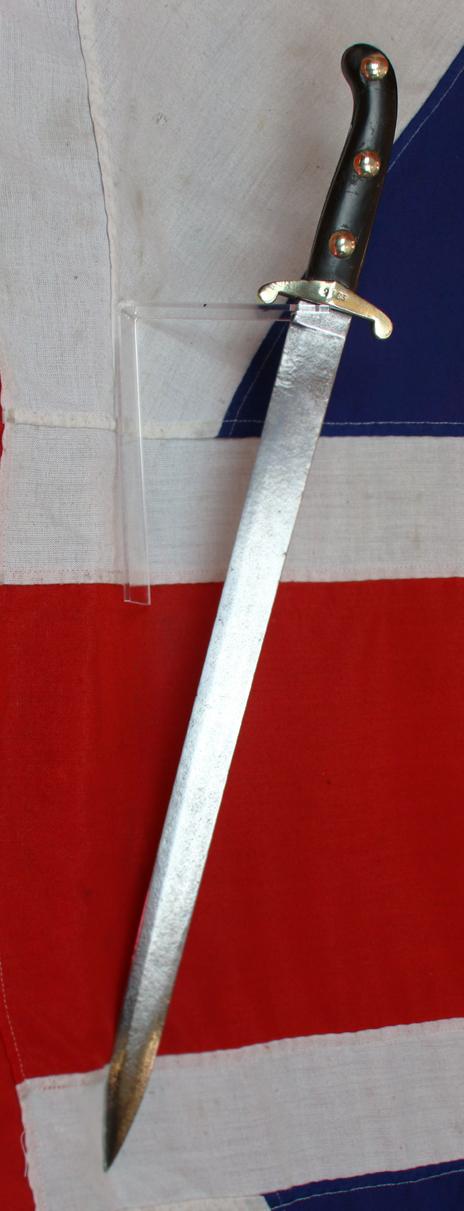
A Most Scarce Original Antique Sharpshooter's Sword Used By Swiss Mercenaries In the 1849 Italian Revolution. Made by F Horster of Solingen. Wooden grip with brass rivets. Single edged blade made by Horster of Solingen. Carried by the Swiss Infantry sharpshooters, snipers. Used by of the swiss regimental sharpshooter mercenaries that fought for the King in the revolution in Italy in 1848. A Swiss regiment that fought in the streets of Naples for Ferdinand II, King of the two Kingdoms of Sicily, during the uprising of 15 May 1848. Between 1856 and 1860, around 1,200 Swiss mercenaries from the Swiss regiments in Naples continued their military careers in the Dutch colonial army. The Revolution which began in Palermo was one of a series of such events in Italy, though perhaps more violent than others. It quickly spread across the island and throughout Italy, where it prompted Charles Albert, King of Sardinia, to follow the example of Ferdinand II and issue a written constitution, the Albertine Statute {the Albertine Statute later became the constitution of the unified Kingdom of Italy and remained in force, with changes, until 1948}. In imitation of these events, riots and revolutions followed around Europe at the same time, and may be considered a taste of the socialist revolts to come. King Ferdinand II of the Two Sicilies By the recapture of Sicily in May 1849, the battle was said to be practically over. Filangieri, however, dared not let his troops enter the set of alleys that then made up the historic center of Messina: although the regular Sicilian forces had been exterminated or forced to flee, the bombardment of the Bourbons continued on the defenseless city, that is, on the part that had not yet been occupied by the regi, for another seven hours. The soldiers of the Bourbon army gave themselves up to the looting and violence against the inhabitants. Homes of foreigners living in Messina were also looted and destroyed, so much so that the English consul Barker reported the incident to his government writing that many English subjects living there were reduced to ruin and that even a diplomat, the consul of Greece and Bavaria M. G.M. Rillian, despite being in uniform, had been wounded by sabre, before his dwelling was also looted and burned down. The Bourbon troops did not spare even the religious buildings from looting. For example, the church of San Domenico, rich in works of art, was first looted of its sacred objects, then burned down and totally destroyed. Loss of life was incalculable. A Bourbon official wrote to his brother, immediately after the capture of Messina, stating that the Neapolitan departments had recaptured the city with a very intense fire and "trampling corpses in every step that progressed for the space of about two miles" and then commenting "What a horror! What a fire! British Admiral Parker also condemned the work of the Bourbons, and in particular the prolonged terrorist bombardment of the city even after the end of all resistance for eight hours: "The greatest ferocity was shown by the Neapolitans, whose fury was incessant for eight hours, after all resistance had ceased". During the siege of Messina, the last insurgents who resisted the attack of the Bourbons inside a convent, rather than hand themselves over, chose to throw themselves into a well, taking their tricolour flags with them. Messina was also troubled by the work of common criminals sent by King Ferdinand II to Sicily against the insurgents and that after tormenting the Sicilians for months with brigand actions (crimes, violence, thefts, etc.) they gave themselves at the time of the fall of the city to its looting, arriving with small boats from Calabria to make loot. Overall in nice condition, with old traces of pitting throughout the blade , one rivet cap lacking, no scabbard. A very rarely seen sword. Every single item from The Lanes Armoury, Britain's famous, favourite, and oldest original Armoury Antique store, is accompanied by our unique Certificate of Authenticity. Part of our continued dedication to maintain the standards forged by us over the past 100 years of our family’s trading, and thus, it is a lifetime guarantee.
  • Nation : British
  • Local Price : £350.00 GBP
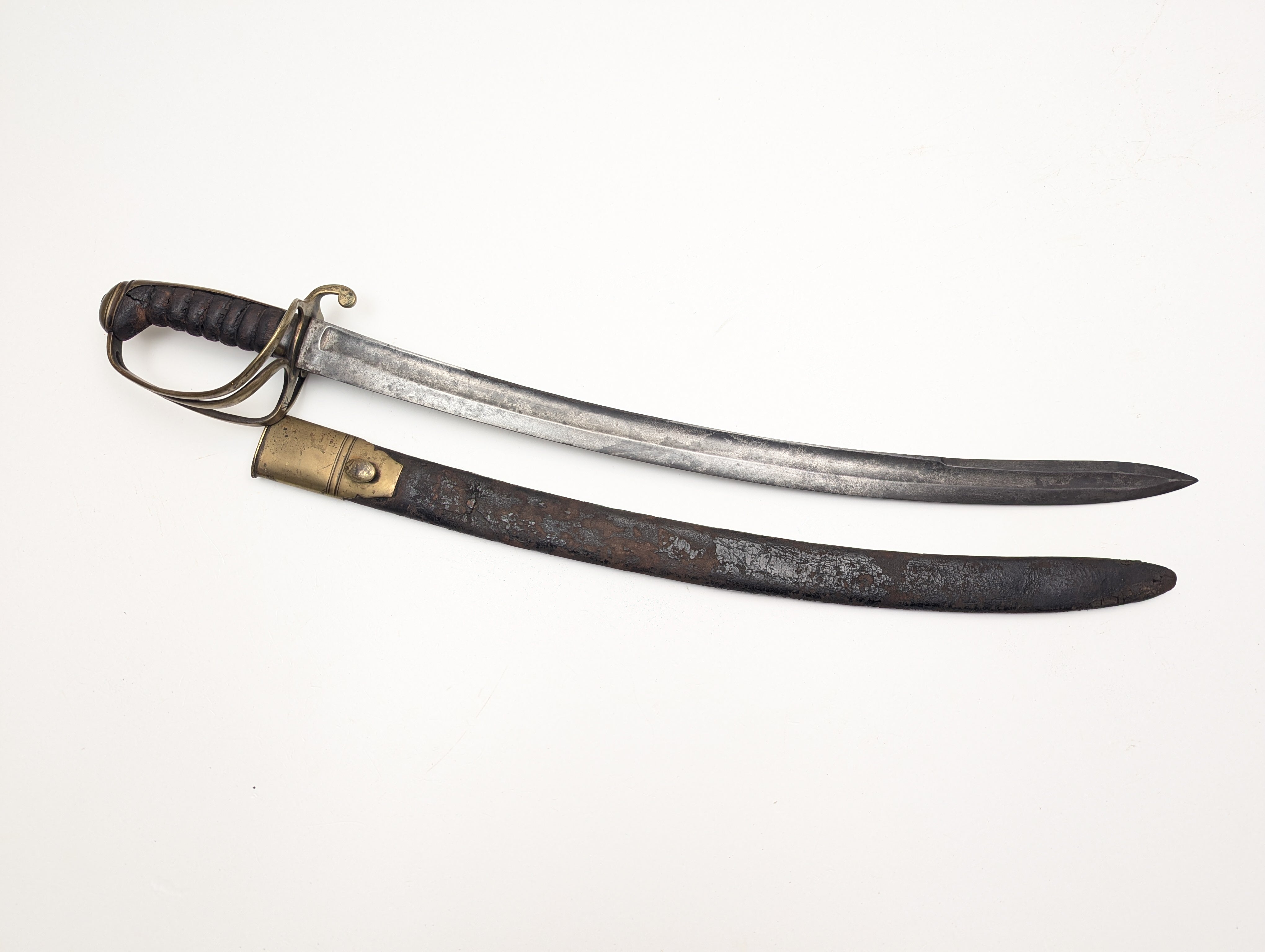
Georgian Sidearm, 3-Bar Hilt. A Georgian sidearm with a 3-bar hilt."
  • Nation : American
  • Local Price : 485.00 USD
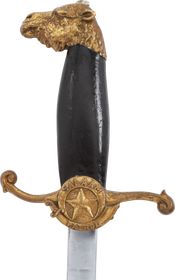
RARE VARIATION AMERICAN SECRET SOCIETY SWORD. Scimitar form with gilt hilt. The pommel as a large fully modeled camel's head. The recurved guard with a star surrounded by SALAAM PATROL. Black japanned grip. 24 ½” curved broad fullered blade. Evidently a sub group of Masons, we found no swords matching but a few ceramic mugs with SALAAM PATROL, and 1908 and 1909 dates. Very rare.
  • Nation : -
  • Local Price : 485.00 USD
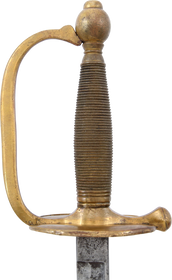
AMES MARKED US M.1840 NCO SWORD. Civil War issue. Standard pattern. See The American Sword, Peterson #10. 32 1/4" single edged blade quite smooth with some spotty pitting last half, toward the point. Brass hilt with simulated wire wrap grip, with storage surface soiling and age patina. Good representative Civil War Civil War example.
  • Nation : Russian
  • Local Price : 485.00 USD
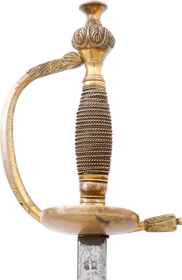
PRUSSIAN INFANTRY OFFICER’S SWORD. Late 19th-century. Standard pattern with 34 1/4” broad fullered single edged blade, decorated half its length with stylized foliage and military trophies. Brass hilt with double raised edge shell guards the right folding.  Fine wire wrapped grip, sound and tight. The blade with scattered minor smooth black staining and some pitting to the tip.
  • Nation : American
  • Local Price : 485.00 USD
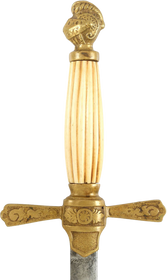
US MILITIA SWORD C.1850. Peterson #11. Brass hilt with helmet form pommel and straight cross guard with foliage decoration, shows some wear from use and good patina. Reeded bone grip, excellent. 28 1/8" d.e. blade with mottled gray patina. The base marked J A Joel & Co, New York, noted retailer of the Civil War period.
  • Nation : Swedish
  • Local Price : £485.00
Swedish M1848 Fascine Knife / Cutlass by A&E Holler. Unfullered leaf-shaped blade with spear point, brass hilt, brass ferrule, curved grip with swell to the pommel, the grips being wood slabs painted black and secured to the exposed tang by two rivets of steel & brass. Brass-lined hole at the pommel for a sword knot. Black leather scabbard with brass fittings at the throat and chape, the throat piece with loop for a frog strap, the chape piece with ball finial. Blade 17 1/8 inches in length, the knife 23 inches overall. The blade is faintly stamped at the ricasso on one side with the maker’s mark ‘A & E H’ within a dotted oval, indicating the maker A & E Holler of Solingen, Germany. This became F.W. Holler in 1869. This seems a less common maker, most contracts being given to Swedish manufacturers instead. Next to this is stamped ‘8 R 6 K N o 128’, which is a Swedish unit mark. The hilt is stamped with ‘GVA’, possibly an inspection mark, while the finial of the chape piece is stamped with ‘H’ within a circle. Introduced initially as a pioneer’s sidearm, to be used much like a machete, the M1848 fascine knife grew popular among Swedish forces and its usage spread to most infantry units and the coastal artillery. Some coastal artillery units were transferred to the Navy and brought the M1848 with them, leading some to consider it to have used as a cutlass. While it would have been usable in combat In a pinch, it was probably valued more for its handier size to carry than a full-length sword. The M1848 had a long service life, still being issued to some units into the early 20 th century, while I have seen examples given to soldiers as prizes as late as 1943. The blade is very sharp, with visible sharpening marks along the whole edge. It is bright and has probably been kept polished in the past, although its unit mark remains quite crisp. Likewise the brass fittings have only a light patina, signs of polishing to the scabbard fittings in particular. A few dents and slight movement to the hilt. Some minor scratches to the chape piece. The leather of the scabbard is good with all stitching intact, one very small cut to its edge on one side. The black paint of the grips has some rubbing from handling, exposing the wood beneath in a few spots.
  • Nation : British
  • Local Price : £485.00
British WW1 1897 Pattern Infantry Officer’s Sword of Captain William Henry German, 6th Devonshire Regiment, KIA Battle of Dujailah, Iraq 1916. Straight single-fullered spear-pointed blade. Steel hilt with pierced decoration including the crown and cypher of Edward VII, and sword knot slit. Steel ferrule, fully chequered steel backstrap, integral oval pommel with tang button. Wire-bound black shagreen grip, brown leather washer. Brown leather field scabbard with frog strap and nonferrous throat piece, probably nickel-plated brass. Blade 32½ inches in length, 1.04 inches wide at the shoulder, the sword 38¾ inches overall. The blade is etched at the ricasso on one side with the retailer’s mark ‘HOBSON & SONS 1-3 & 5 LEXINGTON S T LONDON W’. At the ricasso on the other side is an etched six-pointed star within which is a brass proof slug stamped with ‘PROVED P’. The blade is further etched on one side with the royal coat of arms, the crown and cypher of Edward VII and foliate motifs, and on the other side with the royal crown above the text ‘6 th Devonshire Regt’, a cartouche for the optional etching of the owner’s name, filled with the ornately monogrammed initials ‘W H G’, and foliate motifs. William Henry German was born in December 1886 in Okehampton, Devon, the son of William Bird German and Clara Sherwood German (née Trigg). The elder William was a long-standing alderman of the town and was Mayor of Okehampton three times: in 1891, from 1904-06 and finally in 1919. William was commissioned into the 6 th Battalion of the Devonshire Regiment in June 1910. This would be the most likely purchase date for this sword, bought along with his new officer’s uniform. The 6 th Battalion was a Territorial Force (TF) unit of part-time volunteers, at that time numbering 27 officers and 853 men. Having been formed on 1 April 1908 from the former 4th Volunteer Battalion, it was in its second full year of existence under this designation. Headquartered in Barnstaple it had eight companies based across North Devon: B Company was based in Okehampton itself and would have made sense for him to join, although I do not know which William was actually assigned to. He was promoted to Lieutenant in October 1912. On the outbreak of the First World War the 6 th Battalion was mobilized at Barnstaple. William was promoted to Captain in September 1914. The 6 th sailed for India in October 1914. They and other volunteer units were stationed at Lahore for over a year as ‘Internal Security’ troops, replacing garrison units of the regular army who were needed on the Western Front. They were underequipped and considered ‘semi-trained’ but adequate for garrison duties at short notice, and occupied themselves while in India with intensive training. However, they would soon find themselves on an active front as the British campaign to the northwest in Mesopotamia (modern Iraq) took a turn for the worse. In late 1915, British and Indian forces of the 6 th (Poona) Division under General Townshend, making a highly unwise and strategically unnecessary grab for Baghdad, were unable to conclusively defeat Ottoman forces at the Battle of Ctesiphon. Exhausted and overextended, Townshend retreated his forces to the town of Kut-al-Amara (often rendered simply as ‘Kut’), where they were then besieged by pursuing Ottomans. The campaign had been hitherto managed by the Indian General Staff, who had badly failed in logistics and medical capacity, so the War Office in London took direct control of the campaign. They could see that Kut was an impending disaster, with more than 13,000 troops at risk should the town fall. The British urgently needed reinforcements to break the siege before the garrison starved, which was predicted to be in mid-April, leading them to call upon the Territorial units already stationed nearby in India. The 6 th Battalion was accordingly redeployed, landing at Basra on 5 January 1916 as part of the 36th Indian Brigade. Two British attacks by other units in January to relieve the siege (the Battle of Wadi and Battle of Hanna) both failed with heavy losses. The Ottomans had built very strong defensive positions and were now under the able command of the German general, Colmar von der Goltz. The British had to be aggressive however as the weather would soon turn against them, the spring thaw and oncoming rainy season turning the area near the Tigris into a quagmire. The British and Ottomans both realized that attack along the right bank of the Tigris River was the most promising angle of attack remaining. The Ottomans had begun constructing a redoubt there at Dujailah (also written Dujaila) soon after the Battle of Hanna – by the time the British were ready to attack it, its glacis was estimated to be 25 feet high in places. The British crossed the river at night on the 7 th March, with 6 th Battalion forming part of the force which would assault the redoubt under the command of Major-General Kemball. As planned they reached assault positions just before dawn on the 8 th . Some men of the 26th Punjabis pushed up early and found that the formidable redoubt was barely occupied, with the Ottomans taken totally by surprise. Kemball, however, ordered them to withdraw, insisting on waiting for the preliminary artillery bombardment and getting all troops lined up for the prearranged assault time. This was a terrible tactical error. Rather than seize the moment and occupy the poorly defended redoubt the British held back, lost the element of surprise and allowed the Ottomans three hours to bring reserves over the river and man their defenses. When it finally occurred (late, in fact) the infantry assault suffered heavy casualties to machine gun and artillery fire, ultimately capturing only part of the redoubt’s trench system before an Ottoman counterattack forced them back again. The attack was a total failure with more than 4,000 British casualties – William among them. He was wounded in the assault and ultimately died of those wounds on the 16th March 1916, aged 29. The British sustained between 23,000 and 30,000 casualties in their attempts to save the men at Kut, but with no relief the garrison surrendered on April 29, 1916. British officers, especially higher ranks, were mostly separated and treated relatively well in accordance with the Hague Convention but their men, already suffering from starvation, were abused by the Ottomans. 70% of the British and 50% of the Indian soldiers who surrendered at Kut are estimated to have died on the 1,200-mile desert death march that followed or during internment in Ottoman prison camps in Anatolia. The 6th Battalion remained in Mesopotamia, and in 1917 joined a much stronger offensive under General Maude which recaptured Kut in February, and participated in the pursuit of Ottoman forces toward Baghdad. In April, the battalion moved to Shaiba, west of Basra. For the remainder of the war, their role shifted to protecting the Tigris Line of Communication (a light railway line between Sheikh Sa'ad and the Shatt al-Hai), collecting battlefield salvage, and occasional skirmishes with local bandits. William is buried at the Amara War Cemetery in what is now southern Iraq. This cemetery has been inaccessible to the Commonwealth War Graves Commission since 1991 and is now in dilapidated condition. He was survived only by his father William, who had no other children. The sword is solid in the hand with no movement. The blade has previously been sharpened in its tip section including a little of the false edge, with sharpening and grinding marks and small scattered spots of cleaned pitting. The edge has dulled somewhat but has no nicks, the tip is rounded by ~1mm. The blade has a slightly matt finish but its etching is clear with only light rubbing beyond the end of the fuller. There is a patch of heavy cleaned pitting on both sides of the blade at the base of the fuller, the depressed areas darkly patinated, which does impact the etching in those areas but does not obscure any significant information. The hilt, backstrap, pommel and scabbard throat have a bright steel finish, some small lighter spots that may be remnants of plating. The shagreen of the grip is all intact with light handling wear, the wire binding is also all present with slight movement to a couple of the loops. The throat piece of the scabbard is clean and bright, the leather scabbard body has some small dents and scuffs to its surface, a couple of longer scratches near the midsection. Its chape end aside from the edges of the chape piece is covered over with pressed leather, similar in tone but not identical, which has less surface wear and an undulating surface in places – this is probably a repair or reinforcement, age uncertain. The stitching of the scabbard where visible is all intact, the pressed section has a glued butt seam.
Page 91 of 124