
Show

Forgot your password?

Error message here!

Error message here!

Error message here!

Error message here!

Show Error message here!

Show Error message here!

Lost your password? Please enter your email address. You will receive a link to create a new password.

Error message here!

Back to log-in

Close

For Sale

The following items are listed by for sale by users of the site and dealers. They are in no way endorsed or guaranteed by www.antiquearmsresearch.com

Add a Classified Item
to

Clicking on the sword will take you through to the relevant classified item or dealer site.
Don't miss out! - Do you want to be kept informed weekly of new aditions? Just join our weekly update list.

You can also receive regular email notifcations when items match your keywords. To recieve them just register or logon at the top right of this page.
Page 104 of 158
  • Nation : American
  • Local Price : 525.00 USD
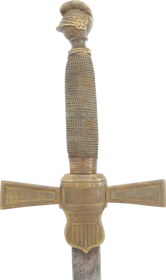
AMERICAN MILITIA NCO SWORD C.1850. Pattern which served both sides in the Civil War!  Brass hilt, formerly gilt, with bow tie guard and relief stars & bars shield langets. Plumed helmet pommel. Wire wrapped grip and 25 3/8" blade, somewhat broader than usually encountered. The blade base lightly stamped with a P R possibly the initials of the soldier who carried it which would not be inconsistent with militia rules. The cross guard as well stamped BUCHOLZ each side, with individual letter stamps. Uniform used condition and good military character. The name probably applied by the soldier who carried it, after the war for veterans ceremonies.
  • Nation : -
  • Local Price : 525.00 USD
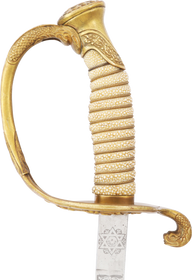
US M.1852 NAVAL OFFICER’S SWORD. Second half of the 20th century. See The American Sword, Peterson #138, 30 7/8” broad fullered single edged blade, decorated first half with foliage, military trophies, eagle, anchor, U S N and owner's name. The fort with PROVED mark. Gilt hilt with near all gold remaining. Wire wrapped simulated sharkskin grip. In its cloth storage bag but without scabbard.
  • Nation : American
  • Local Price : 525.00 USD
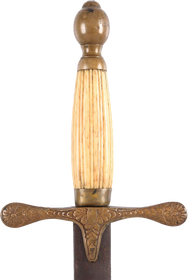
US MILITIA NCO SWORD C.1850. Rare early example. Identical to Peterson #12 with cross guard decorated in floral motifs, cruciform with pointed langets. That style draws from the Ottoman taste and saw selective use in American and England in the first half of the 19th century. Reeded bone grip with good patina (single crack and small chips). 25 ½” broad d.e. blade etched with military trophies and eagle clutching arrow cluster below motto Estates Unes on ribbon. Gray, quite smooth with minor pitting. Hilt with fine aging.
  • Nation : -
  • Local Price : 4,800 kr
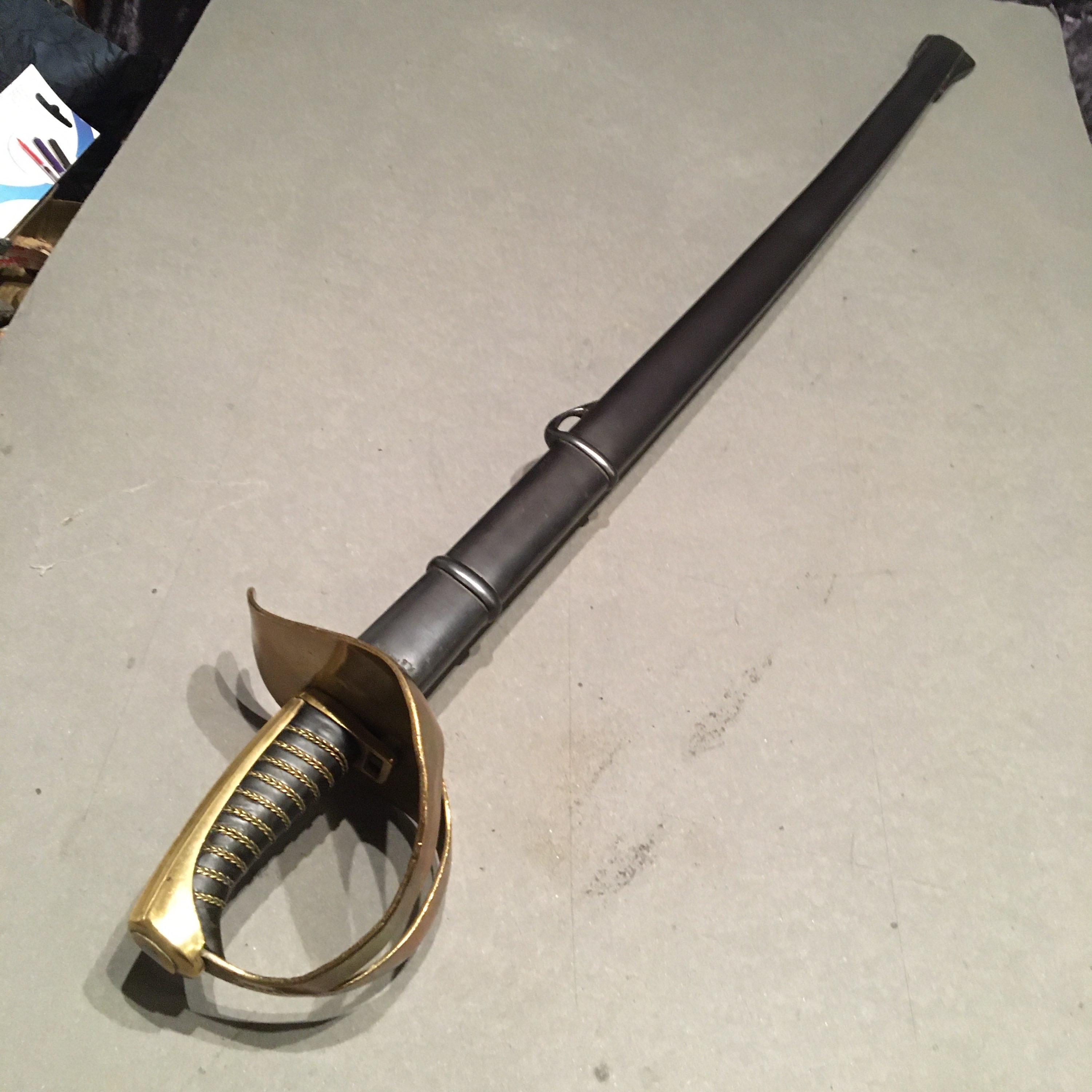
Sv cavalry sable w/1854.
  • Nation : -
  • Local Price : 4,800 kr
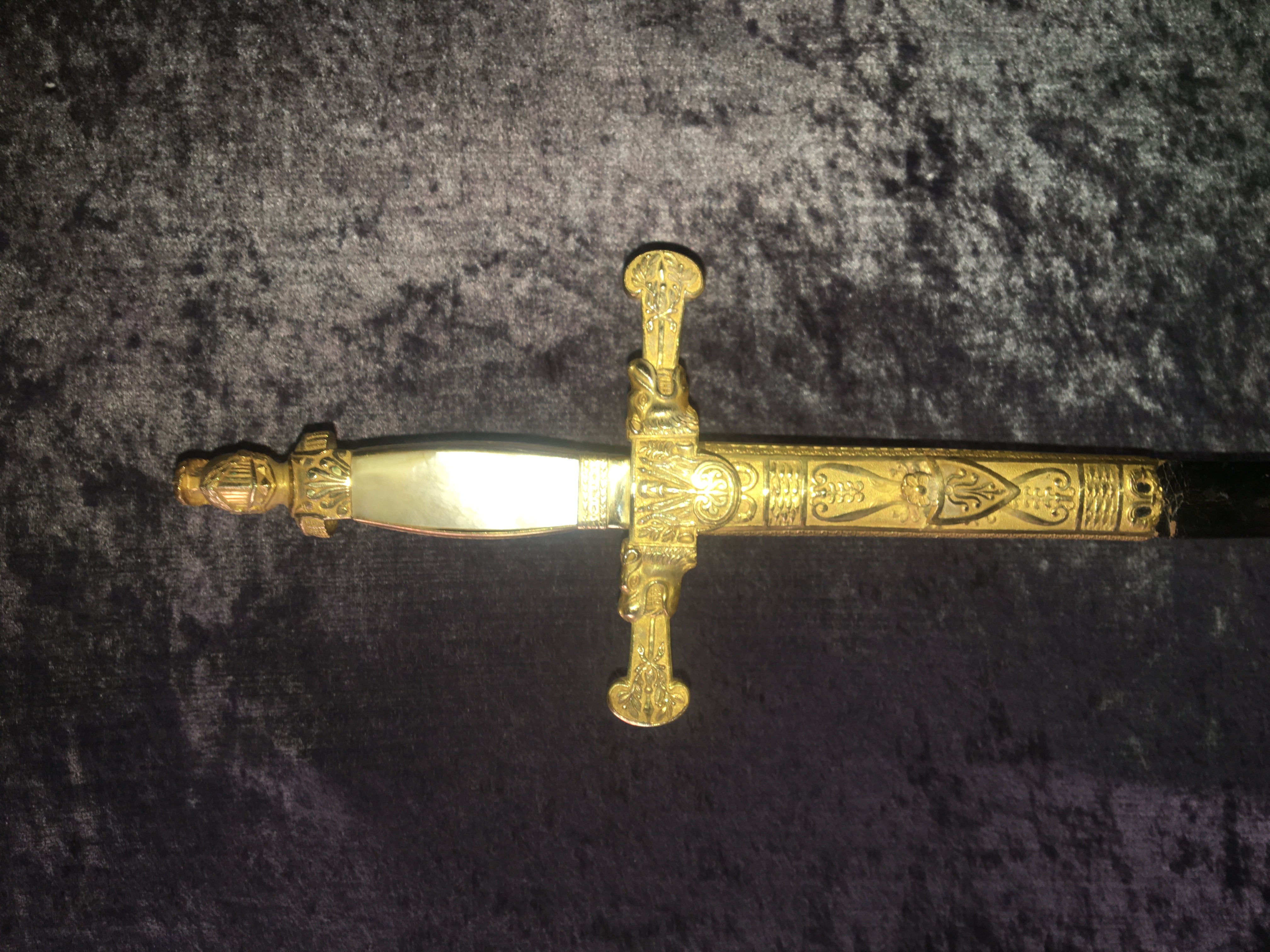
Dräktvärja 1800talets första hälft.
  • Nation : British
  • Local Price : £375.00
Victorian / WW1 Era British Officers Swagger Sword Stick With Brass Screw Thread Locking Mechanism. Sn 21885 -. This is an excellent Victorian / WW1 era Swagger Sword Stick & Scabbard. It has a 13 ¾” single edged steel blade. The blade has just light staining to be expected with age. It measures 22” overall in its scabbard. The wood hilt and scabbard are undamaged. The hilt has a brass ferrule with screw thread the turns into a brass ferrule on the scabbard, firmly retaining the sword stick in the scabbard when being carried as a swagger stick. The price includes UK delivery. Sn 21885 (top of rifle rack armoury)
  • Nation : British
  • Local Price : £375.00
1967 ER II British Wilkinson Sword 1897 Pattern Infantry Officer’s Sword With Etched Blade Issued To A Superintendent Of The Swaziland Police Africa, Leather Covered Field Service Scabbard & Frog. Sn 21720 -. Founded in 1907 when the African Estwani territory was under British rule, the Royal Swaziland Police Force initially consisted of 22 European officers along with 125 African Zulus, under Captain C.H. Gibson. A police training school was established in Mbabane in 1927 and a modern training college was built in 1965 at Matsapha. During the independence celebrations in 1968 King Sobhuza II renamed it into the Royal Swaziland Police Service. This is an original British1897 pattern Infantry Officer’s sword with scabbard and frog which was reputedly issued to a police officer in Swaziland on his promotion to Superintendent in 1967. His career further promoted him to Senior Superintendent, a paper copy of a group photograph of the Officer (name unknown) which accompanies the sword depicts the man as a Junior Officer (top right of picture). The sword has a 32 ½” long blade with partial fullers and measures 39 ¼” overall. The blade has areas of staining consistent with age and use. The blade has foliate etched panels and Queen Elizabeth II Crown & ‘ER II’ Royal Cypher. The blade has Wilkinson Sword’s name, Royal appointment and crossed swords legend, it also has etched ordnance acceptance proof star and original leather hilt washer. The spine of the blade is numbered 91225. It has a full pierced 1897 Pattern nickel plated knuckle guard with Crown ER II device. It has a curved stepped pommel with ball top, knurled back strap for grip & fish skin grip with wire binding in very good condition. It is complete with leather covered wood field service scabbard. The scabbard has a nickel plated throat mount & is fitted with leather frog that has 2 belt loops and buckles. The price includes UK delivery. Sn 21720
  • Nation : Italian
  • Local Price : £375.00
Italian Circa 1848 Piedmontese Short Sword, Italian War of Independence with Risorgimento Inscription. Description Straight, double-edged, spear pointed blade with shallow central fuller. Cast brass hilt with acorn shaped finials and central cross motif on one side, ribbed brass grip, round pommel. Black leather scabbard with brass pieces at the chape and throat, heart-shaped frog stud. The scabbard is faintly stamped &#acute;OAM&#acute;. The blade is etched on one side with foliate motifs and the dedication &#acute;Valore Lombardo 22 Marzo 1848&#acute; and on the other &#acute;Nell&#acute;Unione La Forza&#acute;. I believe this translates to &#acute;Bravery in Lombardy [on the] 22nd March 1848 of the Forces of Union&#acute;. This is probably to commemorate the events of the 22nd March 1848, in which an armed rebellion in Milan and elsewhere in Lombardy-Venetia forced the occupying Austrian army to withdraw from much of that region. The unexpectedly successful rebels were both anti-Austrian and pro-Italian unification, part of what came to be called the Risorgimento. To satisfy popular demand, and perhaps seeing an opportunity to gain territory, the Kingdom of Sardinia (the Piedmontese) declared war on Austria and moved its army, which had been mobilized on the 1st March due to fears of insurrection, into Lombardy-Venetia to drive the Austrians out of their remaining holdings. The other Italian states all joined the war, but the slow and disorganized advance of the various forces across Lombardy gave the Austrians time to regroup and fortify their positions. The advance of the Piedmontese stalled on the 6th May 1848, after which the Austrians launched an energetic counterattack with fresh reinforcements. Italian forces were gradually forced back, several states withdrew from the war for political reasons, and exactly one year later the Kingdom of Sardinia was successfully invaded by the Austrians. The war was an Austrian victory, but the desire of Italians to be free of Austrian influence was not extinguished, leading directly to the Second Italian War of Independence in 1859 and fuelling the Italian unification movement. The inscription on this sword is politically interesting: Not all Piedmontese would have been unificationists, but whoever had this sword inscribed seems to have believed in that cause. The events of March 1848, which became known as the &#acute;Five Days of Milan&#acute;, convinced many that a &#acute;guerra di popolo&#acute; or &#acute;people&#acute;s war&#acute; could bring about a single independent Italian state. The blade has scattered areas of pitting, little of it affecting the inscription. There is a small amount of side-to-side movement in the hilt. The bottom of the chape piece has split, and with the sword fully sheathed its tip emerges from the gap. The leather of the scabbard is in quite good condition, all the stitching intact, with only some surface-level cracks and a few dents.
Page 104 of 158