
Show

Forgot your password?

Error message here!

Error message here!

Error message here!

Error message here!

Show Error message here!

Show Error message here!

Lost your password? Please enter your email address. You will receive a link to create a new password.

Error message here!

Back to log-in

Close

For Sale

The following items are listed by for sale by users of the site and dealers. They are in no way endorsed or guaranteed by www.antiquearmsresearch.com

Add a Classified Item
to

Clicking on the sword will take you through to the relevant classified item or dealer site.
Don't miss out! - Do you want to be kept informed weekly of new aditions? Just join our weekly update list.

You can also receive regular email notifcations when items match your keywords. To recieve them just register or logon at the top right of this page.
Page 132 of 157
  • Nation : Chinese
  • Local Price : £195
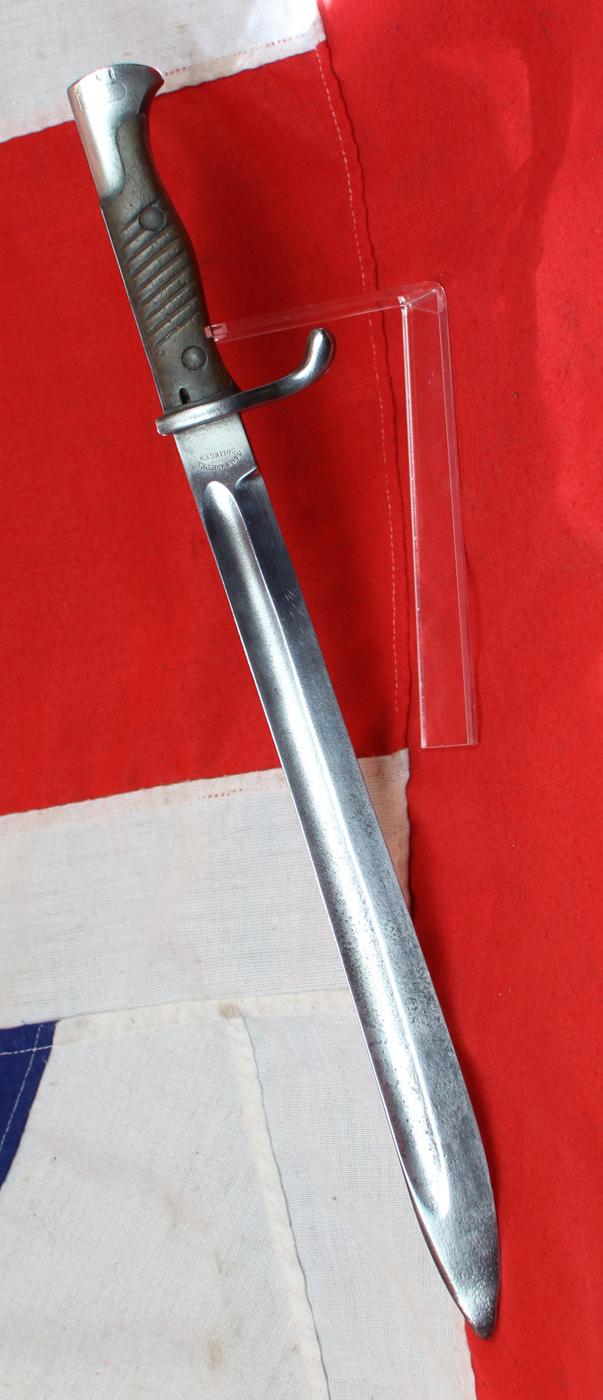
Click and use the code >25902 to search for this item on the dealer website Superb, German, WW1 Mauser Gew 98 ´Butcher´ Bayonet
  • Nation : British
  • Local Price : £185.00
British L1A4 Bayonet by Hopkinson, Chromed Parade Order. Description Straight single fullered blade with clipped Bowie point. Steel hilt with muzzle ring, black painted sheet steel slab grips secured by two rivets around concealed tang. Steel pommel riveted to the tang, with locking button. Steel scabbard with round frog stud. Black rubber frog with buckled retaining strap. The pommel is stamped with &#acute;C&#acute; within a square on one side and &#acute;H&#acute; within a square on the other. The grips are stamped on one side with &#acute;L.1.A.4. 9600259 S.M.&#acute;, L1A4 being the model number, 9600259 being the NATO item number for the L1A4 bayonet, and S.M. being the manufacturer code for Hopkinson. The blade is stamped at the ricasso on one side with an indistinct mark, obscured by the chrome. The scabbard is stamped at the throat above the frog stud with a broad arrow War Department stamp. The L1A4 bayonet for the SLR rifle was sealed as a pattern in 1958 but not actually produced until the 1970s by the firm Hopkinson based in Sheffield. It has some minor simplifications in construction compared to its predecessor the L1A3. This example has had the metal parts of both bayonet & scabbard chromed to be worn on parade and is paired with the correct glossy black frog that would also have been worn. The bayonet&#acute;s chromed finish is in good condition with a few spots of wear around the muzzle ring, in the recesses for the grip rivets & locking button, and on the scabbard body. Some small dents to a grip scale on one side. The tip of the blade is missing, this was probably deliberately blunted to make it safer for parade handling. No damage to the edge. One significant dent to the scabbard on the reverse side, with some pitting to the recesses of the dent “ this does not interfere with sheathing and drawing. A screw near the throat of the scabbard is missing. The frog&#acute;s rubber retaining strap is broken where it should thread into the buckle “ the scabbard stays in place anyway due to the rigidity and friction of the rubber but the strap cannot be done up to secure it.
  • Nation : British
  • Local Price : £185.00
British 1895 Pattern Socket Bayonet for the .303 Martini-Enfield, by Wilkinson 1912. Description Steel socket bayonet with triangular blade. Black leather Mk II scabbard with brass throat and chape pieces and two brass rivets to the leather section. Blade 21 5/8 inches (547mm) in length from the shoulder, the bayonet 25 inches overall (635mm), muzzle ring diameter 16.5mm. The blade is marked at the ricasso on the broadest side with a broad arrow War Department stores mark, the maker&#acute;s mark &#acute;WSC&#acute; for the Wilkinson Sword Company, a crown inspection mark with &#acute;E&#acute; for Enfield, the date 2 &#acute;12 indicating that it was converted in February 1912, and two broad arrows point to point, indicating equipment that was declared obsolete or to be sold off. The narrower lower sides of the blade are also stamped, one with the number &#acute;30&#acute;, this being cancelled with a strikethrough, and the other with non-English script markings, possibly serial numbers, one of these also being cancelled. The 1895 Pattern socket bayonet was produced by converting existing stocks of the 1876 Pattern. It was intended to fit to the Martini-Enfield, which was itself a conversion of existing Martini-Henry rifles to accept the new .303 British cartridge. This required the bayonets to be bushed to fit a smaller diameter barrel and their sockets remodelled to mount the blade below the barrel instead of to the side. The conversion stamps seen on this bayonet are unusual: the Royal Small Arms Factory at Enfield is usually listed as the sole site for production of the 1895 Pattern, with conversion work taking place there between 1895 and 1902. However, Graham Priest writes that Wilkinson also performed some conversions (see Socket Bayonets, page 72). Nonetheless the clearly marked date of 1912 is remarkably late for conversion to have still been taking place, though the non-English script markings on this example may suggest that it was done for Commonwealth service (perhaps India or Nepal?). The Martini-Enfield hung around for many years after its official replacement since the .303 round remained current and readily available. It was in service in some capacity in New Zealand and India through WW1 and beyond, was widely seen in the Middle East, was used by South African cadet forces until the mid-20th century, and in Britain some remained stored in armouries long enough to be issued to Home Guard units in WW2. The blade is clean and bright with only a few patches of very light patination. The socket retains almost all of its blued finish. A few small dents and scratches to the scabbard fittings, which have a moderate patina, and similarly some rubbing and dents to the leather section. All of its stitching is intact.
  • Nation : -
  • Local Price : £185.00
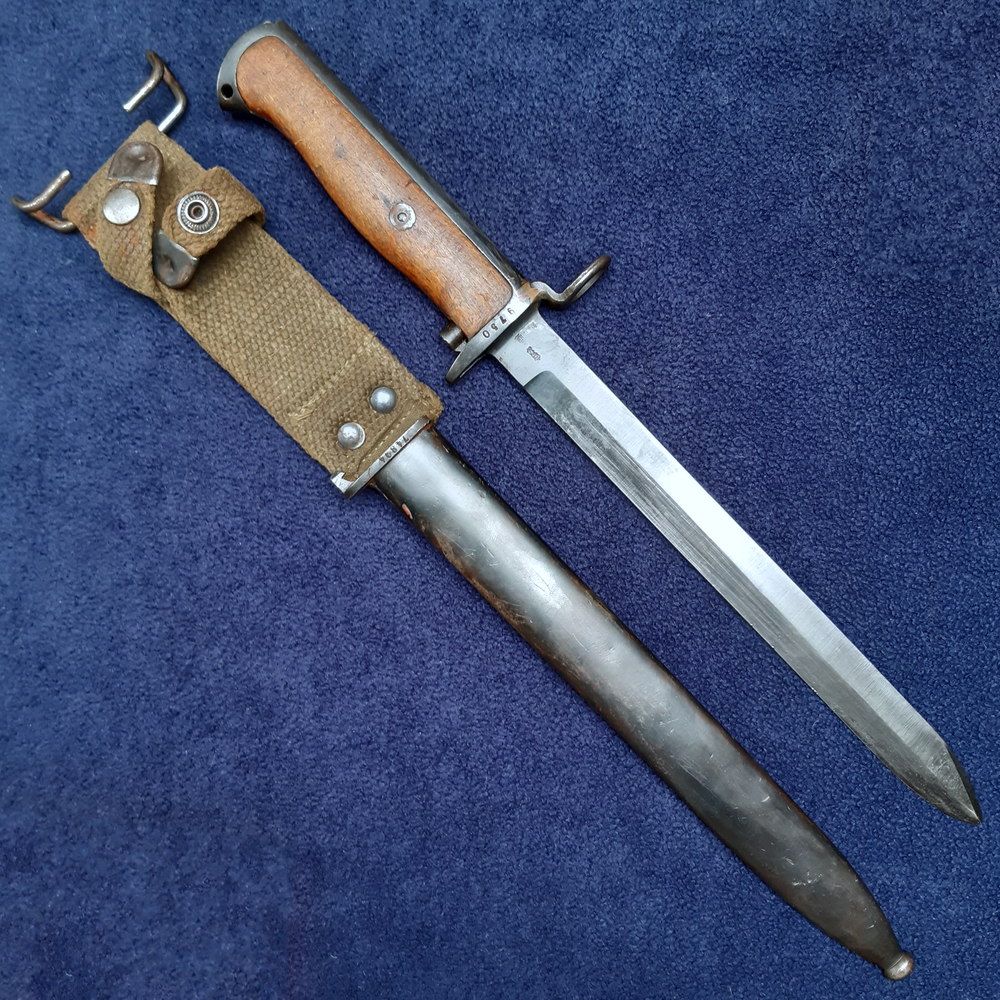
Norwegian M1894 Bayonet Converted for the M1 Carbine. Description Unfullered spear-pointed blade, wood slab grips secured by a single screw, steel one-piece hilt, backstrap and pommel with integral sprung locking mechanism in the hilt, that both locks the bayonet to its scabbard and locks it onto a rifle. Muzzle ring attached by brazing, 1.45cm in diameter. Steel scabbard with projecting hook on the throat piece to engage with the locking mechanism, integral green canvas frog with wire loop webbing hooks and buttoned retaining strap, also attached by brazing to the scabbard body. Blade 21.3cm in length, the bayonet 33.5cm overall. The blade is stamped at the ricasso on one side with the crown and cypher of King Haakon VII, and on the other side with a crown and &#acute;K&#acute;, the maker&#acute;s mark of Kongsberg Våpenfabrikk (Kongsberg Weapons Factory). The hilt is stamped with the serial number &#acute;9750&#acute;. The throat piece of the scabbard is stamped with the serial number &#acute;74894&#acute;. Norway received rifles from the United States under its Military Assistance Program from 1950 until 1963, with nearly 100,000 M1 and M2 Carbines delivered. The M1 was designated the Selvladekarabin M1 (Self-loading Carbine M1) in Norwegian service. Some US-made M4 bayonets for these rifles were delivered but were clearly insufficient in number, as Norway manufactured its own copy of the M4 bayonet at the Kongsberg arsenal, then opted to convert some of its existing stocks of M1894 bayonets made for the Krag Jorgensen rifle to fit the M1. Norway had an oversupply of this bayonet due to a new production run ordered in 1943 during their occupation by Nazi Germany. 30,000 bayonets were modified in 1956-57, probably at Kongsberg, by brazing on a new muzzle ring and modifying the locking mechanism in the mortise. A further 1,000 were converted by the Hærens Våpentekniske Korps. This is not one of the wartime production run (which have Waffenamt stamps, and lack a ball finial on the scabbard), but an original M1894, made between 1912 and 1926. The blade has some nicks to its edge, which is unsharpened. All metal parts have a blued finish, which shows little wear. The wood grip scales have only a few tiny dents. Some scratching to the reverse side of the scabbard, no denting.
  • Nation : -
  • Local Price : £185.00
Norwegian M1894 Bayonet Converted for the M1 Carbine. Description Unfullered spear-pointed blade, wood slab grips secured by a single screw, steel one-piece hilt, backstrap and pommel with integral sprung locking mechanism in the hilt, that both locks the bayonet to its scabbard and locks it onto a rifle. Muzzle ring attached by brazing, 1.45cm in diameter. Steel scabbard with projecting hook on the throat piece to engage with the locking mechanism, integral green canvas frog with wire loop webbing hooks and buttoned retaining strap, also attached by brazing to the scabbard body. Blade 20.6cm in length, 32.6cm overall. The blade is stamped at the ricasso with a crown and &#acute;K&#acute;, the maker&#acute;s mark of Kongsberg Våpenfabrikk (Kongsberg Weapons Factory). The hilt is stamped with &#acute;7&#acute;. The throat piece of the scabbard is stamped with the serial number &#acute;8174&#acute;. Norway received rifles from the United States under its Military Assistance Program from 1950 until 1963, with nearly 100,000 M1 and M2 Carbines delivered. The M1 was designated the Selvladekarabin M1 (Self-loading Carbine M1) in Norwegian service. Some US-made M4 bayonets for these rifles were delivered but were clearly insufficient in number, as Norway manufactured its own copy of the M4 bayonet at the Kongsberg arsenal, then opted to convert some of its existing stocks of M1894 bayonets made for the Krag Jorgensen rifle to fit the M1. Norway had an oversupply of this bayonet due to a new production run ordered in 1943 during their occupation by Nazi Germany. 30,000 bayonets were modified in 1956-57, probably at Kongsberg, by brazing on a new muzzle ring and modifying the locking mechanism in the mortise. A further 1,000 were converted by the Hærens Våpentekniske Korps. This is not one of the wartime production run (which have Waffenamt stamps, and lack a ball finial on the scabbard), but an original M1894, made between 1912 and 1926. All metal parts have a blued finish, with a small amount of wear on raised edges, eg the beak of the pommel. Some small dents to the chape end of the scabbard, which do not interfere with sheathing. One of the grip scales (on the inside as worn) has a small crack next to the locking button and denting to its surface.
  • Nation : -
  • Local Price : £185.00
Argentine Type C Socket Bayonet for the FN FAL, Argentine Marines, Falklands War. Description Tubular steel one-piece bayonet with flash ports and spear-pointed blade with semicircular profile. Blade length 6½ inches (16.5cm), 11 3/8 inches (28.9cm) overall. Black plastic scabbard with eyelet chape, circular frog stud and steel throat piece, green canvas frog with retaining strap, plastic belt grip and wire hanger. The bayonet is inscribed on the blade with the serial number &#acute;02-73026&#acute;, applied with an electric pencil. The &#acute;02&#acute; prefix indicates allocation to the Argentine Marines. The FN FAL infantry rifle and its bayonet were adopted by Argentina in the late 1950s, initially purchased from FN in Belgium but later made domestically by Argentine manufacturers. Several types of bayonet and webbing attachments were used by the Argentinean Army and Marines during the Falklands conflict: the tubular model was the &#acute;Type C&#acute;, compatible with later models of the FAL (post 1962) which had a 22mm muzzle device. This was used side by side with the &#acute;Type A&#acute; knife bayonet, which fitted to the early FALs. The scabbards are not interchangeable between Types, the blades being of different shapes. Belt frogs for these bayonets are made of either green leather or nylon fabric: the &#acute;Correaje Argentino de Cuero&#acute; (Argentine Leather Belting) load-bearing system was introduced around 1970, but incorporated some preexisting elements including leather frogs and pistol holsters, which were then painted green to match. The nylon &#acute;Correaje Tempex&#acute; (Tempex Belting) was introduced in the early 1980s to replace it which included a new frog. Both forms of load-bearing system were still in use by 1982 so both were carried in the Falklands. Either frog will fit either Type of bayonet. After Argentine forces surrendered to the British on June 14 1982 their small arms were piled up by the thousand in the Islands&#acute; capital Port Stanley, where most Argentine forces had been deployed or driven back to. A large quantity of arms had also been captured earlier at Goose Green, which was a key ammunition dump for the Argentine forces, and still more were gathered later from unengaged Argentine garrisons on the island of West Falkland. The FAL rifles became British government property and were either brought to the UK or dumped at sea, while bayonets and the short machete-like officer&#acute;s sidearms frequently became personal trophies or souvenirs for British soldiers as they would not be illegal to own in civilian life. This example is most likely one such &#acute;bring-back&#acute;. The bayonet has its original blued finish, with black paint on the release catch. Some minor rubbing to both these finishes on raised edges. The blade has some spots of patination, a few light dents to the blunt &#acute;edge&#acute; of the blade on one side. The tip of the blade has rolled (<1mm). Bright lines to the blade where it rubs against the scabbard on sheathing. Light scratching to the plastic scabbard body and one broad, shallow dent on its front face which does not interfere with sheathing and drawing. Rubbing and dark patination on the frog rivets, some dirt and spots of very light surface fraying to its canvas. One half of the black plastic belt grip on the frog has been lost, a small piece remaining in place under a rivet. The other half has some scratching to the plastic. The wire belt hook is slightly bent. It swings freely with no rust.
  • Nation : British
  • Local Price : £185.00
American 1917 Pattern WW1 Bayonet. British WW2 Reissue. #2505010. This American WW1 1917 Pattern bayonet was used with the Enfield .30 calibre rifle. The bayonet was made by Remington.The 431mm blade has a deep single fuller on both sides and a rounded spine. The blade is in excellent condition and retains its original factory edge and blueing to the ricasso.The ricasso is stamped with the 1917 pattern designation above the Remington maker’s mark. The obverse ricasso bears the “flaming grenade” over “US” ordnance stamp and the eagle head, numbered inspection stamp. The ricasso also bears a partially struck bend test X stamp.The cross guard and pommel retain their original blueing and the wooden grip scales are in good condition with age and use-related chips and marks. The press-stud locking mechanism works perfectly.The bayonet is complete with its original Mk II green leather scabbard, which is in great condition. The leather is firm and undamaged. The stitching is intact and strong. The scabbard is complete with a 1939 pattern brown leather frog with Broad Arrow stamp, indicating the bayonet was reissued, probably for Home Guard service during WW2. The bayonet sheathes and draws smoothly and is held firmly within the scabbard.This Remington P1917 bayonet is a great example of the pattern.
  • Nation : German
  • Local Price : 2,300 kr
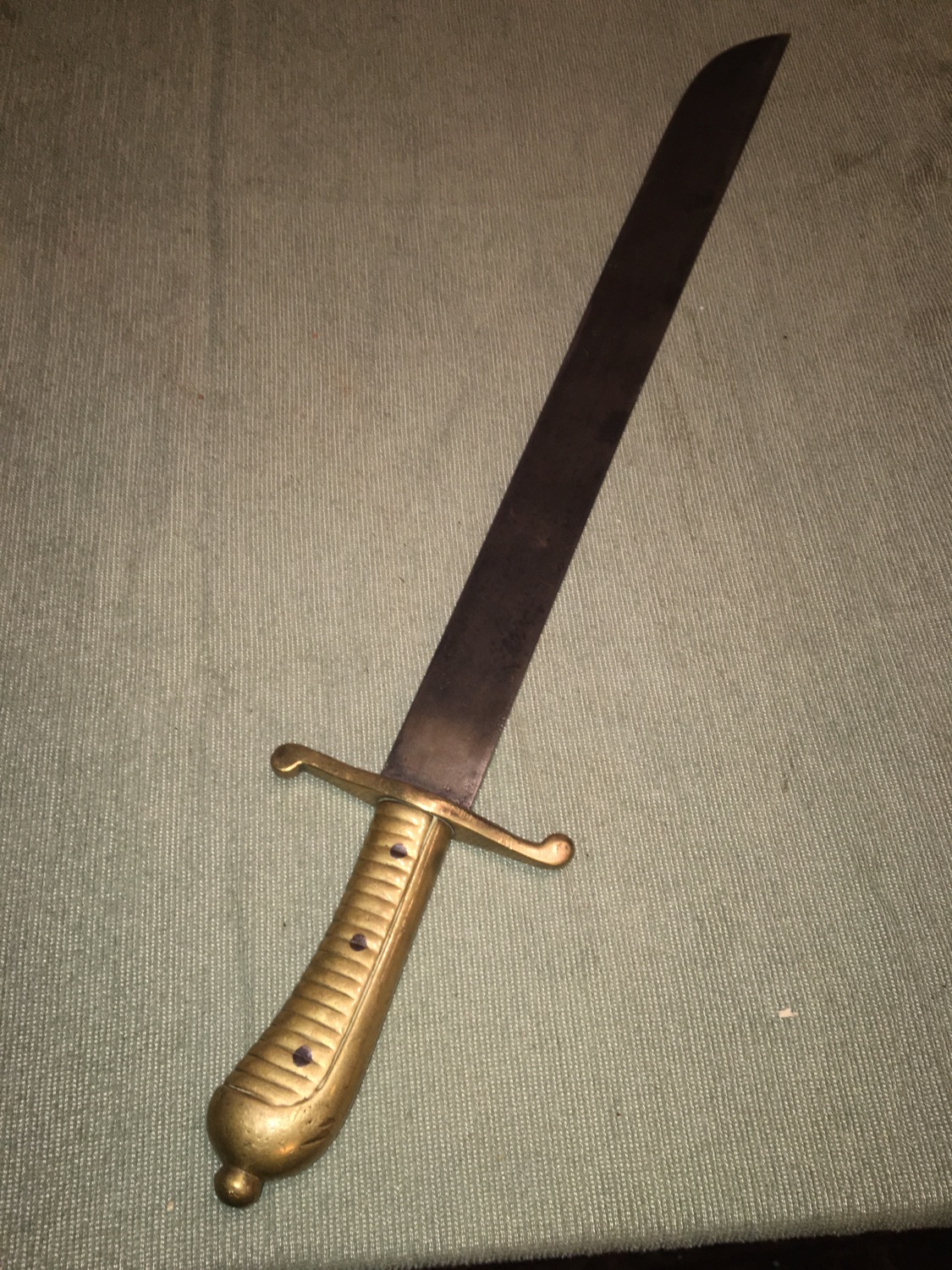
German fascine knife 1800s..
Page 132 of 157