
Show

Forgot your password?

Error message here!

Error message here!

Error message here!

Error message here!

Show Error message here!

Show Error message here!

Lost your password? Please enter your email address. You will receive a link to create a new password.

Error message here!

Back to log-in

Close

For Sale

The following items are listed by for sale by users of the site and dealers. They are in no way endorsed or guaranteed by www.antiquearmsresearch.com

Add a Classified Item
to

Clicking on the sword will take you through to the relevant classified item or dealer site.
Don't miss out! - Do you want to be kept informed weekly of new aditions? Just join our weekly update list.

You can also receive regular email notifcations when items match your keywords. To recieve them just register or logon at the top right of this page.

Page 133 of 157
  • Nation : Australia
  • Local Price : £180.00
Australian WW2 Lee Enfield 1907 Pattern Bayonet by Orange Arsenal, Dated 1944. Description Straight single-fullered knife blade, steel hilt with muzzle ring, wood slab grips secured by two screws, steel beaked pommel with locking button. Black leather scabbard with steel locket & round frog stud and steel chape piece. The ricasso is stamped on one side with &#acute;MA&#acute; for Munitions Australia, over &#acute;1907&#acute;, the model, over &#acute;1&#acute;, as well as a broad arrow War Department mark, the manufacturer&#acute;s mark &#acute;OA&#acute; indicating the Orange Arsenal, and an &#acute;X&#acute; indicating that it passed a manufacturer&#acute;s bending test. On the other side it is stamped with another &#acute;MA 1907 1&#acute; mark and the manufacture date 4 &#acute;44 indicating April 1944. One of the wood grips is stamped between the screws with &#acute;SLAZ 43&#acute; and the other with &#acute;SLAZ 44&#acute;, indicating that they were produced in 1943 and 1944 by the Slazenger company, better known for its sporting equipment. The throat piece of the scabbard is stamped next to the staple with another &#acute;OA&#acute;. The chape piece is stamped next to the staple with a seven-pointed star. The leather section of the scabbard is stamped next to the seam with &#acute;MANGROVITE 44&#acute;. The blade has an even dark parkerised finish with some wear only along the spine from rubbing upon sheathing and drawing, exposing bright steel. The hilt, exposed tang and pommel likewise are darkly parkerised. The grips have some abrasion next to the pommel “ possibly deliberately shaved down to better fit it to the pommel “ and are otherwise excellent. The throat piece of the scabbard has some light scratches showing bright steel and some rubbing to the finish on the frog stud, likewise some rubbing to the tip of the chape piece. The leather of the scabbard has some light denting and surface rubbing.
  • Nation : British
  • Local Price : £180.00
British Lee Enfield 1907 Pattern Bayonet, Rugby School Officers Training Corps. Description Straight single-fullered knife blade, steel hilt with muzzle ring, wood slab grips secured by two screws, steel beaked pommel with oil hole and locking button. Black leather No. 1 Mk 2 scabbard with steel locket & teardrop frog stud and steel chape piece. 1925 Pattern khaki canvas frog with retaining loop and distinctive brass button to clip the frog to the belt. The ricasso is stamped on one side with a crown, 1907 (the pattern) &#acute;9 17&#acute;, indicating the manufacture date of September 1917, the manufacturer&#acute;s mark &#acute;SANDERSON&#acute;, four crown inspection stamps (three with &#acute;E&#acute; indicating the Royal Small Arms Factory at Enfield), and multiple reissue stamps dated &#acute;27, &#acute;31 and &#acute;39. On the other side it is stamped with a &#acute;broad arrow&#acute; War Department stores mark, three more crown inspection stamps with &#acute;E&#acute;, and an &#acute;X&#acute; indicating that it passed a manufacturer&#acute;s bending test. The pommel is stamped with &#acute;O.T.C&#acute; over &#acute;RUG&#acute; over &#acute;283&#acute;. This indicates that this was bayonet number 283 used by the Rugby School OTC (Officers&#acute; Training Corps). The throat piece of the scabbard is stamped with a diamond-shaped manufacturer&#acute;s mark. The leather of the scabbard is stamped next to the seam with two further crown inspection marks, a broad arrow and an illegible mark which would be the manufacture date - all these marks being faint from rubbing. A large number of volunteer units sprang up across the United Kingdom during the late 1850s after a national appeal by the Secretary of State for War, due to a perceived threat of invasion of Britain by France. Oxford and Cambridge universities were very quick to respond with the formation of their own units of Rifle Volunteers, and some schools also followed suit, Rugby being one of the first wave of six schools to form their own Corps in 1860. As years went by the number of school units only increased until by 1898 there were 39, with another surge of interest due to the Boer War nearly doubling that number by 1902. These school units provided early experience for young men who would then be in a good position to move up to the university units and perhaps a military career afterward. There was lively competition between Corps for shooting prizes in particular, with Rugby one of the most successful “ although it may be said that success came in part with a school&#acute;s willingness to spend on equipment and training. The Officers&#acute; Training Corps were established in 1906 as part of the wide-ranging Haldane Reforms to the British Army&#acute;s structure. The OTCs were intended to alleviate the shortage of trained officers in the various volunteer units (Militia, Yeomanry, Volunteer Force and Reserve of Officers) by forming a system of junior training units in public schools and senior ones in universities. Some of the junior OTCs were formed out of the existing school Cadet Corps, which by this date numbered more than fifty, while senior OTCs were often formed from the university units. During WW1 the OTCs became training units for supplying officers to the regiments, an OTC Certificate generally considered full qualification to become an officer, although some individuals chose for various reasons to enlist in the ranks. Rugby School OTC supplied 291 recruits, all of them gazetted officers, between August 1914 and March 1915. The Rugby School Cadet Corps still exists today as part of the Combined Cadet Force (CCF), with Army, Royal Marines and RAF contingents. Under the modern Army structure it serves as a leadership and training organisation, teaching a number of military skills but with no obligation to go on to full military service. Because of its features this bayonet must postdate 1910, and was probably issued to replace the 1903 Pattern bayonets that were initially issued to school Corps. Its frog is quite a scarce pattern:  the 1925 Pattern frog was issued to the RAF and in fact was not made in khaki until 1932 when the Canadian government appears to have ordered a number of them from the Mills Equipment Company. The 1937 Pattern generally replaced these so it may have been handed down as surplus and found its way to an OTC unit “ as its reissue marks attest this bayonet was still in use as of 1939. The scabbard is not actually fully fitted into it “ it arrived this way and I do not wish to force the stiff canvas too much to get the frog stud into it, although I think there is enough give. The blade has a matt parkerised finish with streaks of rubbing, some scratches and spots of light patination. Some small nicks to the sharpened edge near the tip, the tip rounded. The blued band at the shoulder of the blade is intact. The hilt, pommel and scabbard fittings are blued with some light rubbing on raised edges, but have also been impacted by rust leading to areas of moderate to heavy pitting and encrustation, the latter most notable on the throat piece of the scabbard. While this is removable by polishing, that would also remove the remaining blueing. Only a few small dents to the wood grips. The leather scabbard body has some light dents and surface abrasion. All the scabbard&#acute;s stitching remains intact.
  • Nation : Portuguese
  • Local Price : £180.00
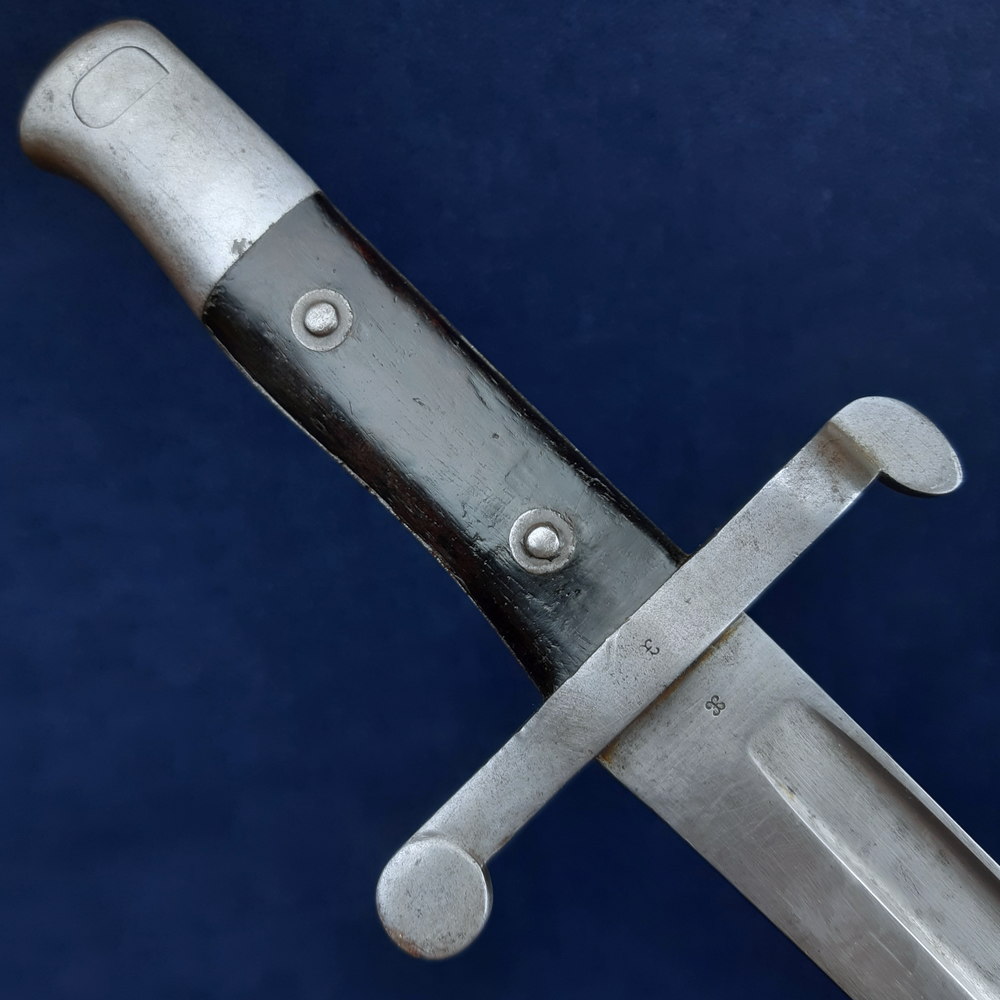
Portuguese M1886 Kropatschek Bayonet by Steyr. Description Yataghan curved single-fullered blade, crossbar hilt with upper muzzle ring and quillon and lower circular finial, black wood grips, plain steel scabbard with frog hook. No maker&#acute;s mark to the spine of the blade “ it may have been removed by polishing. The frog stud of the scabbard is marked &#acute;WG&#acute;, a Steyr factory mark. Hilt marked &#acute;N159&#acute;, scabbard marked at the throat with &#acute;RR884&#acute;. The M1886 Kropatschek rifle proved to be reliable and had a long service life - while it was replaced by the 1904 Mauser in the Portuguese army it was used by colonial units in WW1, issued to the Portuguese Legion during the Spanish Civil War, and was still in use by colonial police as late as the 1960s. Its bayonet was one of the last to make use of the &#acute;yataghan&#acute; downward-curving blade.
  • Nation : American
  • Local Price : £175.00
US M1912 Fencing Bayonet for the Trapdoor Fencing Musket. Description Flexible steel &#acute;blade&#acute; with looped end, brown leather cover, bare exposed tang, hilt with muzzle ring and lower lobe quillon, pommel piece with second muzzle ring, both rings with a drilled hole for a set screw. Blade 16½ inches (41.9cm) in length, 19½ inches (49.5cm) overall. The leather cover is stamped with &#acute;HEK&#acute; “ this is an inspector&#acute;s mark for Henry E Kelsey, leather goods inspector at Rock Island Arsenal (RIA). The steel parts would have been fabricated at Springfield Armory, but RIA produced the leather covers in their &#acute;Harness and Accoutrements Shop&#acute;. Seeking to improve soldiers&#acute; skills at bayonet fighting, the US Army commissioned a number of different models of &#acute;fencing bayonets&#acute; from as early as 1852, to allow a more realistic simulation of combat. Early versions used a flexible whalebone blade screwed in to a cut-down metal socket, then in 1897 the first all-steel model was introduced. The M1906 Fencing Bayonet was the first to be based on the knife bayonet, imitating the M1905 bayonet for the Springfield rifle. Technically speaking the Army never commissioned an &#acute;M1912&#acute;, this is just a more convenient way of referring to the third variation of the M1906. The difference is substantial, however: the M1912 was introduced in that year to remedy some defects in its predecessor the M1909, which was deemed to be too easily broken and reportedly caused &156;ugly wounds&157; when the blades broke in sparring creating sharp edges. This understandably discouraged bayonet training and the Inspector General complained in annual reports that soldiers&#acute; skills were suffering. To fix the issue the M1912 went back and reintroduced some features that had been mistakenly removed since the socket bayonet days: a horizontal blade, achieved by adding a 90-degree twist starting 2 inches forward of the hilt, and a leather cover over the full length of the blade. Letting the blade spring up and down rather than side to side was found to reduce breakages, and even if they did occur the leather would keep sharp edges covered. The new model was a success and 11,000 were made between 1913 and 1915, getting the infantry trained up in time for the United States&#acute;s entry into WW1. It attached (with two screws through the muzzle ring holes) to the Trapdoor Fencing Musket, a training piece made at Springfield Armory by converting obsolete .45-70 Trapdoor rifles. These had their barrels and stock shortened to mimic the length and weight of the M1903 rifle, and the sights, external hammer and sling swivels removed. The M1912 bayonets remained in use throughout WW1 and remained in stores for some time afterward, eventually being sold as surplus. The blade remains flexible. All the leather cover&#acute;s stitching is intact, some creasing and light rubbing to the leather surface, more prominent on the ball end piece, but no damage. The exposed section of the blade retains a blued finish, the hilt parts are bright and clean.
  • Nation : Japanese
  • Local Price : £175.00
**EXPERT ASSESSED**Japanese C1800-1850 Echizen Kinai Masters Style Wakizashi / Small Katana Sword Pierced Iron Tsuba. Sn 21038 -. This is an original C1800-1850 Iron Tsuba in the Echizen Kinai masters style. It has been assessed by UK Japanese sword expert Bill Tagg. His assessment & illustration of the tsuba can be read in the images and accompanies the piece. The price includes UK delivery. Sn 21038
  • Nation : French
  • Local Price : £175
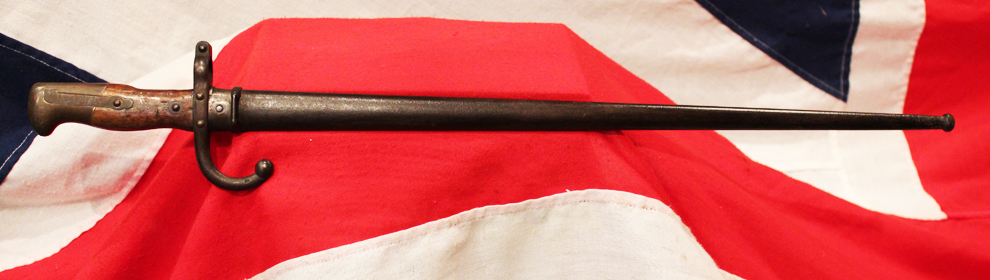
Click and use the code >19122 to search for this item on the dealer website French Model 1874 "Gras" Sword Bayonet
  • Nation : -
  • Local Price : 2,200 kr
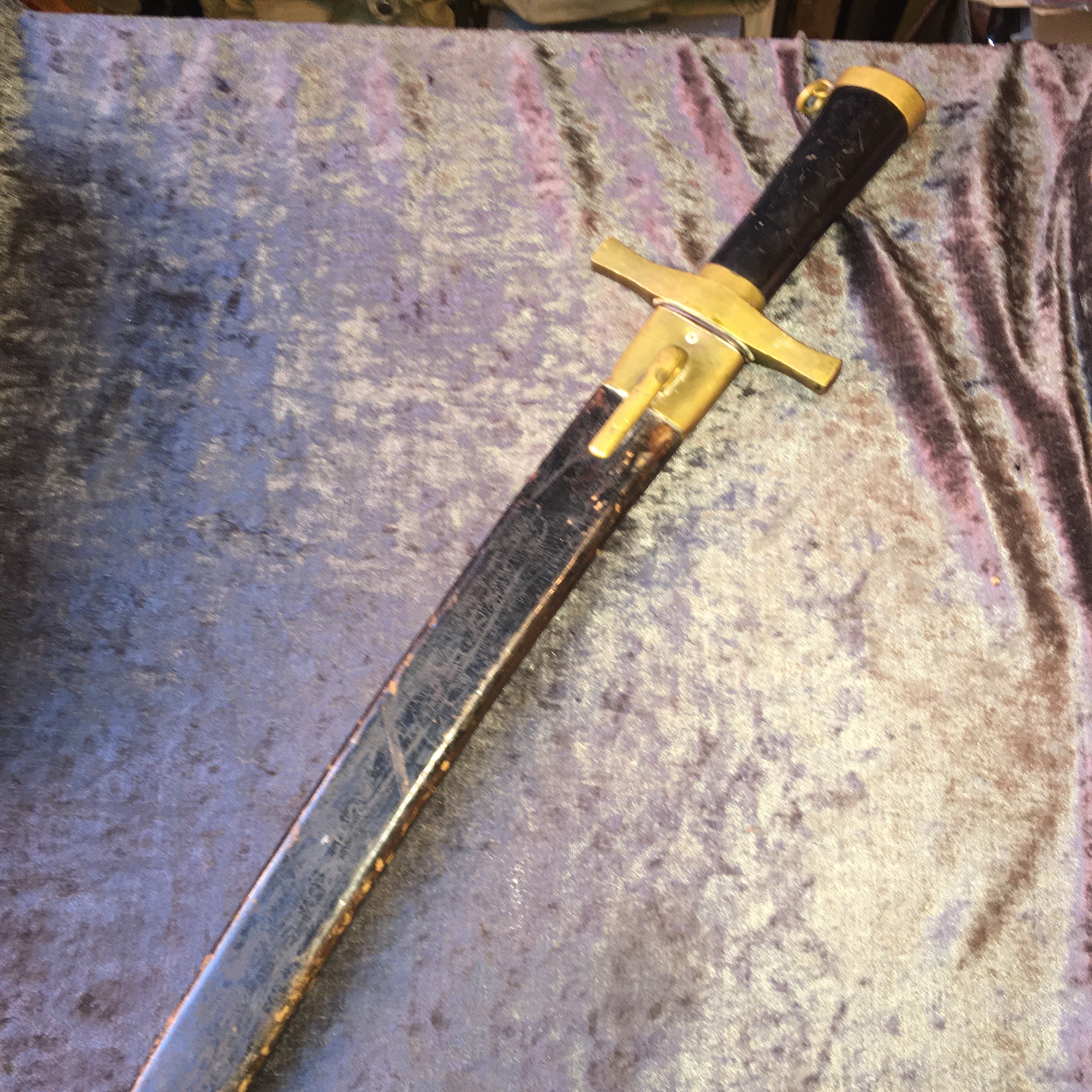
Sv cutlass m/1856.
  • Nation : -
  • Local Price : 2,200 kr
Italiensk Carcano fällbajonett m/1938.
Page 133 of 157