
Show

Forgot your password?

Error message here!

Error message here!

Error message here!

Error message here!

Show Error message here!

Show Error message here!

Lost your password? Please enter your email address. You will receive a link to create a new password.

Error message here!

Back to log-in

Close

For Sale

The following items are listed by for sale by users of the site and dealers. They are in no way endorsed or guaranteed by www.antiquearmsresearch.com

Add a Classified Item
to

Clicking on the sword will take you through to the relevant classified item or dealer site.
Don't miss out! - Do you want to be kept informed weekly of new aditions? Just join our weekly update list.

You can also receive regular email notifcations when items match your keywords. To recieve them just register or logon at the top right of this page.
Page 32 of 165
  • Nation : British
  • Local Price : £2350
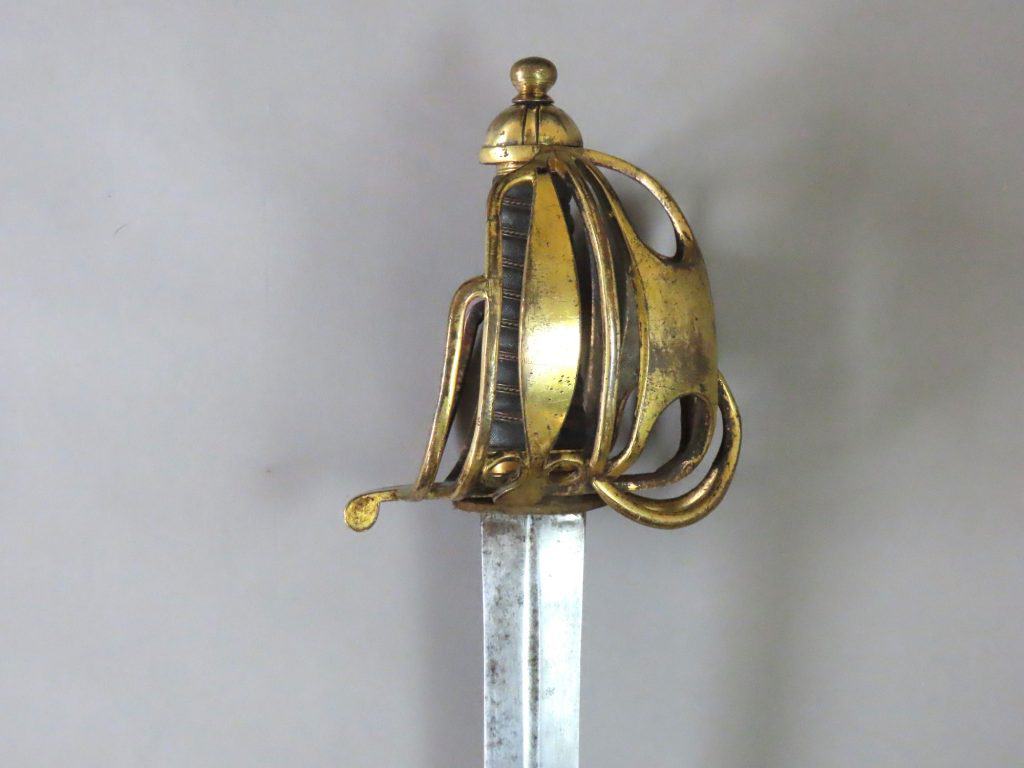
1798 Pattern Scottish Highland Infantry Officers’ Sword with Gilt Copper Hilt. An example of the distinctive basket hilted sword introduced for Scottish Infantry officers in Highland Regiments in 1798. It was replaced by the regulation steel basket hilt 1828 pattern three decades later. The sword type was used throughout the Napoleonic War period. This sword has most of its gilt covering to the bronze hilt still in place. The hilts of these swords were most usually made of gilt copper, bronze or brass. The hilt of this sword is of gilt bronze. The basket guard is made of rounded bars and flattened plates in the usual manner with forward loop guards and a swollen solid wrist guard terminal to the rear quillon. The upper terminals of the guard arms are fixed onto a ring inside which the stem of the mushroom shaped pommel is fitted. The pommel is dome-shaped with a large separate waisted and domed pommel button on top from which four sets of decorative grooves flanked by narrower lines radiate to the pommel edge. The double-edged gently tapering blade is 32.75 inches (83 cm) long. Typically it is of lenticular section with a short ricasso. A central fuller commences a short distance from the hilt on each side and is 8 inches (20 cm) long. The blade is unmarked and probably a German import which was the norm for this sword type and most probably of Solingen manufacture. The grip is of spirally grooved wood covered with shagreen held in place with thin ropes of twisted copper wire flanked with plainer thinner wire now coloured with age. It is mounted with gilt bronze ferrules top and bottom which are incised with decorative lines. The materials used for 1798 pattern hilts were less robust than iron and as a result were more susceptible to damage. Many surviving and published examples have bars missing, are out of shape and are often with repairs. This sword is a fine example without any such problems. The blade has a few small patches of blackened age-related staining in places and the hilt has kept its shape without damage or repairs as can be seen in the photos. For other examples of the 1798 type see: Harvey J S Withers, “The Scottish Sword 1600-1945”, Paladin Press, 2009, pages 13 to 151 and Cyril Mazansky, “British Basket-Hilted Swords”, Boydell Press, 2005, pages 131 to 133.
  • Nation : British
  • Local Price : £2350
English Civil War Period Mortuary Sword. An English “Mortuary” hilted sword dating to the middle part of the 17th century. This style of sword is a symbol of the English Civil War and Protectorate periods. The hilt is of typical form consisting of a broad saucer-shaped guard plate from which three main guard bars extend upwards in curves with the flattened angled terminals screwed into the pommel. The guard plate is covered with chiselled decoration. A segmented panel with a dot in each shape surrounds the tang aperture in the middle. This is surrounded by four “Green Man” faces with wild staring eyes separated by ferns instead of the more usual sedate busts that often adorn these sword hilts.  The guard bars and pommel are decorated with chiselled fern-like shapes.   The pommel is globular in shape and has an integral button on top and a pronounced flared neck beneath. Historically the Green Man appeared in traditional springtime rural village pagan fetes and ceremonies as a symbol of growth and fertility for the coming farming season.  The figure, dressed in green garlands, was exhibited then sacrificed by ritual decapitation, hence the appearance of the head separated from the body amongst new growth foliage. The practice was so embedded in rural communities that it survived into the Christian era and appears in the architecture of many early churches. In the 17th and early 18th centuries it appears on some English sword hilts and blades. Imbued with the ideal of “renewal” the Green Man embodied an element of spiritual protection then later became more of a “good luck” charm as is probably intended on this sword hilt. Two downward facing bars emanate from each side of the knuckle bow towards its top and join the base of each side guard bar to add strength to the structure. On the opposite side of the side bars another curved bar emanates and joins the dish near its curled wrist guard which is fashioned from the rear of the plate. The wooden grip is wrapped with copper wire in twisted and straight lengths. The grip base sits on an iron flanged plug mounted onto the inside of the guard plate from which two langets extend through the tang aperture to flank the blade either side for a short distance from the hilt. The imposing double-edged blade has a pronounced ricasso and two central fullers which run in parallel from the hilt almost to the tip. The fullers contain punched letters, numbers and small orb and cross marks. The blade is probably of Solingen manufacture.  Blades were imported into England in huge quantities from European blade making centres to satisfy the demand for swords on both sides during the Civil War. The blade is 29.5 inches long (75 cm) and overall the sword measures 35.25 inches (89.5 cm) long. For a further discussion on Mortuary swords see Cyril Mazansky, British Basket Hilted Swords, Boydell Press 2005, Chapter 11, pages 233 to 280. Also see Stuart C Mowbray, “British Military Swords”, Mowbray Publishing, 2013, pages 178 to 225, in particular, the sword illustrated on page 219. Condition: The sword is in good overall condition. The hilt has a repair to the top of the knuckle bow where the top portion of an inch or so has been replaced.  The repair is hammer forged and pinned rather than welded indicating the repairs are “working life”.
  • Nation : Spanish
  • Local Price : 3,200.00 USD
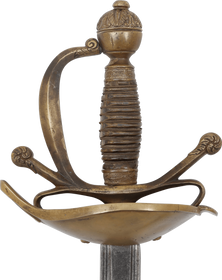
SPANISH OFFICER'S RAPIER C.1800. This sword is a good example of the individuality and stylistic expression which influenced Spanish sword design in the colonial period. It is a rapier with its roots in the European officers small swords of the period. The boat form guard was widely adapted to the Spanish taste but seldom as faithfully as here. The wire wrapped horn grip has a distinctively colonial flavor. It likely was made as part of the armament in anticipation of Spain's involvement in the Napoleonic Wars and may have served in the Peninsular War after 1808. It is as likely to have carried on its service in the colonies including North America and the Caribbean, where Spain struggled to maintain control after Napoleon's defeat. In true Spanish character, it is as functional as it is charming.
  • Nation : British
  • Local Price : £2295
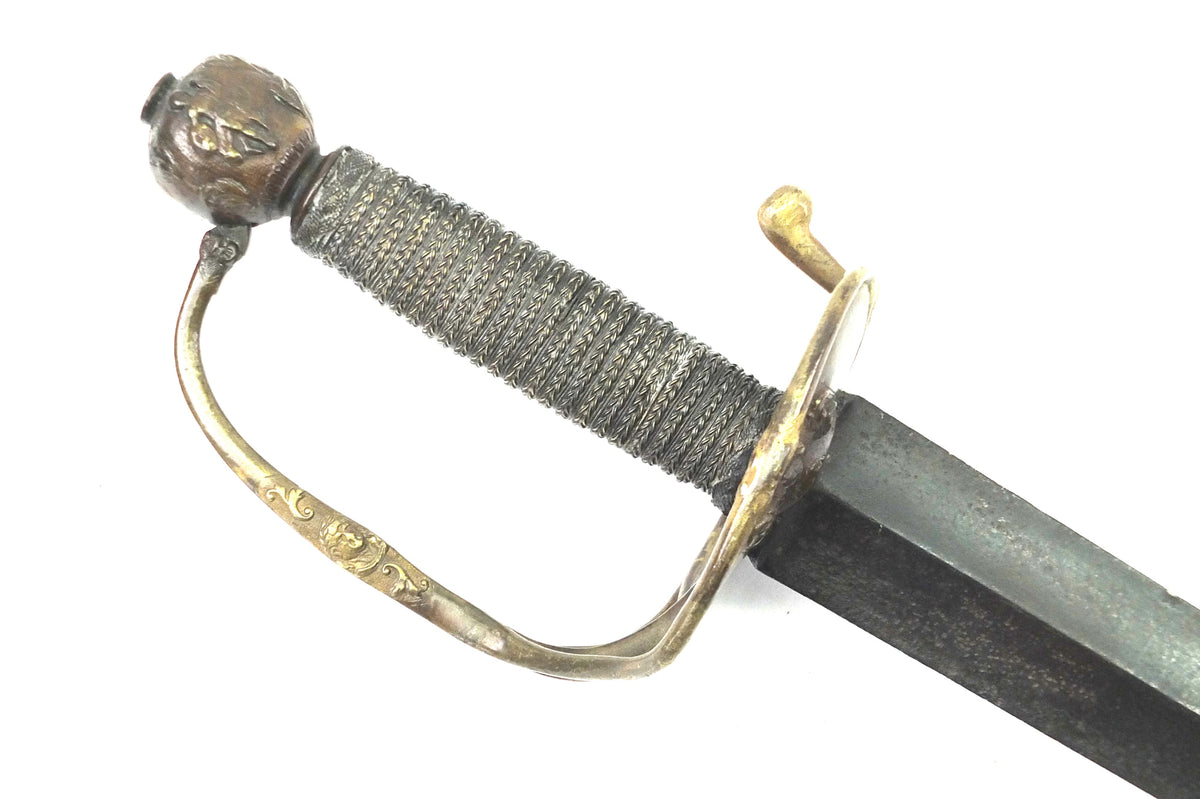
Click and use the code >23950 to search for this item on the dealer website 18th Century 1770´s Hallmarked Silver Hilted American Revolutionary War Period Officer´s Sword Used By Both American and British Officers. Made by William Kinman of London
  • Nation : American
  • Local Price : $2295.00
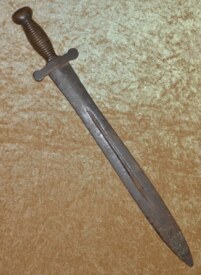
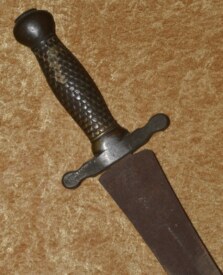
Scarce Confederate Artillery Short Sword by Boyle, Gamble, & McFee. The firm of Boyle (Edward), Gamble (Thomas) & McFee (Edward) was located on 6th Street in Richmond, Virginia, just one block from the Richmond Armory. They made a wide range of edged weapons for the Confederacy. The foot artillery short sword is completely unmarked and was unidentified as to maker until a marked example was recently found which proved they were the work of this Richmond firm. Like most foot artillery short swords of the period it was fashioned after the French model which was a modern recreation of the ancient Roman gladius. When adopted by the French, these were originally intended to kill or maim charging cavalry horses, but such use during the Civil War was rarely practical so these stout weapons were largely used to clear brush and help with setting up the artillery batteries. It features a somewhat crude one-piece cast hilt of high copper content brass with flat cross guard and integral grip with 19 ribs. The 18 7/8″ double-edged blade of gladius form features a single unstopped 9″ central fuller on each side. Blade is uncleaned with rust patination; heavier encrustation and edge nicks toward the rounded point. Brass hilt is tight with undisturbed peen and rich patina. Overall length 24 1/4″. It lacks its leather scabbard, which rarely survives.
  • Nation : American
  • Local Price : $2295.00
Rare Confederate Froelich Artillery Short Sword. All Confederate-made swords are relatively rare, but perhaps one of the rarest is the foot artillery short sword made by Louis Froelich of Wilmington, NC and later Kenansville, NC. It would appear that the artillery sword was one of his earliest pieces, as the State of North Carolina contracted for 200 foot artillery swords in 1861 and it is known that the ordnance office in Raleigh paid $12 each for 151 of these between December 1861 and March, 1862. In Wilmington the company was known as the Wilmington Sword Factory or the Confederate Arms Factory, but in September, 1862 Froelich bought a 2.5 acre tract in Kenansville, NC and the new factory became known as the Confederate States Armory, where most of their wartime production occurred. They produced a wide array of products from buttons, knapsacks, and accouterments, to all types of edged weapons, including swords and surgical instruments. They are perhaps best known for their cavalry sabers, of which they provided over 11,000 to the Confederacy. The quality of their products was generally better than other Confederate-made items. The example offered here is of simple form with cast one-piece brass hilt comprising guard, scaled grip, and pommel. Double-edged 18 1/4″ blade of gladius form with unstopped fuller on each side. It is completely unmarked and identified mostly from its distinctive cross guard. Like almost all foot artillery short swords of the period it was fashioned after the French model which was a modern recreation of the ancient Roman gladius. When adopted by the French, these were originally intended to kill or maim charging cavalry horses, but such use during the Civil War was rarely practical so these stout weapons were largely used to clear brush and help with setting up the artillery batteries. As such, the blade of this example shows much use with numerous deep edge nicks and the tip is worn. The piece is uncleaned and the high copper content brass hilt show a dark patina with some lighter patches. Blade with dark rust patina. Most Confederate swords show considerable wear and use, as is the case with this very rare example. No scabbard. Overall length 23 1/2″.
  • Nation : British
  • Local Price : $2295.00
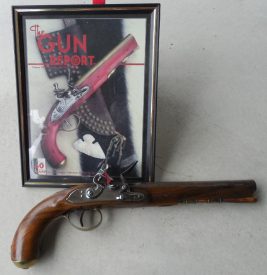
English Flintlock Trade Pistol by Sharpe, First Quarter 19th C. Flat lockplate with line border and feather cluster design behind cock; with a crown over “NR” and marked “SHARPE” (1800-1840). Flat cock with beveled edges and line border. 8″ round .58 cal. barrel with Birmingham proofs, a series of stars, and marked “EXTRA/SHARPE/PROOF at breech; tang with line border and broad arrow stamp. Brass furniture includes butt cap, ramrod thimbles, and sideplate and trigger guard with engraved snowflake design. Silver wrist escutcheon crudely engraved with letters “CF”. Walnut stock with small crack on fore end; wood ramrod. Metal parts cleaned. These early trade pistols were highly prized by the Indian tribes. This exact gun is pictured in Lar Hothem’s “Rare and Unusual Indian Artifacts”, page 386. Tom Richards Collection.
  • Nation : British
  • Local Price : £2,295.00
Williamite Walloon Hilted Officer´s Sword, very fine. SN 9114. A Very Fine Williamite Walloon Hilted Officer´s Sword. 43&157; overall, 36&157; earlier flattened diamond section hollow ground blade, characteristic gilt bronze hilt, the solid cast oval side guards decorated with scrolls & classical figures of warriors to the underside & inside, upturned quillon, D shaped knuckle guard decorated with a Roman bust at the mid point, two short supporting side bars, spherical pommel decorated to match, gilt brass wire bound grip with Turk´s heads. Sword 1685-1710, blade circa 1620.&194;&160; &194;&160; &194;&160; &194;&160; &194;&160; &194;&160; &194;&160; &194;&160; &194;&160; &194;&160; &194;&160; &194;&160; &194;&160; &194;&160; &194;&160; &194;&160; &194;&160; &194;&160; &194;&160; &194;&160; &194;&160; &194;&160; &194;&160; &194;&160; &194;&160; &194;&160; &194;&160; &194;&160; &194;&160; &194;&160; &194;&160; &194;&160; &194;&160; &194;&160; &194;&160;&194;&160; Very fine Anglo-Dutch sword in good condition, very fine hollow ground blade probably German fitted&194;&160; to later hilt. Images courtesy of West Street Antiques (https://antiquearmsandarmour.com/)
Page 32 of 165