
Show

Forgot your password?

Error message here!

Error message here!

Error message here!

Error message here!

Show Error message here!

Show Error message here!

Lost your password? Please enter your email address. You will receive a link to create a new password.

Error message here!

Back to log-in

Close

For Sale

The following items are listed by for sale by users of the site and dealers. They are in no way endorsed or guaranteed by www.antiquearmsresearch.com

Add a Classified Item
to

Clicking on the sword will take you through to the relevant classified item or dealer site.
Don't miss out! - Do you want to be kept informed weekly of new aditions? Just join our weekly update list.

You can also receive regular email notifcations when items match your keywords. To recieve them just register or logon at the top right of this page.
Page 50 of 160
  • Nation : Belgian
  • Local Price : £1,250.00 GBP
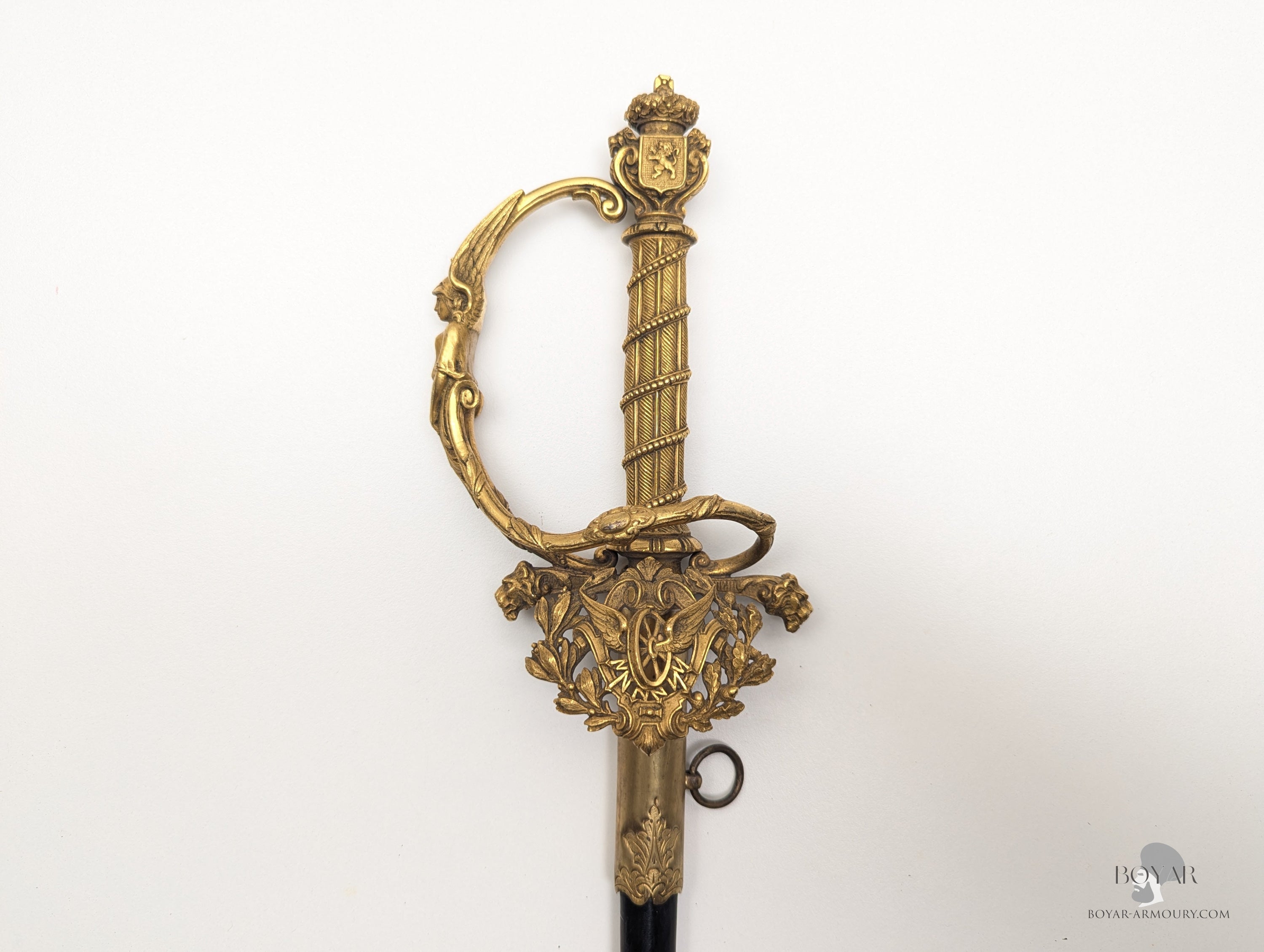
Belgian Rail Official's Smallsword. One of the most ornate swords I have ever come across, a Belgian railways official's sword from the reign of Leopold II. Intricately decorated hilt with a full sculpture of the Greek god Hermes and very detailed lion's head quillons. The pommel depicted as an intricate crown adorning the Belgian coat of arms. The blade"
  • Nation : French
  • Local Price : £1,250.00
French Double Barrelled Flintlock Sporting Gun. French Double Barrelled Flintlock Sporting Gun in very good condition, the locks with internal hammers and maker marked please see images. The stock with polished steel mounts matching the locks and original brass tipped ramrod. Overall length 120cm the barrels 80cm UK shipping only
  • Nation : British
  • Local Price : £1,250.00
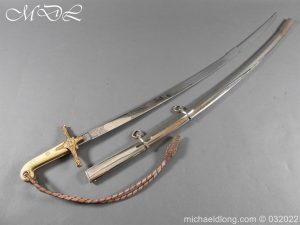
British Georgian Mameluke Sabre. Indian Wootz Steel Blade. Circa 1800. #2407010. This Mameluke sabre dates to the reign of King George III (1760-1820) and has an Indian wootz (crucible) steel “trophy” blade. The use of Mameluke sabres by British officers became popular in the late 18th Century after the defeat of the Tipu Sultan in 1799. Arthur Wellesley, the future Duke of Wellington fought in the campaign against the Tipu sultan and was a proponent of the efficacy of Mameluke sabres.Indian wootz steel is high in carbon as a result of first removing the impurities in the heated metal by repeatedly hammering out, folding and re-hammering the raw iron. Carbon is then added by re-heating the iron in a crucible with wood chips. At an extremely high temperature the metal absorbs the carbon from the burnt wood. The resulting high carbon steel is then forged into billets that have a fine-grained appearance. These billets can then be forged into blades of superior quality that hold a fine edge.The grain pattern within the steel is a result of repeated folding and hammering of the heated metal to uniformly distribute the carbon throughout the steel. Its aesthetically pleasing grain is a byproduct, and not the main intention as is seen in modern forged, highly decorative blades. The 740mm curved blade has a flat spine and terminates in a hatchet point. The blade is un-fullered and single edged. The edge remains very sharp and has four small use-related nicks. The grain of the steel is faint and more visible in some areas than others. The blade is in very good condition and is free from rust and tarnish.The ivory hilt is engraved with chevrons and a fan-like centre piece. The ivory grip scales are held firmly in place by rivets with decorative domed caps. One cap is missing. The ivory is in good condition with only a small crack on the left-hand scale. The langueted steel cross-guard is in good condition and free from rust. There is some small movement of the blade in the hilt, something that is common with antique Mameluke sabres.The sabre is complete with its steel scabbard with twin suspension rings. The scabbard is in very good condition and is free from rust and damage. The sword sheaths and draws smoothly and is held firmly within the scabbard.This is an excellent example of an early 19th Century fighting Mameluke sabre. The sword would have been carried by an officer either serving in or recently returned from India.UK ivory submission #CCLKPVEJ Was: £1,250.00Now:
  • Nation : British
  • Local Price : £1,250.00
1831 Pattern Officer’s Mameluke Sword of The Rt Hon Lord Kenyon. A George V 1831 pattern Officer’s mameluke sword, the 84.5cm curved single edged blade with bayonet tip, etched Royal Crown and Prince of Wales Feathers to one side, George V cypher to the other, with proof slug in Star of David to base, set to a regulation gilt brass hilt with cast Prince Of Wales Feathers, shaped replacement grip and rosette fastenings, with sword knot and white metal scabbard Provenance: The Estate of Lord Kenyon, Gredington.
  • Nation : British
  • Local Price : £1,250.00
British Kings Own Scottish Borderers Officers Sword. British Kings Own Scottish Borderers Officers Sword George the 5th period and named to L A Furst K.O.S.B In super condition levee weight sword with Infantry officers hilt, fish skin grip and tassel. The blade with excellent etching and blued panel detailing L A Furst K.O.S.B It is complete with matching scabbard overall length 39 inch 99cm and the blade 32.5 inch 83cm
  • Nation : Dutch
  • Local Price : £1,250.00
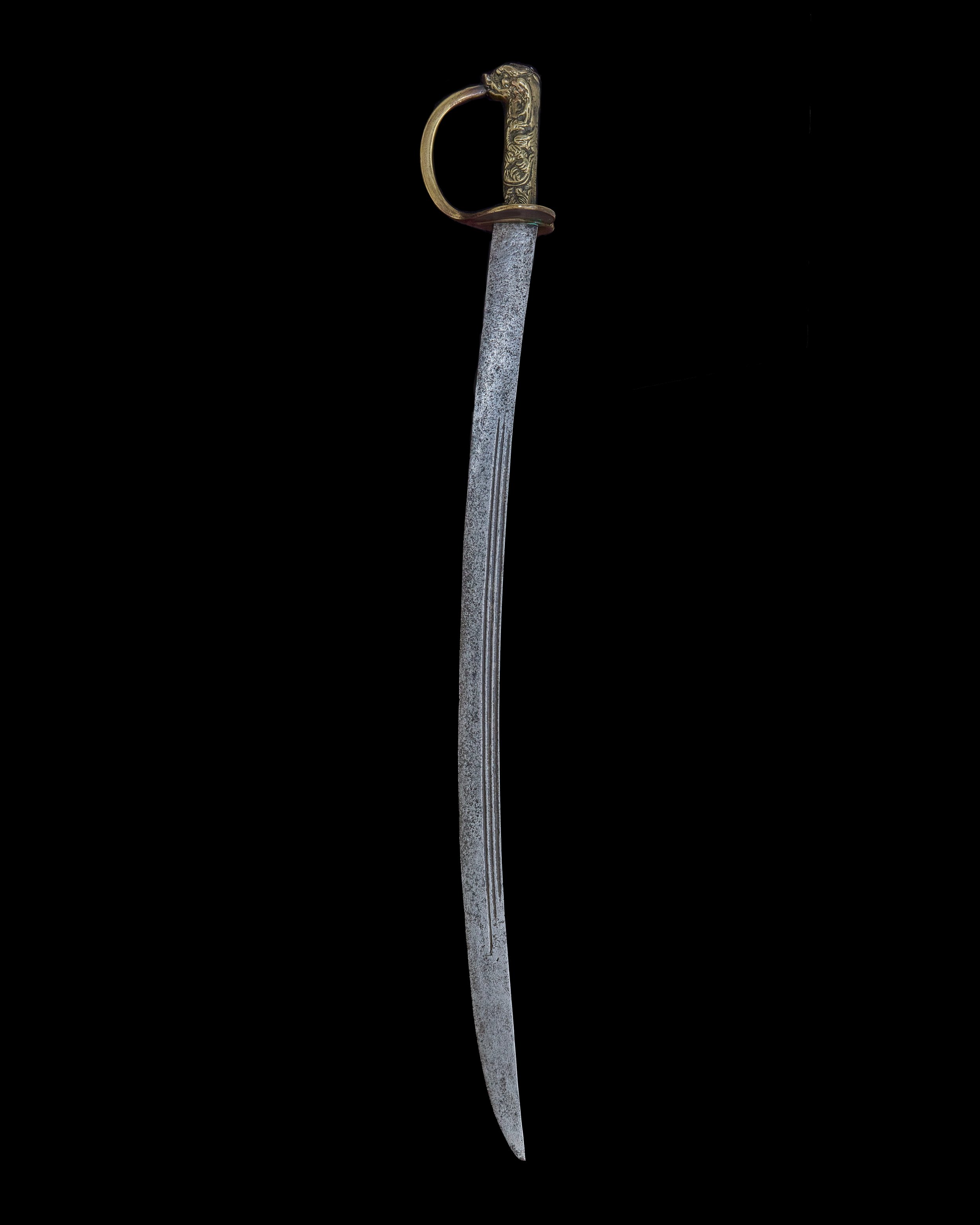
British "dog’s head" hanger. A British "Dog’s Head" or "Monster Head" Hanger c1690. Popular with both infantry and naval troops these hangers were part of a style of &156;brass hilted hangers&157; that were ordered in 1692 by the British Board of Ordnance and were produced for issue to sailors or &156;matrosses&157;. The hilt style is thought to have been influenced by contemporary Sinhalese (Sri-Lankan) swords and were carried by sailors in the service of the Dutch East India Company. These are one of the more decorative types of swords carried by British infantry troops during the 18th centurySolid cast bronze handle and double clamshell guard. The pommel is in the form of a grimacing dog biting the end of the knucklebow. The blade is of standard hanger form for the period, with a slightly curved blade and triple fullers extending around half the length of the blade
  • Nation : Hungarian
  • Local Price : £1250
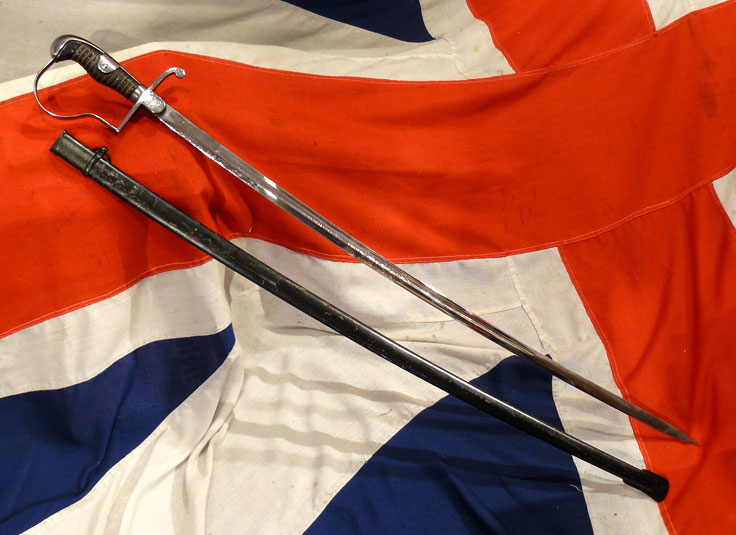
Click and use the code >21358 to search for this item on the dealer website Good, & Very Rare, German Third Reich, WW2 Wehrmacht 14th Kavallerie Regimental Sword
  • Nation : Japanese
  • Local Price : £1,225.00
Pre WW2 December 1938 Dated Japanese Civilian Sword With Possible Gendaito Artisan Smith Signed Regulation Military Length Blade Possibly ‘TOMO KAZU SUKE’ / ‘SUKE MITSU’ With Scabbard & Expert Assessment. Sn 20547. -. This sword has been assessed by a UK based Japanese sword expert Bill Tagg. His assessment accompanies this piece. In exerts from the assessment he states “Civilian katana, pre-war manufacture December 1938. This blade possibly made by an artisan & not trained sword smith. The mei (signature) is crudely written, especially the 1st kanji of name, cannot pin it down, tried numerous translations could be ‘Tomo Mitsu’, ‘Kazu Mitsu’ or ‘Suke Mitsu’. There is one Suke Mitsu showa period, a smith working as a gunto arsenal smith. Regulation military length at 25 ½”, no arsenal marks could be basic Gendai. Or high grade showa-to with a Nioi oil tempered blade, hamon unusual Hosho Suguha, no grain visible, a very clumsy looking sword, not in good polish. Saya good quality Honoki wood with thick black lacquer with its Kurikata for Sageo cord. Tsuba is Mokko (4 lobe) shape in a Sentoku brass metal possibly been blackened to match Shakudo Fuchi & Kashira on hilt (Tsuka). With Gunto Cherry Blossom menuki. Hilt with brown ito tape which is frayed with age. An interesting example, needs more research”. In illustrations of the blade & tang which accompany the assessment, Bill states that the cutting edge is 25 ½”, total length is 32 ¼”. He translates the tang date & signature as far as possible and describes other blade characteristics and dimensions (illustrated). The price for this interesting Katana worthy of further research with expert assessment includes UK delivery. Sn 20547.
Page 50 of 160