
Show

Forgot your password?

Error message here!

Error message here!

Error message here!

Error message here!

Show Error message here!

Show Error message here!

Lost your password? Please enter your email address. You will receive a link to create a new password.

Error message here!

Back to log-in

Close

For Sale

The following items are listed by for sale by users of the site and dealers. They are in no way endorsed or guaranteed by www.antiquearmsresearch.com

Add a Classified Item
to

Clicking on the sword will take you through to the relevant classified item or dealer site.
Don't miss out! - Do you want to be kept informed weekly of new aditions? Just join our weekly update list.

You can also receive regular email notifcations when items match your keywords. To recieve them just register or logon at the top right of this page.
Page 75 of 159
  • Nation : British
  • Local Price : £685.00
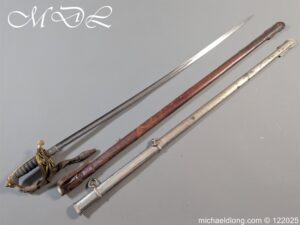
Victorian 27th LRV Officers Sword. Victorian 27th LRV Officers Sword. Levee weight sword with brass gilt hilt with folding side guard, fish skin grip, leather liner and sword knot both showing age wear. The blade slightly curved engraved with 27 LRV, Victorian crown and initials J R B the reverse with V R and crown plus regimental badge and motto, Tutus in undis. Complete with two scabbards, parade and field both in poor condition please see images Overall length 37.5 inch the blade 32.5 inch maker marked Joel Edwards and Sons Hanover Street London
  • Nation : German
  • Local Price : £685.00
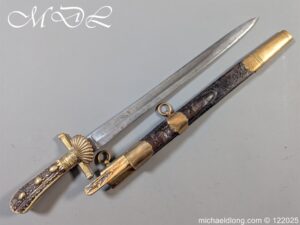
German 19th Century Hunting Hanger. German 19th Century Hunting Hanger by Weyersberg Kirschbaum & Cie. Super quality, gilt brass hilt with riveted stag horn grips and small shell guard and straight quillions. The blade engraved with hunting scene&#acute;s and wildlife and stamped with markers mark under the shell guard W K & C – Weyersberg Kirschbaum & Cie was the amalgamation of two very old Solingen family companies in 1883 Complete with leather scabbard with matching mounts and ensuite knife. Overall length 20.5 inch the blade 15.5 inch
  • Nation : British
  • Local Price : £675.00
British 1897 Pattern Henry Wilkinson London Officer’s Sword With Etched Blade Inscribed Monogram ‘HG Monogram’, Blade number 26504 Scabbard & Leather Foul Weather Cover. Sn 21226 -. This is a very good, 1897 pattern Infantry Officer’s Sword By Henry Wilkinson. It has a 32 ¼” long blade with partial fullers. The blade has just light staining consistent with age & etched on both sides with decorative foliate panels & Queen’s crown with Royal Cypher ‘VR’ Victoria Regina’. The blade is also etched by the manufacturer ’Henry Wilkinson Pall Mall London’ together with Royal Warrant and has the ordnance acceptance star with roundel. One side of the blade is inscribed with stylised monogram ‘combined HG’ Palm tree crest and indistinct motto within banner most likely a family crest of the original Officer who owned this sword. The back of the blade is numbered ’26504’ (Wilkinson keep records of their blades and it may be possible to determine the date the sword was manufactured and who commissioned it). It has a full 1897 Pattern knuckle guard with Victorian Crown VR (Victoria Regina) device. It has a stepped pommel with ball top, fish skin grip with wire binding all complete and intact. It comes with its original steel scabbard with 2 hanging rings and original leather foul weather cover with full flap cover, retaining strap with buckle and rear carry loop. The cover has ink stamp ‘W’. The price for this presentation sword worthy of further research regarding the blade number & monogram includes UK delivery. Sn 21226
  • Nation : British
  • Local Price : £675.00
**RARE**C1887 Victorian Greaves & Co Kings Head Police Station, Chingford Kent Weapon Number 9 Police Constabulary Sword Hanger With Etched Blade ‘KHP No.9’ & Scabbard. ED 2562 -. The Metropolitan police was formed in 1829 and although Chingford in Kent was in its jurisdiction, the scattered village fell under the control of Waltham Abbey Police Force and did not warrant its own police station at that time. In the 1870’s there were concerns about the increase in lawlessness in Chingford, in particular, rowdy behaviour by some of the many visitors to the forest. In 1887 land was found to build the station next to the Kings Head public house. Illustrated in image 1 is a period image taken Circa 1887 of a Group of King’s Head Police Station Police Officer’s outside their new Police Station. This is an original Victorian era Police hanger & scabbard to the King’s Head Police manufactured by Greaves & Co. It has a faint etched panel on one side of the 23 ½” swept cutlass form blade ‘KHP No.9’ (Kings Head Police Weapon Number 9). The spine has a faint etched panel ‘Greaves & Co Manufacturer’. The fullered blade has just staining consistent with age and is very sharp. The blade has its original leather hilt washer. The shagreen wrapped handle is in good order with brass hand guard & stepped pommel. The hilt’s locking catch works correctly retaining the hanger securely in its scabbard, The overall length of the sword is 29 ½”. The leather scabbard with brass mounts is in good condition with just small areas of stitching on the spine open & just scuffs & abrasions to leather consistent with age and service use. The brass throat mount has a frog locket. The price for this rare hanger to a small Victorian Police constabulary includes UK delivery. ED 2562
  • Nation : British
  • Local Price : £675.00
Victorian British Firmin & Sons London 1822 Pattern Infantry Officer’s Sword With Gilt Brass Guard Etched Blade To The 1st Manchester (Volunteer) Rifles & Steel Scabbard. Sn 22090 -. Originally raised as the King’s Royal Rifle Corps in 1755, the Rifle Brigade was officially formed in 1800. The Manchester Volunteer Rifles were raised in 1859/60. Their expansion in WW1 as eighteen battalions of the Manchester Regiment saw the Regiment play a significant role in the Great War. The 1822 pattern sword was a radical departure from previous designs, having a ‘gothic’ style pierced basket hilt so named after its resemblance to window shapes in gothic architecture (see page 173 of World Swords by Withers & Page 159 of Robson). This original infantry Officer’s Pattern 1822 sword has a clean 32 ½” single edged steel blade (38 ½” overall).. The blade is signed by the maker or retailer ‘Firmin & Sons 153 Strand London’ and has ordnance acceptance star and inlaid proof roundel. Both sides of the blade have etched decoration featuring foliate panels Queen’s crown VR Royal Cypher, ‘First Manchester Rifles’ within scrolling banners and heradic arms of Manchester with motto ‘From Acorns Spring Oaks’. The gilded brass gothic style voided guard has stylised Royal Cypher Queen’s crown ‘VR’ (Victoria Regina). Its fish skin grip with finger grooves & wire binding is in excellent condition. The sword is complete with its steel scabbard which has 2 steel hanging rings. The price includes UK delivery. Sn 22090
  • Nation : British
  • Local Price : £675.00
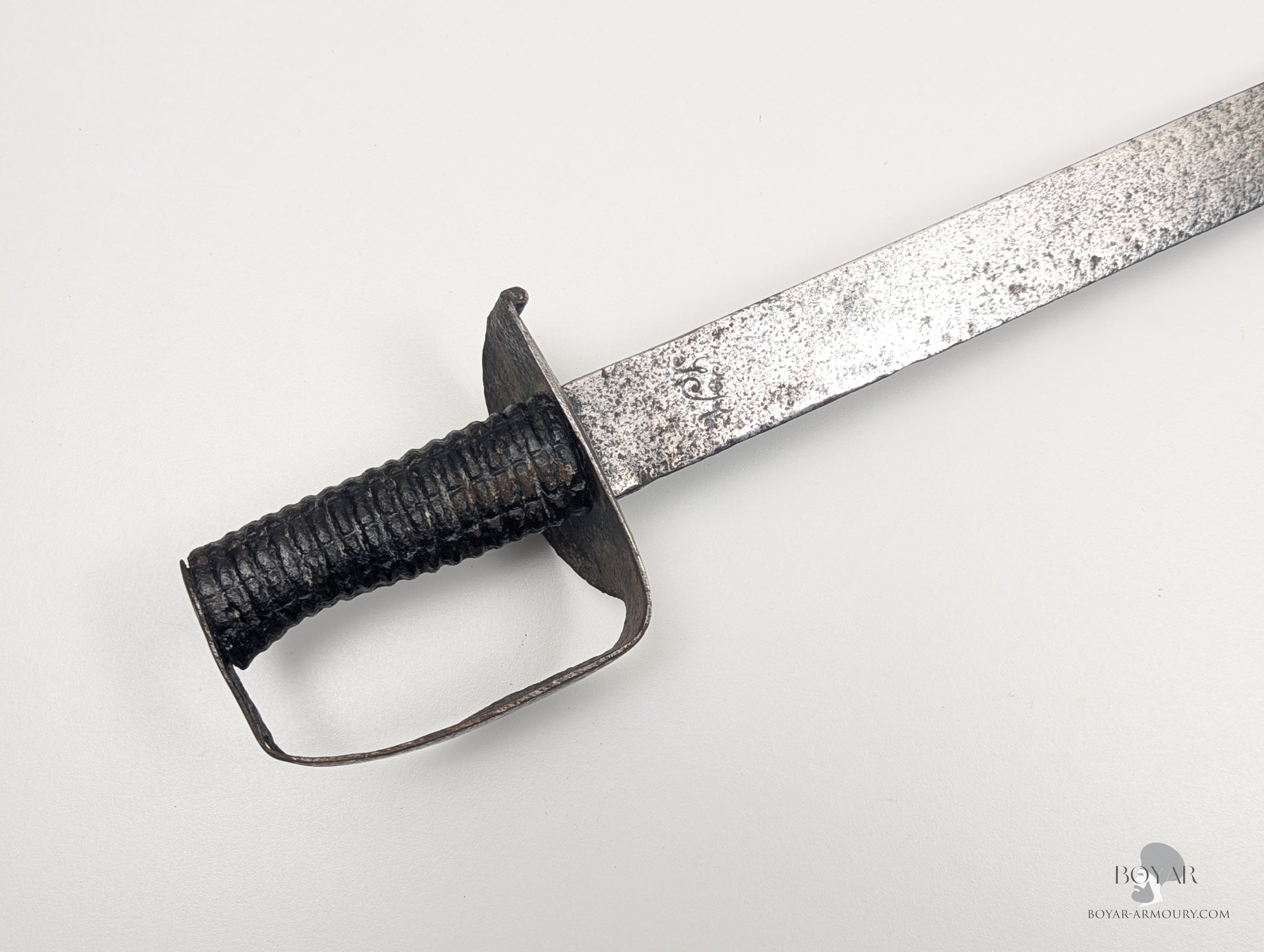
British Ordnance Marked Victorian 1845 Pattern Royal Navy Boarding Cutlass. Sn 22266 -. The British Royal Navy due to its global presence and command of the sea was by far the most organised and trained of all the World major sea services and it’s edged weapons used for boarding and repelling boarders reflected this. The Royal Navy was one of the first Navies in the 18th Century to begin standardising the personal edged weapons used by ordinary seaman. Experiments during the early 1840s for a new naval cutlass design to replace the venerable 1804 Pattern resulted in a design by George Lovell, the Inspector of Small Arms, being accepted in 1842. A fire at the Tower of London destroyed early stocks and the design did not enter service in bulk until three years later, hence being termed the 1845 Pattern. It was considered very successful, handling well compared to its bulky predecessor the 1804 Pattern and being simpler to manufacture. This is a very good original Victorian 1845 Pattern boarding Cutlass (see page 248 of World Swords by Withers). Our example has the classic broad single edged 29 ½” blade (34 ½” overall). The blade is just under 1 ½” broad at its widest and the spine is 7mm width at its widest. It has the correct full steel bowl knuckle guard and ribbed steel hilt all blackened. The guard is slotted for wrist strap. The blade has some staining consistent with age & service use and has its original leather hilt washer. Near to the hilt one side of the blade has a ‘crown 13’ British ordnance inspection mark. The spine has faint indistinct partial maker’s name ‘***INGTON’ . These weapons were stored in locked racks on board ships and issued only for training or combat so are often found without scabbards. Only a small number were furnished with scabbards so that with a baldrick they could be worn for land-bound duties. Our example is without scabbard. The price for this piece of British Naval history includes UK delivery. Sn 22266 (tub armoury)
  • Nation : British
  • Local Price : £675.00
British Board Of Ordnance 1845 Pattern Royal Navy Boarding Cutlass Weapon Number ‘172’ Regulation Converted Slender Blade C1887 / 1888. Sn 22296 -. The British Royal Navy due to its global presence and command of the sea was by far the most organised and trained of all the World major sea services and it’s edged weapons used for boarding and repelling boarders reflected this. The Royal Navy was one of the first Navies in the 18th Century to begin standardising the personal edged weapons used by ordinary seaman. Experiments during the early 1840s for a new naval cutlass design to replace the venerable 1804 Pattern resulted in a design by George Lovell, the Inspector of Small Arms, being accepted in 1842. A fire at the Tower of London destroyed early stocks and the design did not enter service in bulk until three years later, hence being termed the 1845 Pattern. It was considered very successful, handling well compared to its bulky predecessor the 1804 Pattern and being simpler to manufacture. Many of the 1845 pattern cutlasses were converted in 1887 and 1888 to the new specifications. They had their blades made more slender (see page 248 of World Swords by Withers). Our example is one of the regulation converted blades which would have been performed circa 1887- 1888. It has the classic single edged 28 ½” (34” overall). The blade is 1 ½” broad at its widest and the spine is 5mm width at its widest. The blade has some staining consistent with age & service use. It has the correct full steel bowl knuckle guard and ribbed steel hilt all blackened. The guard is slotted for wrist strap and has an additional period pierced hole. The guard has 2 brass rivets (these would most likely have supported a brass lozenge riveted to the front with a weapon / rack number. The lozenge is absent (Wither’s book illustrates afore described hilt plates). The guard also has engraved ‘BO WD arrow’ Board of Ordnance mark and weapon number ‘172’. These weapons were stored in locked racks on board ships and issued only for training or combat so are often found without scabbards. Only a small number were furnished with scabbards so that with a baldrick they could be worn for land-bound duties. Our example is without scabbard. The price for this piece of British Naval history includes UK delivery. Sn 22296 (tub armoury)
  • Nation : British
  • Local Price : £675.00 GBP
Georgian Boarding Cutlass, 1804 Pattern. A scarce 1804 pattern 'figure of 8' cutlass, marked with the George III monogram on the blade. The guard has been officially modified to facilitate ease of wear (Naval Swords by PWG Annis, 1970)."
Page 75 of 159