
Show

Forgot your password?

Error message here!

Error message here!

Error message here!

Error message here!

Show Error message here!

Show Error message here!

Lost your password? Please enter your email address. You will receive a link to create a new password.

Error message here!

Back to log-in

Close

For Sale

The following items are listed by for sale by users of the site and dealers. They are in no way endorsed or guaranteed by www.antiquearmsresearch.com

Add a Classified Item
to

Clicking on the sword will take you through to the relevant classified item or dealer site.
Don't miss out! - Do you want to be kept informed weekly of new aditions? Just join our weekly update list.

You can also receive regular email notifcations when items match your keywords. To recieve them just register or logon at the top right of this page.
Page 98 of 158
  • Nation : -
  • Local Price : 5,500 kr
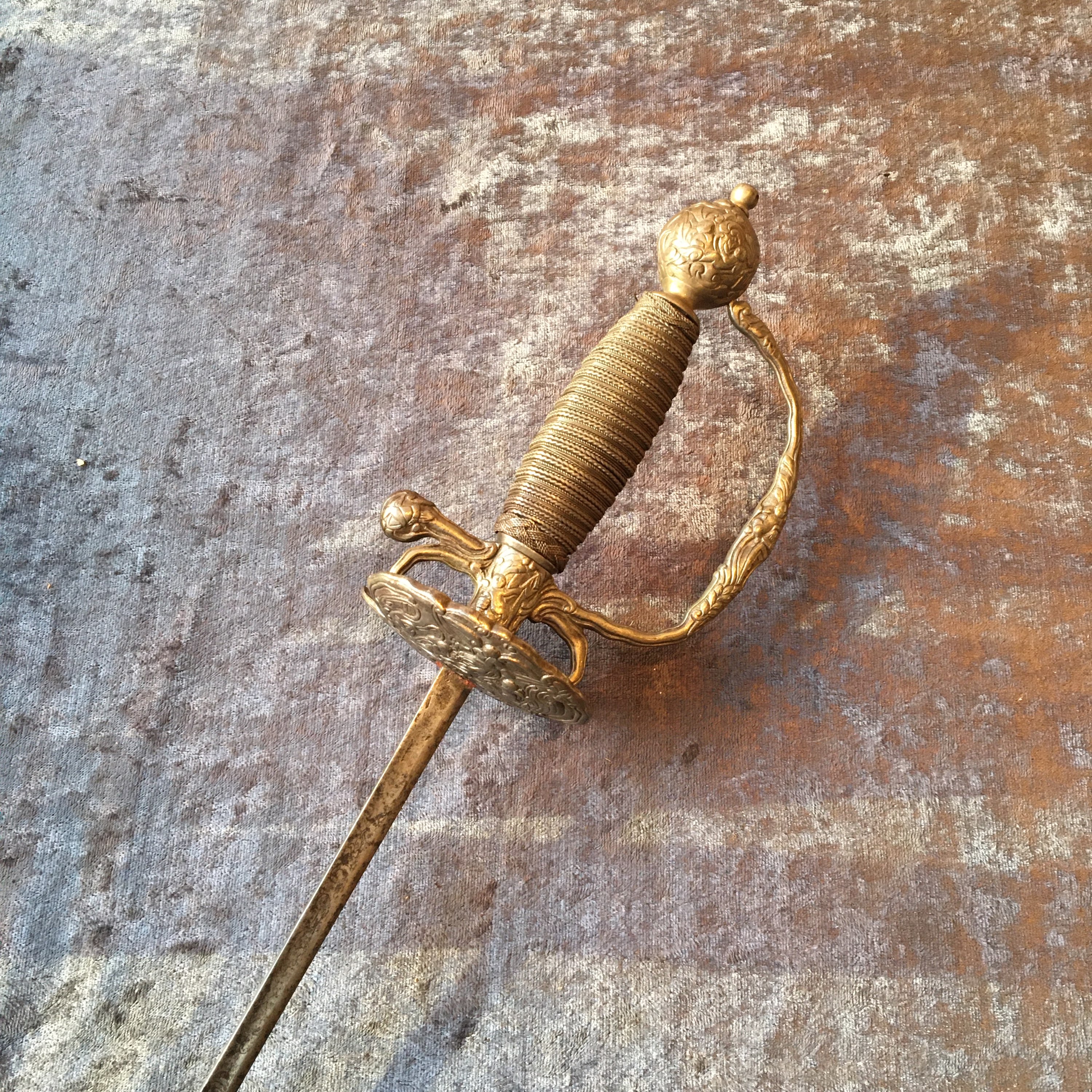
Mid-18th century civilian thrust sword with unusual blade..
  • Nation : -
  • Local Price : 5,500 kr
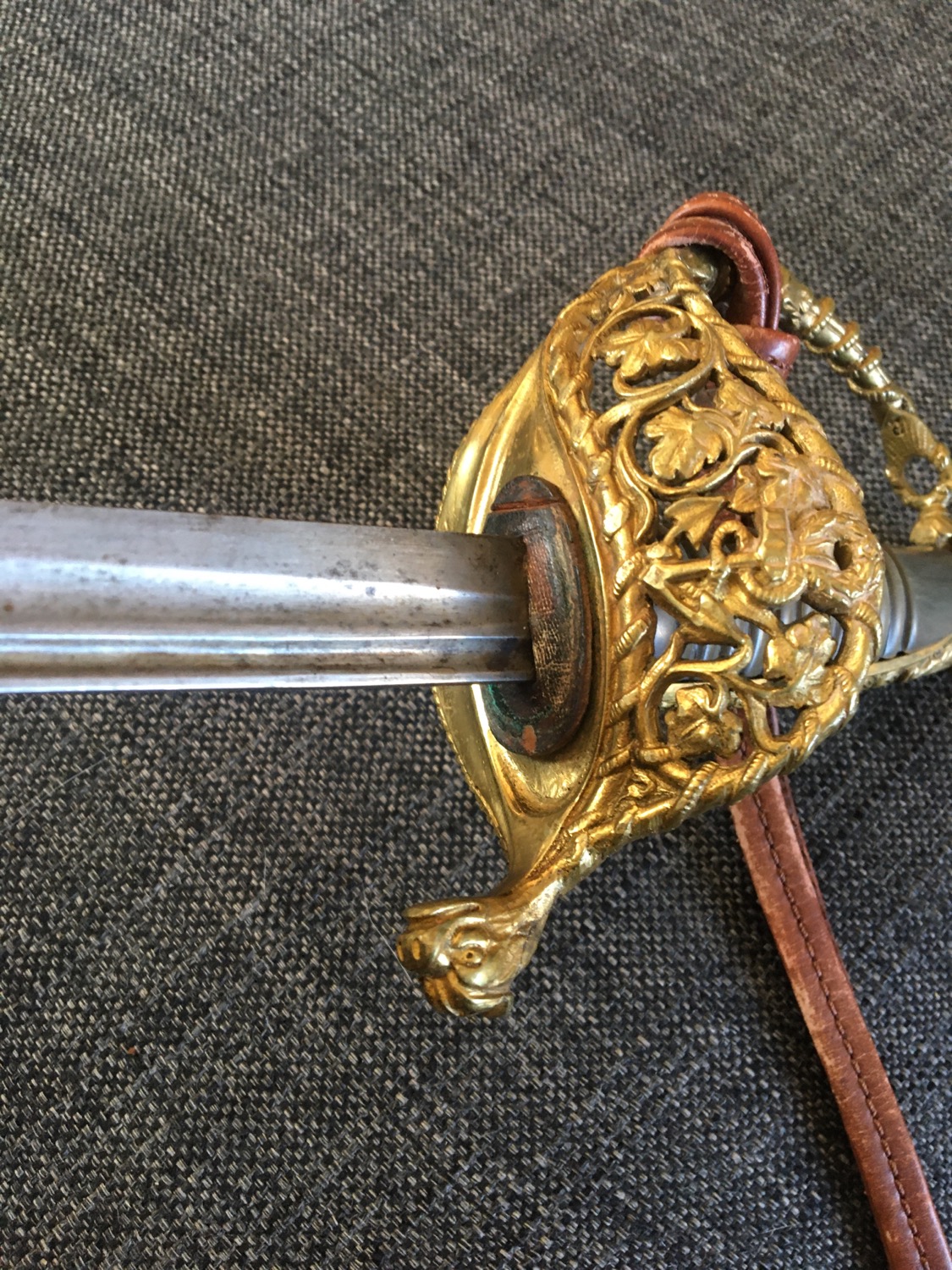
Marine officers saber m / 1837-48.
  • Nation : British
  • Local Price : £430.00
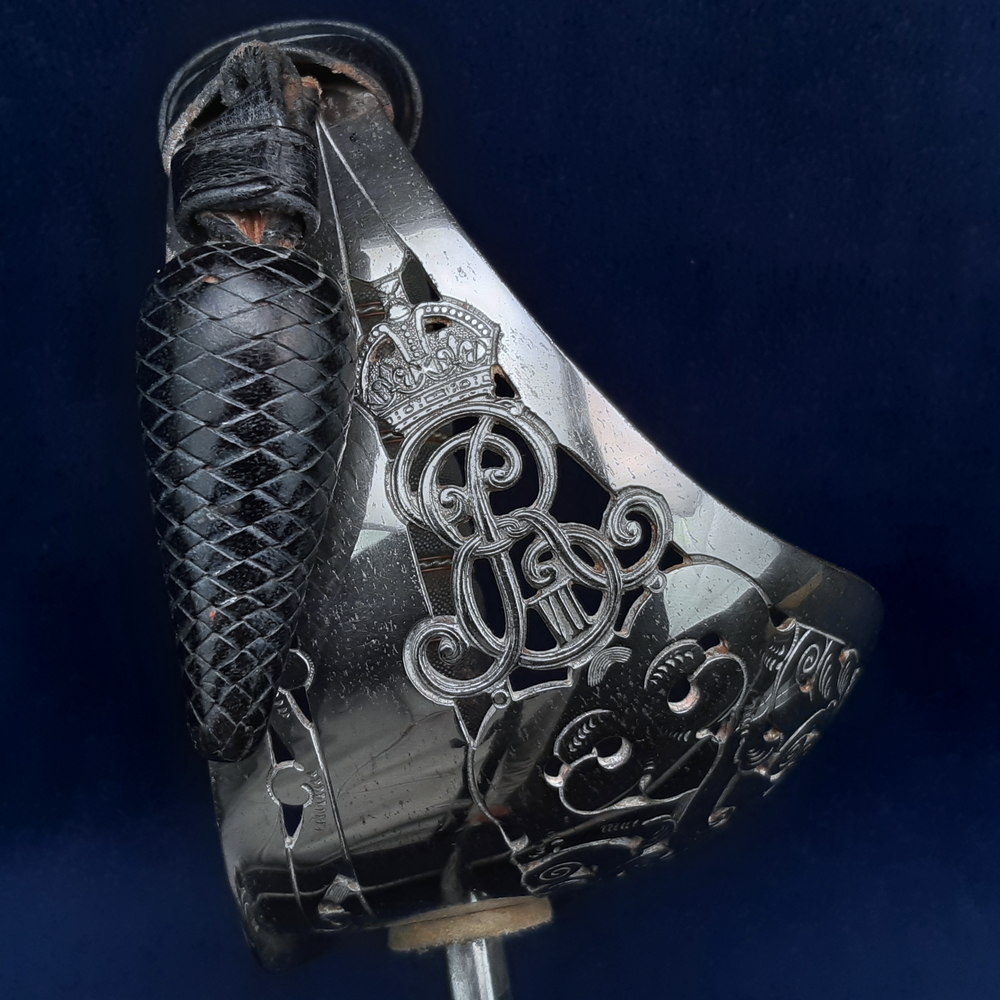
British Edwardian 1897 Pattern Infantry Officer&#acute;s Sword by J R Gaunt & Son, 1901-1910. Description Straight single-fullered spear-pointed blade. Steel hilt with pierced and imprinted decoration including the crown and cypher of King Edward VII. Steel ferrule, fully chequered steel backstrap, integral oval pommel with tang button. Wire-bound black shagreen grip, buff leather washer, black leather sword knot with acorn. Black leather field scabbard with frog strap and nickel-plated nonferrous throat piece. Blade 32¾ inches in length past the washer, 1.05 inches (2.67cm) wide at the shoulder, the sword 39 inches overall. Black canvas sword bag with chamois leather lining. The blade is faintly etched at the ricasso on one side with the retailer&#acute;s mark &#acute;G. PHILLIPS & SON OUTFITTERS PLYMOUTH&#acute;. At the ricasso on the other side is an etched six-pointed star within which is a brass proof slug stamped with &#acute;PROVED T&#acute;. The blade is further etched on one side with the royal crown and shield, on the other side with the crown and cypher of Edward VII (the cypher in its mirrored form), and on both sides with a wreath of laurel & palm and foliate motifs. There is a cartouche for the optional etching of the owner&#acute;s name, which has been left blank. There is little reference in my sources to the firm of Phillips and Son, which was clearly a military outfitter rather than a sword manufacturer. Like many such shops Phillips would have ordered its swords from a manufacturer, with their own branding added to the blades. These would then have been sold to an officer along with his uniform. Being a fortified port town, Plymouth outfitters might have seen more trade from the Royal Navy then the Army, but there was a considerable Royal Marines presence locally as well as battalions of the Devonshire Regiment and passing trade from troops transiting through the port. Swords with the Phillips mark are relatively rare and seem to all be from the Edwardian period suggesting it only traded in them briefly. Based on the design of the proof slug applied to the blade I am confident in identifying the actual maker as J. R. Gaunt & Son. R. Gaunt was another military outfitter which began producing its own swords in 1897 when it bought out Edward Thurkle and Sons, the Thurkle dynasty of cutlers having produced swords continuously since 1749. In the Edwardian period Gaunt traded from premises in both London and Birmingham. The proof slug used on Gaunt&#acute;s blades was for many years the same as that previously used by Thurkle. They kept the same mark to emphasise the pedigree, only creating their own design in the mid-1920s. Gaunt ceased manufacturing swords in 1942 and shut down altogether in 1969. King Edward VII reigned from 1901 to 1910, putting a relatively narrow date range on this sword&#acute;s production. Officer&#acute;s swords were privately purchased and the most common time for the officer to buy one was when he was newly commissioned, a sword being a necessary part of his new uniform, at which point the cypher of the current monarch would be used. The blade&#acute;s finish is excellent with only some light speckled patination in the lower section, a mirror polish on the tip section beyond the etching with only small areas of light frosting. The etching is bright and clear, retaining the contrast between the matt acid-etched background and the reflective polished designs within it. The blade&#acute;s edge is unsharpened and undamaged. The shagreen of the grip is all intact with light handling wear, its wire binding is all present and tight. The scabbard mouth, hilt, ferrule, backstrap and pommel have all been nickel-plated and this plating is in very good condition with light wear on the inside of the hilt where fingers would rub against it when held, one very small spot of wear on the pommel exposing patinated steel. The leather sword knot has some surface cracking to the leather where the movement of the acorn flexes it, otherwise it is excellent with very little wear and retains its black finish. The scabbard is likewise excellent: its throat piece is bright, its leather is glossy and lustrous with only a few very small dents or scuffs, all of its stitching is intact, its frog strap has a few very small surface cracks and wrinkles but is flexible and strong.
  • Nation : -
  • Local Price : £425.00
Royal Company of Archers Sword. Royal Company of Archers Sword. The hilt which would have been brass is embossed with scrolls and straight matching cross guard however this sword has ben totally silver plated including the blade maybe as a presentation item. Overall length 26 inched the blade 20 inches
  • Nation : Swiss
  • Local Price : £425.00
Swiss M1852 Cavalry Trooper&#acute;s Sword. Description Curved blade with hatchet point, with a long central fuller and shorter narrow fuller near the spine of the blade (a la Montmorency). Brass hilt with central knucklebow and two side bars, spiral ribbed grip of pressed black leather over wood. Steel scabbard with two hanging rings. Blade 36 inches in length, the sword 42 inches overall. The blade is stamped at the ricasso on one side with the maker&#acute;s mark &#acute;Gebr: Weyersberg&#acute;, and on the other side with &#acute;Solingen&#acute; indicating the manufacturer Gebrüder Weyersberg (Weyersberg Brothers). Founded by the brothers Wilhem, Peter and Johann Ludwig Weyersberg in 1787, this major Solingen-based firm merged with W. R. Kirschbaum & Co in 1883, forming the even larger Weyersberg, Kirschbaum & Co. which still exists today as WKC Stahl- und Metallwarenfabrik. The blade is also stamped in the fuller on one side with a crown over &#acute;AA&#acute;, the arsenal stamp of Bern, Switzerland, and the serial number &#acute;1060&#acute;. The French M1822 Light Cavalry sabre proved to be an extremely popular design. It was adopted by Belgium in 1834 after its independence from the Netherlands. The United States also adopted this sword as the Model 1840, and surplus French-made swords were sold to Poland and Finland in the 1920s. The Swiss initially adopted it as the M1842 - this example is the later M1852, which lacks the clipped point of its predecessor. The Swiss contracted production of the blades to firms in Solingen, Germany. I have also seen examples marked to Clemen & Jung, so the contracts were probably spread across multiple manufacturers. The blade is bright with only a few tiny spots of patination, a few nicks to the edge towards the point (beyond the end of the fuller). The brass hilt has a dark patina which I have left untouched. The grip&#acute;s wire binding has been lost, aside from a few stubs at the pommel end. The grip leather is intact with light handling wear. The scabbard is free of dents and is bright with some patination in the recesses.
  • Nation : French
  • Local Price : £425.00
French 1833 Coastal Artillery Cutlass. Here we have a good example of a French 1833 pattern naval cutlass. Clearly marked on the spine of the blade for the government arms making centre of Chatellerault, the inspection stamps are for Réviseur Joseph Ambroise Bisch who worked there until 1834. The blade is etched with a pair of anchors, one of each side. The hilt is in a good condition, featuring the narrower symmetrical guard without the large side-wing thay many have. It also features some examples of period repares.The Manufacture d&#acute;Armes de Châtellerault , nicknamed La Manu , is a French arms company located in Châtellerault , created in 1819 and disappeared in 1968.
  • Nation : British
  • Local Price : £425.00
British Royal Army Service Corps Sword. WW1. #2404014. A scarce WW1, Royal Army Service Corps (RASC) officer’s sword made by a scarce wartime maker, Mower & Co., of Sheffield, England. During WW1, many companies not previously associated with weapons manufacture were recruited to aid the war effort.The 875mm Wilkinson style blade has a flat spine and broad, three-quarter length fuller on both sides. The blade terminates in a double-edged spear point. The finely etched blade bears scrolled foliate panels below trefoil arches. The centre of the blade bears the badge of the Royal Army Service Corps. The obverse bears the crowned cipher of King George V amidst foliate scrollwork and arches. The blade is in good condition with its original polish and crisp etching. There are a few, small patches of pale corrosion/tarnish. The ricasso bears the makers’ details, S. C. Mower & Co. Makers. Sheffield. The obverse is etched with a Damascus star and stamped with the word, PROVED.The nickel-plated three-bar guard is in excellent condition with all the plating intact. The shagreen grip is excellent and the three strands of twisted copper wire are intact and tight. The blade is firm in the hilt.The sword is complete with its brown, wood and leather scabbard. The body of the scabbard is in very good condition with age and use-related wear and scuffs. The frog strap is missing. The sword sheathes and draws smoothly and is held firmly within the scabbard.This is a very nice example of a scarce WW1 RASC officer’s sword.
  • Nation : British
  • Local Price : £425
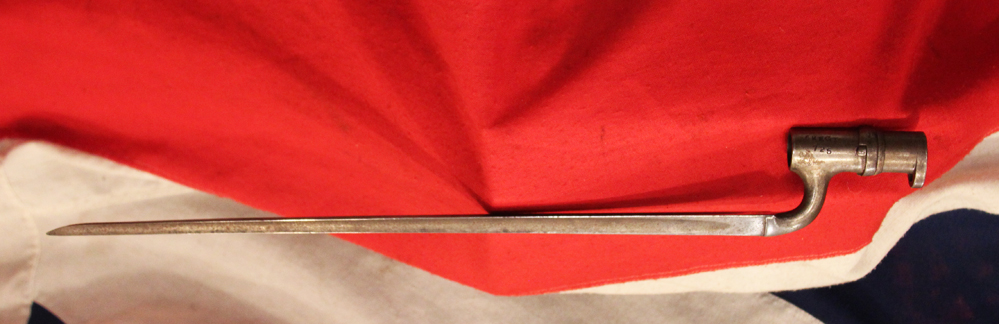
Click and use the code >21392 to search for this item on the dealer website Rare 1853 Royal Warwickshire Regt. Historically Significant &#acute;Jamaican Rebellion&#acute; Enfield Bayonet The Morant Bay Rebellion, From a Defender of Paul Bogle.
Page 98 of 158