
Show

Forgot your password?

Error message here!

Error message here!

Error message here!

Error message here!

Show Error message here!

Show Error message here!

Lost your password? Please enter your email address. You will receive a link to create a new password.

Error message here!

Back to log-in

Close

For Sale

The following items are listed by for sale by users of the site and dealers. They are in no way endorsed or guaranteed by www.antiquearmsresearch.com

Add a Classified Item
to

Clicking on the sword will take you through to the relevant classified item or dealer site.
Don't miss out! - Do you want to be kept informed weekly of new aditions? Just join our weekly update list.

You can also receive regular email notifcations when items match your keywords. To recieve them just register or logon at the top right of this page.
Page 99 of 158
  • Nation : Russian
  • Local Price : £425
Click and use the code >21714 to search for this item on the dealer website Most Rare Imperial German State´s ´Postal Protection Officer´s´ Sword
  • Nation : British
  • Local Price : $795.00 CAD
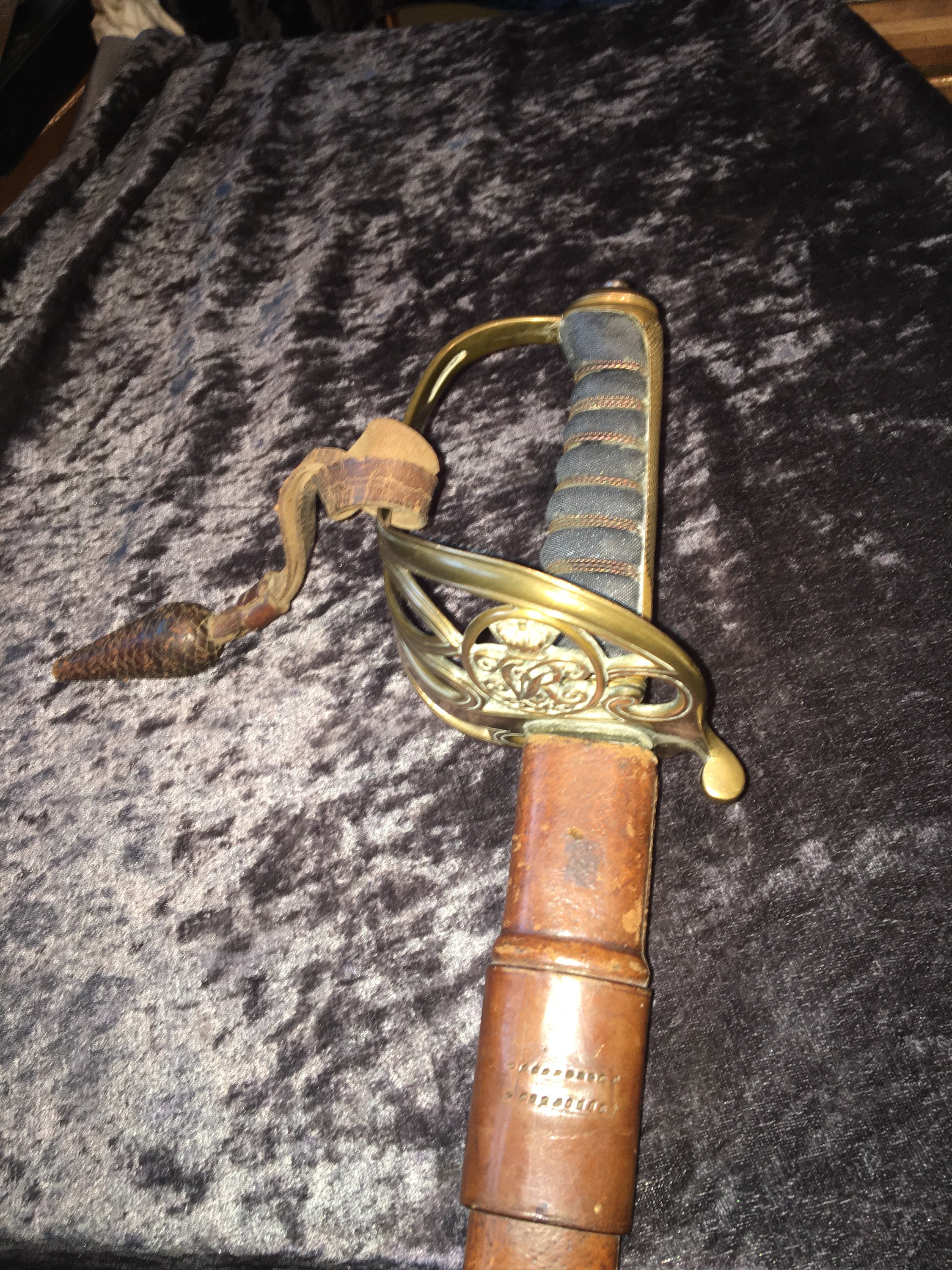
BRITISH P.1822/45 GENERAL OFFICER’S SWORD. BRITISH P.1822/45 GENERAL OFFICER’S SWORD: Maker: E. THURKLE, Maker, SOHO, LONDON. Thurkle worked at this address from 1876 to 1899. Very nicely etched blade with Victoria’s Cypher on the left side and crossed batons on the right. Some patches of light to medium pitting on the lower half of the blade. Wire-bound fish-skin grip is excellent. Brass Scabbard is very nice with only a few minor dents. The brass scabbard was instituted in April 1832. With original General Officer’s Sword Knot. ROBSON # 191 & 193 $795.00
  • Nation : -
  • Local Price : 575.00 USD
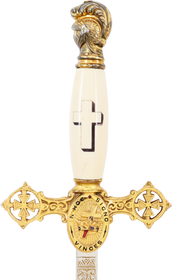
FINE KNIGHTS TEMPLAR SWORD. Mid 20th century. 29 7/8" blade finely decorated with Crusades scenes and motifs, owner's name, with the gold background just showing light wear and about 50% bright. Gilt hilt with faux ivory grip inscribed with cross, Masonic motifs and monogram. Gilt scabbard with finely detailed mounts. Fine enamel inlay to the guard and scabbard mounts (small losses). Excellent quality and excellent preservation for impressive bright presentation. 
  • Nation : American
  • Local Price : 575.00 USD
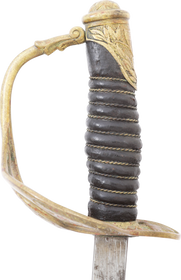
US 1872 CAVALRY OFFICER'S SWORD. See The American Sword, Peterson #86. Custer era and showing distinctive Western Frontier character. 31 3/4" broad fullered blade unmarked. Brass hilt with three bar guard and wire wrapped leather covered grip (dry but complete and excellent). Blade crisp with gray patina and minor oxidation the mid point right side, negligible. Early Custer era example with great age appearance which exudes Western/cowboy character. 
  • Nation : British
  • Local Price : 5,100 kr
English saber w/1892 for field doctor rare..
  • Nation : British
  • Local Price : £400.00
British c1860 Volunteer Lancaster Bayonet. Description Unfullered pipeback blade with quill point, steel cross hilt with straight lower quillon with round forward-swept finial, and upper quillon projecting from the muzzle ring. Grip slabs of pressed black leather over wood, secured to the exposed tang with four rivets, one of which secures the external leaf spring which actuates the locking catch. Black leather scabbard with steel throat piece with oval frog stud and steel chape piece. Blade 58.9cm (~23 3/16 inches) in length, the bayonet 72.4cm (28½ inches) overall, muzzle ring diameter 20mm. The blade is stamped at the ricasso on one side with the maker&#acute;s mark &#acute;CHAVASSE&#acute;, indicating manufacture by Chavasse & Co, Birmingham. The pommel is stamped with the number &#acute;208&#acute;, probably a rack or weapon number. The Lancaster carbine was adopted by the Royal Sappers and Miners (the precursor to the Royal Engineers) in 1855, and came with a bayonet that was unusual for British Army issue, as it used brass for its hilt, pommel and scabbard fittings and had a conspicuously long pipeback blade. Pipeback blades for swords had fallen out of usage on British swords in the 1840s: while they were intended to be stiff in the thrust with a durable point, they were difficult to forge, easily bent and the cutting edge was so thin as to be fragile. The design might have fared better on a bayonet for which thrusting was paramount, and the shorter blade was less likely to flex, but fullered blades were the norm and the Lancaster would be the only British pipeback bayonet. While its looks were striking on parade, the Lancaster bayonet was fragile, requiring more frequent repairs than other models. Despite this issue, sheer decorative appeal meant that the bayonets outlasted the carbines they were made for, being repurposed as parade sidearms for the Royal Army Medical Corps and remaining in service into the early 20th century. Shortly after the Lancaster&#acute;s introduction, growing tensions in Europe raised concerns about Britain&#acute;s vulnerability to potential invasion. To bolster national defenses the War Office sanctioned the establishment of &#acute;Volunteer Corps&#acute; in 1859. These units were somewhat a reinvention of the militia “ non-professional soldiers who were expected to provide their own uniform and equipment, train at regular intervals and be ready for mobilisation in case of invasion. Providing their own equipment extended to arms too “ some volunteer rifle units were provided with Army surplus but many instead pooled money and purchased weaponry from the commercial market. Volunteer rifle units generally purchased carbines wherever possible, and one option for a bayonet to pair with these was the Lancaster. Its looks may have appealed to volunteer soldiers, or its potential to double as a bayonet and a sidearm. Commercial versions differed from the service model: they usually had steel components instead of brass, and a different scabbard closer to that of the contemporary cutlass bayonets. See British & Commonwealth Bayonets by Skennerton, p123. These were not necessarily fitted to Lancaster carbines “ each bayonet would have been hand-fitted and this may have been to the Enfield short rifles or carbines, of which there were multiple models. The blade is unsharpened with no nicks to its edge. Some grinding and polishing marks to the blade, with some spots of patination, some frosting at the hilt end, areas of moderate pitting along the spine and small spots of heavy pitting on the flat of the blade in the pipeback section, some of these contacting the edge. The hilt, pommel, rivets and exposed tang have heavy dark patination and speckled light pitting, moderate pitting to the muzzle ring and upper quillon. The locking button functions well. The leather grips are very good with no apparent wear to the knurling, beside some surface rubbing at the pommel end. One small dent to the exposed tang. The scabbard leather has some surface rubbing and flaking but is generally strong with all of its stitching intact, able to support its own weight. The scabbard throat and chape pieces are heavily patinated with peppered heavy pitting, some small dents to the chape piece which do not interfere with sheathing and drawing.
  • Nation : Italian
  • Local Price : £400.00
Italian M1860 Cavalry Trooper&#acute;s Sword. Description Curved, single-fullered spear-pointed blade. Black leather grip bound with brass wire. Steel hilt with turned over inner edge, large pierced teardrop-shaped hole to form two &#acute;bars&#acute;, and angled rectangular slot for sword knot. Stepped cylindrical steel pommel cap. Steel scabbard with two hanging rings. The ricasso of the blade is marked on one side with &#acute;S&K&#acute;, the maker&#acute;s mark of Schnitzler & Kirschbaum of Solingen, one of the German firms which manufactured these swords on behalf of the Italian government. The hilt is stamped with the serial number &#acute;156&#acute;. The blade’s edge is unsharpened but there are a few very small dents and edge imperfections, with one noticeable chip/roll where the fuller ends. A couple of small dents to the edge of the guard. Some patina to the scabbard, light pitting at the chape end, one noticeable dent to the lower section and one very small dent at the chape.
  • Nation : French
  • Local Price : £400.00
French 1870 Franco-Prussian War ’Defense Nationale’ Bayonet for the Remington Rolling Block Rifle, Repurposed M1831 Sword Blade. Description Straight unfullered blade with spear point, cross hilt with muzzle ring and hooked lower quillon with ball finial. Ribbed cast brass grip and beaked pommel, one steel rivet which also secures the external leaf spring which actuates the locking catch, peened tang at the pommel. Steel scabbard with frog loop. Blade length: 48.6cm (19 1/8 inches), overall length 61.1cm (~24 inches), muzzle ring diameter 18mm. The hilt is stamped on one side with the serial number &#acute;859&#acute;. These bayonets were made at the French arsenal of Chatellerault for two months of the year 1870 during the Franco-Prussian War (July 1870 - January 1871), intended to fit the Remington Rolling Block rifle. They are sometimes referred to as &#acute;Defense Nationale&#acute; bayonets, presumably because they were commissioned as a matter of emergency for national defense. They are in many respects like the German &#acute;ersatz&#acute; bayonets of WW1, including the use of repurposed materials: the French combined the hilt and grip of the M1866 Chassepot bayonet with blades of the much older M1816 and M1831 infantry sidearms, (both of &#acute;gladius&#acute; style). These obsolete short swords were presumably seen as expendable sources of good blade steel, but they needed significant reshaping to make serviceable bayonets. One edge of the double-edged, diamond profile blade has been ground down to form a flat spine and clear the way for the rifle to be fired. The blade was originally leaf-shaped broadening slightly along its length, and this is still visible in the remaining edge. The shoulder of the blade has been slimmed on both sides. With no fuller and no additional distal taper the blade remains noticeably heavy for a bayonet: a standard M1866 weighs 622g while this piece weighs 774g, despite being nearly 10cm (4in) shorter. Note the small divots on the third rib of the brass grips, placed as a guide to where a second grip rivet would usually be located. That rivet is always absent on these models. Its scabbard is a modified version of the standard M1866 scabbard: identical in its upper section but in its lower section it remains straight rather than curving as the M1866 must to accommodate a yataghan blade. It is oversized in length relative to the bayonet it holds. They were finished in bright steel, never blued. The French acquired around 210,000 Rolling Block rifles from Remington during the Franco-Prussian War, most being the model ordered by Egypt in 1869, chambered in .43. The Egyptian government had been delinquent in payment so Remington happily resold its initial order of 60,000 to France and produced the rest thereafter “ the Egyptians had to wait until 1876 to get theirs. Many of the rifles acquired by France were adapted to use the M1866 Chassepot bayonet but these rare bayonets are examples of an attempt to go in the opposite direction. One may marvel today at the very idea of there ever having been a shortage of Chassepot bayonets. See page 415 of Collecting Bayonets by Maddox for discussion of this type.
Page 99 of 158