
Show

Forgot your password?

Error message here!

Error message here!

Error message here!

Error message here!

Show Error message here!

Show Error message here!

Lost your password? Please enter your email address. You will receive a link to create a new password.

Error message here!

Back to log-in

Close

For Sale

The following items are listed by for sale by users of the site and dealers. They are in no way endorsed or guaranteed by www.antiquearmsresearch.com

Add a Classified Item
to

Clicking on the sword will take you through to the relevant classified item or dealer site.
Don't miss out! - Do you want to be kept informed weekly of new aditions? Just join our weekly update list.

You can also receive regular email notifcations when items match your keywords. To recieve them just register or logon at the top right of this page.
Page 10 of 124
  • Nation : British
  • Local Price : £3900
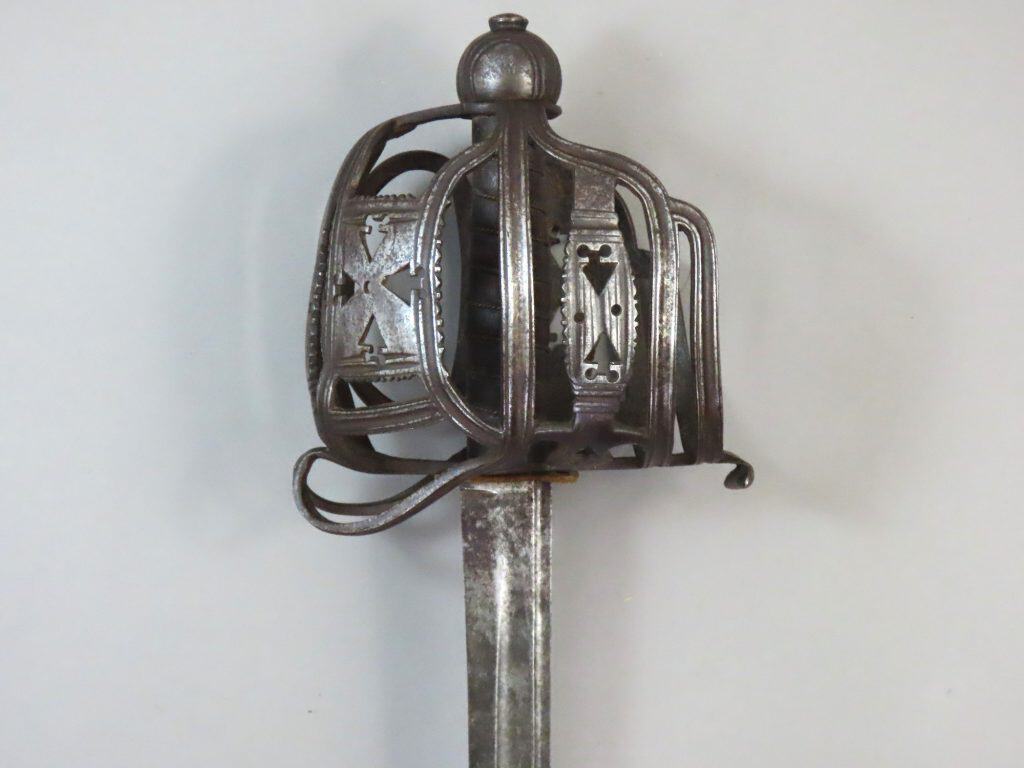
Scarce Royal Horse Guards Basket Hilted Back Sword circa 1750 to 1780. A fine example of a British Horseman’s Basket Hilted Back Sword made for an officer in The Royal Horse Guards as is evidenced by the subjects in surviving contemporary portraits of officers in that regiment. Whilst the hilt type is distinctive in terms of its stylistic features, a further aspect which is not conveyed by the photographs featured below, is its large size. The hilt type is one of a group of surviving swords with similar distinctive hilts which was once an Ordnance Pattern at the higher end of the quality range for British military swords. Its issue coincided with the outbreak of the Seven Years War in Europe (1756 to 1763). Simultaneously this conflict also spread to North America where it is referred to as the French and Indian War fought there between Britain and France. The sword type would have seen service in both theatres and most likely in the American Revolutionary War (1775 to 1783). The basket guard is particularly well constructed from thick robust iron bars.  The form of hilt decoration is the same style as that developed earlier in the century by the leading Scottish sword makers working in Glasgow such as John Simpson (I) and Thomas Gemmill who were both Kings Armourers. These makers developed the “Glasgow” style of Scottish hilt consisting of bold, flattened, rectangular structural bars, decorated on the outside with long shallow central grooves flanked by narrower incised lines either side. The style of our sword is the same but it was probably made by Harvey in Birmingham having adopted the Glasgow style for this particular pattern of hilt. The fully formed basket retains its pleasing oval shape and is pierced with triangles and circles in the main front and side guard panels which are also finely fretted at the edges with symmetrical chevrons and merlons. One of the main frontal guard plates in traditional basket hilt design has been replaced with a “horseman’s” oval ring. An additional elaboration by Harvey to the hilt design was to apply an extra transverse bar underneath the main guard plate just above the frontal loop guard. The arms of the guard are forged onto a circle of iron into which the base of the bun shaped pommel sits. The pronounced button is integral with the pommel and not of separate manufacture. The pommel is decorated with three sets of lines, similar in form to those present on the main bars of the hilt, formed as crescents. The grip is of wood covered leather bound with brass wire with iron ferrules top and bottom. Unusually this sword retains its full length single edged blade of 39.25 inches (99.5 cm). It has a short ricasso and a deep fuller running underneath the blunt back edge on each side for 22.5 inches (57 cm) after which the blade is double edged. A shallower broader fuller commences an inch or so from the hilt, runs along the middle of the blade, and tapers in proportion with the overall taper of the blade to the tip. The sword is in good condition overall with some blackened patination and age related staining. The parts of the hilt are tight together. See Robert Brooker, “British Military Pistols and Associated Edged Weapons”, Colorcraft Ltd, 2016  page 96, Figure 67 for a very similar example. Also see Richard Bezdek, “Swords and Sword Makers of England and Scotland”, Paladin Press, 2003, page 285 for another similar sword.
  • Nation : British
  • Local Price : $3,895.00
English Silver Hilt Smallsword with Original Scabbard, ca. 1775. Exquisite cast and chased silver hilt, the shell guard pierced and depicting stands of arms amid geometric shapes and scrolling foliage. Small pas d’ane, forward and reverse scroll quillons, quillon block, knuckle bow, and spherical pommel with button decorated ensuite. Grip wrapped with alternating twisted and single-strand silver wire. Bright, hollow ground, triangular-section 34″ colichemarde blade etched with geometric design on the broad section. Original vellum-covered scabbard with matching silver throat with frog hook and chape; reverse of throat inscribed in script “Bock/Cock Spur Street/Charg. Cross” . Mark Bock (1729-82) was a London gilder, goldsmith, and silver hilt maker and sword cutler working at that address from 1774 until his death. Very fine quality and condition. Similar example illustrated and described in “Silver Mounted Swords” , by Daniel Hartzler, Fig. 114, with scabbard throat signed in similar script. Overall length 40 1/2″, not including scabbard. Swords of this type were carried by officers and gentlemen on both sides during the American Revolution, including George Washington.
  • Nation : British
  • Local Price : £3,850.00
Scottish Fencibles Officers Sword c 1794. A rare basket-hilted sword for an officer of the Fencibles, 1794 circa. Single edged blade with wide fuller the spine maker marked Woolley and Co. Basket-shaped hilt with flattened bars and consisting of two halves with engraved decoration, the central part featuring the large Georgian crown, round pommel with extended tang button, and fish-skin grip secured by twisted brass wire. Information: The Fencibles from the word defencible were British regiments raised in the United Kingdom, Isle of Man and in the colonies for defence against the threat of invasion during the Seven Years’ War Blade Length: 77cm Overall Length: 92cm
  • Nation : -
  • Local Price : £3,850.00
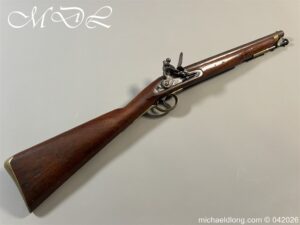
WR Paget 16-Bore Tower Flintlock Cavalry Carbine. Paget 16-Bore Flintlock Cavalry Carbine, the barrel with brass fore-sight, stamped with Tower proofs and crowned M inspection mark, plain tang with inspection mark, flat engraved lock with WR crowned, figured full stock stamped with Board of Ordnance ownership mark on one side of the butt, initial P under the saddle ring, two inspection marks behind the tang of the trigger guard, and with regulation brass mounts, saddle-bar and ring, and stirrup ramrod. UK shipping Free “ Rest of the World at cost
  • Nation : Unknown
  • Local Price : £3,850.00
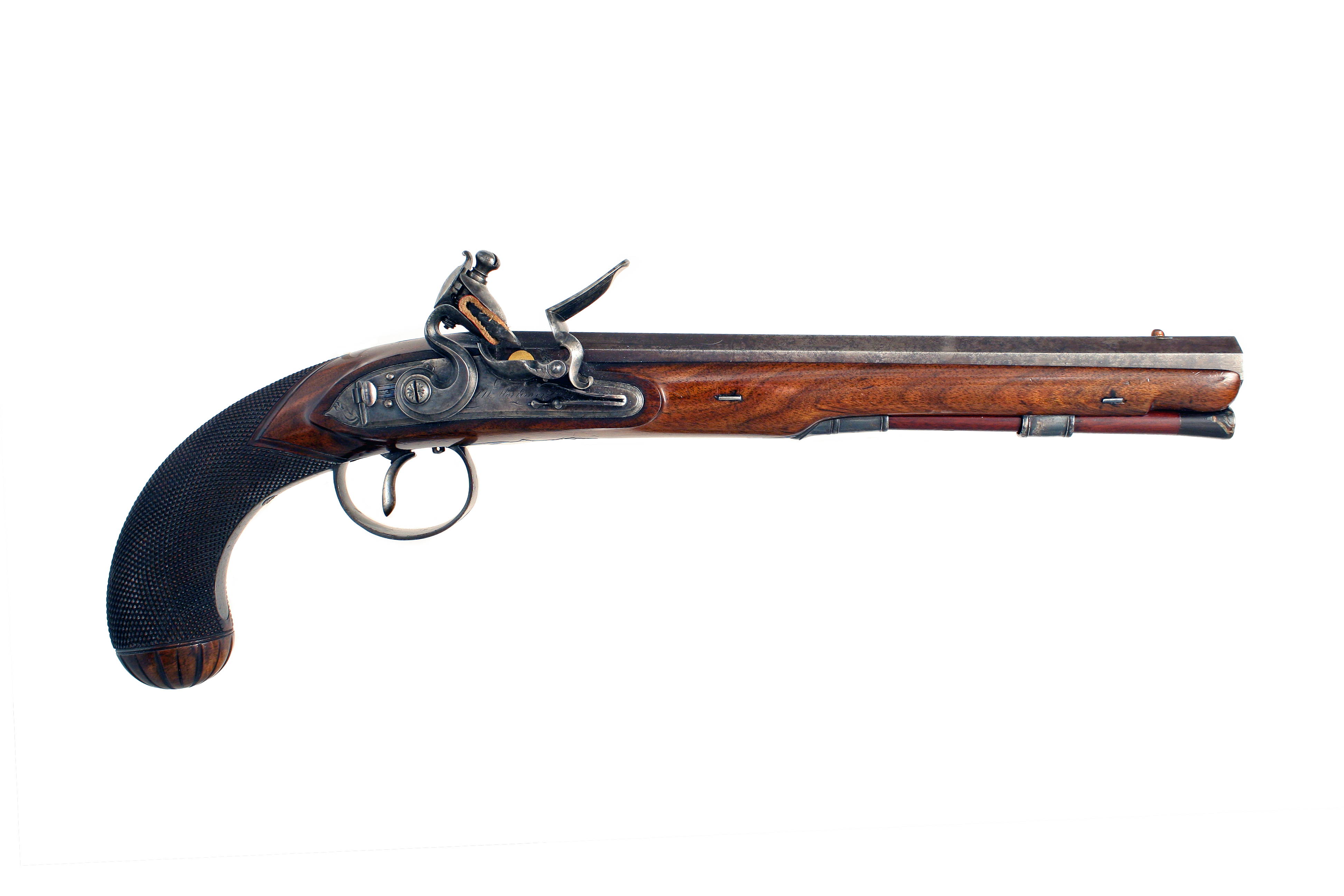
A Good Flintlock Duelling Pistol by H.W. Mortimer.. A Good Flintlock Duelling Pistol by H.W. Mortimer. With swamped sighted octagonal barrel, signed ‘H.W.MORTIMER. LONDON GUNMAKER TO HIS MAJESTY’ decorated with a geometric band at the breech and gold touch-hole, beautifully engraved tang fitted with rear-sight, border engraved lock, signed beneath the pan and fitted with a sliding safety catch, full-stocked in walnut, cut with crisp chequering at the grip and with characteristic Mortimer butt, original horn-tipped rammer. In good clean order overall. MORTIMER Harvey Walklate Son of Samuel Mortimer, born 1753. Apprenticed to father, 1772; free of Farriers Co., 1782; elected Assistant, 1807. Gunmaker, at Mr Greens ironmonger, 6 Kings Street., Lincolns Inn Fields, 1779; 89 Fleet Street., 1782-99. Appointed Gunmaker to George III, 1783. Contractor to East India Co., 1796-1806. Specialised in repeating pistols and gold mounted guns for the Eastern market. Advertised For the Inspection of the Curious, just finished, Three pair of Elegant Pistols, mounted in solid gold value 547 intended as a present to a foreign Prince, 1784 (Morning Herald, 20 August). Registered mark as small worker at Goldsmiths Hall, 1798. Made gold-mounted firearms set with diamonds for the U.S. Government as present for Bey of Tunis, 1801-2. Member of Law Association Volunteers, provided their muskets, 1803. His own musket in Inns of Court Museum, London. Became H. W. Mortimer, Son & T. Mortimer. Retired, 1811. Died 1819. Howard L. Blackmore (1986) Gunmakers Of London, 1350-1850. George Shumway Publisher. Dimensions: Bore: 25 Bore Barrel Length: 10 Inches (25.40 cm) Overall Length: 15 Inches (38.10 cm)
  • Nation : Italian
  • Local Price : £3,850.00
Venetian Schiavona c 1760. Venetian Schiavona c 1760 super quality with tapering blade struck with a series of small marks within and about the four short narrow fullers on both sides at the forte, the two lower fuller extending to the point. The signed iron basket-guard of characteristic type incorporating thumb-ring and forward-swept rear quillon, brass shield-shaped pommel decorated on both sides with a demon mask cast in relief, and the grip with leather binding. Overall length 108cm the blade 92cm NOtes: These letters are Croatian Cyrillic, used up to the end of XVIIIc and read Grgur (Gregory). It is a very common marking on late XVIIIc. schiavona hilts. You may find a longer version of this inscription: “Grgur majstor” – meaning Gregory artisan – indicating local hilt production in Dalmatia. Gregory is believed to be a local Dalmatian artisan/hiltmaker. So the blades would be imported from a variety of sources and then probably hilted locally according to taste. Stemming from the 16th-century sword of the Balkan mercenaries who formed the bodyguard of the Doge of Venice, the name came from the fact that the Doge&#acute;s guard consisted largely of Schiavoni, Istrian and Dalmatian Slavs. The schiavona became popular among the armies of those who traded with Italy and was the weapon of choice for many heavy cavalry. It was popular among mercenary soldiers and wealthy civilians alike; examples decorated with gilding and precious stones were imported by the upper classes to be worn as a combination of fashion accessory and defensive weapon. Doges of Venice were elected for life by the Venetian nobility. The doge was neither a duke in the modern sense, nor the equivalent of a hereditary duke. The title “doge” was the title of the senior-most elected official of Venice.
  • Nation : British
  • Local Price : £3.850
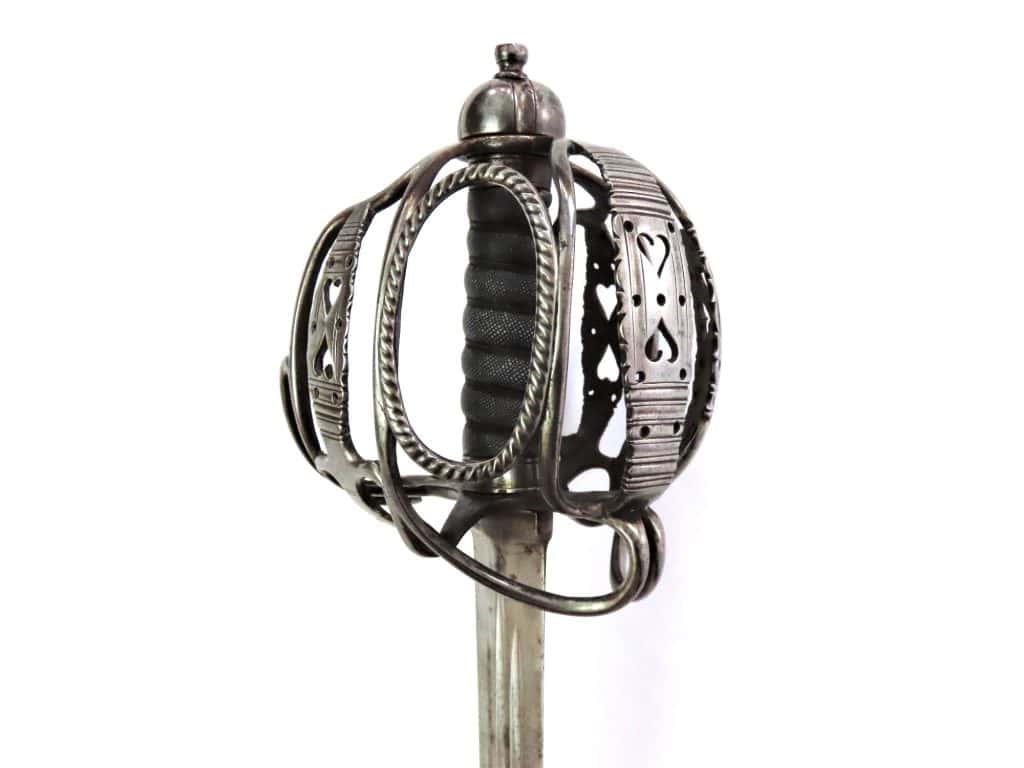
British Basket Hilted Cavalry Sword Circa 1775 to 1780 and the American Revolutionary War Period. An outstanding example of a horseman's basket hilted broad sword made for an Officer in a North British / Scottish Regiment of Dragoons in the American Revolutionary War period. These swords were issued by the Board of Ordnance to British regiments mainly with Scottish associations and were manufactured in the traditional Scottish style. The sword is in exceptional  condition. Swords of this military type were first issued towards the second quarter of the 18th century to officers and men and were used throughout the periods of the Jacobite Rebellion of 1745, Britain's wars in Europe and the American Revolutionary War. They went out of use towards the end of the century when different more tightly defined regulation patterns started to appear. Subtle differences in the features of the hilt indicate that this sword is late in the production period and represents the last phase of its type. It is a rare survivor. The fully formed basket is pierced with hearts and circles in the main front and side panel guards which are also finely fretted at the edges with chevrons and merlons. One of the usual primary frontal guard plates has been replaced in this  hilt design with an oval ring in the “horseman” fashion.  The hilt is decorated with patterns of incised lines and grooves more profusely than is usual and the oval ring is grooved in a gadrooned manner which is unique for this sword type. These embellishments indicate that the sword is an Officer’s weapon produced in Birmingham probably at one of the factories owned by Samuel Harvey for a specific regiment as part of the expansion in arms production needed to supply the British Army in North America. The arms of the guard are forged onto a circle of iron into which the base of the bun shaped pommel sits. The pronounced button is central to the pommel dome and of separate manufacture. Four grooves radiate from it flanked by narrow incised lines. The original spirally grooved grip is of hardwood and retains its shagreen cover, twisted wire binding and grooved iron ferrules top and bottom. The tapering double edged blade is of fine quality.  It has a short ricasso after which a triple fuller commences and extends to a distance 7.5 inches (19 cm) from the tip. The middle fuller is slightly longer than those on its flanks. The blade is 32 inches (81.25 cm) long and overall the sword is 38.25 inches (just over 97 cm) long. Overall the sword is in very fine and original condition. The metal parts are very well preserved. The hilt maintains its original profile and is without damage or repairs. For further examples of this sword type, although much plainer and slightly earlier than ours, see Cyril Mazansky, British Basket-Hilted Swords, Boydell Press / Royal Armouries, 2005, plate F1e page 97, for a sword in the National Museums of Scotland, collection reference LA33, and page 125 plate F17c for one in the late Anthony Darling Collection
  • Nation : British
  • Local Price : £3,795.00
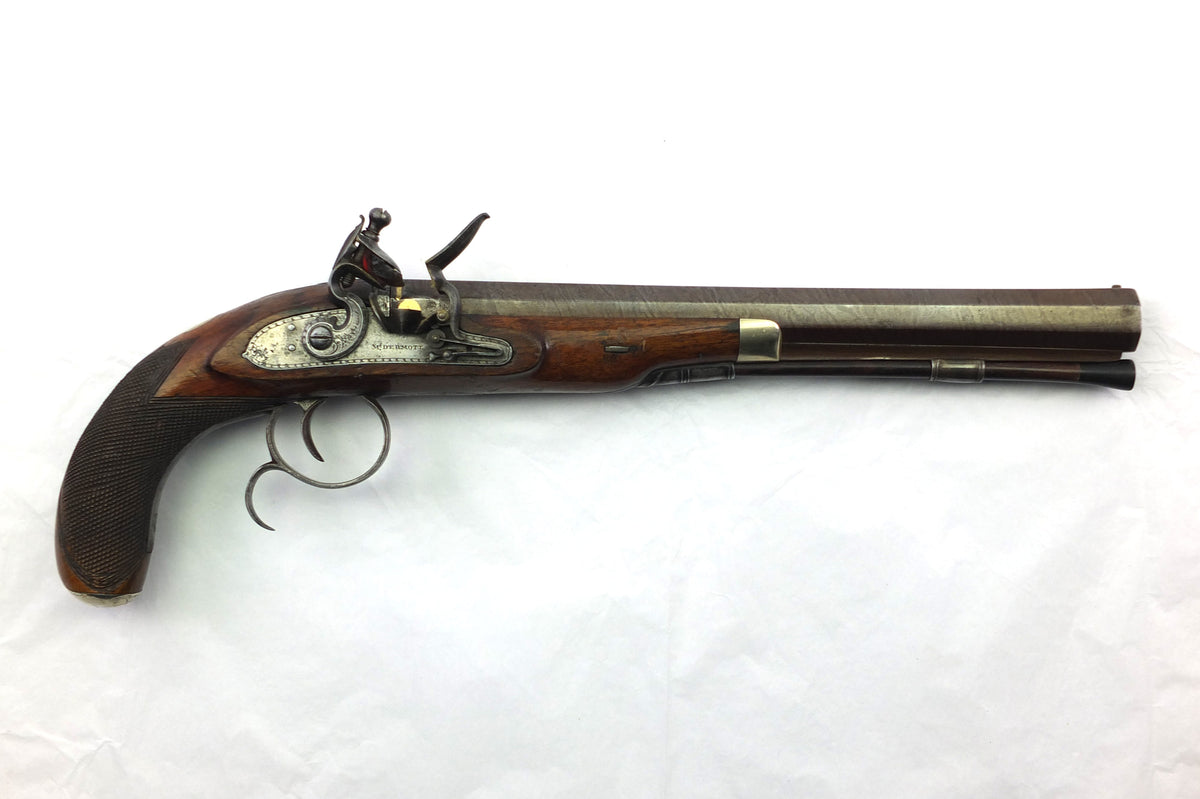
Irish Officers Flintlock Duelling Pistol by McDermott, Fine. Ref X3608. A Fine Irish Officers Flintlock Duelling Pistol by McDermott.&194;&160;17 &194;&188;&157; overall, 11 &194;&190;&157; sighted Damascus musket bore barrel, with gold line at breech, ´McDermott Dublin´ on top flat, the tang decorated with a stand of arms, gold lined touch hole, border wheat ear engraved, lock signed ´McDermott´, fully waterproof pan, swan neck cock. Half stocked with border engraved steel mounts, the spur trigger guard decorated with a stand of arms and pineapple final, silver fore-end, vacant silver escutcheon, the&194;&160;chequered wooden butt with silver butt cap engraved with a harp below a rising sun, horn&194;&160;tipped rammer with a worm. Circa 1810&194;&160; Pistol in good condition, some original finish.&194;&160; &194;&160;&194;&160; Rising Sun above a Irish Harp may be a badge of The United Irishmen. Farrell McDermott St Mary’s Abbey 1795 "e; 1796, 2 Abbey Street 1797 "e; 1810,&194;&160;1 Abbey Street&194;&160;1811 "e; 1827.&194;&160;&194;&160;&194;&160;&194;&160;&194;&160;&194;&160;&194;&160;&194;&160; &194;&160; &194;&160; &194;&160; &194;&160; &194;&160; &194;&160; &194;&160; &194;&160; &194;&160; &194;&160; &194;&160; &194;&160; &194;&160;&194;&160; &194;&160; &194;&160; &194;&160; &194;&160; &194;&160; &194;&160; &194;&160; &194;&160; &194;&160; &194;&160; &194;&160;&194;&160; Images courtesy of West Street Antiques (https://antiquearmsandarmour.com/)
Page 10 of 124