
Show

Forgot your password?

Error message here!

Error message here!

Error message here!

Error message here!

Show Error message here!

Show Error message here!

Lost your password? Please enter your email address. You will receive a link to create a new password.

Error message here!

Back to log-in

Close

For Sale

The following items are listed by for sale by users of the site and dealers. They are in no way endorsed or guaranteed by www.antiquearmsresearch.com

Add a Classified Item
to

Clicking on the sword will take you through to the relevant classified item or dealer site.
Don't miss out! - Do you want to be kept informed weekly of new aditions? Just join our weekly update list.

You can also receive regular email notifcations when items match your keywords. To recieve them just register or logon at the top right of this page.

Page 101 of 118
  • Nation : French
  • Local Price : £360.00
19th Century Cavalry Sabre in the French M1822 Style, Probably German-made for the US Market. Curved blade with one broad & one narrow fuller and hatchet point. Brown leather washer, brass three-bar hilt, ribbed wood grip covered with wire-bound black leather, brass pommel with oval pommel cap and tang button. Steel scabbard with two hanging rings. Blade 35¼ inches in length, the sword 41 inches overall. The knucklebow is stamped near the pommel with the serial or rack number ‘94’. A few loops missing of the wire binding at the pommel end. The leather of the grip has some handling wear, exposing the wood core on some of the raised ribs. One short crack and a chip to the leather at the hilt end.
  • Nation : British
  • Local Price : £360.00
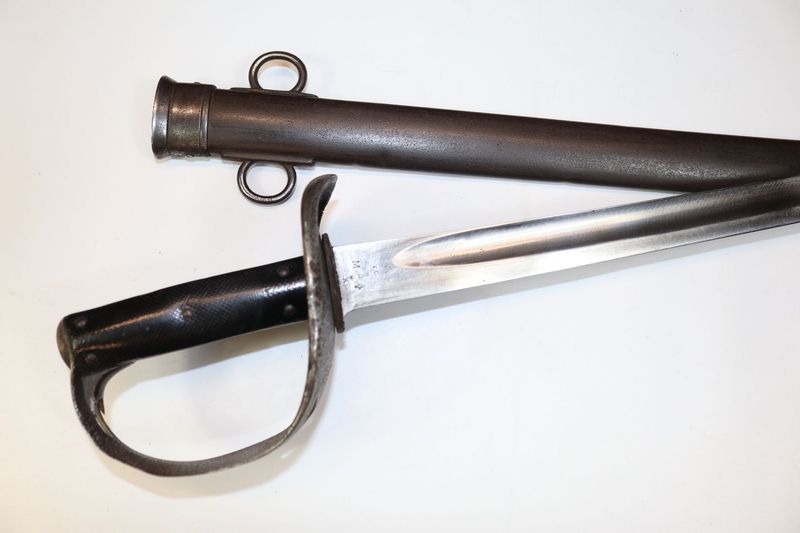
Victorian 1885 Pattern Cavalry Sword by WKC. EL7321 - A good 1885 pattern cavalry sword made by WKC in Solingen in 1887 and with numerous stamps which tell the story of its subsequent service life. Complete in scabbard, which carries a lot of dents from stirrups and steps!
  • Nation : British
  • Local Price : £355.00
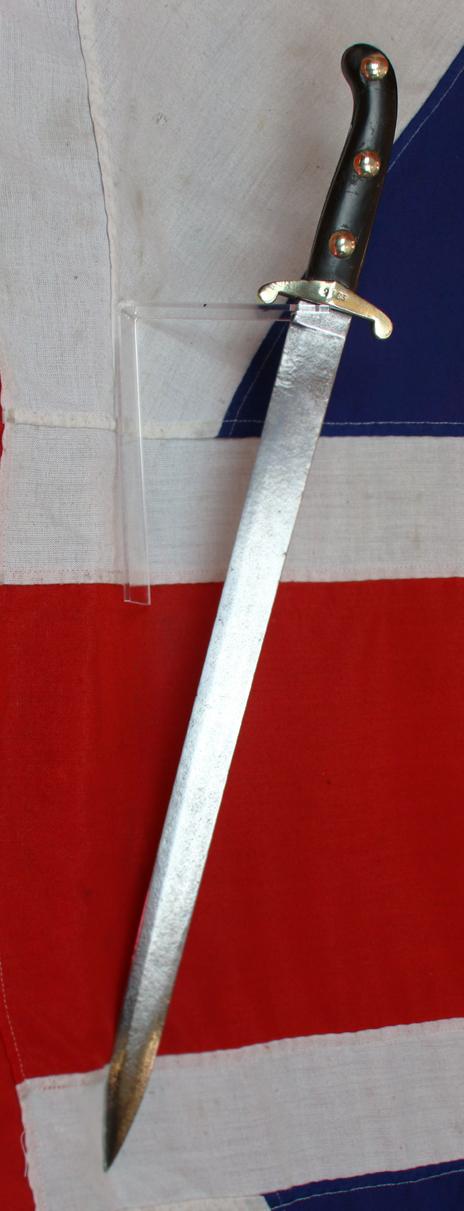
A Most Scarce Original Antique Sharpshooter's Sword Used By Swiss Mercenaries In the 1849 Italian Revolution. Made by F Horster of Solingen. Wooden grip with brass rivets. Single edged blade made by Horster of Solingen. Carried by the Swiss Infantry sharpshooters, snipers. Used by of the swiss regimental sharpshooter mercenaries that fought for the King in the revolution in Italy in 1848. A Swiss regiment that fought in the streets of Naples for Ferdinand II, King of the two Kingdoms of Sicily, during the uprising of 15 May 1848. Between 1856 and 1860, around 1,200 Swiss mercenaries from the Swiss regiments in Naples continued their military careers in the Dutch colonial army. The Revolution which began in Palermo was one of a series of such events in Italy, though perhaps more violent than others. It quickly spread across the island and throughout Italy, where it prompted Charles Albert, King of Sardinia, to follow the example of Ferdinand II and issue a written constitution, the Albertine Statute {the Albertine Statute later became the constitution of the unified Kingdom of Italy and remained in force, with changes, until 1948}. In imitation of these events, riots and revolutions followed around Europe at the same time, and may be considered a taste of the socialist revolts to come. King Ferdinand II of the Two Sicilies By the recapture of Sicily in May 1849, the battle was said to be practically over. Filangieri, however, dared not let his troops enter the set of alleys that then made up the historic center of Messina: although the regular Sicilian forces had been exterminated or forced to flee, the bombardment of the Bourbons continued on the defenseless city, that is, on the part that had not yet been occupied by the regi, for another seven hours. The soldiers of the Bourbon army gave themselves up to the looting and violence against the inhabitants. Homes of foreigners living in Messina were also looted and destroyed, so much so that the English consul Barker reported the incident to his government writing that many English subjects living there were reduced to ruin and that even a diplomat, the consul of Greece and Bavaria M. G.M. Rillian, despite being in uniform, had been wounded by sabre, before his dwelling was also looted and burned down. The Bourbon troops did not spare even the religious buildings from looting. For example, the church of San Domenico, rich in works of art, was first looted of its sacred objects, then burned down and totally destroyed. Loss of life was incalculable. A Bourbon official wrote to his brother, immediately after the capture of Messina, stating that the Neapolitan departments had recaptured the city with a very intense fire and "trampling corpses in every step that progressed for the space of about two miles" and then commenting "What a horror! What a fire! British Admiral Parker also condemned the work of the Bourbons, and in particular the prolonged terrorist bombardment of the city even after the end of all resistance for eight hours: "The greatest ferocity was shown by the Neapolitans, whose fury was incessant for eight hours, after all resistance had ceased". During the siege of Messina, the last insurgents who resisted the attack of the Bourbons inside a convent, rather than hand themselves over, chose to throw themselves into a well, taking their tricolour flags with them. Messina was also troubled by the work of common criminals sent by King Ferdinand II to Sicily against the insurgents and that after tormenting the Sicilians for months with brigand actions (crimes, violence, thefts, etc.) they gave themselves at the time of the fall of the city to its looting, arriving with small boats from Calabria to make loot. Overall in nice condition, with old traces of pitting throughout the blade , one rivet cap lacking, no scabbard. A very rarely seen sword. Every single item from The Lanes Armoury, Britain's famous, favourite, and oldest original Armoury Antique store, is accompanied by our unique Certificate of Authenticity. Part of our continued dedication to maintain the standards forged by us over the past 100 years of our family’s trading, and thus, it is a lifetime guarantee.
  • Nation : Unknown
  • Local Price : £350.00
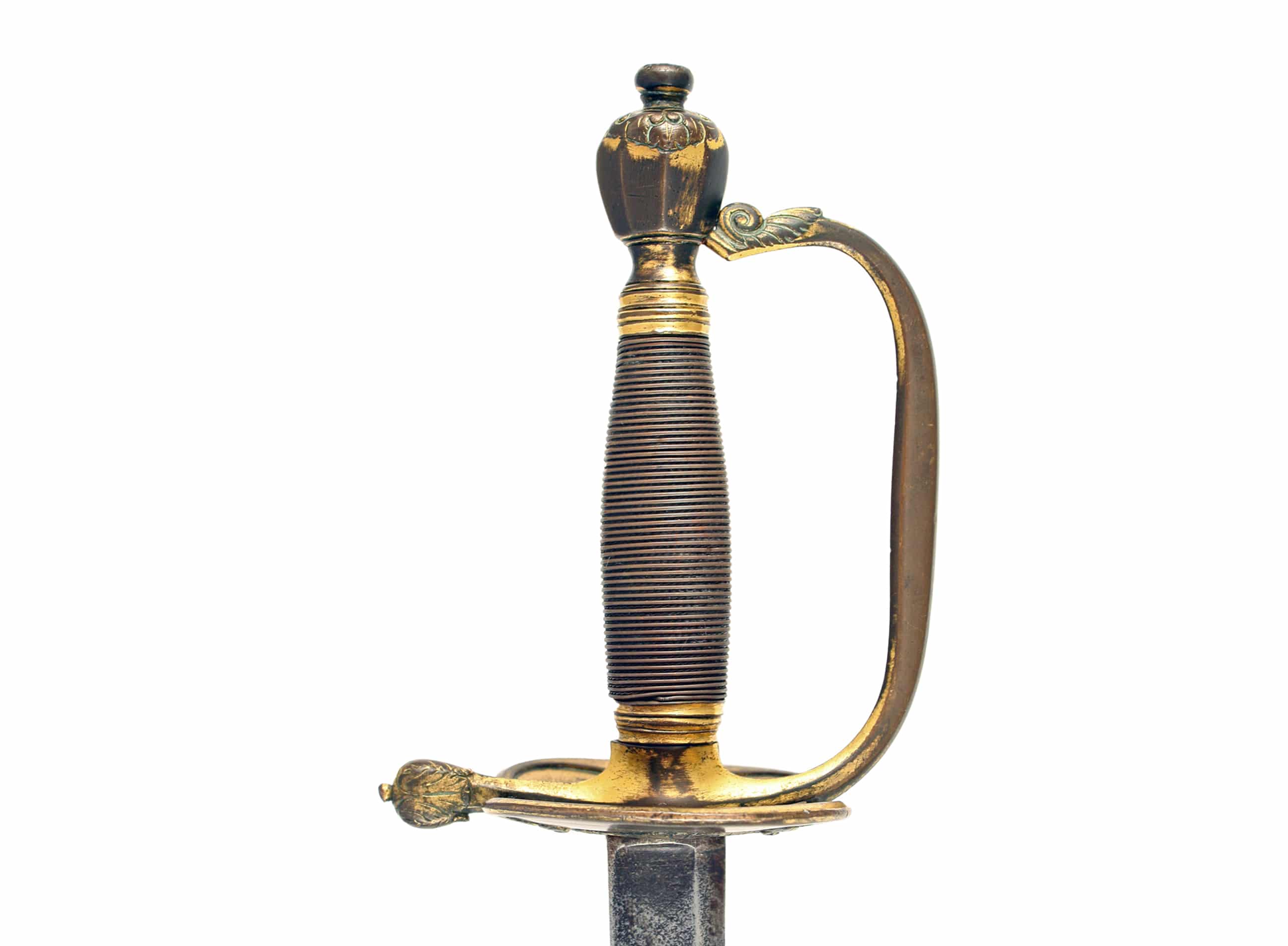
A 1796 Pattern Infantry Officers Sword..
  • Nation : Unknown
  • Local Price : £350.00
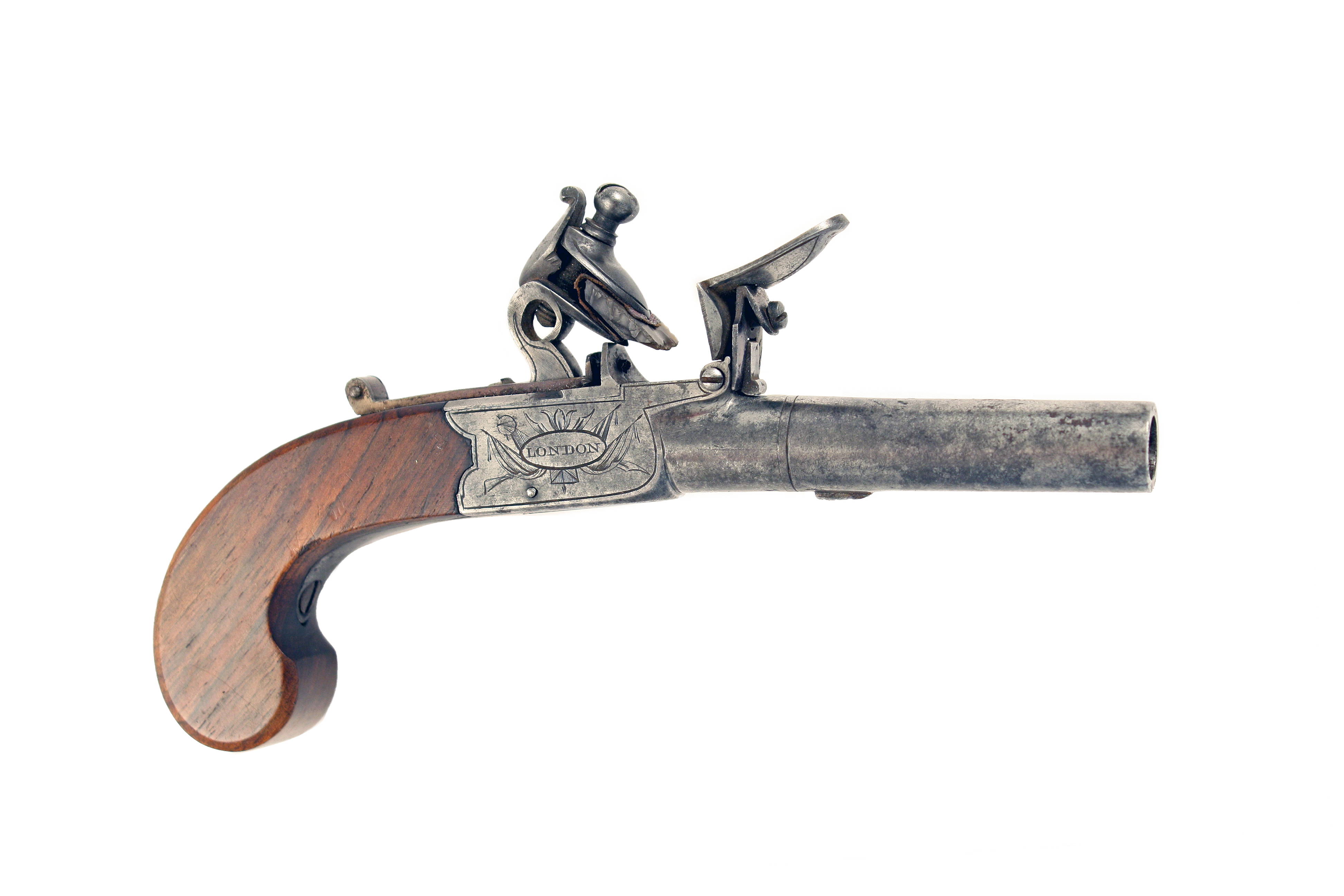
A Crisp Flintlock Pocket Pistol by Tindall & Dutton.
  • Nation : British
  • Local Price : £350.00
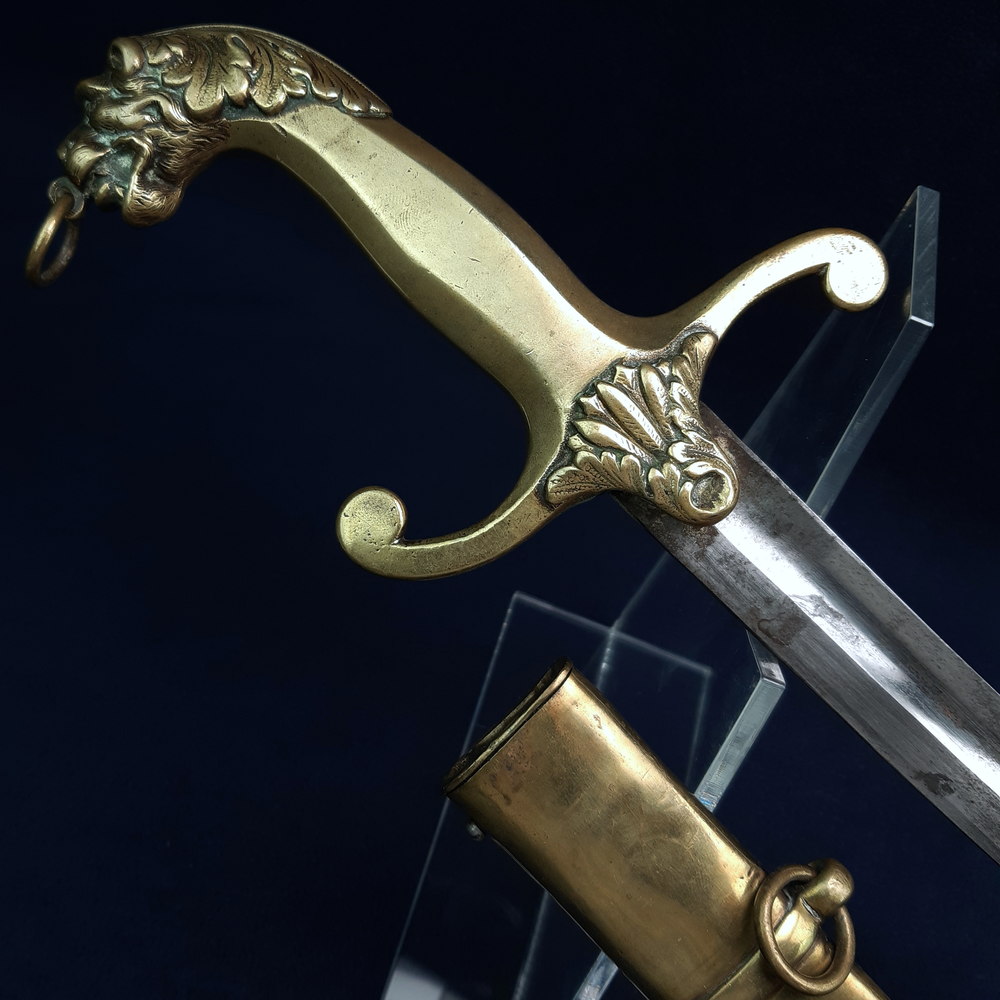
British Bandsman's Sword of the Cambridgeshire Militia, Circa 1833. Curved blade with single fuller and hatchet point, single-piece cast brass mameluke-style hilt featuring a lion’s head pommel with eyelet and ring, a smooth faceted grip, recurved quillons with comma-shaped finials, and langets cast with a mirrored floral motif, perhaps acanthus leaves. Brass scabbard with two hanging rings and two steel screws securing the throat piece. Blade 28¼ inches in length, 1 inch wide at the shoulder, the sword 33½ inches overall. The grip is stamped on one side with ‘68’ over ‘CM’ over ‘19’. This seems to follow the form of a unit mark. Other examples exist which are also marked 68 / CM / [number] including an example I acquired together with this one, available here – that being marked 68 / CM / 5. As the last digit changes but the others do not it seems clear that 68 CM is a unit and the last digits a weapon number. There were a number of British units in the 19 th century which might have used the abbreviation ‘CM’, including the Cambridgeshire Militia, Cardiganshire Militia, Cornwall Militia and Cumberland Militia. However, when lots were drawn by the King for the order of precedence of the militia regiments in 1833 the Cambridgeshire Militia was ranked 68 th . Most militia took little notice of their official numbering but the Cambridgeshires certainly did as ‘68’ was placed on their shako. This numbering coincides nicely with the period of these swords and remained in place until the end of the militia system in 1908. This puts it clearly above the other possibilities and I think we can be reasonably confident therefore that this sword was number 19 issued to the band of the Cambridgeshire Militia some time after 1833. There was no standard pattern for the ornamental swords carried by military bands in the eighteenth and early 19 th centuries. Each regiment was responsible for equipping its band as it saw fit, the expense generally paid for by its officers. Nonetheless bands were often well equipped as regiments took great pride in their music and sought to outdo each other in their pageantry. Composed of a mixture of enlisted men and paid civilian musicians, military bands often performed for the public, becoming a cultural fixture and a useful means of outreach between military and civilians, a tradition which continues to this day. Despite their non-standard procurement there was a common style to the British band sword (with considerable variation): a short, usually curved, mameluke-style sword with brass fittings and a pommel in the form of an animal head, most often a lion. The Royal Armouries collection contains a great number of British bandsman’s swords which the Armouries curators have grouped into types based on the form of their hilts – under their system this sword would be a ‘Type G’. See Royal Armouries item IX.7246 for more discussion of this Type and bandsman’s swords generally (also IX.1067, although this is a variant with a hilt made of steel rather than brass). Dating bandsman’s swords can be tricky, but as noted this example’s unit mark means it must date from after 1833. The first standardized Pattern of band sword was introduced in 1856, which would have prompted the decline of non-standard types, and the Royal Armouries date their examples of this type between 1800-1860, so 1833-c1860 seems a reasonable date range for this piece. For more examples of the ‘Type G’ see Robson’s Swords of the British Army , Revised Edition, page 259 (item 225), which he dates to circa 1820, or Withers’s British Military Swords page 78, or Wilkinson-Latham’s British Cut & Thrust Weapons , page 43. The blade is sharp with its edge and tip undamaged. Its surface is bright with quite a high polish, some areas of frosting, one patch of cleaned light pitting and a few small spots of moderate patination as well as polishing and grinding marks. The brass hilt, grip and pommel have light patination and a little verdigris in recesses, the grip has some small scrapes on the side with the unit mark. The brass scabbard has an even light patina with a number of small dents, particularly along the leading edge, none of which interfere with sheathing and drawing. Some scuffing and light scratching to the scabbard, particularly in the lower section. One of the steel screws securing the throat piece has been lost. The end section of the scabbard’s shoe has been lost leaving it open (pictured).
  • Nation : German
  • Local Price : £250.00
German WW2 Army NCO’s Sword ‘Extrasäbel’ by Paul Seilheimer, Solingen. Curved, narrow single-fullered blade with spear point. P-shaped single bar hilt with quillon, shield-shaped langets, steel backstrap with riveted ears. Grip of ribbed black plastic bound with gilt wire. Brown leather washer. Steel scabbard painted black, with single fixed hanging ring and frog loop. The blade is stamped on one side with a mark of a P-hilt sabre vertically impaling a triangle that contains the word ‘SOLINGEN’. The sword’s hilt lies between the letters ‘P’ and ‘S’. This is the maker’s mark of Paul Seilheimer of Solingen. Established in 1917, the firm of Paul Seilheimer was one of many based in the city of Solingen, Germany. It manufactured swords and bayonets as well as kitchen cutlery. It was an approved government manufacturer of swords and daggers for various military and political organisations throughout WW2, although examples are relatively scarce so this may not have been at a large scale. The company ceased trading in 1970. ‘Extrasäbel’, or ‘specialty sabres’ were privately purchased from a number of retailers by German soldiers and NCOs, and were not an official pattern, although they were very similar to the Army officer’s sword. They were carried for show, ceremonial use, or as a dress sword. Not being fighting swords, the buyers often chose to ornament the blades, which could include plating, etching, bluing etc. This model is visible in product catalogues of the period produced by Waffenfabrik Paul Seilheimer, where it is listed as ‘Mannschafts-Extrasäbel’ – Mannschaft meaning ‘enlisted personnel’ which were distinct from officers (Offizier). All metal pieces of the sword itself have been nickel plated, with some light speckled wear to the plating overall, including the blade. The wire binding of the grip is all intact and tight, some fractional movement to the hilt and grip. The scabbard is free of dents and retains almost all its original paint with only a few small chips.
  • Nation : British
  • Local Price : £250.00 GBP
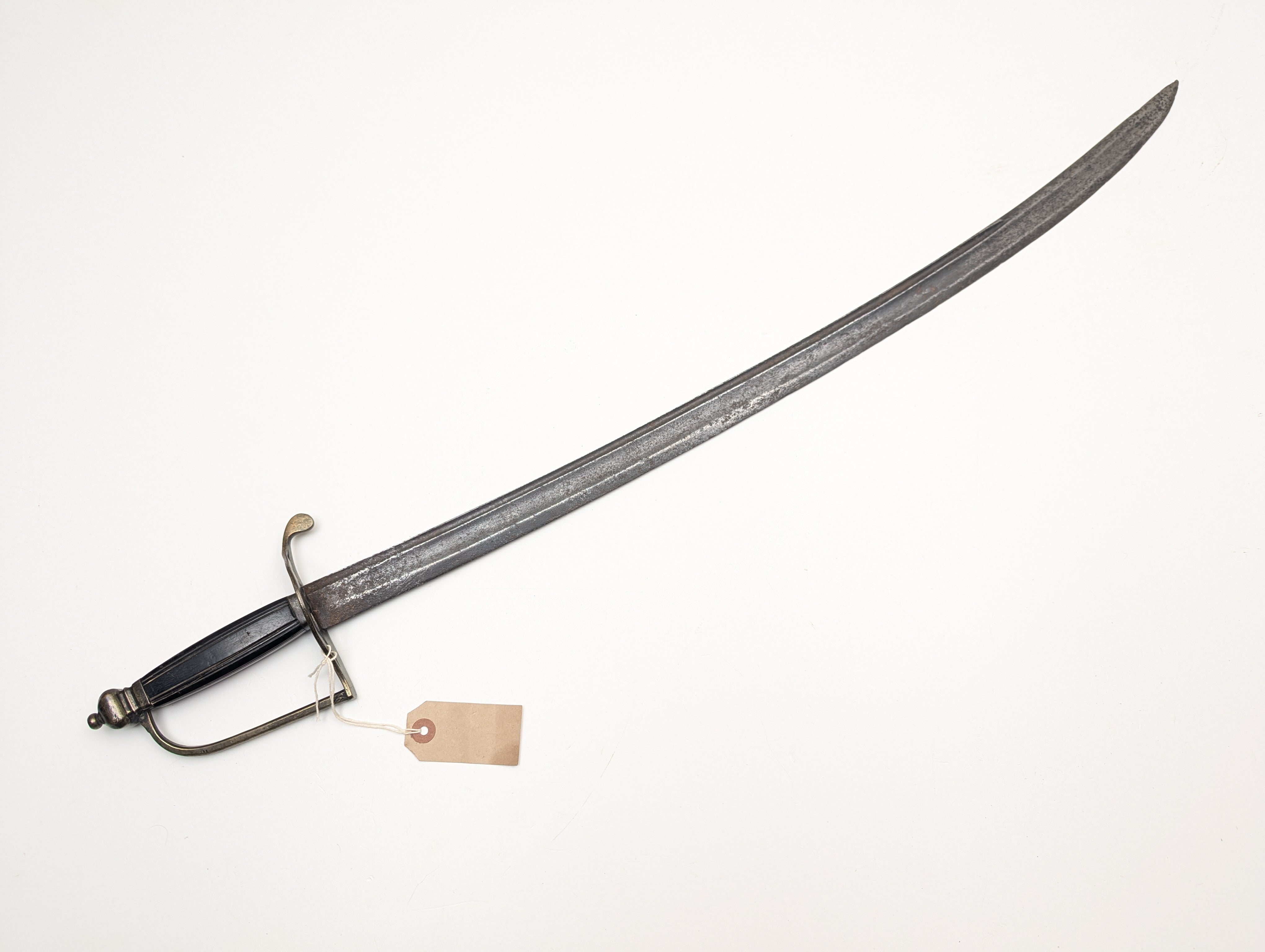
Georgian Pre-Regulation Sword (1780s). Georgian Pre-Regulation Hanger (1780s). The area that meets the diamond shape to the guard is not attached."
Page 101 of 118