
Show

Forgot your password?

Error message here!

Error message here!

Error message here!

Error message here!

Show Error message here!

Show Error message here!

Lost your password? Please enter your email address. You will receive a link to create a new password.

Error message here!

Back to log-in

Close

For Sale

The following items are listed by for sale by users of the site and dealers. They are in no way endorsed or guaranteed by www.antiquearmsresearch.com

Add a Classified Item
to

Clicking on the sword will take you through to the relevant classified item or dealer site.
Don't miss out! - Do you want to be kept informed weekly of new aditions? Just join our weekly update list.

You can also receive regular email notifcations when items match your keywords. To recieve them just register or logon at the top right of this page.
Page 102 of 120
  • Nation : American
  • Local Price : 335.00 USD
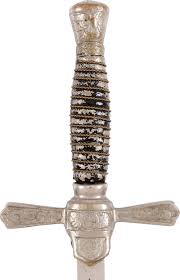
US MILITIA NCO SWORD C.1870-80. Indian Wars Period C.1870-80. Two piece plated brass hilt. The pommel of 1860s regulation form integral with the black japanned spirally fluted grip. Brass wire wrap. Decorated “bow tie” form guard. 28 1/2” d.e blade, plated, unmarked and excellent. Hilt plating worn through on the pommel high spots. The black grip coating mostly flaked off. Classic post-Civil War example as served the Westward Expansion.
  • Nation : British
  • Local Price : £330.00
British 1899 Pattern Cavalry Trooper’s Sword, 1st King’s Dragoon Guards. Curved single-fullered sabre blade, Steel bowl guard with turned-over inside edge. No washer. Black pressed leather grips secured to the exposed full-width tang with three large rivets, steel pommel. No scabbard. Blade ~33¼ inches (85.6cm) in length, the sword ~40 inches (101.7) overall. The ricasso of the blade is stamped on one side with a broad arrow War Department mark, ‘EFD’ indicating manufactured at the Royal Small Arms Factory at Enfield, a crown inspection stamp with ‘E’ for Enfield and an ‘X’ indicating the blade passed a manufacturer’s bending test. It is stamped on the other side with reissue dates of ’02, ’03 and ’06 and two further Enfield crown inspection stamps. The spine of the blade is stamped with ‘/99’, its pattern, and another Enfield crown inspection mark. The exposed tang is stamped near the hilt with the letters ‘G’ and ‘X’. The outside of the guard is stamped with another broad arrow, ‘EFD’ and crown inspection stamp with ‘E’. The inside of the guard is stamped with the issue date ‘9 06’ for September 1906 above the unit mark ‘1 DG’, indicating the 1 st King’s Dragoon Guards and the serial number ‘413’. The ‘D’ has been double stamped creating an overlap. The 1899 Pattern cavalry trooper’s sword was introduced on the 19 th October 1899, eight days after the Second Boer War broke out. It was intended to be a refinement on the 1890 Pattern, with a slightly shorter blade, greater protection for the hand and a longer grip. Users generally considered it on the heavy side and much more effective in the thrust than the cut: this cemented the growing consensus that cavalry swords should be built entirely for thrusting. The 1899 Pattern was carried during the Boer War, in which the 1 st King’s Dragoon Guards served from January 1901. Immediately upon their arrival they were drafted into a brigade under Colonel Bethune which drove General De Wet’s forces out of the Cape Colony. They then operated in the Orange River Colony until the end of the war in 1902. The dates on this example suggest that it was in use with someone as of 1902, and the brown finish found in places on the hilt might well be field camouflage, but the 1906 date next to the unit mark suggests to me that it was not issued to the KDG until then, so its war service is uncertain. The blade has speckled patination with some patches of light pitting, increasing towards the tip. The edge has previously been sharpened with numerous nicks. The tip is rounded. The outside of the hilt has some denting, a few scratches, cleaned pitting and spots of dark patination. There is a noticeable red-brown finish present on most of the inside of the hilt (except near the lip where the unit mark is placed), parts of the exposed tang, and on small areas of the outside of the hilt, including around the sword knot slit and near the turned-over inner guard – in both cases these are recesses where there would be less friction and polishing would be difficult. This finish may be chemical browning, it does not appear to be paint. Cavalry swords in the Boer War were routinely camouflaged due to the well-known marksmanship of the Boers. The leather grips have light handling wear, a few small dents and abrasions.
  • Nation : German
  • Local Price : £325.00
Italian M1860 Cavalry Trooper’s Sword. Curved, single-fullered spear-pointed blade. Black leather grip bound with brass wire. Steel hilt with turned over inner edge, large pierced teardrop-shaped hole to form two ‘bars’, and angled rectangular slot for sword knot. Stepped cylindrical steel pommel cap. Steel scabbard with two hanging rings. The ricasso of the blade is marked on one side with ‘S&K’, the maker’s mark of Schnitzler & Kirschbaum of Solingen, one of the German firms which manufactured these swords on behalf of the Italian government. The hilt is stamped with the serial number ‘156’. The blade's edge is unsharpened but there are a few very small dents and edge imperfections, with one noticeable chip/roll where the fuller ends. A couple of small dents to the edge of the guard. Some patina to the scabbard, light pitting at the chape end, one noticeable dent to the lower section and one very small dent at the chape.
  • Nation : German
  • Local Price : £325.00
Bavarian Circa 1810 Infantry Trooper’s Sword. Single-edged hanger blade with narrow fuller running close to the spine and hatchet point. Brass hilt with round forward quillon and plain knucklebow, smooth brass backstrap with tang button, ribbed grip of black leather over wood. Black leather washer. No scabbard. Blade ~23½ inches in length (59.4cm), the sword 28¼ inches (71.8cm) overall. The blade is engraved on both sides with the crown and cypher of Maximilian I Joseph, first King of Bavaria, who reigned from 1806 to 1825. The blade is sharp with a number of nicks and chips to its edge in the upper portion. Scattered spots of cleaned pitting to the blade, more significant patches at the shoulder and near the tip. Some rounding wear to the tip sharpening marks, also polishing marks to the faces. The leather washer has some losses on one side. The grip is all intact with no losses. The brass hilt and backstrap have a few small dents and an even midtone patina.
  • Nation : Indian
  • Local Price : £325.00
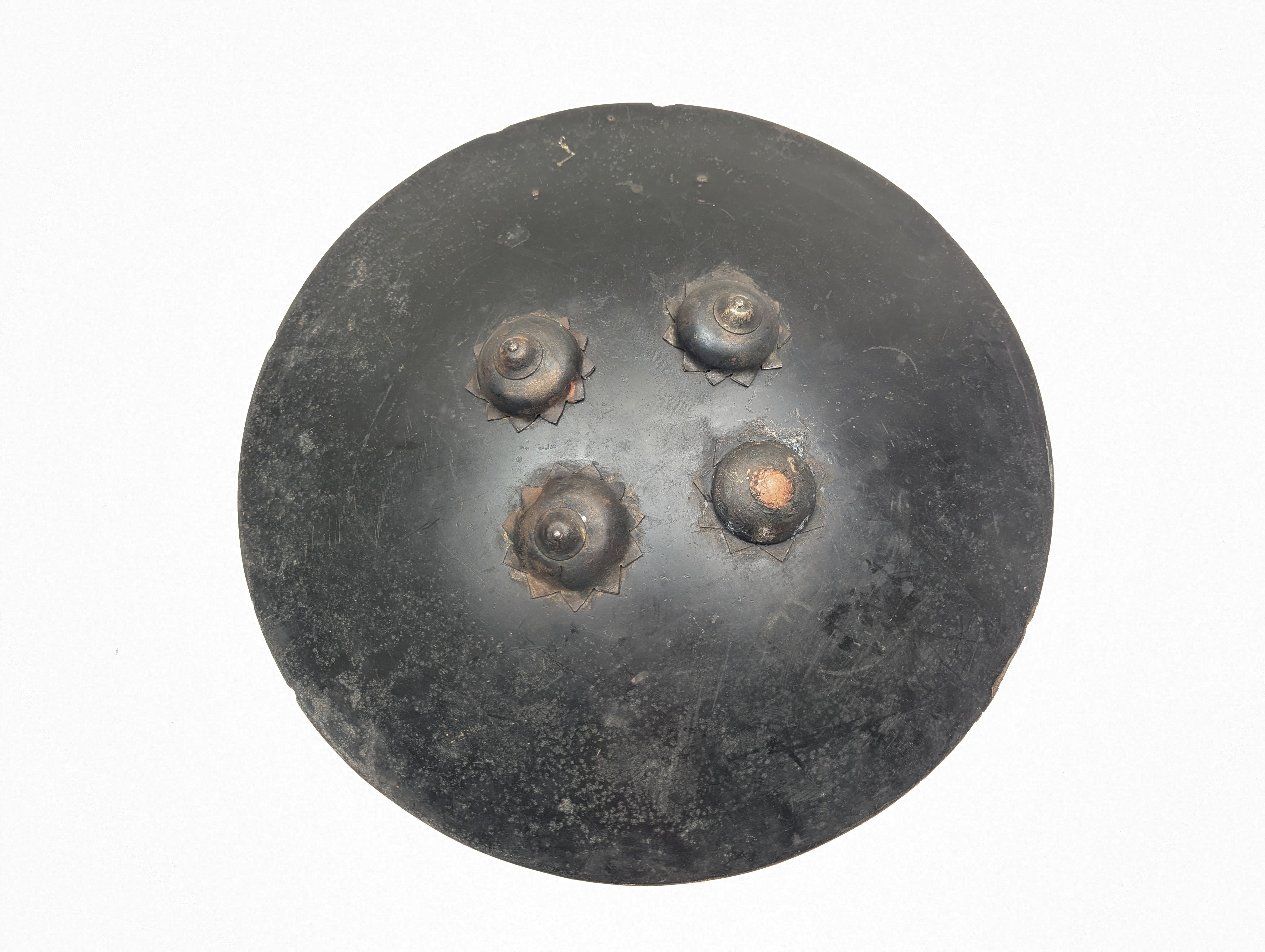
Large Indian Dhal Shield. Origin: India, Culture: Indian, Period: 19th Century. An Indian dhal hide shield of large proportions. Diameter: 65 cm.
  • Nation : Unknown
  • Local Price : £320.00
An Antique, 19th Century Long & Straight Sword of A Mandinka Warrior, West African, Very Long Fluted Broadsword Blade With Leather Covered Baluster Hilt, .. In some areas they are referred to locally as termed a 'kota' and in the scabbard was termed 'kotaholga' ( house 'for the sword') The Mandinka are the descendants of the Mali Empire, which rose to power in the 13th century under the rule of king Sundiata Keita, who founded an empire that would go on to span a large part of West Africa. They migrated west from the Niger River in search of better agricultural lands and more opportunities for conquest. Nowadays, the Mandinka inhabit the West Sudanian savanna region extending from The Gambia and the Casamance region in Senegal to Ivory Coast. Although widespread, the Mandinka constitute the largest ethnic group only in the countries of Mali, Guinea and The Gambia. Most Mandinka live in family-related compounds in traditional rural villages. Their traditional society has featured socially stratified castes.Mandinka communities have been fairly autonomous and self-ruled, being led by a chief and group of elders. Mandinka has been an oral society, where mythologies, history and knowledge are verbally transmitted from one generation to the next. Their music and literary traditions are preserved by a caste of griots, known locally as jelis, as well as guilds and brotherhoods like the donso (hunters). Between the 16th and 19th centuries, many Muslim and non-Muslim Mandinka people, along with numerous other African ethnic groups, were captured, enslaved and shipped to the Americas. They intermixed with slaves and workers of other ethnicities, creating a Creole culture. The Mandinka people significantly influenced the African heritage of descended peoples now found in Brazil, the Southern United States and, to a lesser extent, the Caribbean. This high-status sword from The Gambia demonstrates the widespread African practice of importing European sword blades and supplying them with a hilt and scabbard of local style. The blades of such Mandinka dress swords are usually reflecting the economic networks of European colonial influence. These swords were the exclusive prerogative of Mandinka men of importance or social standing and were intended to enhance their impressive and martial appearance. Photos in the gallery of 19th century Sudanese warriors but carrying very similar swords with cruciform broadsword blades like this one and the paddle ended scabbards
  • Nation : British
  • Local Price : £320.00
British Circa 1820 India Pattern Brown Bess Socket Bayonet with India Spring. Triangular blade with unfullered top surface and fullered lower surfaces. A roughly rectangular leaf spring is attached to the outer surface of the socket, retained by a single screw. Wood-lined black leather scabbard with brass locket and chape piece. The blade is stamped with the maker’s mark ‘S HILL’, indicating the manufacturer Stephen Hill, who traded from Pritchett Street in Birmingham from around 1830, then changed the trade name to S. Hill & Sons from 1849-1855, an inspection mark ‘D 4’, and the letter ‘F’ at the very base of the blade. The blade markings are partly worn: Indian socket bayonets were repolished often to keep them bright, which often resulted in the loss of detail to the markings. The rear rim of the socket is stamped with ‘6’ and four incised lines. The leather at the throat end is stamped with decorative criss-crossing lines. The ‘Indian Spring’ was reputedly designed by Ezekiel Baker, the same gunsmith who created the famous Baker Rifle, to improve the fastening of the socket bayonet to the India Pattern Brown Bess musket. This is the later version of the spring introduced around 1820 with an almost rectangular shape, still doing the same job of preventing the bayonet from shifting position once it had been fixed to the rifle, but stronger than the early type, which was more triangular. The bayonet is clean overall with only small areas of patina and some very light pitting near the tip of the blade. The brass chape piece and a small amount of leather have become detached from the rest of the scabbard. The detached chape piece has several dents, the throat piece has one very small one to its rim. The leather of the scabbard is quite worn in places, with rubbing to raised edges and surface cracking.
  • Nation : US
  • Local Price : £320.00
US Navy Model 1870 Yataghan Bayonet. Yataghan blade, brass hilt with muzzle ring and lobe quillon, brass grip with ‘feathered’ or ‘fishscale’ texture, beaked pommel with motif of crossed cannon barrels over an anchor. Unusual hilt design with high leaf spring locking catch and lower hole to accommodate the cleaning rod of the 1870 rifle. Black leather scabbard with brass locket and chape, with frog stud. Blade is unmarked. Hilt is marked with ‘S’. The back of the grip is stamped with ‘GGS’ and the pommel end with ‘J.G.B’. The US 1870 Navy rifle was a Springfield made rolling block type – the bayonets for it are thought to have all been made by the Ames Manufacturing Company of Chicopee, Massachusetts. Two versions are known to exist, this version with the yataghan blade and a straight-bladed version. Blade has some pitting, brass hilt has some very small dings and patina as expected for age. Scabbard is very good, only minor rubbing to the leather, no structural damage. Some small dents to the chape piece.
Page 102 of 120