
Show

Forgot your password?

Error message here!

Error message here!

Error message here!

Error message here!

Show Error message here!

Show Error message here!

Lost your password? Please enter your email address. You will receive a link to create a new password.

Error message here!

Back to log-in

Close

For Sale

The following items are listed by for sale by users of the site and dealers. They are in no way endorsed or guaranteed by www.antiquearmsresearch.com

Add a Classified Item
to

Clicking on the sword will take you through to the relevant classified item or dealer site.
Don't miss out! - Do you want to be kept informed weekly of new aditions? Just join our weekly update list.

You can also receive regular email notifcations when items match your keywords. To recieve them just register or logon at the top right of this page.
Page 105 of 118
  • Nation : British
  • Local Price : £310.00
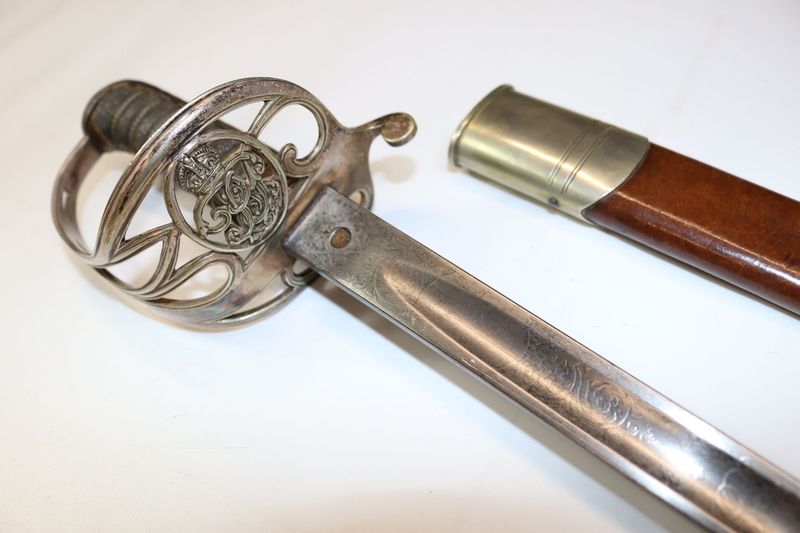
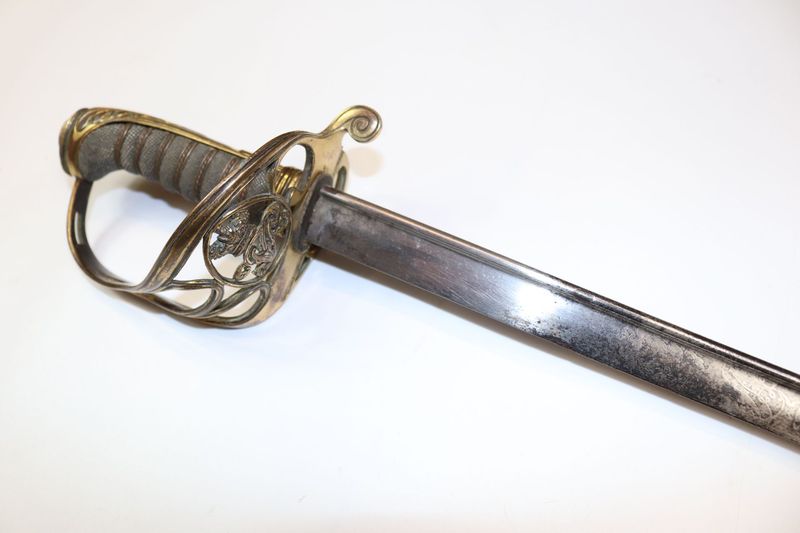
Early Victorian 1822 Pattern Infantry Officer's Sword. EL7203-2 - A Victorian 1822 pattern infantry officer's sword (dating to 1837-1845). Bright blade with early Victorian style etched panel to each side, with plain ricasso and no sign of a maker or retailer. The hilt in good condition, with much gilt remaining and good shagreen and wire. The folding drop of the guard works well. There is a little bit of movement in the hilt on the tang. A very light
  • Nation : Indian
  • Local Price : £310.00
Late-Victorian Bengal Police Officer's Sword by Pillin. EL7334 - A late-Victorian (circa 1895) Bengal Police officer's sword, by Pillin. In rather worn condition, with quite faint etching to the 32 inch 1892 pattern blade, and the shagreen of the grip very worn from use. The brass Gothic hilt furniture was plated and most of this remains. Complete in Indian field service scabbard. A relatively scarce sword.
  • Nation : British
  • Local Price : £310.00
Prussian M1816 Infantry Hanger / Sabre. Curved hanger blade with hatchet point, single fuller. Cast brass heart-shaped hilt with short quillon and knucklebow, brass grip with diagonal grooves on one side and smooth on the other, round brass pommel. No scabbard. Blade 25½ inches (65cm) in length, the sword 31½ inches (80cm) overall. The M1816 was a near-copy of its predecessor the M1715 infantry sword. The Napoleonic Wars having finally concluded, the Prussian army chose in 1815 to adopt the French infantry saber as standard for their infantry – the Guards regiments however preferred the old Prussian model and so new stocks were produced. The blade is of the form the English called a ‘hanger’ although German sources consider it a sabre. Sturdy and simple to produce, these swords had a long service life, remaining in use longest as a parade weapon with the Schloßgarde-Kompanie (guards of the royal palaces) until they units were disbanded with the end of the Prussian monarchy in 1918. This example is very slightly non-standard, having simpler ferrules and a blade about 3/8 of an inch longer. It bears no official markings so might be a privately purchased version. The blade has a bright polished finish. There are a few small nicks to the blade around its midsection and some very small patches of pitting in the same area. The brass of the hilt has an even patina, with the usual minor dents and some brown spotting. It has one small crack near where the knucklebow meets the hilt, but remains solid with no movement. The quillon is bent slightly to one side.
  • Nation : US
  • Local Price : £220.00
US 1873 Socket Bayonet for the Springfield Trapdoor Rifle, New Jersey National Guard. Socket bayonet for the Model 1873 .45-70 Springfield Trapdoor rifle, with fullered triangular blade and steel scabbard. Scabbard with drainage hole and frog hanging hook, black leather frog with rotating belt loop. The ricasso of the blade is stamped ‘US’. The brass swivel of the belt frog is cast with ‘NJ’ indicating that it was made for the New Jersey National Guard. The leather inside of the scabbard loop is also roughly inscribed with ‘AL’, presumably a soldier’s initials. The last model of standard-issue socket bayonet, the M1873 was used with the 1873 and 1879 ‘Trapdoor’ Springfield rifles, until 1884 when the new model introduced a rod bayonet. Both bayonet and scabbard have been deeply blued and retain a great deal of this original finish. Some rubbing and flaking to the belt loop in places, the leather is stiff but undamaged and the loop still rotates freely. A few small patches of pitting to the blade, some edge chipping towards the point. The scabbard body is free of dents with rubbing wear to the bluing towards the chape.
  • Nation : French
  • Local Price : £220.00
French M1892 Mannlicher Berthier 2nd Pattern Bayonet. Single-fullered straight blade, wood grips (meaning that this is the 2nd pattern, the 1st having composite grips) secured with two rivets. The blade has notches near the hilt which engage with a mechanism locking the blade into the scabbard. Steel scabbard, brown leather frog. Hilt with muzzle ring and quillon. The quillon has been reduced in size, a modification carried out during WW1. The quillon of the bayonet and the scabbard are both stamped with the serial number ‘8279’, indicating an original matching pair. Some light patination to the blade, hilt and pommel. The wood grips are undamaged. The scabbard has numerous small dents to its lower section. The leather frog is in good condition, with all stitching intact.
  • Nation : British
  • Local Price : £220.00
French Model 1831 Artillery Sidearm, Dated 1839 by Chatellerault. Straight double-edged blade, unfullered with diamond profile and spear point. One-piece cast brass hilt, grip and pommel, the hilt with circular finials, the grip ribbed, the pommel oval with a domed circular tang button. Black leather scabbard with brass throat and chape pieces, the throat piece with a frog loop, the leather section with two debossed lines lengthwise on the front face, similar on the reverse face but with one line being the stitching. Blade 48.8cm in length (just over 19 1/8 inches), the sword 63.9cm (just over 25 inches) overall. The blade is engraved on one side at the forte with the maker’s mark ‘Manufre Rale de Chatellerault’ (Manufacture Royale) and on the other side with ‘Fbre 1839’ next to which it is stamped with two French ‘poincon’ inspection stamps at the shoulder. The hilt is stamped on one side with the serial number ‘165’. The chape piece of the scabbard is faintly stamped with two poincons. The leather of the scabbard is stamped with the maker’s mark ‘GIRARD LOUIS A CHÂTELLERAULT’. Created in 1816, the Manufacture de Chatellerault, near Poitier, was a key arms factory for the French state. In the 1830s it took over from the Maubeuge, Charleville and Klingenthal plants, all of these being considered too close to the German border to be relied upon during a war. Girard Louis would have been a private contractor producing scabbards for the government plant, or possibly just their leather bodies. During the late 19 th and early 20 th centuries production of swords at Chatellerault decreased while firearms manufacture surged. Despite increasing use of machine tools and the nearing obsolescence of the sword, its blades were all hand-forged until 1916. Swordmaking there ceased in 1937. Sidearms with the form of a neoclassical ‘gladius’ appear to have originated with the French 1771 ‘Eagle Head’ Artillery sword. A series of very similar-looking short swords were subsequently designed, including the French 1816 & 1831 Artillery models, the US Model 1832 Foot Artillery, the Swiss 1842 Pioneer’s, the Russian 1848 Pioneer’s and the British 1855 Land Transport. They were simple and robust but not particularly useful for combat (the gladius having become obsolete for good reasons) so remained either ceremonial items or in the role of a machete for various field tasks such as clearing brush. Many examples of this type have been repolished, sometimes many times over to keep the brass bright, which results in surface wear and obscures markings. This example is one of two held in the same family by descent from a French ancestor since at least the late 19 th century (the other also for sale), and has been stored well but otherwise left alone, lending the brass an evenly aged patina. [Click here for the other example of the pair] The blade is unsharpened with multiple nicks to both edges. The blade has light speckled patination, with some spots of heavier patination including at the shoulder. A few small dents to the brass throat piece of the scabbard. The scabbard leather is good with some small dents on both sides and chunks of abrasion on the lower front face. All of its stitching is intact.
  • Nation : US
  • Local Price : £300.00
US Navy Model 1870 Yataghan Bayonet. Yataghan blade, brass hilt with partial muzzle ring and lobe quillon, brass grip with ‘feathered’ or ‘fishscale’ texture, beaked pommel with motif of crossed cannon barrels over an anchor. Unusual hilt design with high leaf spring locking catch and lower hole to accommodate the cleaning rod of the 1870 rifle. Black leather scabbard with brass locket and chape, with frog stud. Blade is unmarked. Hilt is marked with ‘S’. The back of the grip is stamped with ‘GGS’ and the pommel end with ‘J.G.B’. The US 1870 Navy rifle was a Springfield made rolling block type – the bayonets for it are thought to have all been made by the Ames Manufacturing Company of Chicopee, Massachusetts. Two versions are known to exist, this version with the yataghan blade and a straight-bladed version. Blade has some pitting, brass hilt has some very small dings and patina as expected for age. Scabbard is very good, only minor rubbing to the leather, no structural damage. Some small dents to the chape piece.
  • Nation : British
  • Local Price : £300.00
Indian 19th Century Foot Artillery Sword. Slightly curved unfullered blade with false edge and spear point. Blade 65.8cm in length, ¼ inch (6.5mm) thick at the shoulder, the sword 78.4cm overall. Steel hilt with forward curving comma-shaped quillon and recurved single bar knucklebow. Full-width tang with slab grips of black hardwood secured by five rivets. Flat teardrop-shaped pommel. No scabbard. These swords are thought to have been used by one of the princely states of British India during the 19 th century. Princely states were protectorates with a degree of autonomy and sometimes considerable wealth, which could raise and equip their own armies or even navies. The swords are somewhat scarce – supposedly all extant examples were discovered as a group and exported together during the 1980s, presumably as a clearout of an old armoury. If true this suggests that they were a small custom order probably intended for a single unit. No scabbards appear to have survived, if they had one originally. The outside of the knucklebow is engraved in Hindi with what appears to be ज ४ ०. In the Devanagari script ज is a consonant with the sound ‘ja’ and ४ ० are numerals for ‘4 0’. I therefore believe this is a rack or serial number, essentially equivalent to ‘J40’. All other examples I can find use the ज prefix and two following digits – I have noted ‘2 9’ and ‘5 0’. Were there fewer than 100 examples? Its design is clearly inspired by standard-issue British Army swords of the 19 th century, especially the 1853 Pattern Cavalry Trooper’s sword, which also uses a full-width tang, black slab grips secured by five rivets and a similar shaped quillon. This model in particular seems to have been well regarded in India – the swords used by the cavalry of the Baroda State were also modelled on it. The blade reminds me somewhat of that of the Baker rifle bayonet: a similar length, unfullered, with a prominent false edge. Baker bayonets were often used as sidearms even beyond the life of the Baker rifle itself. However, some elements of its design are simpler than on British types, such as its unfullered blade and lack of leather covering on the grips, and its construction seems more artisanal than one would expect from British workshops or even larger Indian workshops like Rodwell & Co which made the Baroda swords. This may mean that the swords were made locally by blacksmiths. They are consistently referred to as ‘foot artillery’ swords and this seems reasonable given their design, but I can find no hard evidence for it. They are certainly too short for cavalry use and their thick heavy blades (with essentially no distal taper until the last 12cm) are a far cry from the light, flexible and razor-sharp cutting swords favoured by most Indian swordsmen. Indian foot troops would have been shorter men than the British in that period, and if they were indeed artillerymen they would have also had to kneel while crewing guns without their sidearms getting in the way, and would not have been expected to fight hand-to-hand except in extremis. The blade has been sharpened along the true edge, the false edge is unsharpened. The blade has some spots of patination, one larger spot also with light pitting, some tiny divots which I think are imperfections in forging. Some undulation to the spine, possibly from hand manufacture, with patination to the recessed areas. Some areas of darker patination to the hilt and exposed tang. One grip slab is intact, the other has areas of chipping which partly expose the tang on the edge side and one of the rivets next to the pommel.
Page 105 of 118