
Show

Forgot your password?

Error message here!

Error message here!

Error message here!

Error message here!

Show Error message here!

Show Error message here!

Lost your password? Please enter your email address. You will receive a link to create a new password.

Error message here!

Back to log-in

Close

For Sale

The following items are listed by for sale by users of the site and dealers. They are in no way endorsed or guaranteed by www.antiquearmsresearch.com

Add a Classified Item
to

Clicking on the sword will take you through to the relevant classified item or dealer site.
Don't miss out! - Do you want to be kept informed weekly of new aditions? Just join our weekly update list.

You can also receive regular email notifcations when items match your keywords. To recieve them just register or logon at the top right of this page.

Page 104 of 118
  • Nation : British
  • Local Price : £300.00
Indian 19th Century Foot Artillery Sword. Slightly curved unfullered blade with false edge and spear point. Blade 65.8cm in length, ¼ inch (6.5mm) thick at the shoulder, the sword 78.4cm overall. Steel hilt with forward curving comma-shaped quillon and recurved single bar knucklebow. Full-width tang with slab grips of black hardwood secured by five rivets. Flat teardrop-shaped pommel. No scabbard. These swords are thought to have been used by one of the princely states of British India during the 19 th century. Princely states were protectorates with a degree of autonomy and sometimes considerable wealth, which could raise and equip their own armies or even navies. The swords are somewhat scarce – supposedly all extant examples were discovered as a group and exported together during the 1980s, presumably as a clearout of an old armoury. If true this suggests that they were a small custom order probably intended for a single unit. No scabbards appear to have survived, if they had one originally. The outside of the knucklebow is engraved in Hindi with what appears to be ज ४ ०. In the Devanagari script ज is a consonant with the sound ‘ja’ and ४ ० are numerals for ‘4 0’. I therefore believe this is a rack or serial number, essentially equivalent to ‘J40’. All other examples I can find use the ज prefix and two following digits – I have noted ‘2 9’ and ‘5 0’. Were there fewer than 100 examples? Its design is clearly inspired by standard-issue British Army swords of the 19 th century, especially the 1853 Pattern Cavalry Trooper’s sword, which also uses a full-width tang, black slab grips secured by five rivets and a similar shaped quillon. This model in particular seems to have been well regarded in India – the swords used by the cavalry of the Baroda State were also modelled on it. The blade reminds me somewhat of that of the Baker rifle bayonet: a similar length, unfullered, with a prominent false edge. Baker bayonets were often used as sidearms even beyond the life of the Baker rifle itself. However, some elements of its design are simpler than on British types, such as its unfullered blade and lack of leather covering on the grips, and its construction seems more artisanal than one would expect from British workshops or even larger Indian workshops like Rodwell & Co which made the Baroda swords. This may mean that the swords were made locally by blacksmiths. They are consistently referred to as ‘foot artillery’ swords and this seems reasonable given their design, but I can find no hard evidence for it. They are certainly too short for cavalry use and their thick heavy blades (with essentially no distal taper until the last 12cm) are a far cry from the light, flexible and razor-sharp cutting swords favoured by most Indian swordsmen. Indian foot troops would have been shorter men than the British in that period, and if they were indeed artillerymen they would have also had to kneel while crewing guns without their sidearms getting in the way, and would not have been expected to fight hand-to-hand except in extremis. The blade has been sharpened along the true edge, the false edge is unsharpened. The blade has some spots of patination, one larger spot also with light pitting, some tiny divots which I think are imperfections in forging. Some undulation to the spine, possibly from hand manufacture, with patination to the recessed areas. Some areas of darker patination to the hilt and exposed tang. One grip slab is intact, the other has areas of chipping which partly expose the tang on the edge side and one of the rivets next to the pommel.
  • Nation : -
  • Local Price : 295.00 USD
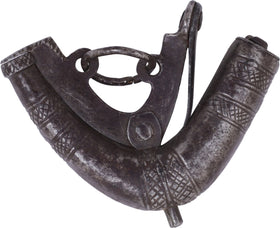
18th CENTURY OTTOMAN PRIMING FLASK FOR FLINTLOCK PISTOL. All iron of small size to hold about three pan charges, likely the most expected to be used in a battle where the opportunity for reloading was rare. Just over 2 3/4" width with curved chamber engraved hatched bands and pivoting spring cut off. Excellent with uniform light to medium surface patina.
  • Nation : British
  • Local Price : £295.00
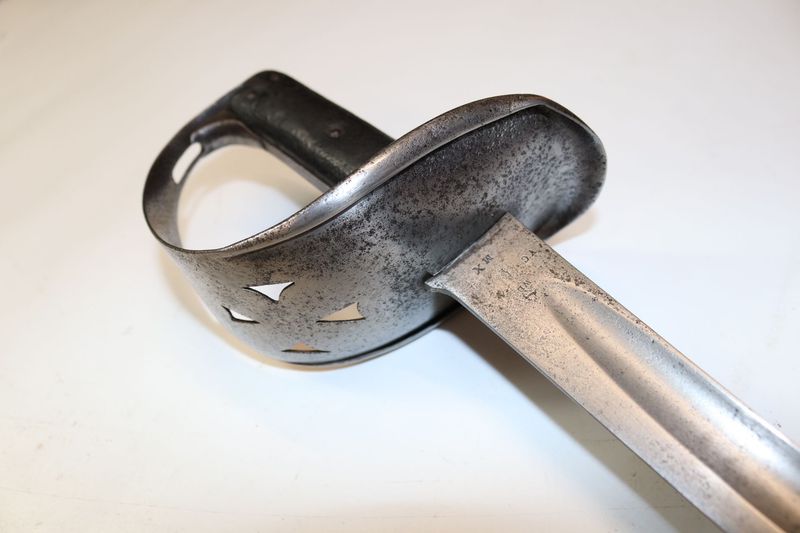
1890 Pattern Cavalry Sword. EL7325 - A late-Victorian 1890 pattern cavalry sword, with numerous markings, in quite good condition, with some pitting at the ricasso, and no scabbard.
  • Nation : British
  • Local Price : £295.00
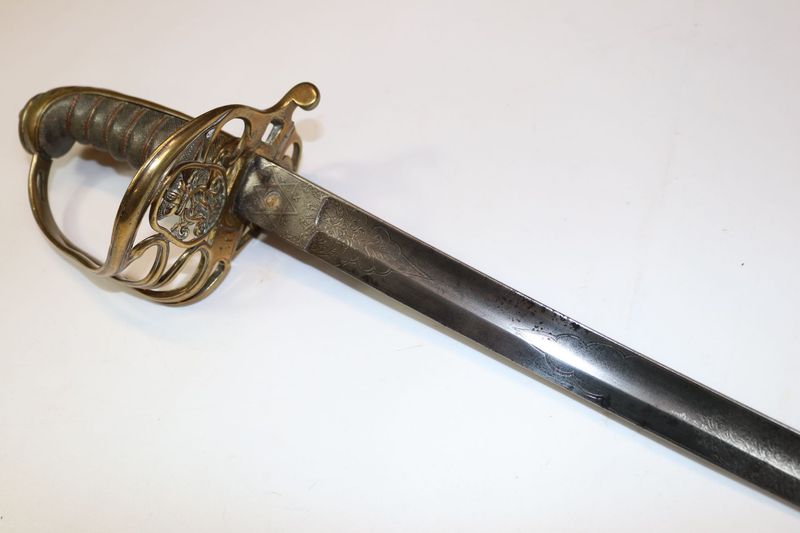
Mid-Victorian Infantry Officer's Sword by Buckmaster. EL7313 - A good quality mid-Victorian 1845 pattern Infantry officer's sword by Buckmaster. Bright blade with good detailed and crisp etching, firm in the hilt. The brass guard has a very tiny amount of movement, but very small, the grip in good condition and firm on the tang. The folding drop works well. No scabbard.
  • Nation : British
  • Local Price : £295.00
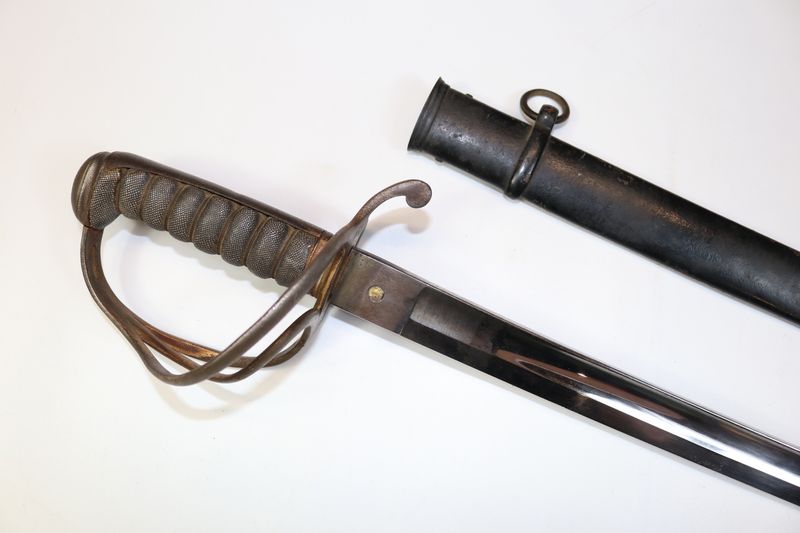
British Cavalry or Artillery NCO's Sword. EL7302 - A mystery British sword, perhaps for an artillery or cavalry NCO. Featuring a completely plain and un-etched blade of just under 33 inches long, retaining most of the original mirror polish. Firm in the hilt, but with the tiniest bit of movement in the guard. The shagreen of the grip in good condition, but with no grip wire. The three-bar hilt with light pitting and traces of gold paint
  • Nation : -
  • Local Price : £295.00
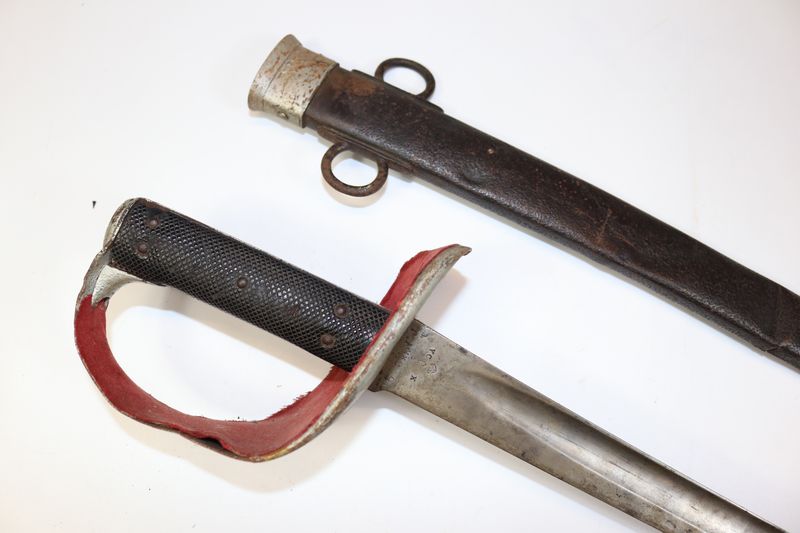
1890 Pattern Cavalry Sword for Restoration. EL7211 - An 1890 pattern cavalry sword. With numerous stamps, showing that this was made in 1890 and approved for service in Birmingham, then re-issued in 1895. The blade is nice and clean, with a bright finish. The hilt and scabbard have been painted and this should be removed, and there is a red cloth liner added to the guard, which I imagine was for theatrical purposes. A restoration project
  • Nation : British
  • Local Price : £285.00
British Bandsman's Sword, Early 19th Century. Straight blade with diamond profile, single short central fuller and spear point, single-piece cast brass hilt with straight crossguard with circular quillon terminals, spiral ribbed grip, lion’s head pommel with eyelet and movable ring. No scabbard. Blade just over 22½ inches (57.4cm) in length, the sword just under 28½ inches (72.2cm) overall. The hilt is stamped on the grip side on one quillon with ‘2B2R’ and the other with ‘B.10’. This might be a unit mark and a few bandsman’s swords do have identifiable regimental markings, but I cannot identify this one. Many bandsmen’s sword markings are cryptic and the letters may, for instance, refer to subunits within a regiment or some idiosyncratic system. There was no standard pattern for the ornamental swords carried by military bands in the eighteenth and early 19 th centuries. Each regiment was responsible for equipping its band as it saw fit, the expense generally paid for by its officers. Nonetheless bands were often well equipped as regiments took great pride in their music and sought to outdo each other in their pageantry. Composed of a mixture of enlisted men and paid civilian musicians, military bands often performed for the public becoming a cultural fixture and a useful means of outreach between military and civilians, a tradition which continues to this day. Despite their non-standard procurement there was a common style to the British band sword (with considerable variation): a short, usually curved, mameluke-style sword with brass fittings and a pommel in the form of an animal head, most often a lion. This one is somewhat unusual given its straight blade, and as mentioned I have only seen one other example. The Royal Armouries collection contains a great number of British bandsman’s swords which the Armouries curators have grouped into types based on the form of their hilts – but this type is not included among them, although it is closest to the ‘Type N’ which also has a straight diamond profile blade and straight crossbar hilt (see Royal Armouries item IX.431 – pictured in their online collection and also in Swords of the British Army, 1 st Edition by Robson 1975, p170). The RA collection is by no means exhaustive however and it is always interesting to find new variants. Most bandsmen’s swords were curved to make them easier to carry on the march, so straight blades are rarer, although this one is quite short. The Mark I Drummer’s sword introduced in 1856 also had a short straight diamond-shaped blade (19 inches), and this type might have been a precursor. Dating this piece is difficult, but the use of such swords would have declined after 1856 and the Royal Armouries generally date their examples to between 1800 and 1860. I have seen another example of this model which was stamped to Wilkinson and unit marked in the same format, so this example too may be by Wilkinson. The blade has spots of light and moderate scratching, light patination, and patches of light pitting, most notably near the tip. No damage to its edge, which is unsharpened. The tip is rounded – it may always have been so but if it was sharp it probably extended by another ~2mm. The hilt, grip and pommel have an even midtone patina.
  • Nation : British
  • Local Price : £285.00
British 1887 Pattern MkIV Martini Henry Sword Bayonet by Enfield, 1887. Straight unfullered spear-pointed blade. Steel hilt with comma-shaped quillon and stepped muzzle ring, steel beaked pommel. Chequered leather grips (technically, knurled) secured by four steel rivets, leaf spring locking mechanism secured to one side with a screw. Black leather scabbard with steel mounts at the throat and chape, with frog hook. The blade is stamped at the ricasso on one side with a crown over ‘V.R.’ for Queen Victoria (this mark mostly erased by polishing with only the V.R. clearly visible), the manufacture date /87 for 1887, a reissue stamp 98 for 1898 and a crown inspection mark with ‘B’. It is stamped on the other side with a War Department mark of a broad arrow over ‘WD’, and a crown inspection mark with ‘E’ for Enfield and an ‘X’ indicating the blade passed a manufacturer’s bending test. The spine of the blade is stamped with two further crown inspection stamps for Enfield. The exposed tang is stamped with a Birmingham repair mark: a crown over ‘BR’ over ‘66’. ‘N’ and a chevron-shaped mark. The pommel is stamped with the serial number ‘5307’. The scabbard is stamped next to the throat with the serial number ‘5312’, which has been stamped over another mark which appears to read ‘CIF 200’. The 1887 Pattern bayonet was introduced into service in the face of the ‘British Bayonet Scandal’ – a controversy (eagerly whipped up by the media) that British Army bayonets were made of inferior metal and/or badly heat-treated, and the Army was outsourcing blade manufacture overseas to the detriment of British industry. The Government responded by centralising bayonet manufacture as much as possible at the RSAF in Enfield. Enfield produced two successive models of trials bayonets in 1886-7 in order to settle on the design for the new model, with 23,668 of the first and 23,569 of the second type. The final design having been worked out, Enfield then manufactured 36,400 new 1887 Pattern Mk I bayonets, but trials bayonets could also be put into service by converting them to the final design. 21,113 of the 23,668 second model trials bayonets were converted in 1887 to Mk I specification. The Mk II and Mk III models were all newly manufactured but in 1891, the Mk IV was approved. This model was another reuse of old stock: it was made initially out 22,845 (nearly all) of the 1 st model trials bayonets, but later in 1894 1,196 of the Mk I bayonets were converted too. This bayonet lacks any of the ‘E-M’ stamps seen on the trials models, suggesting it was a newly-made Mk I produced in 1887 then converted to Mk IV in 1894, which if true would make it uncommon among Mk IVs. The blade is bright with some old polishing marks, refinished during its service life either upon conversion or as part of the marked repair at Birmingham. A few tiny spots of cleaned pitting along its edge. Its tip is undamaged. The hilt is bright with a few tiny spots of patination, the pommel more mottled light patination. The leather grips have light handling wear, a spot of heavier wear to the knurling and one indentation on the leaf spring side. The scabbard fittings have some old polishing marks, light speckled patination to the throat piece, a couple of spots of heavier patination to the chape piece at the edge and at the very tip, the latter also with some light pitting. The leather of the scabbard is good with only light surface rubbing, a couple of small dents at the edges.
Page 104 of 118