
Show

Forgot your password?

Error message here!

Error message here!

Error message here!

Error message here!

Show Error message here!

Show Error message here!

Lost your password? Please enter your email address. You will receive a link to create a new password.

Error message here!

Back to log-in

Close

For Sale

The following items are listed by for sale by users of the site and dealers. They are in no way endorsed or guaranteed by www.antiquearmsresearch.com

Add a Classified Item
to

Clicking on the sword will take you through to the relevant classified item or dealer site.
Don't miss out! - Do you want to be kept informed weekly of new aditions? Just join our weekly update list.

You can also receive regular email notifcations when items match your keywords. To recieve them just register or logon at the top right of this page.

Page 108 of 118
  • Nation : South African
  • Local Price : £185.00
British 1895 Pattern Socket Bayonet for the .303 Martini-Enfield, by Wilkinson 1912. Steel socket bayonet with triangular blade. Black leather Mk II scabbard with brass throat and chape pieces and two brass rivets to the leather section. Blade 21 5/8 inches (547mm) in length from the shoulder, the bayonet 25 inches overall (635mm), muzzle ring diameter 16.5mm. The blade is marked at the ricasso on the broadest side with a broad arrow War Department stores mark, the maker’s mark ‘WSC’ for the Wilkinson Sword Company, a crown inspection mark with ‘E’ for Enfield, the date 2 ‘12 indicating that it was converted in February 1912, and two broad arrows point to point, indicating equipment that was declared obsolete or to be sold off. The narrower lower sides of the blade are also stamped, one with the number ‘30’, this being cancelled with a strikethrough, and the other with non-English script markings, possibly serial numbers, one of these also being cancelled. The 1895 Pattern socket bayonet was produced by converting existing stocks of the 1876 Pattern. It was intended to fit to the Martini-Enfield, which was itself a conversion of existing Martini-Henry rifles to accept the new .303 British cartridge. This required the bayonets to be bushed to fit a smaller diameter barrel and their sockets remodelled to mount the blade below the barrel instead of to the side. The conversion stamps seen on this bayonet are unusual: the Royal Small Arms Factory at Enfield is usually listed as the sole site for production of the 1895 Pattern, with conversion work taking place there between 1895 and 1902. However, Graham Priest writes that Wilkinson also performed some conversions (see Socket Bayonets, page 72). Nonetheless the clearly marked date of 1912 is remarkably late for conversion to have still been taking place, though the non-English script markings on this example may suggest that it was done for Commonwealth service (perhaps India or Nepal?). The Martini-Enfield hung around for many years after its official replacement since the .303 round remained current and readily available. It was in service in some capacity in New Zealand and India through WW1 and beyond, was widely seen in the Middle East, was used by South African cadet forces until the mid-20 th century, and in Britain some remained stored in armouries long enough to be issued to Home Guard units in WW2. The blade is clean and bright with only a few patches of very light patination. The socket retains almost all of its blued finish. A few small dents and scratches to the scabbard fittings, which have a moderate patina, and similarly some rubbing and dents to the leather section. All of its stitching is intact.
  • Nation : British
  • Local Price : £185.00
British L1A4 Bayonet by Hopkinson, Chromed Parade Order. Straight single fullered blade with clipped Bowie point. Steel hilt with muzzle ring, black painted sheet steel slab grips secured by two rivets around concealed tang. Steel pommel riveted to the tang, with locking button. Steel scabbard with round frog stud. Black rubber frog with buckled retaining strap. The pommel is stamped with ‘C’ within a square on one side and ‘H’ within a square on the other. The grips are stamped on one side with ‘L.1.A.4. 9600259 S.M.’, L1A4 being the model number, 9600259 being the NATO item number for the L1A4 bayonet, and S.M. being the manufacturer code for Hopkinson. The blade is stamped at the ricasso on one side with an indistinct mark, obscured by the chrome. The scabbard is stamped at the throat above the frog stud with a broad arrow War Department stamp. The L1A4 bayonet for the SLR rifle was sealed as a pattern in 1958 but not actually produced until the 1970s by the firm Hopkinson based in Sheffield. It has some minor simplifications in construction compared to its predecessor the L1A3. This example has had the metal parts of both bayonet & scabbard chromed to be worn on parade and is paired with the correct glossy black frog that would also have been worn. The bayonet’s chromed finish is in good condition with a few spots of wear around the muzzle ring, in the recesses for the grip rivets & locking button, and on the scabbard body. Some small dents to a grip scale on one side. The tip of the blade is missing, this was probably deliberately blunted to make it safer for parade handling. No damage to the edge. One significant dent to the scabbard on the reverse side, with some pitting to the recesses of the dent – this does not interfere with sheathing and drawing. A screw near the throat of the scabbard is missing. The frog’s rubber retaining strap is broken where it should thread into the buckle – the scabbard stays in place anyway due to the rigidity and friction of the rubber but the strap cannot be done up to secure it.
  • Nation : Australian
  • Local Price : £180.00
Australian WW2 Lee Enfield 1907 Pattern Bayonet by Orange Arsenal, Dated 1944. Straight single-fullered knife blade, steel hilt with muzzle ring, wood slab grips secured by two screws, steel beaked pommel with locking button. Black leather scabbard with steel locket & round frog stud and steel chape piece. The ricasso is stamped on one side with ‘MA’ for Munitions Australia, over ‘1907’, the model, over ‘1’, as well as a broad arrow War Department mark, the manufacturer’s mark ‘OA’ indicating the Orange Arsenal, and an ‘X’ indicating that it passed a manufacturer’s bending test. On the other side it is stamped with another ‘MA 1907 1’ mark and the manufacture date 4 ’44 indicating April 1944. One of the wood grips is stamped between the screws with ‘SLAZ 43’ and the other with ‘SLAZ 44’, indicating that they were produced in 1943 and 1944 by the Slazenger company, better known for its sporting equipment. The throat piece of the scabbard is stamped next to the staple with another ‘OA’. The chape piece is stamped next to the staple with a seven-pointed star. The leather section of the scabbard is stamped next to the seam with ‘MANGROVITE 44’. The blade has an even dark parkerised finish with some wear only along the spine from rubbing upon sheathing and drawing, exposing bright steel. The hilt, exposed tang and pommel likewise are darkly parkerised. The grips have some abrasion next to the pommel – possibly deliberately shaved down to better fit it to the pommel – and are otherwise excellent. The throat piece of the scabbard has some light scratches showing bright steel and some rubbing to the finish on the frog stud, likewise some rubbing to the tip of the chape piece. The leather of the scabbard has some light denting and surface rubbing.
  • Nation : Spanish
  • Local Price : £180.00
Portuguese M1886 Kropatschek Bayonet by Steyr. Yataghan curved single-fullered blade, crossbar hilt with upper muzzle ring and quillon and lower circular finial, black wood grips, plain steel scabbard with frog hook. No maker’s mark to the spine of the blade – it may have been removed by polishing. The frog stud of the scabbard is marked ‘WG’, a Steyr factory mark. Hilt marked ‘N159’, scabbard marked at the throat with ‘RR884’. The M1886 Kropatschek rifle proved to be reliable and had a long service life - while it was replaced by the 1904 Mauser in the Portuguese army it was used by colonial units in WW1, issued to the Portuguese Legion during the Spanish Civil War, and was still in use by colonial police as late as the 1960s. Its bayonet was one of the last to make use of the ‘yataghan’ downward-curving blade.
  • Nation : US
  • Local Price : £175.00
US M1912 Fencing Bayonet for the Trapdoor Fencing Musket. Flexible steel ‘blade’ with looped end, brown leather cover, bare exposed tang, hilt with muzzle ring and lower lobe quillon, pommel piece with second muzzle ring, both rings with a drilled hole for a set screw. Blade 16½ inches (41.9cm) in length, 19½ inches (49.5cm) overall. The leather cover is stamped with ‘HEK’ – this is an inspector’s mark for Henry E Kelsey, leather goods inspector at Rock Island Arsenal (RIA). The steel parts would have been fabricated at Springfield Armory, but RIA produced the leather covers in their ‘Harness and Accoutrements Shop’. Seeking to improve soldiers’ skills at bayonet fighting, the US Army commissioned a number of different models of ‘fencing bayonets’ from as early as 1852, to allow a more realistic simulation of combat. Early versions used a flexible whalebone blade screwed in to a cut-down metal socket, then in 1897 the first all-steel model was introduced. The M1906 Fencing Bayonet was the first to be based on the knife bayonet, imitating the M1905 bayonet for the Springfield rifle. Technically speaking the Army never commissioned an ‘M1912’, this is just a more convenient way of referring to the third variation of the M1906. The difference is substantial, however: the M1912 was introduced in that year to remedy some defects in its predecessor the M1909, which was deemed to be too easily broken and reportedly caused “ugly wounds” when the blades broke in sparring creating sharp edges. This understandably discouraged bayonet training and the Inspector General complained in annual reports that soldiers’ skills were suffering. To fix the issue the M1912 went back and reintroduced some features that had been mistakenly removed since the socket bayonet days: a horizontal blade, achieved by adding a 90-degree twist starting 2 inches forward of the hilt, and a leather cover over the full length of the blade. Letting the blade spring up and down rather than side to side was found to reduce breakages, and even if they did occur the leather would keep sharp edges covered. The new model was a success and 11,000 were made between 1913 and 1915, getting the infantry trained up in time for the United States’s entry into WW1. It attached (with two screws through the muzzle ring holes) to the Trapdoor Fencing Musket, a training piece made at Springfield Armory by converting obsolete .45-70 Trapdoor rifles. These had their barrels and stock shortened to mimic the length and weight of the M1903 rifle, and the sights, external hammer and sling swivels removed. The M1912 bayonets remained in use throughout WW1 and remained in stores for some time afterward, eventually being sold as surplus. The blade remains flexible. All the leather cover’s stitching is intact, some creasing and light rubbing to the leather surface, more prominent on the ball end piece, but no damage. The exposed section of the blade retains a blued finish, the hilt parts are bright and clean.
  • Nation : Austro-Hungarian
  • Local Price : £125.00
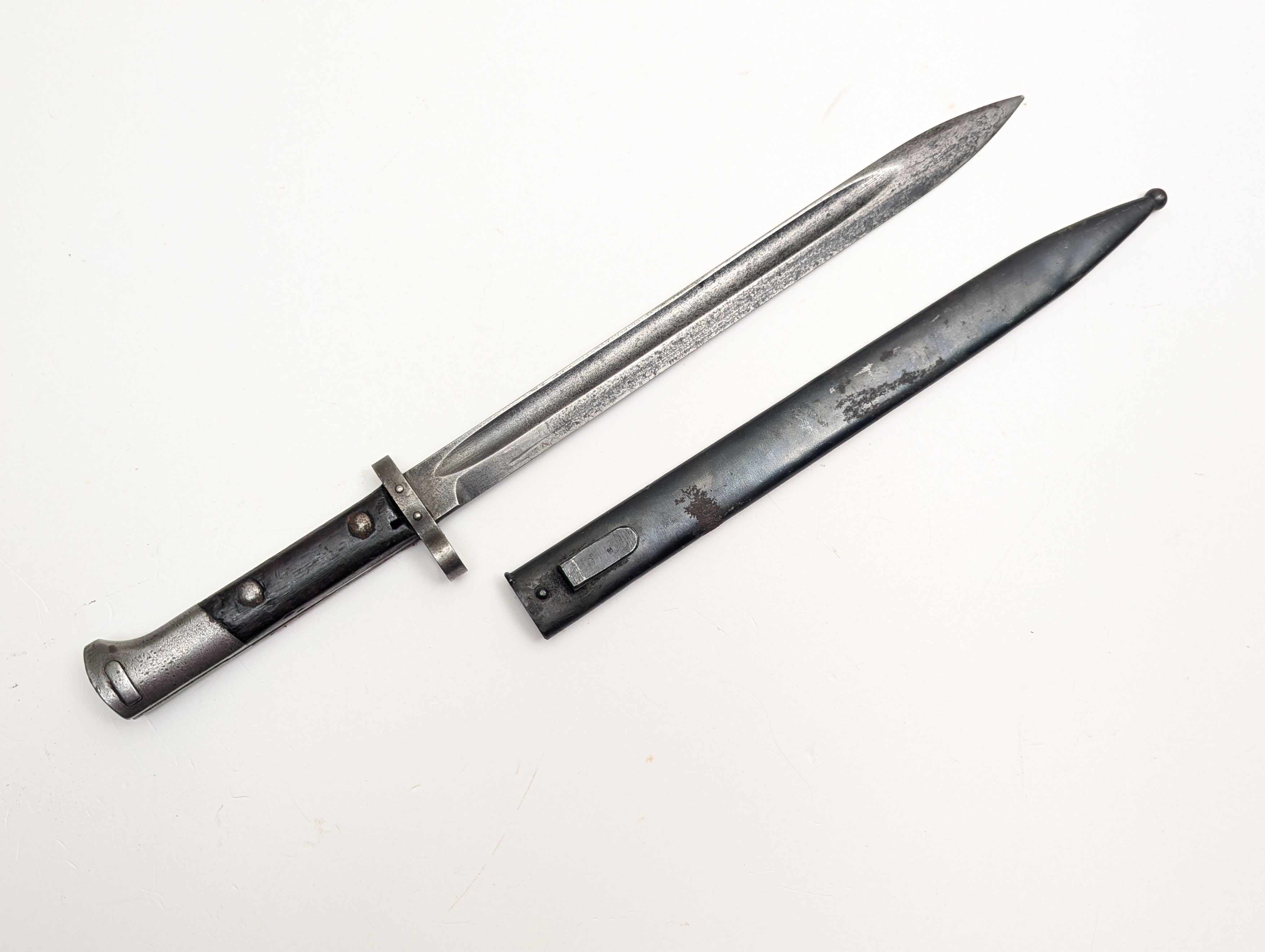
Czech M1924 Bayonet (VZ 24), Dated 1946, Chromed. Single fullered spear pointed knife blade with reversed cutting edge (on the same side as the muzzle ring), steel hilt with muzzle ring and protruding rivets, wood scale grips attached by two screws, steel beaked pommel with locking button. Steel scabbard with frog hook and ball finial. The blade is stamped on one side at the ricasso with ‘ČSZ’ over ‘D’. ČSZ stands for Československá Zbrojovka, the state arms factory in Brno. Its exposed tang is stamped with a three-part stamp ‘E3’, followed by a lion emblem, followed by ‘46’, indicating the year of manufacture was 1946.The scabbard frog hook is stamped with a crossed-swords emblem. The M1924, or VZ 24, was the first bayonet adopted by Czechoslovakia after its independence from the Austro-Hungarian Empire in 1918. It fits the vz. 24 rifle, which was a derivative of the M1898 Mauser rifle that could be chambered in multiple calibres depending on customer demand. These rifles and their bayonets were widely exported, notably to South American countries: Bolivia, Paraguay, Uruguay, Colombia, Venezuela, Guatemala, El Salvador, Brazil, Peru, Nicaragua and Ecuador were all users, and it was found on both sides of South American conflicts of the 1920s and ‘30s such as the Chaco War and Ecuadorian–Peruvian War. During the Spanish Civil War Catalan Republican forces were supplied with vz. 24s purchased by the Soviets. Chinese Nationalist forces purchased 195,000 over the course of a decade (1927-1937), used during the Second Sino-Japanese War and the Chinese Civil War. Iran placed multiple orders and also produced a version under license. Large numbers were captured from Czech arsenals after the fall of the Czech Republic in 1939 and reissued to German forces under the designation Gewehr 24(t) - the Czech factories continued to produce these rifles under occupation, with modifications to match German standards. Nearly 500,000 vz. 24s were also ordered by Romania during the occupation. Production of true Czech VZ 24 bayonets resumed in 1946, through the Communist takeover of 1948, until it was finally halted in 1950 ahead of the introduction of the vz. 52 rifle. All metal parts of the bayonet have been chromed, possibly for parade use – the chrome is bright with no wear or chipping to the plating. There is some dimpling to the blade, which is underneath the plating. The scabbard is free of dents and has very little wear to its deeply blued finish. The wood grips are undamaged.
  • Nation : -
  • Local Price : £125.00 GBP
WW2 Bayonet for VZ24. The bayonet used with the Czechoslovak VZ24 Mauser rifle during WW2."
  • Nation : Japanese
  • Local Price : £125.00
**EXPERT ASSESSED**c1900-1940 Cast Iron Tsuba in the Echizen Kinai Masters Style. ED 826. -. This is an original c1900-1940 cast Iron Tsuba in the Echizen Kinai Masters style. It has been assessed by UK Japanese sword expert Bill Tagg. (A tsuba is a sword guard and part of a sword mounting. It is mounted between the sword’s blade and grip to protect the user’s hands). Constructed of iron with a lovely dark patina and colour with a rope edge and rounded rim. The tsuba depicts a raised mountain landscape scene. The price includes UK delivery. ED 826.
Page 108 of 118