
Show

Forgot your password?

Error message here!

Error message here!

Error message here!

Error message here!

Show Error message here!

Show Error message here!

Lost your password? Please enter your email address. You will receive a link to create a new password.

Error message here!

Back to log-in

Close

For Sale

The following items are listed by for sale by users of the site and dealers. They are in no way endorsed or guaranteed by www.antiquearmsresearch.com

Add a Classified Item
to

Clicking on the sword will take you through to the relevant classified item or dealer site.
Don't miss out! - Do you want to be kept informed weekly of new aditions? Just join our weekly update list.

You can also receive regular email notifcations when items match your keywords. To recieve them just register or logon at the top right of this page.
Page 109 of 118
  • Nation : British
  • Local Price : £250.00
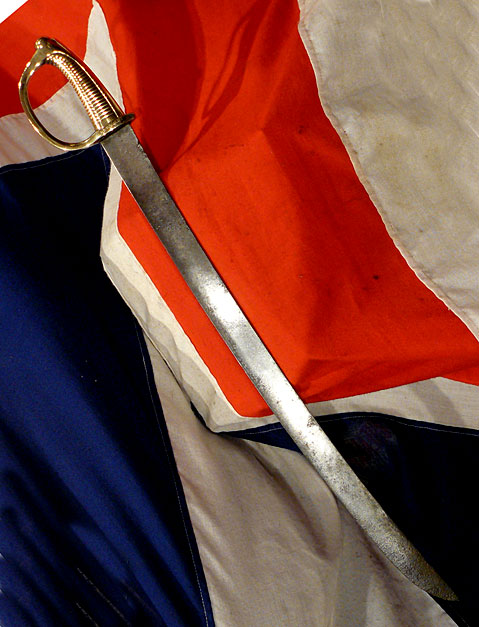
A Scarce Swiss 1842 Briquet Man's Sword of The Guard Regt's. Used in the Italian Uprising of 1848. A very rarely seen sword in the UK, The US and Europe, the Swiss briquet sidearm. It is based on the Franco-Prussian version, and similarly mostly made in Solingen Prussia, and imported to Switzerland in the early 19th century. Marked on the hilt J.P.Stacklj. As used by the Swiss regiment that fought in the streets of Naples for Ferdinand II, King of the two Kingdoms of Sicily, during the uprising of 15 May 1848. Between 1856 and 1860, around 1,200 Swiss mercenaries from the Swiss regiments in Naples continued their military careers in the Dutch colonial army. The Revolution which began in Palermo was one of a series of such events in Italy, though perhaps more violent than others. It quickly spread across the island and throughout Italy, where it prompted Charles Albert, King of Sardinia, to follow the example of Ferdinand II and issue a written constitution, the Albertine Statute {the Albertine Statute later became the constitution of the unified Kingdom of Italy and remained in force, with changes, until 1948}. In imitation of these events, riots and revolutions followed around Europe at the same time, and may be considered a taste of the socialist revolts to come. King Ferdinand II of the Two Sicilies By the recapture of Sicily in May 1849, the battle was said to be practically over. Filangieri, however, dared not let his troops enter the set of alleys that then made up the historic center of Messina: although the regular Sicilian forces had been exterminated or forced to flee, the bombardment of the Bourbons continued on the defenseless city, that is, on the part that had not yet been occupied by the regi, for another seven hours. The soldiers of the Bourbon army gave themselves up to the looting and violence against the inhabitants. Homes of foreigners living in Messina were also looted and destroyed, so much so that the English consul Barker reported the incident to his government writing that many English subjects living there were reduced to ruin and that even a diplomat, the consul of Greece and Bavaria M. G.M. Rillian, despite being in uniform, had been wounded by sabre, before his dwelling was also looted and burned down. The Bourbon troops did not spare even the religious buildings from looting. For example, the church of San Domenico, rich in works of art, was first looted of its sacred objects, then burned down and totally destroyed. Loss of life was incalculable. A Bourbon official wrote to his brother, immediately after the capture of Messina, stating that the Neapolitan departments had recaptured the city with a very intense fire and "trampling corpses in every step that progressed for the space of about two miles" and then commenting "What a horror! What a fire! British Admiral Parker also condemned the work of the Bourbons, and in particular the prolonged terrorist bombardment of the city even after the end of all resistance for eight hours: "The greatest ferocity was shown by the Neapolitans, whose fury was incessant for eight hours, after all resistance had ceased". During the siege of Messina, the last insurgents who resisted the attack of the Bourbons inside a convent, rather than hand themselves over, chose to throw themselves into a well, taking their tricolour flags with them. Messina was also troubled by the work of common criminals sent by King Ferdinand II to Sicily against the insurgents and that after tormenting the Sicilians for months with brigand actions (crimes, violence, thefts, etc.) they gave themselves at the time of the fall of the city to its looting, arriving with small boats from Calabria to make loot. Overall in very nice condition, with old traces of pitting on the blade. A very rarely seen sword. Every single item from The Lanes Armoury, Britain's famous, favourite, and oldest original Armoury Antique store, is accompanied by our unique Certificate of Authenticity. Part of our continued dedication to maintain the standards forged by us over the past 100 years of our family’s trading, and thus, it is a lifetime guarantee. No scabbard
  • Nation : German
  • Local Price : £250.00
German WW2 Army NCO’s Sword ‘Extrasäbel’ by Paul Seilheimer, Solingen. Curved, narrow single-fullered blade with spear point. P-shaped single bar hilt with quillon, shield-shaped langets, steel backstrap with riveted ears. Grip of ribbed black plastic bound with gilt wire. Brown leather washer. Steel scabbard painted black, with single fixed hanging ring and frog loop. The blade is stamped on one side with a mark of a P-hilt sabre vertically impaling a triangle that contains the word ‘SOLINGEN’. The sword’s hilt lies between the letters ‘P’ and ‘S’. This is the maker’s mark of Paul Seilheimer of Solingen. Established in 1917, the firm of Paul Seilheimer was one of many based in the city of Solingen, Germany. It manufactured swords and bayonets as well as kitchen cutlery. It was an approved government manufacturer of swords and daggers for various military and political organisations throughout WW2, although examples are relatively scarce so this may not have been at a large scale. The company ceased trading in 1970. ‘Extrasäbel’, or ‘specialty sabres’ were privately purchased from a number of retailers by German soldiers and NCOs, and were not an official pattern, although they were very similar to the Army officer’s sword. They were carried for show, ceremonial use, or as a dress sword. Not being fighting swords, the buyers often chose to ornament the blades, which could include plating, etching, bluing etc. This model is visible in product catalogues of the period produced by Waffenfabrik Paul Seilheimer, where it is listed as ‘Mannschafts-Extrasäbel’ – Mannschaft meaning ‘enlisted personnel’ which were distinct from officers (Offizier). All metal pieces of the sword itself have been nickel plated, with some light speckled wear to the plating overall, including the blade. The wire binding of the grip is all intact and tight, some fractional movement to the hilt and grip. The scabbard is free of dents and retains almost all its original paint with only a few small chips.
  • Nation : British
  • Local Price : £180.00
British Lee Enfield 1907 Pattern Bayonet, Rugby School Officers Training Corps. Straight single-fullered knife blade, steel hilt with muzzle ring, wood slab grips secured by two screws, steel beaked pommel with oil hole and locking button. Black leather No. 1 Mk 2 scabbard with steel locket & teardrop frog stud and steel chape piece. 1925 Pattern khaki canvas frog with retaining loop and distinctive brass button to clip the frog to the belt. The ricasso is stamped on one side with a crown, 1907 (the pattern) ‘9 17’, indicating the manufacture date of September 1917, the manufacturer’s mark ‘SANDERSON’, four crown inspection stamps (three with ‘E’ indicating the Royal Small Arms Factory at Enfield), and multiple reissue stamps dated ’27, ’31 and ’39. On the other side it is stamped with a ‘broad arrow’ War Department stores mark, three more crown inspection stamps with ‘E’, and an ‘X’ indicating that it passed a manufacturer’s bending test. The pommel is stamped with ‘O.T.C’ over ‘RUG’ over ‘283’. This indicates that this was bayonet number 283 used by the Rugby School OTC (Officers’ Training Corps). The throat piece of the scabbard is stamped with a diamond-shaped manufacturer’s mark. The leather of the scabbard is stamped next to the seam with two further crown inspection marks, a broad arrow and an illegible mark which would be the manufacture date - all these marks being faint from rubbing. A large number of volunteer units sprang up across the United Kingdom during the late 1850s after a national appeal by the Secretary of State for War, due to a perceived threat of invasion of Britain by France. Oxford and Cambridge universities were very quick to respond with the formation of their own units of Rifle Volunteers, and some schools also followed suit, Rugby being one of the first wave of six schools to form their own Corps in 1860. As years went by the number of school units only increased until by 1898 there were 39, with another surge of interest due to the Boer War nearly doubling that number by 1902. These school units provided early experience for young men who would then be in a good position to move up to the university units and perhaps a military career afterward. There was lively competition between Corps for shooting prizes in particular, with Rugby one of the most successful – although it may be said that success came in part with a school’s willingness to spend on equipment and training. The Officers’ Training Corps were established in 1906 as part of the wide-ranging Haldane Reforms to the British Army’s structure. The OTCs were intended to alleviate the shortage of trained officers in the various volunteer units (Militia, Yeomanry, Volunteer Force and Reserve of Officers) by forming a system of junior training units in public schools and senior ones in universities. Some of the junior OTCs were formed out of the existing school Cadet Corps, which by this date numbered more than fifty, while senior OTCs were often formed from the university units. During WW1 the OTCs became training units for supplying officers to the regiments, an OTC Certificate generally considered full qualification to become an officer, although some individuals chose for various reasons to enlist in the ranks. Rugby School OTC supplied 291 recruits, all of them gazetted officers, between August 1914 and March 1915. The Rugby School Cadet Corps still exists today as part of the Combined Cadet Force (CCF), with Army, Royal Marines and RAF contingents. Under the modern Army structure it serves as a leadership and training organisation, teaching a number of military skills but with no obligation to go on to full military service. Because of its features this bayonet must postdate 1910, and was probably issued to replace the 1903 Pattern bayonets that were initially issued to school Corps. Its frog is quite a scarce pattern: the 1925 Pattern frog was issued to the RAF and in fact was not made in khaki until 1932 when the Canadian government appears to have ordered a number of them from the Mills Equipment Company. The 1937 Pattern generally replaced these so it may have been handed down as surplus and found its way to an OTC unit – as its reissue marks attest this bayonet was still in use as of 1939. The scabbard is not actually fully fitted into it – it arrived this way and I do not wish to force the stiff canvas too much to get the frog stud into it, although I think there is enough give. The blade has a matt parkerised finish with streaks of rubbing, some scratches and spots of light patination. Some small nicks to the sharpened edge near the tip, the tip rounded. The blued band at the shoulder of the blade is intact. The hilt, pommel and scabbard fittings are blued with some light rubbing on raised edges, but have also been impacted by rust leading to areas of moderate to heavy pitting and encrustation, the latter most notable on the throat piece of the scabbard. While this is removable by polishing, that would also remove the remaining blueing. Only a few small dents to the wood grips. The leather scabbard body has some light dents and surface abrasion. All the scabbard’s stitching remains intact.
  • Nation : German
  • Local Price : £245.00
German WW2 M84/98 Mauser K98 Bayonet, Dated 1939 by Ernst Pack & Söhne. Single-fullered knife blade with spear point, wood scale grips with cleaning hole and diagonal grooves, held by two screws. Steel hilt, flashguard and pommel with locking button. Steel scabbard with frog hook. Black leather frog. Blade inches in length, the bayonet inches overall. The blade is stamped at the ricasso on one side with the maker’s mark ‘E PACK & S’, indicating Ernst Pack & Söhne. The ricasso on the other side is stamped with ‘5687 a’. The scabbard is stamped near the throat above the frog stud side with the matching number ‘5687 a’, and on the other side with ‘’E. PACK & S 1939’ indicating blade and scabbard are an original pair. The base of the spine is stamped with the manufacture date ‘39’. The pommel is stamped with two Waffenamt eagle stamps. The rear of the leather frog is stamped ‘GLOGAU 1936’ – this must indicate the manufacturer Gustav Schädel based in Glogau (aka Głogów, in what is now Poland). There was probably originally a top line to the marking which would have confirmed this, but has been removed by rubbing. Schädel produced these frogs from 1936 to 1938. The blade is undamaged and retains almost all of its original blueing, with notable rubbing to reveal bright steel between the end of the fuller and the tip, and at spots on the edge of the fuller, due to sheathing and drawing. The hilt and pommel are likewise blued with some rubbing on raised edges, patches of light pitting to the hilt on one side. The grips are undamaged with very little wear. The scabbard is free of dents and retains its blueing, with some light cleaned pitting in places and a few light scratches. Some light rubbed lines on the reverse side beneath the frog. Some light abrasion to the surface of the leather frog.
  • Nation : -
  • Local Price : £175.00 GBP
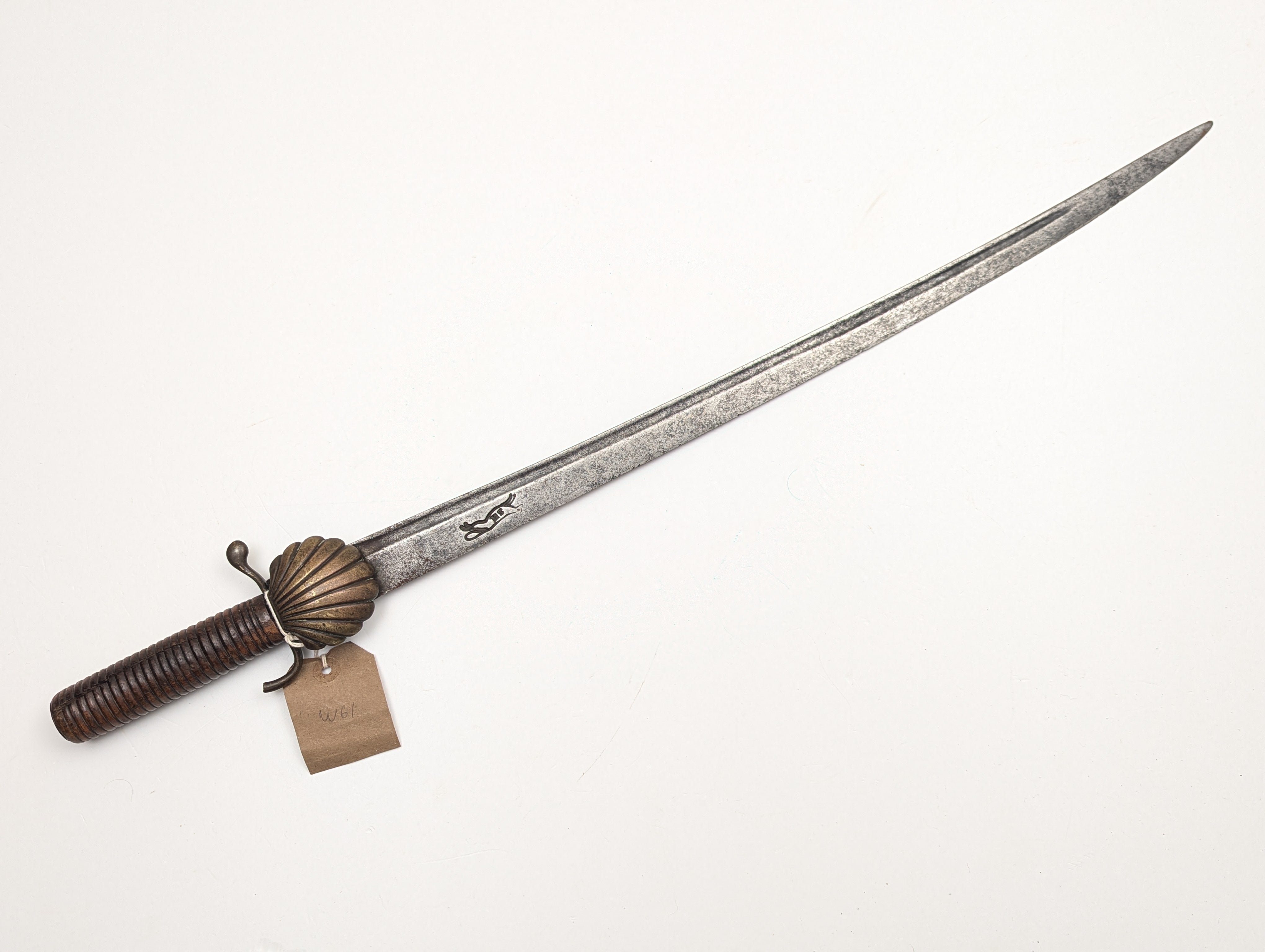
Hunting Hanger, Harvey. A hunting hanger marked with the running fox of Samuel Harvey on both sides. The pommel indicates it most likely belonged to the Hope family, a lowland clan with the motto "At Spes Non Fracta".  One quillon absent.  "
  • Nation : Japanese
  • Local Price : £175.00
20th Century Japanese Gilded Soft Metal Dragon Decorated Kogai For Japanese Wakizashi Sword Fittings. ED 3057 -. This Kogai has been examined by UK Japanese sword expert Bill Tagg. His descriptive note accompanies the Kogai. His note reads “Japanese Kogai (scabbard side knife / bodkin). Gilded soft metal with blackened background to Dragon detail in panel. Looks mid 20th century made. In very good condition suitable for wakizashi size sword”. The price includes UK delivery. ED 3057 (in Tanto box armoury)
  • Nation : Swedish
  • Local Price : £170.00
Swedish m/1914 Mauser Carbine Bayonet by Eskilstuna Jernmanufactur. Introduced in 1894 for horseback and naval use, the m/94 carbine version of the 6.5x55mm Swedish Mauser did not originally come with a bayonet, but the cavalry, artillery and navy all demanded one, the navy even modifying a small number of rifles to accept the m/1867 yataghan bayonet in the interim. Prototypes were developed from around 1909, including a folding type, but were deemed unsatisfactory until the experimental model of 1913, which was trialled between 1913 and 1915, and adopted as the m/1914. A new nose cap with a bayonet mount was introduced for the rifle at the same time. Some were also used by Swedish troops serving as UN peacekeepers in the Congo between 1960-64, fitted onto the C version of the Carl Gustaf m/45 submachine gun. The Royal Guards at Stockholm Palace still carry the m/94 carbine and bayonet today. The blade is stamped at the ricasso with the maker’s mark ‘EJAB’ with an anchor impaling the letter ‘E’, indicating the manufacturer Eskilstuna Jernmanufactur AB (Eskilstuna Iron Manufacturing, Inc). This was a private tool & cutlery manufacturer which produced bayonets for the Swedish military, based in the industrial city of Eskilstuna which also housed a state arsenal. The locking button, tang of the blade and finial of the scabbard are all stamped with a crown inspection mark. The blade is bright with some light frosting and some small spots of patination, retaining its blued band at the ricasso. The scabbard, hilt and pommel retain most of their blued finish, with rubbing on raised edges revealing bright steel. The wood scale grips are good with a few small dents and a short scratch on one side. The locking mechanism is fully functional and the bayonet sheaths and draws smoothly.
  • Nation : -
  • Local Price : $169.00
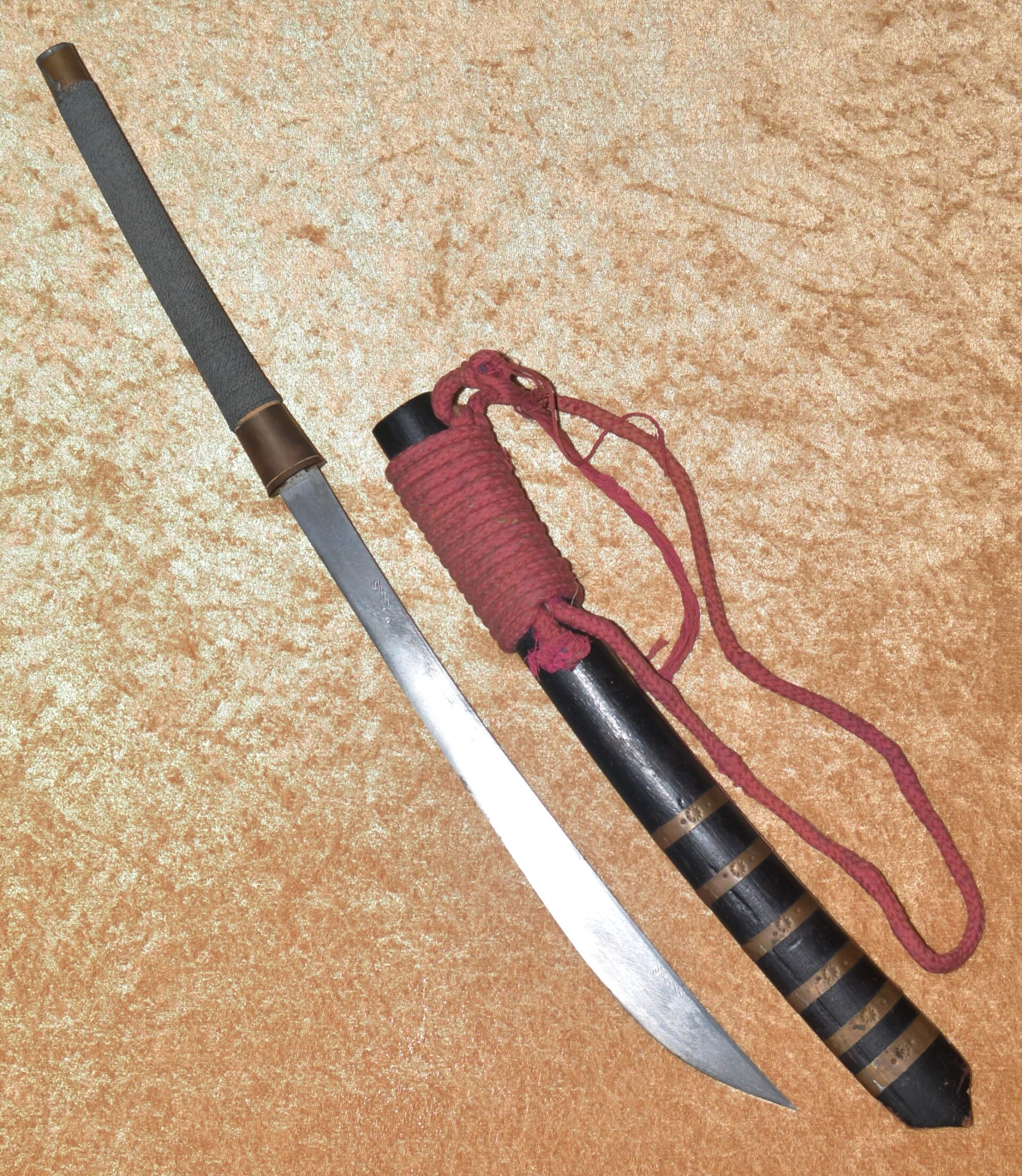
Burmese Dha Short Sword, 20th C. The Dha is a traditional single-edged, slightly curved sword from Myanmar, used historically for combat, utility, and ceremonial purposes across Southeast Asia. This example with 14 1/2″ slightly curved single-edged blade, broadening toward the very sharp point, and stamped with a segmented “C” on one side; the spine with one set of 8 inscribed notches and another set of 7. Tapering 9″ wood hilt, wrapped with twisted iron wire and soldered brass ferrules top and bottom, the top with flat pommel cap with small button. Black-painted wood scabbard with six brass bands and red textile cord wrap and carry loop. Blade with patches of light pitting and several sets of incised notches, the purpose of which is unknown. Shows light wear. Overall length 23 1/2″, not including scabbard.
Page 109 of 118