
Show

Forgot your password?

Error message here!

Error message here!

Error message here!

Error message here!

Show Error message here!

Show Error message here!

Lost your password? Please enter your email address. You will receive a link to create a new password.

Error message here!

Back to log-in

Close

For Sale

The following items are listed by for sale by users of the site and dealers. They are in no way endorsed or guaranteed by www.antiquearmsresearch.com

Add a Classified Item
to

Clicking on the sword will take you through to the relevant classified item or dealer site.
Don't miss out! - Do you want to be kept informed weekly of new aditions? Just join our weekly update list.

You can also receive regular email notifcations when items match your keywords. To recieve them just register or logon at the top right of this page.
Page 111 of 119
  • Nation : -
  • Local Price : £175.00 GBP
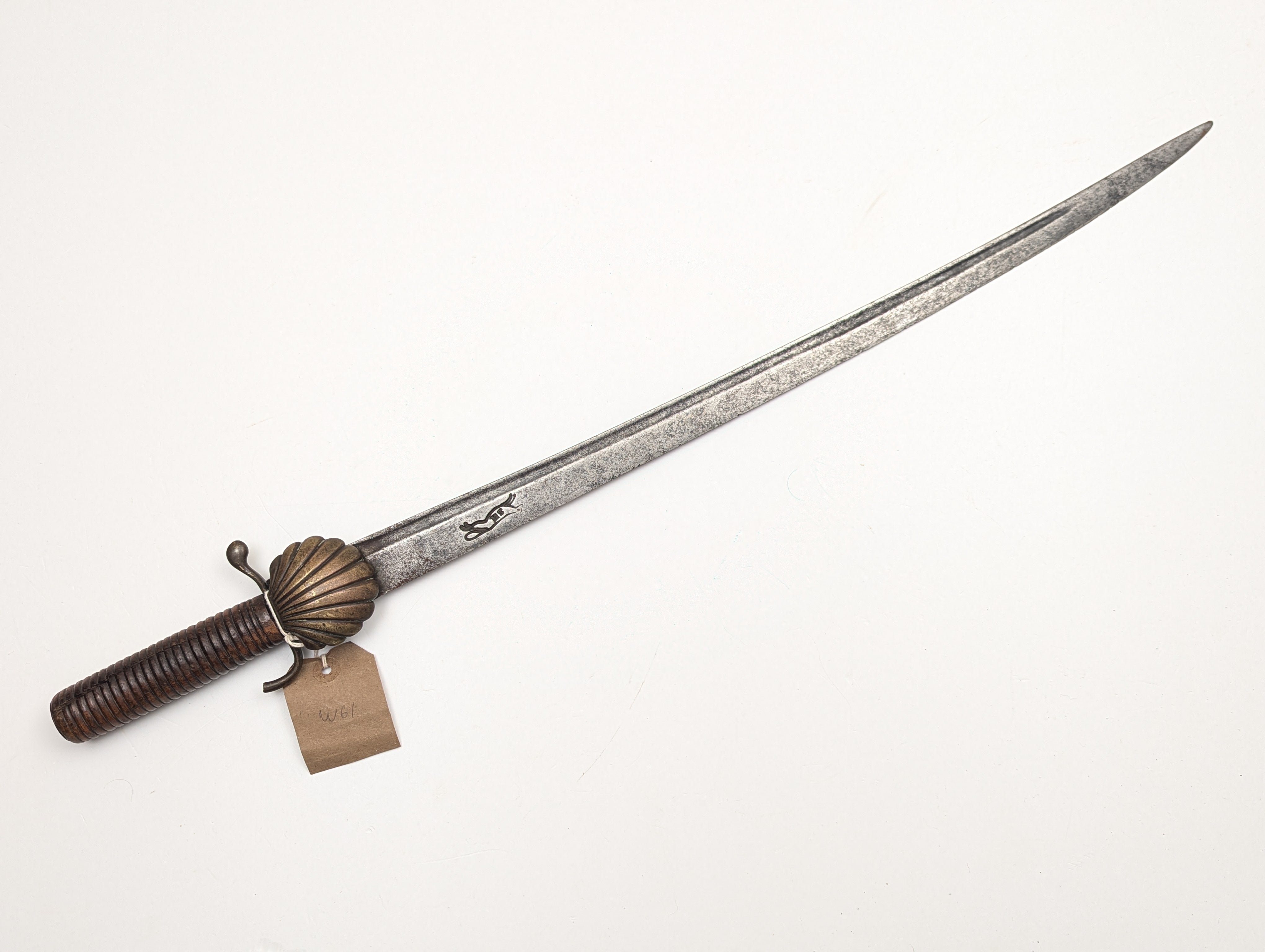
Hunting Hanger, Harvey. A hunting hanger marked with the running fox of Samuel Harvey on both sides. The pommel indicates it most likely belonged to the Hope family, a lowland clan with the motto "At Spes Non Fracta".  One quillon absent.  "
  • Nation : Japanese
  • Local Price : £175.00
20th Century Japanese Gilded Soft Metal Dragon Decorated Kogai For Japanese Wakizashi Sword Fittings. ED 3057 -. This Kogai has been examined by UK Japanese sword expert Bill Tagg. His descriptive note accompanies the Kogai. His note reads “Japanese Kogai (scabbard side knife / bodkin). Gilded soft metal with blackened background to Dragon detail in panel. Looks mid 20th century made. In very good condition suitable for wakizashi size sword”. The price includes UK delivery. ED 3057 (in Tanto box armoury)
  • Nation : Swedish
  • Local Price : £170.00
Swedish m/1914 Mauser Carbine Bayonet by Eskilstuna Jernmanufactur. Introduced in 1894 for horseback and naval use, the m/94 carbine version of the 6.5x55mm Swedish Mauser did not originally come with a bayonet, but the cavalry, artillery and navy all demanded one, the navy even modifying a small number of rifles to accept the m/1867 yataghan bayonet in the interim. Prototypes were developed from around 1909, including a folding type, but were deemed unsatisfactory until the experimental model of 1913, which was trialled between 1913 and 1915, and adopted as the m/1914. A new nose cap with a bayonet mount was introduced for the rifle at the same time. Some were also used by Swedish troops serving as UN peacekeepers in the Congo between 1960-64, fitted onto the C version of the Carl Gustaf m/45 submachine gun. The Royal Guards at Stockholm Palace still carry the m/94 carbine and bayonet today. The blade is stamped at the ricasso with the maker’s mark ‘EJAB’ with an anchor impaling the letter ‘E’, indicating the manufacturer Eskilstuna Jernmanufactur AB (Eskilstuna Iron Manufacturing, Inc). This was a private tool & cutlery manufacturer which produced bayonets for the Swedish military, based in the industrial city of Eskilstuna which also housed a state arsenal. The locking button, tang of the blade and finial of the scabbard are all stamped with a crown inspection mark. The blade is bright with some light frosting and some small spots of patination, retaining its blued band at the ricasso. The scabbard, hilt and pommel retain most of their blued finish, with rubbing on raised edges revealing bright steel. The wood scale grips are good with a few small dents and a short scratch on one side. The locking mechanism is fully functional and the bayonet sheaths and draws smoothly.
  • Nation : -
  • Local Price : $169.00
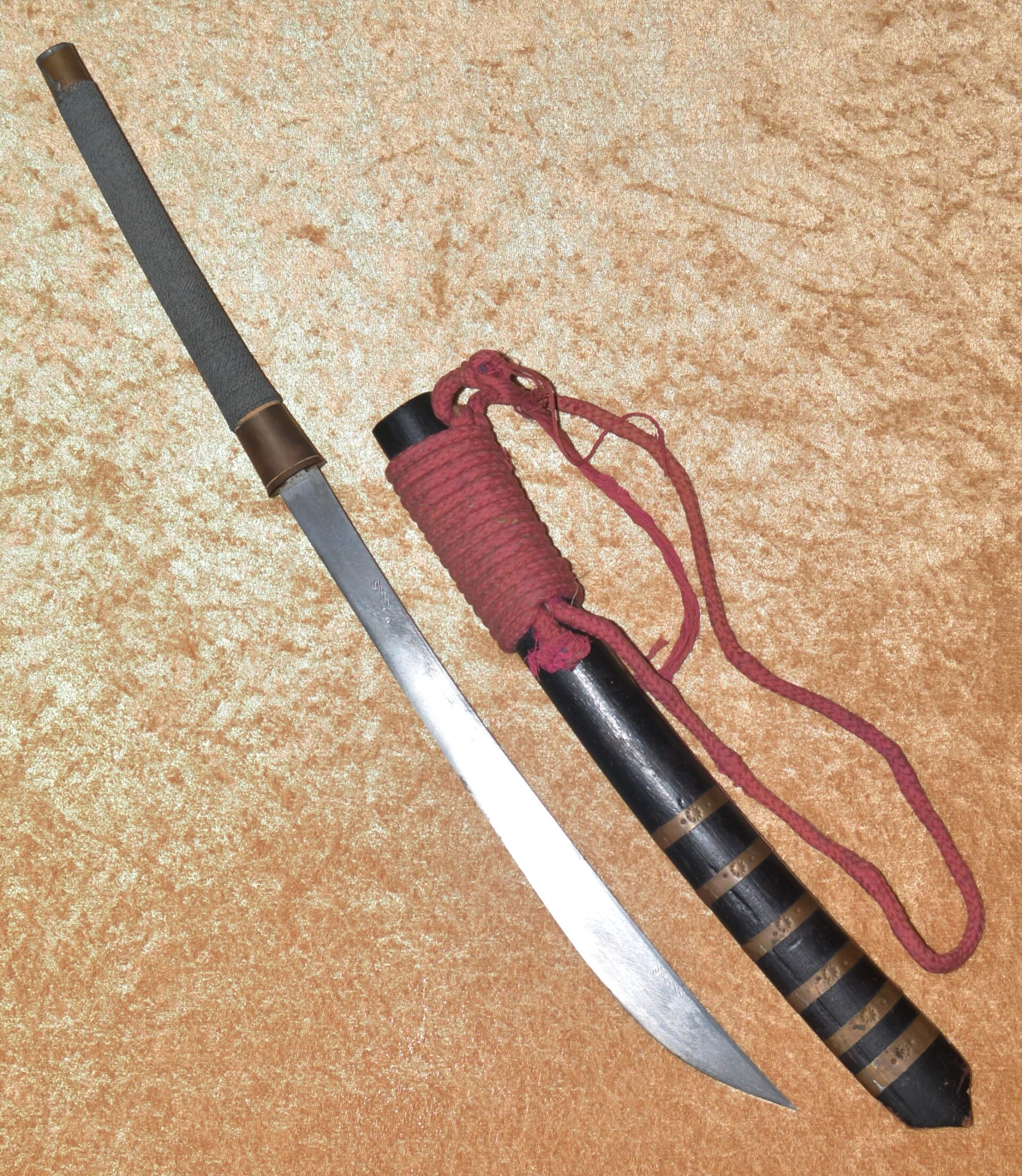
Burmese Dha Short Sword, 20th C. The Dha is a traditional single-edged, slightly curved sword from Myanmar, used historically for combat, utility, and ceremonial purposes across Southeast Asia. This example with 14 1/2″ slightly curved single-edged blade, broadening toward the very sharp point, and stamped with a segmented “C” on one side; the spine with one set of 8 inscribed notches and another set of 7. Tapering 9″ wood hilt, wrapped with twisted iron wire and soldered brass ferrules top and bottom, the top with flat pommel cap with small button. Black-painted wood scabbard with six brass bands and red textile cord wrap and carry loop. Blade with patches of light pitting and several sets of incised notches, the purpose of which is unknown. Shows light wear. Overall length 23 1/2″, not including scabbard.
  • Nation : British
  • Local Price : £230.00
British Lee Enfield No. 7 Mk 1 Land Service Bayonet, Dated 1946 by Poole. Single-fullered bowie knife blade with clipped point, blued for 5mm at the ricasso. Red-brown grips made of Paxolin (resin-impregnated paper, similar to Micarta, and widely used today in circuit boards). Steel scabbard with brass throat piece and circular frog stud. Blue canvas 1937 Pattern Royal Air Force frog with retaining loop. Hilt and pommel lacquered. The blade is stamped on one side at the ricasso with ‘No 7 MK 1/L’ and on the other side with a ‘P’ within a circle indicating the manufacturer Poole, as well as the manufacture date ‘1946’. The pommel is stamped on one side with a broad arrow War Department mark and on its base with some faint numbering, possibly ‘114’. The exposed track for the sliding button is stamped with a broad arrow War Department mark and faint lettering. The frog stud of the scabbard is stamped with a mark indicating manufacture at the Royal Small Arms Factory at Enfield: a superimposed letter E and D, resembling a D with a horizontal strikethrough. The reverse of the frog is faintly inked with some lettering (illegible). The rear side of the scabbard has been daubed with a patch of yellow paint, almost all hidden by the frog when it is fitted. The penultimate model of bayonet designed for the Lee-Enfield No. 4 rifle and Sten Mk 5 submachine gun, the No. 7 was an attempt to produce a bayonet that was equally useful as a utility/fighting knife and a mounted bayonet, by way of an innovative rotating pommel which contains the locking mechanism. 330,000 were produced between 1944 and 1948, but doubts about the rigidity of the mechanism under stress and its high cost of manufacture meant that the No. 7 was largely passed over for the simpler No. 9. The bayonet designed for the ill-fated EM series of experimental bullpup service rifles was essentially a strengthened No. 7.
  • Nation : Japanese
  • Local Price : £165.00
Victorian Era Japanese Tourist Export Tanto Dagger With Ornately Hand Carved Ox Bone Handle & Scabbard. Sn 23362 -. This is an excellent original late 19th Century Japanese Tanto With Beautiful Carved Ox Bone Handle & Scabbard no doubt a Tourist export piece. The Tanto has a sharp 5 ½” single edged blade and measures 8 ¾” overall length (9 ¾” in its scabbard). The blade has no damage and just areas of staining consistent with age. Its handle and scabbard made of the bone from the shin of an Ox are ornately hand carved with attractive imagery of Japanese Noblemen & Monk characters dressed in traditional Japanese Costume. The bone has even aged patina. The scabbard has a holed bone peg for hanging cord. The price for this hand crafted Japanese piece includes UK delivery. Sn 23362 (in tanto box floor armoury)
  • Nation : South African
  • Local Price : £220.00
British / South African Lee Enfield 1907 Pattern Bayonet, Dated 1917 by Wilkinson. Straight single-fullered knife blade, steel hilt with muzzle ring, wood slab grips secured by two screws, steel beaked pommel with oil hole and locking button. Black leather No. 1 Mk 2 scabbard with steel locket & teardrop-shaped frog stud and steel chape piece. Brown leather belt frog with buckled scabbard retaining strap. The ricasso is stamped on one side with a crown over 1907 (the pattern) ‘8 ‘17’, indicating the manufacture date of August 1917, and the maker’s mark ‘Wilkinson’. On the other side it is stamped with a ‘broad arrow’ War Department stores mark, three crown inspection marks with ‘E’ from Enfield, a reissue date stamp ’27 for 1927 and an ‘X’ indicating that it passed a manufacturer’s bending test. The front of the belt frog is stamped with ‘42’ and a ‘U’ containing a broad arrow, the government ownership mark of the Union of South Africa. The leather of the scabbard is faintly stamped with the manufacture date ’15. The scabbard’s chape is stamped beside the staple with ‘RE’ within a circle, suggesting manufacture by Remington. On the rear of the frog’s belt loop is written ‘C T Overbeck 70438296’, which seems to be a name and perhaps service number. Above this is a crossed-out name in a different hand, harder to read. The blade has a matte grey parkerised finish other than a blued band at the ricasso, with no edge damage. The wood grips have no damage or noticeable dents. The hilt, pommel and scabbard parts all have a blued finish, this has worn in places but a dark patina matches it. Likewise the scabbard fittings, blued with some patinated wear, one very shallow dent to the chape piece. The scabbard leather is undamaged with a few minor impressions, the frog is flexible with no damage to the stitching.
  • Nation : British
  • Local Price : £210.00
British Lee Enfield 1907 Pattern Bayonet, Chromed with Unusual Reverse Seam Scabbard. Straight single-fullered knife blade, steel hilt with muzzle ring, wood slab grips secured by two screws, steel beaked pommel with oil hole and locking button. Black leather No. 1 Mk 2 scabbard with reversed seam, steel locket & teardrop frog stud and steel chape piece. White leather parade frog. The ricasso is stamped on one side with a crown over G.R., 1907 (the pattern), a very faint manufacture date stamp which I believe reads 12 ‘16, which would indicate December 1916, and the maker’s mark ‘Wilkinson Pall Mall’. On the other side it is stamped with a ‘broad arrow’ War Department stores mark, four crown inspection marks with ‘E’ from Enfield, the reissue date ‘18 and an ‘X’ indicating that it passed a manufacturer’s bending test. The leather section of the scabbard is stamped with a diamond-shaped manufacturer’s mark. The reverse of the frog is stencilled with the serial number ‘593’ and inked with the name ‘Connolly’ and some indistinct numbers, probably a soldier’s name. The stand-out feature on this bayonet is its unusually constructed scabbard, which has its seam running down the front panel on the same side as the frog stud, the reverse of the usual arrangement. ‘Double-stitched’ scabbards with seams on both the front and back sides were produced in Australia in the 1920s, which allowed smaller pieces of leather to be used in their construction, but why one would be produced anywhere with this single reversed seam is unclear. All metal parts of the blade and scabbard have been chrome plated. This plating has worn in places, particularly the pommel and along the edge of the blade. Some small nicks to the blade’s edge, particularly towards the point. The wood grips are undamaged with only a few tiny dents. Some light rubbing to the scabbard leather on its flat face (the inside as worn). No dents to the scabbard fittings.
Page 111 of 119