
Show

Forgot your password?

Error message here!

Error message here!

Error message here!

Error message here!

Show Error message here!

Show Error message here!

Lost your password? Please enter your email address. You will receive a link to create a new password.

Error message here!

Back to log-in

Close

For Sale

The following items are listed by for sale by users of the site and dealers. They are in no way endorsed or guaranteed by www.antiquearmsresearch.com

Add a Classified Item
to

Clicking on the sword will take you through to the relevant classified item or dealer site.
Don't miss out! - Do you want to be kept informed weekly of new aditions? Just join our weekly update list.

You can also receive regular email notifcations when items match your keywords. To recieve them just register or logon at the top right of this page.

Page 112 of 119
  • Nation : British
  • Local Price : £210.00
British 1887 Pattern MkIII Martini Henry Sword Bayonet by Wilkinson. Straight unfullered spear-pointed blade. Steel hilt with comma-shaped quillon and stepped muzzle ring. Chequered leather grips (technically, knurled) secured by two steel rivets with washers. Black leather scabbard with steel mounts at the throat and chape, with frog hook. The blade is stamped at the ricasso on one side with a crown over ‘V.R.’ for Queen Victoria, an issue stamp 4 ’98 for April 1898, and the maker’s mark ‘WILKINSON SWORD COMPANY LONDON’. It is stamped on the other side with a War Department mark of a broad arrow over ‘WD’, a crown inspection mark with ‘W’ for Wilkinson and an ‘X’ indicating the blade passed a manufacturer’s bending test. The spine of the blade is stamped with two further crown inspection stamps for Wilkinson. The scabbard is stamped at the throat with the serial number ‘6843’. The throat piece of the scabbard is stamped under the staple on the front side with a crown inspection mark. The reverse of the scabbard is stamped next to the seam with further marks - these usually consist of another broad arrow over ‘WD’ and another crown inspection mark but are illegible on this example due to rubbing. The 1887 Pattern bayonet was introduced into service in the face of the ‘British Bayonet Scandal’ – a controversy (eagerly whipped up by the media) that British Army bayonets were made of inferior metal and/or badly heat-treated, and the Army was outsourcing blade manufacture overseas to the detriment of British industry. The Government responded by centralising bayonet manufacture as much as possible at the RSAF in Enfield. However, Enfield was already overstretched and would not be able to manufacture the new pattern for some time. A tender was put out for private manufacturers to fill the gap – German manufacturers made the cheapest offers but politics moved the government to choose the British firm Wilkinson of Pall Mall. This contract was instrumental in the rise of Wilkinson as a company and they manufactured around 42,000 1887 Pattern MkIIIs in 1888 and 1889, which made up 83% of the total supplied. The blade has a light patina with some old polishing marks – it appears to have been refinished during its service life as the issue stamp is fresher and less rubbed than the maker’s mark next to it. Only a couple of very tiny nicks to the edge, not readily visible. The hilt and pommel have light patination in their recesses. The leather grips have some moderate handling wear that has somewhat smoothed the knurling, some small spots of losses to the leather on one side. The chape piece of the scabbard has some light dents, these do not interfere with sheathing and drawing. The leather of the scabbard has surface rubbing and some spots of abrasion near the throat and beside the seam. All its stitching remains intact.
  • Nation : -
  • Local Price : £150.00 GBP
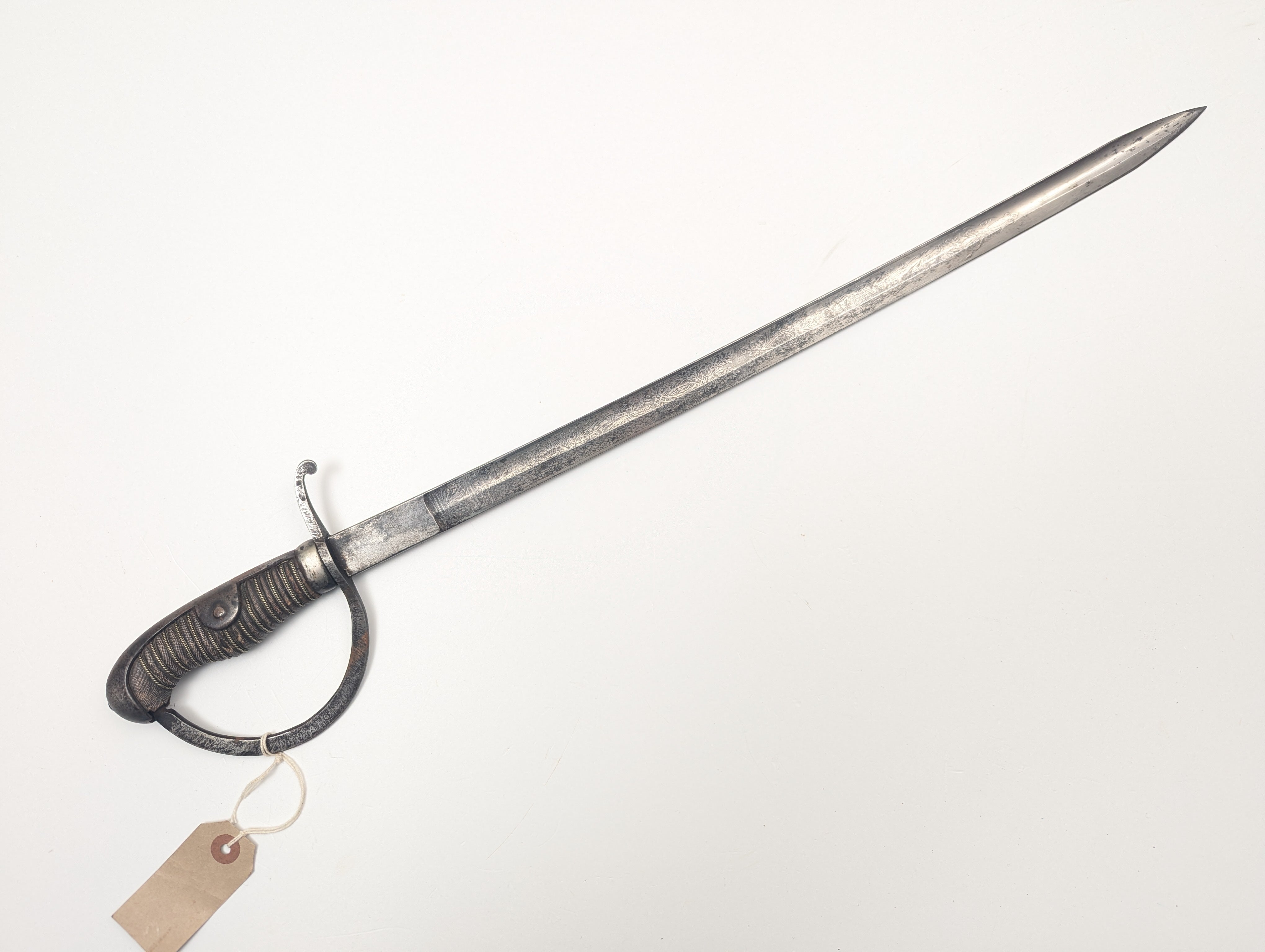
Ottoman Officer's Short Sword. A WW1-era Ottoman Officer's Short Sword"
  • Nation : French
  • Local Price : £145.00
French M1886/93/16/35 Lebel Bayonet. Cruciform shortened spike blade, steel hilt with muzzle ring, brass grip, tubular steel scabbard. Brown leather frog, outer side painted black. Blade 33.5cm (13¼ inches) in length, the bayonet 45.5cm (~18 inches) overall. The hilt is stamped with a serial number which is beneath paint, making it only partly legible. The blade has an inspection mark ‘T’ to the forte. The 1886/93/16 bayonet pattern fitted to the M1886 Lebel and M1907 Berthier rifles used by the French Army during WW1, and was the third version of the M1886 (which was revised in 1893 and 1916). This version had a simplified flat locking button and was manufactured without the quillon found on earlier types. The brass handle was another expediency measure to increase production – German silver (cupro-nickel-zinc alloy) was the original material. In 1935 many of the various types of Lebel bayonets in the French arsenals had their blades shortened to 13¼ inches by removing the slender tip and repointing. The shorter blades were considered less prone to breakage, and perhaps with the decline of the bayonet in warfare additional reach was less important than ease of carry. The scabbards were also modified to match – this one has been cut down to size by removing the lower section, with the chape end (with drainage hole) then reattached by brazing. The blade has some spots of patination, particularly towards the reshaped tip. The scabbard has a few small dents and some losses to the black gloss paint, revealing patinated steel. The hilt has the same black paint, in the same condition. The brass grip has tiny dents. The leather frog is flexible, with all if its stitching intact. There is one small tear to the edge of the leather on the rear side belt loop, not enough to threaten its integrity. Some surface cracking to the unpainted rear side, and rubbing of the paint in high-wear areas on the front side, revealing the brown leather.
  • Nation : Turkish
  • Local Price : 200.00 USD
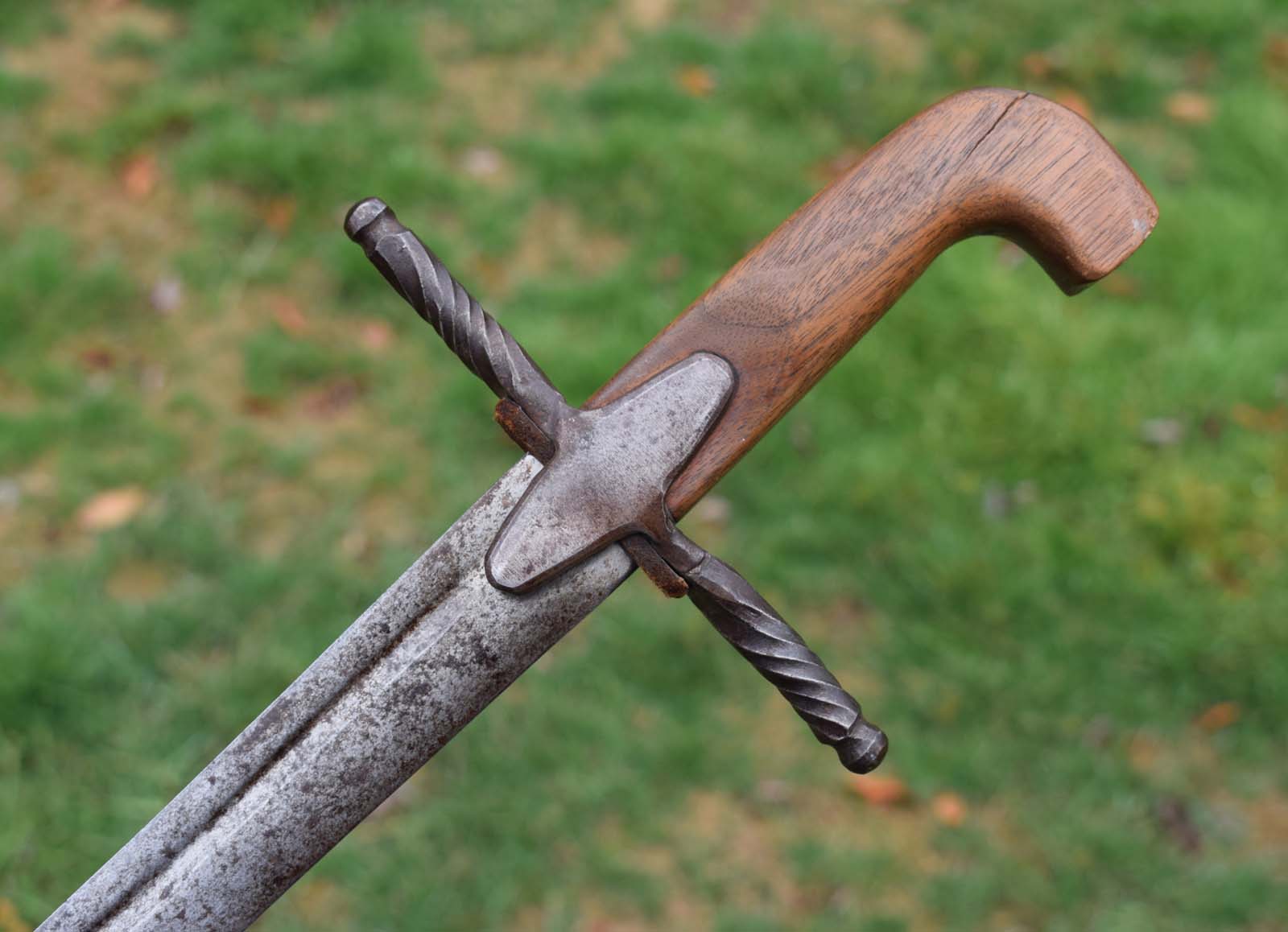
19th Century Turkish Or Hungarian Sword (shamshire)!. Here we have a wonderful Turk or Hungarian drastically curved saber! Blade is 31" long. Hilt has wonderful twisted iron guard and original wood "pistol" grip (some age cracks). A very impressive and very sturdy weapon! Selling at a bargain price! Price is firm. Thanks for looking! Be sure to check out our other listings for more great swords, arms and armor! Our direct email address is: [email protected]
  • Nation : East India Company
  • Local Price : £200.00
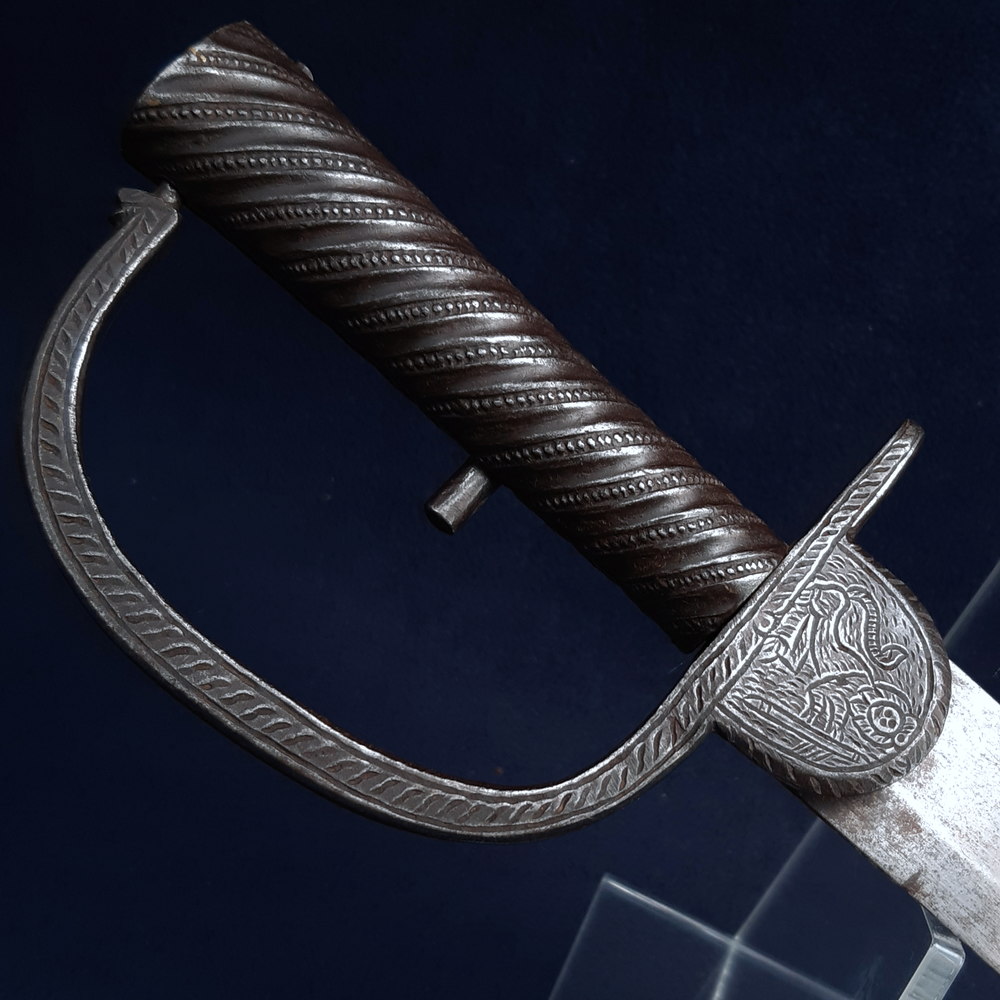
Indian or Nepalese 19th Century Baker-Style Bayonet. Straight, spear-pointed blade. Steel hilt with semioval langet on one side only and D-shaped knucklebow. Steel grip with beading and ribbing to its surface, formed of two halves brazed together, with mortise slot and inset steel leaf spring locking mechanism attached with a single screw. Blade 21 5/8 inches in length, 1.2 inches wide at the shoulder, with false edge for the last 5¾ inches, the bayonet 26 1/8 inches overall. The langet bears a chiselled design of a lion rampant with its paws on a staff with pennant or a flagpole – this resembles the badge of the East India Company, which was a lion rampant holding a crown between its forepaws, and it even more closely resembles the supporters of the Company’s coat of arms, which were lions rampant holding flags of St George on flagpoles. These bayonets are thought to have been manufactured in India or Nepal, probably to fit to locally-made percussion rifles made in the style of the British P1837 Brunswick rifle, this being cheaper than importing ‘official’ Brunswick bayonets. The design clearly harks back to the bayonet for the Baker rifle which preceded the Brunswick, that had been very popular among Indian troopers. Being local crafts purchased outside the Army procurement structure they carry no production markings. Some were found in the huge cache of surplus arms kept at the Royal Palace in Kathmandu, Nepal, and sold off in 2008. See page 346 of British Commonwealth Bayonets by Skennerton & Labudda, or page 318 of British & Commonwealth Bayonets by Skennerton & Richardson, for an example of this model (referred to as I3) and discussion of several variations of the type. Skennerton notes that the higher quality versions are those with steel hilts – this would make sense given the cost of steel hilts over brass. The locking mechanism functions, although I have not tested whether it will fit to a Brunswick. The blade has some forging imperfections, light scratching and some small spots of patination and light cleaned pitting in places, particularly towards the tip, which is rounded by ~3mm. A number of tiny nicks to both edges, one small notch to the true edge. The hilt has a dark forged finish with light rubbing wear to raised edges showing bright steel. The blade is solidly peened to the grip, slight movement to the knucklebow & langet.
  • Nation : French
  • Local Price : 195.00 USD
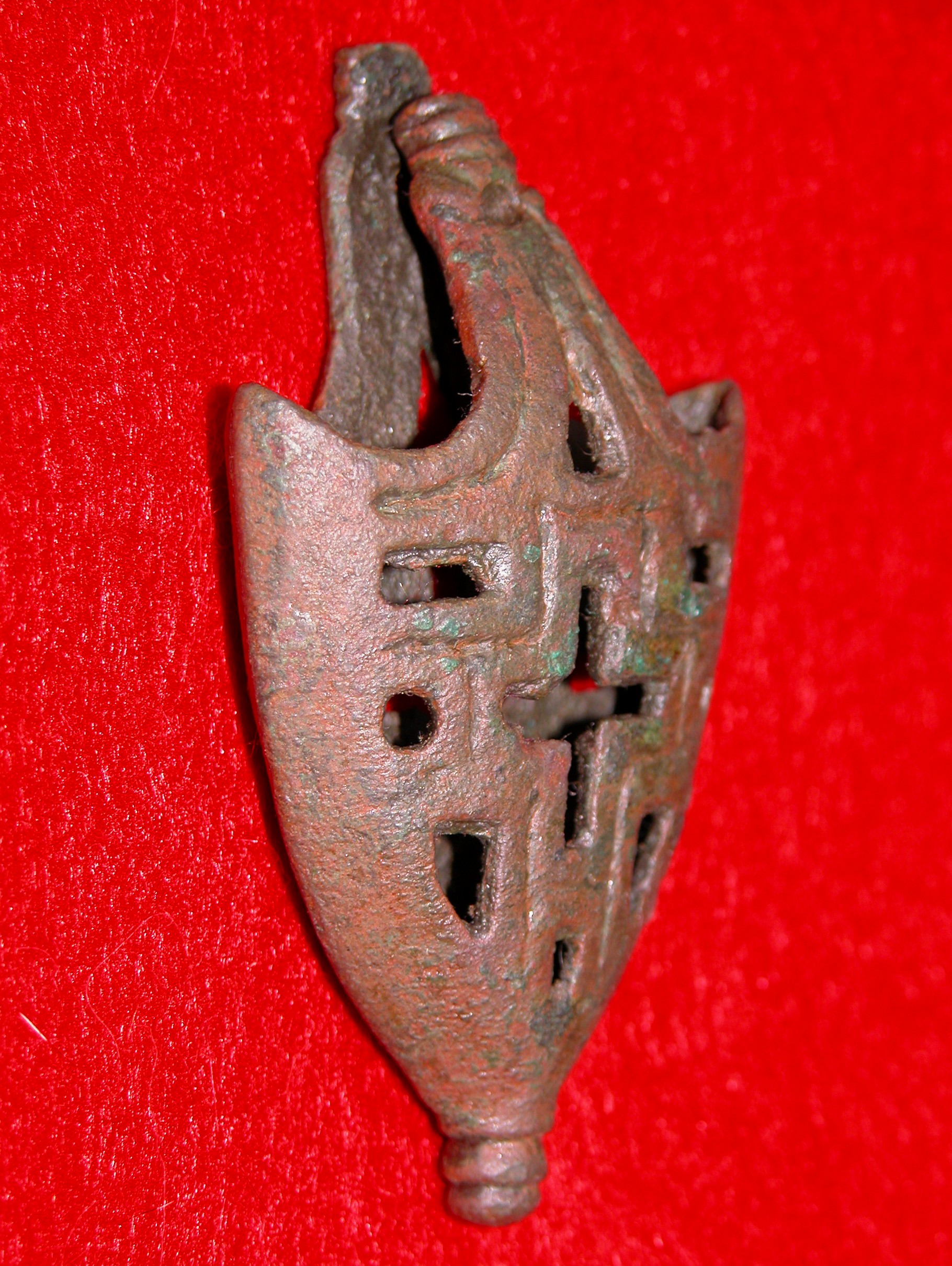
Crusader's Openwork Bronze Sword Scabbard Chape W/ Cross. #ac 123. Here is a very good decorated chape (drag) from a medieval sword circa 1200 AD. It was found in France with a metal detector in the late 20th century. It is in perfect condition with a slight bend from burial, see photo. It has a deep bronze/green patina overall. About 3†tall x 1 ½†wide. A nice example of early Christian art. The openwork is superb. Price is firm. Thanks for looking. Be sure to check out our other listings for more great swords, arms and armor! Our direct email address is: [email protected]
  • Nation : British
  • Local Price : £195.00
British Lee Enfield 1907 Pattern Bayonet, Royal Scots Fusiliers. Straight single-fullered knife blade, steel hilt with muzzle ring, wood slab grips secured by two screws, steel beaked pommel with oil hole and locking button. Black leather No. 1 Mk 2 scabbard with steel locket & teardrop frog stud and steel chape piece. Khaki canvas frog with retaining loop. The ricasso is stamped on one side with a crown over ‘GR’, 1907 (the pattern) ‘11 ‘18’, indicating the manufacture date of November 1918, the manufacturer’s mark ‘SANDERSON’, a crown inspection stamp and a reissue stamp dated ’21. On the other side it is stamped with a ‘broad arrow’ War Department stores mark, three crown inspection marks with ‘E’ indicating the Royal Small Arms Factory at Enfield, and an ‘X’ indicating that it passed a manufacturer’s bending test. The pommel is stamped with ‘R S F’, indicating issue to the Royal Scots Fusiliers, above ‘R534’, probably a rack number. The throat and chape pieces of the scabbard are both stamped with ‘RE’ within a circle, indicating the manufacturer Remington. The leather of the scabbard is stamped next to the seam with another crown inspection mark and the manufacture date ’17, these marks being faint from rubbing. The rear of the frog is inked with a faint maker’s mark, the manufacture date ‘1939’ and a broad arrow. Given the manufacture date I would not class this bayonet as WW1 issue, but from its reissue stamps it clearly did see some service with the Royal Scots Fusiliers in the interwar period. The regular battalions of that regiment continued to be deployed overseas during this period: the 1st Battalion spending time in Ireland, Palestine and India while the 2nd Battalion was deployed to the Black Sea region as part of the wider Allied intervention in the Russian Civil War that lasted from 1917-22, then to India and China. The blade is bright with a few spots of light patination, some grinding marks and small nicks to its edge near the tip. The wood grips have only a few light dents and remain quite glossy with little handling wear. The hilt, pommel and scabbard fittings are bright with a few spots of light patination. The leather body of the scabbard has some surface abrasions, shallow dents and thin shallow cuts. One crack to the lower section near the chape piece, running from one edge of the seam to the near side edge, then branching to run down that edge for about 2cm. This has had the effect of slightly kinking the chape end to one side. This does not prevent sheathing and drawing and the scabbard remains solid, though one should take care when the blade is withdrawn. The scabbard’s stitching remains intact.
  • Nation : Unknown
  • Local Price : £185.00
An 1821 Pattern Militia Artillery Officers Sword..
Page 112 of 119