
Show

Forgot your password?

Error message here!

Error message here!

Error message here!

Error message here!

Show Error message here!

Show Error message here!

Lost your password? Please enter your email address. You will receive a link to create a new password.

Error message here!

Back to log-in

Close

For Sale

The following items are listed by for sale by users of the site and dealers. They are in no way endorsed or guaranteed by www.antiquearmsresearch.com

Add a Classified Item
to

Clicking on the sword will take you through to the relevant classified item or dealer site.
Don't miss out! - Do you want to be kept informed weekly of new aditions? Just join our weekly update list.

You can also receive regular email notifcations when items match your keywords. To recieve them just register or logon at the top right of this page.

Page 113 of 121
  • Nation : British
  • Local Price : £165.00
Indian WW2 1907 Pattern Mk II* Bayonet, by Jhelum Arsenal. Straight unfullered knife blade with clipped point and 2-inch false edge. Wood grips secured by two screws, beaked pommel with oil hole. Black leather scabbard with steel throat and chape. Blade 12 inches in length, the bayonet 16 5/8 inches overall. The bayonet is stamped on one side at the ricasso with ‘Mk. II’, the bayonet model, ’11 43’, meaning the bayonet was manufactured in November 1943, and ‘JU’, meaning the manufacturer was the Jhelum Arsenal (in what is now Pakistan). It is stamped on the other side with two Indian inspection marks. The throat piece of the scabbard is stamped next to the staple on one side with ‘C^117’, with ^ being a broad arrow War Department mark, and the number ‘8’ overstamped. The alphanumeric code may indicate a particular contractor and is similar to the British wartime numbering system for that purpose. The chape piece of the scabbard is likewise stamped on one side with ‘C^117’, with ‘I.M.’ overstamped. These bayonets were made to fit the many SMLE No. 1 rifles made at Ishapore. The Mk II began the process of progressive simplification of the 1907 Pattern in Indian service, having a new unfullered blade (the Mk I used shortened original blades) but the hilt, grips and pommel were all left unchanged. Later models modified the pommel and grips to further reduce the number of manufacturing steps required. The Mk II* was simply the Mk II with the addition of a false edge to the blade. You may notice that the model stamp is incorrect – this is certainly a MkII* due to its false edge, but the stamp shows ‘MkII’. Incorrect factory stamping is a known phenomenon with Indian bayonets, as well as failing to add stamps for conversions, factory repairs and so on. See British & Commonwealth Bayonets by Skennerton & Richardson, p348 and 349: they write that “ some of the MkII* conversions were not marked with the additional ‘*’ “. The blade, hilt and pommel retain their original blued finish. A few small dents to the wood grips, one small chip on one side next to the hilt. The scabbard leather is very good with only a few light dents and abrasions.
  • Nation : British
  • Local Price : £220.00
French Model 1831 Artillery Sidearm, Dated 1839 by Chatellerault. Straight double-edged blade, unfullered with diamond profile and spear point. One-piece cast brass hilt, grip and pommel, the hilt with circular finials, the grip ribbed, the pommel oval with a domed circular tang button. Black leather scabbard with brass throat and chape pieces, the throat piece with a frog loop, the leather section with two debossed lines lengthwise on the front face, similar on the reverse face but with one line being the stitching. Blade 48.8cm in length (just over 19 1/8 inches), the sword 63.9cm (just over 25 inches) overall. The blade is engraved on one side at the forte with the maker’s mark ‘Manufre Rale de Chatellerault’ (Manufacture Royale) and on the other side with ‘Fbre 1839’ next to which it is stamped with two French ‘poincon’ inspection stamps at the shoulder. The hilt is stamped on one side with the serial number ‘165’. The chape piece of the scabbard is faintly stamped with two poincons. The leather of the scabbard is stamped with the maker’s mark ‘GIRARD LOUIS A CHÂTELLERAULT’. Created in 1816, the Manufacture de Chatellerault, near Poitier, was a key arms factory for the French state. In the 1830s it took over from the Maubeuge, Charleville and Klingenthal plants, all of these being considered too close to the German border to be relied upon during a war. Girard Louis would have been a private contractor producing scabbards for the government plant, or possibly just their leather bodies. During the late 19 th and early 20 th centuries production of swords at Chatellerault decreased while firearms manufacture surged. Despite increasing use of machine tools and the nearing obsolescence of the sword, its blades were all hand-forged until 1916. Swordmaking there ceased in 1937. Sidearms with the form of a neoclassical ‘gladius’ appear to have originated with the French 1771 ‘Eagle Head’ Artillery sword. A series of very similar-looking short swords were subsequently designed, including the French 1816 & 1831 Artillery models, the US Model 1832 Foot Artillery, the Swiss 1842 Pioneer’s, the Russian 1848 Pioneer’s and the British 1855 Land Transport. They were simple and robust but not particularly useful for combat (the gladius having become obsolete for good reasons) so remained either ceremonial items or in the role of a machete for various field tasks such as clearing brush. Many examples of this type have been repolished, sometimes many times over to keep the brass bright, which results in surface wear and obscures markings. This example is one of two held in the same family by descent from a French ancestor since at least the late 19 th century (the other also for sale), and has been stored well but otherwise left alone, lending the brass an evenly aged patina. [Click here for the other example of the pair] The blade is unsharpened with multiple nicks to both edges. The blade has light speckled patination, with some spots of heavier patination including at the shoulder. A few small dents to the brass throat piece of the scabbard. The scabbard leather is good with some small dents on both sides and chunks of abrasion on the lower front face. All of its stitching is intact.
  • Nation : French
  • Local Price : £220.00
French M1892 Mannlicher Berthier 2nd Pattern Bayonet. Single-fullered straight blade, wood grips (meaning that this is the 2nd pattern, the 1st having composite grips) secured with two rivets. The blade has notches near the hilt which engage with a mechanism locking the blade into the scabbard. Steel scabbard, brown leather frog. Hilt with muzzle ring and quillon. The quillon has been reduced in size, a modification carried out during WW1. The quillon of the bayonet and the scabbard are both stamped with the serial number ‘8279’, indicating an original matching pair. Some light patination to the blade, hilt and pommel. The wood grips are undamaged. The scabbard has numerous small dents to its lower section. The leather frog is in good condition, with all stitching intact.
  • Nation : French
  • Local Price : £215.00
French M1892 Mannlicher Berthier 1st Pattern Bayonet. Straight blade with spear point, single fuller on each face as well as short fuller on the spine running to the tip. Black slab composition grips (meaning that this is the 1 st pattern, the 2 nd pattern having wood grips) secured to the exposed tang by two steel rivets. Hilt with muzzle ring overlapping the grip and a hooked lower quillon. Many M1892 bayonets had the quillon removed during WW1 – this example remains intact and original. Steel pommel with locking button. Steel scabbard with frog loop, brown leather frog of the correct type for the M1892, with strap and brass buckle. The bayonet’s quillon is stamped with a cursive F and the serial number ’38157’. The scabbard is also numbered on the frog loop band but because of the black paint that has been applied to it this number is illegible, so I cannot tell if the bayonet and scabbard are a matching pair or not. The scabbard has a small ‘S’ inspection mark next to the rivet hole on one side. The blade is bright with some light frosting and a few small spots of patination in the fullers. The edge of the blade has been sharpened with visible grinding marks – the tip has also been ground but is not particularly sharp, probably because of its thick point intended to pierce without breaking. The hilt, tang and pommel have areas of patination, the pommel some speckled cleaned light pitting. Some small indentations to the grip slabs. The scabbard has been painted gloss black – this is mostly intact with just a few small chips revealing steel. The rivet near the throat of the scabbard is missing. The leather frog has some surface rubbing and loss of stitching in places.
  • Nation : British
  • Local Price : £210.00
British Lee Enfield 1907 Pattern Bayonet, Ampleforth College Officers Training Corps. Straight single-fullered knife blade, steel hilt with muzzle ring, wood slab grips secured by two screws, steel beaked pommel with oil hole and locking button. Black leather No. 1 Mk 2 scabbard with steel locket & circular frog stud and steel chape piece. The ricasso is stamped on one side with a crown over ER, 1907 (the pattern) ‘10 16’, indicating the manufacture date of November 1916, the manufacturer’s mark ‘WILKINSON’, two crown inspection stamps with ‘E’ indicating the Royal Small Arms Factory at Enfield, and a reissue stamp dated ’27. On the other side it is stamped with a ‘broad arrow’ War Department stores mark, four more crown inspection stamps with ‘E’, a reissue stamp ’19 and an ‘X’ indicating that it passed a manufacturer’s bending test. The pommel is stamped with ‘O.T.C’ over ‘AMP’ over ‘170’. This indicates that this was bayonet number 170 used by the Ampleforth College OTC (Officers’ Training Corps). The leather of the scabbard is stamped next to the seam on one side with another broad arrow, the manufacturer’s mark ‘EFD’ for Enfield, another crown inspection mark with ‘E’, and the manufacture date ’26. On the other side of the seam is stamped a letter ‘W’ indicating that the scabbard leather was made with a waxed finish. The throat piece of the scabbard is stamped at the mouth with the serial number ‘223’, and next to the staple with another crown inspection mark. The chape piece is stamped next to the staple with ‘RE’, indicating that this component was manufactured by Remington in the United States. Most of the blade markings are somewhat rubbed yet are blued over, with the exception of the ’27 reissue stamp which looks crisper. Combining this fact with the 1926 manufacture date of the scabbard suggests to me that this bayonet may have been officially refurbished in around 1927 involving refinishing of the blade and fitting of a new scabbard. A large number of volunteer units sprang up across the United Kingdom during the late 1850s after a national appeal by the Secretary of State for War, due to a perceived threat of invasion of Britain by France. Oxford and Cambridge universities were quick to join in with the formation of their own units of Rifle Volunteers, and some schools also followed suit from 1860. As years went by the number of school volunteer units only increased until by 1898 there were 39, with another surge of interest due to the Boer War nearly doubling that number by 1902. These units provided early experience for young men who would then be in a good position to move up to the university units and perhaps a military career afterward. There was lively competition between Corps for shooting prizes in particular – although it may be said that success came in part with a school’s willingness to spend on equipment and training. The Officers’ Training Corps were established in 1906 as part of the wide-ranging Haldane Reforms to the British Army’s structure. The OTCs were intended to alleviate the shortage of trained officers in the various volunteer units (Militia, Yeomanry, Volunteer Force and Reserve of Officers) by forming a system of junior training units in public schools and senior ones in universities. Some of the junior OTCs were formed out of the existing school Cadet Corps, which by this date numbered more than fifty, while senior OTCs were often formed from the university units. Ampleforth College’s OTC was established in 1911, relatively late and with no previous history of Cadet activity at the school. 9 boys from its OTC were gazetted as Army officers from its founding up to 1914. During WW1 the OTCs became training units for supplying officers to the regiments, an OTC Certificate generally being considered full qualification to become an officer, although some individuals chose for various reasons to enlist in the ranks. Ampleforth OTC supplied 24 officer recruits and 15 other ranks between August 1914 and March 1915. During WW2 a group of related officers who trained in the OTC together at Ampleforth in the 1920s came to play key roles in the British special forces – David Stirling and his brother William joined the SOE then were founding members of the SAS, while their cousin Simon Fraser, 15th Lord Lovat, led 4 Commando at Dieppe and the Special Service Brigade at the Normandy landings. The Ampleforth College Corps still exists today as part of the Combined Cadet Force (CCF), with Army and RAF contingents. Under the modern Army structure it serves as a leadership and training organisation, teaching a number of military skills but with no obligation to go on to full military service. The blade has a matt parkerised finish with some small spots of light patination. No damage to its edge, which is sharp, while its tip is very fractionally rolled. The blued band at the shoulder of the blade is intact although as noted may have been refinished during its service life. The hilt, exposed tang, pommel and scabbard fittings are blued with some light rubbing on raised edges, most notably the locking button. Some very small spots of rust patination on the pommel end. A few small dents to the wood grips. The leather scabbard body has some light dents and surface abrasion to the otherwise glossy waxed finish. All the scabbard’s stitching remains intact.
  • Nation : US
  • Local Price : £210.00
US M1873 Socket Bayonet for the Springfield Trapdoor Rifle, Pennsylvania National Guard. Socket bayonet for the Model 1873 .45-70 Springfield Trapdoor rifle, with fullered triangular blade and steel scabbard. Scabbard with drainage hole and frog hanging hook, black leather frog with rotating belt loop. The brass swivel of the belt frog is also cast with ‘N.G.P.’ indicating that it was made for the Pennsylvania National Guard. The leather inside of the scabbard loop is also roughly inscribed with ‘WM’, presumably a soldier’s initials. The last model of standard-issue socket bayonet, the M1873 was used with the 1873 and 1879 ‘Trapdoor’ Springfield rifles, until 1884 when the new model introduced a rod bayonet. The blade is bright with some patination, likewise the socket apart from the shank, which has bluing. The scabbard body is free of dents, it has been painted black with substantial flaking to the paint revealing patinated steel, particularly along edges. The leather frog is partly cracked along the seam attaching the semicircular ‘ear’ piece to the scabbard loop – it can support its own weight but should be handled with care. Some rubbing to the leather frog, surface flaking to the belt loop in places. The loop still rotates freely. One small dent to the flat side of the scabbard body.
  • Nation : British
  • Local Price : £210.00
British 1887 Pattern MkIII Martini Henry Sword Bayonet by Wilkinson. Straight unfullered spear-pointed blade. Steel hilt with comma-shaped quillon and stepped muzzle ring. Chequered leather grips (technically, knurled) secured by two steel rivets with washers. Black leather scabbard with steel mounts at the throat and chape, with frog hook. The blade is stamped at the ricasso on one side with a crown over ‘V.R.’ for Queen Victoria, an issue stamp 4 ’98 for April 1898, and the maker’s mark ‘WILKINSON SWORD COMPANY LONDON’. It is stamped on the other side with a War Department mark of a broad arrow over ‘WD’, a crown inspection mark with ‘W’ for Wilkinson and an ‘X’ indicating the blade passed a manufacturer’s bending test. The spine of the blade is stamped with two further crown inspection stamps for Wilkinson. The scabbard is stamped at the throat with the serial number ‘6843’. The throat piece of the scabbard is stamped under the staple on the front side with a crown inspection mark. The reverse of the scabbard is stamped next to the seam with further marks - these usually consist of another broad arrow over ‘WD’ and another crown inspection mark but are illegible on this example due to rubbing. The 1887 Pattern bayonet was introduced into service in the face of the ‘British Bayonet Scandal’ – a controversy (eagerly whipped up by the media) that British Army bayonets were made of inferior metal and/or badly heat-treated, and the Army was outsourcing blade manufacture overseas to the detriment of British industry. The Government responded by centralising bayonet manufacture as much as possible at the RSAF in Enfield. However, Enfield was already overstretched and would not be able to manufacture the new pattern for some time. A tender was put out for private manufacturers to fill the gap – German manufacturers made the cheapest offers but politics moved the government to choose the British firm Wilkinson of Pall Mall. This contract was instrumental in the rise of Wilkinson as a company and they manufactured around 42,000 1887 Pattern MkIIIs in 1888 and 1889, which made up 83% of the total supplied. The blade has a light patina with some old polishing marks – it appears to have been refinished during its service life as the issue stamp is fresher and less rubbed than the maker’s mark next to it. Only a couple of very tiny nicks to the edge, not readily visible. The hilt and pommel have light patination in their recesses. The leather grips have some moderate handling wear that has somewhat smoothed the knurling, some small spots of losses to the leather on one side. The chape piece of the scabbard has some light dents, these do not interfere with sheathing and drawing. The leather of the scabbard has surface rubbing and some spots of abrasion near the throat and beside the seam. All its stitching remains intact.
  • Nation : British
  • Local Price : £150.00
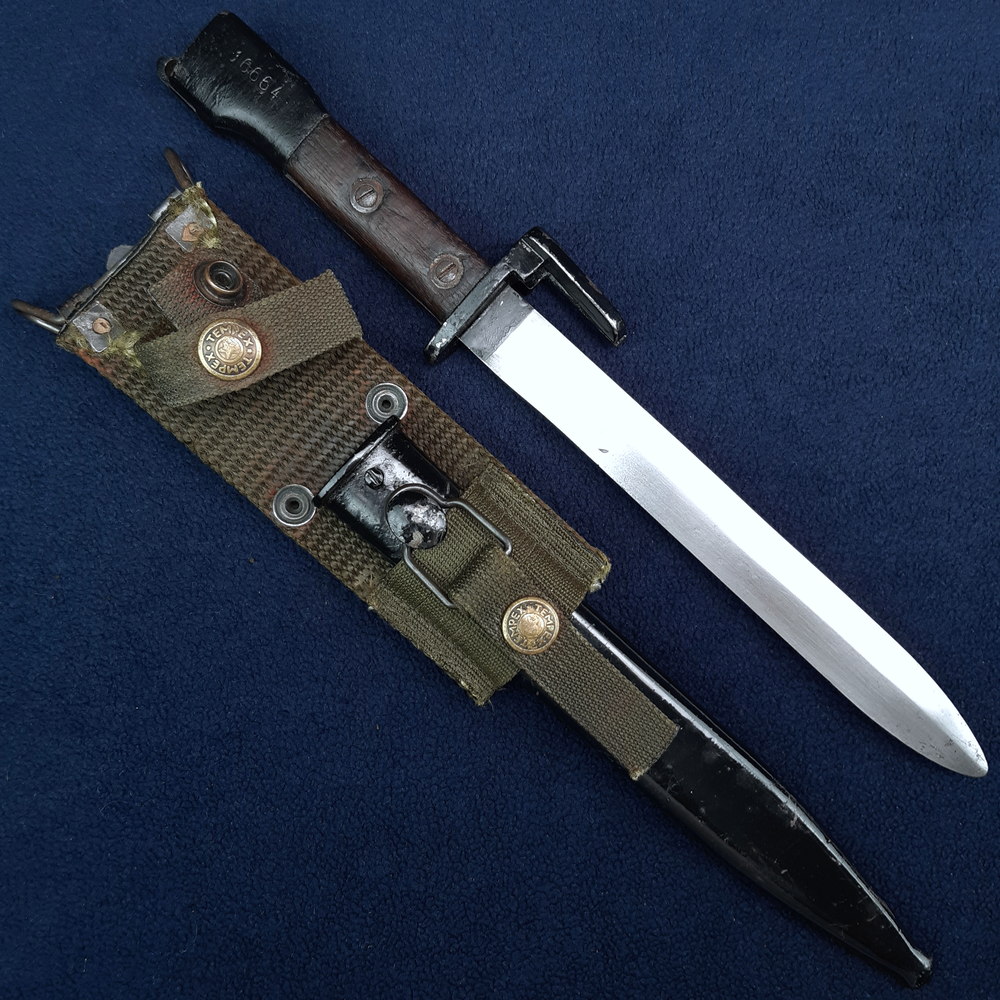
Argentine Type A Knife Bayonet for the FN FAL with Tempex Frog, Falklands War, Early Export Model. Spear-pointed knife blade with partial false edge. Steel hilt with muzzle ring and integral flash-hider prongs, wood grip scales held by two screws, exposed tang, steel pommel. Steel scabbard with frog hook and ball finial, green nylon frog with retaining strap, plastic belt grip and wire hooks. Blade 7.68 inches (19.5cm) in length, the bayonet 12.4 inches (31.5cm) overall. The bayonet is stamped on the pommel with the serial number ’16664’. The scabbard body is stamped beside the mouth with ‘20715’. The FN FAL infantry rifle and its bayonet were adopted by Argentina in the late 1950s, initially purchased from FN in Belgium but later made domestically by Argentine manufacturers. Several types of bayonet and webbing attachments were used by the Argentinean Army and Marines during the Falklands conflict: the knife model with distinctive flash-hider ‘prongs’ on its muzzle ring was the ‘Type A’ bayonet, which fitted to the early FALs. Its blade was based upon the US M4. This was used side by side with the tubular ‘Type C’ model, which was introduced when a 22mm muzzle device was added to the FAL in 1962. The scabbards are not interchangeable between Types, the blades being of different shapes. This example is the early Belgian export model, shown by the smooth wood grip scales – the domestic Argentine type used ribbed plastic. The style of its stamped serial number indicates its Argentine service. Belt frogs for these bayonets are made of either leather or nylon fabric: the ‘Correaje Argentino de Cuero’ (Argentine Leather Belting) load-bearing system made of green-dyed leather was introduced around 1970, but incorporated some preexisting elements including leather frogs and pistol holsters, which were then painted green to match. The nylon ‘Correaje Tempex’ (Tempex Belting) was introduced in the early 1980s to replace it which included a new frog. Both forms of load-bearing system were still in use by 1982 so both were carried in the Falklands. Either frog will fit either Type of bayonet. After Argentine forces surrendered to the British on June 14 1982 their small arms were piled up by the thousand in the Islands’ capital Port Stanley, where most Argentine forces had been deployed or driven back to. A large quantity of arms had also been captured earlier at Goose Green, which was a key ammunition dump for the Argentine forces, and still more were gathered later from unengaged Argentine garrisons on the island of West Falkland. The FAL rifles became British government property and were either brought to the UK or dumped at sea, while bayonets and the short machete-like officer’s sidearms frequently became personal trophies or souvenirs for British soldiers as they would not be illegal to own in civilian life. This example is most likely one such ‘bring-back’. The blade is bright with small spots of light patination & cleaned light pitting, its edge unsharpened with a couple of small nicks, the tip rounded. The grips have light handling wear, a small hole next to the pommel and hairline crack on one slab, one chip next to the tang on the other. The hilt, pommel, exposed tang and scabbard have been painted black, plus a 1cm wide band at the base of the blade. This paint is in unusually good condition with only minor chipping on raised edges, eg flash hider prongs, exposing bright steel. The frog has some spots of light fraying above the retaining strap. The pair of rivets at the top of the frog holding the belt hook bracket appear to be replacements made of copper or brass with roughly square steel backing washers - originals would have matched the steel rivets lower down. Perhaps the brackets holding the wire hooks failed and needed repair.
Page 113 of 121