
Show

Forgot your password?

Error message here!

Error message here!

Error message here!

Error message here!

Show Error message here!

Show Error message here!

Lost your password? Please enter your email address. You will receive a link to create a new password.

Error message here!

Back to log-in

Close

For Sale

The following items are listed by for sale by users of the site and dealers. They are in no way endorsed or guaranteed by www.antiquearmsresearch.com

Add a Classified Item
to

Clicking on the sword will take you through to the relevant classified item or dealer site.
Don't miss out! - Do you want to be kept informed weekly of new aditions? Just join our weekly update list.

You can also receive regular email notifcations when items match your keywords. To recieve them just register or logon at the top right of this page.

Page 118 of 120
  • Nation : German
  • Local Price : Price on request
Very Rare German Lansknecht Katzbalger Sword Circa 1540-60:. 323) Very Rare German Lansknecht Katzbalger Sword Circa 1540-60: Beautiful sword for sale. The Katzbalger sword is a rare short close combat sword for the Landsknecht mercenaries in 16th century Germany. It has a thick double blade with a circular point and a highly defensive circular eight guard. This example was found in a city wall. From one of the best private collections in the world. Contact Me To Get The Latest Lowest Price Possible From The Owner*
  • Nation : German
  • Local Price : Price on request
GERMAN BROADSWORD WITH SCALLOPED SHELL GUARD CIRCA 1600:. Description: Long, wide, curving single-edged blade with a long, double-edged point,  fuller at the top running concurrently with the false edge about two-thirds the length of the blade, steel hilt vertically recurved quillons with circular-shaped tips, shell-shaped knuckle guard, shell-shaped inner ring guard, thumb loop; beautiful, circular pommel. Old replaced grip with Turks Heads. Length: 35 inches. Comparable: a near identical example is found in the Royal Collection at the Tower of London. Conclusion: A very elegant broadsword that would make a great addition to any collection. Very well priced for a quick sale!!!*
  • Nation : British
  • Local Price : Price on request
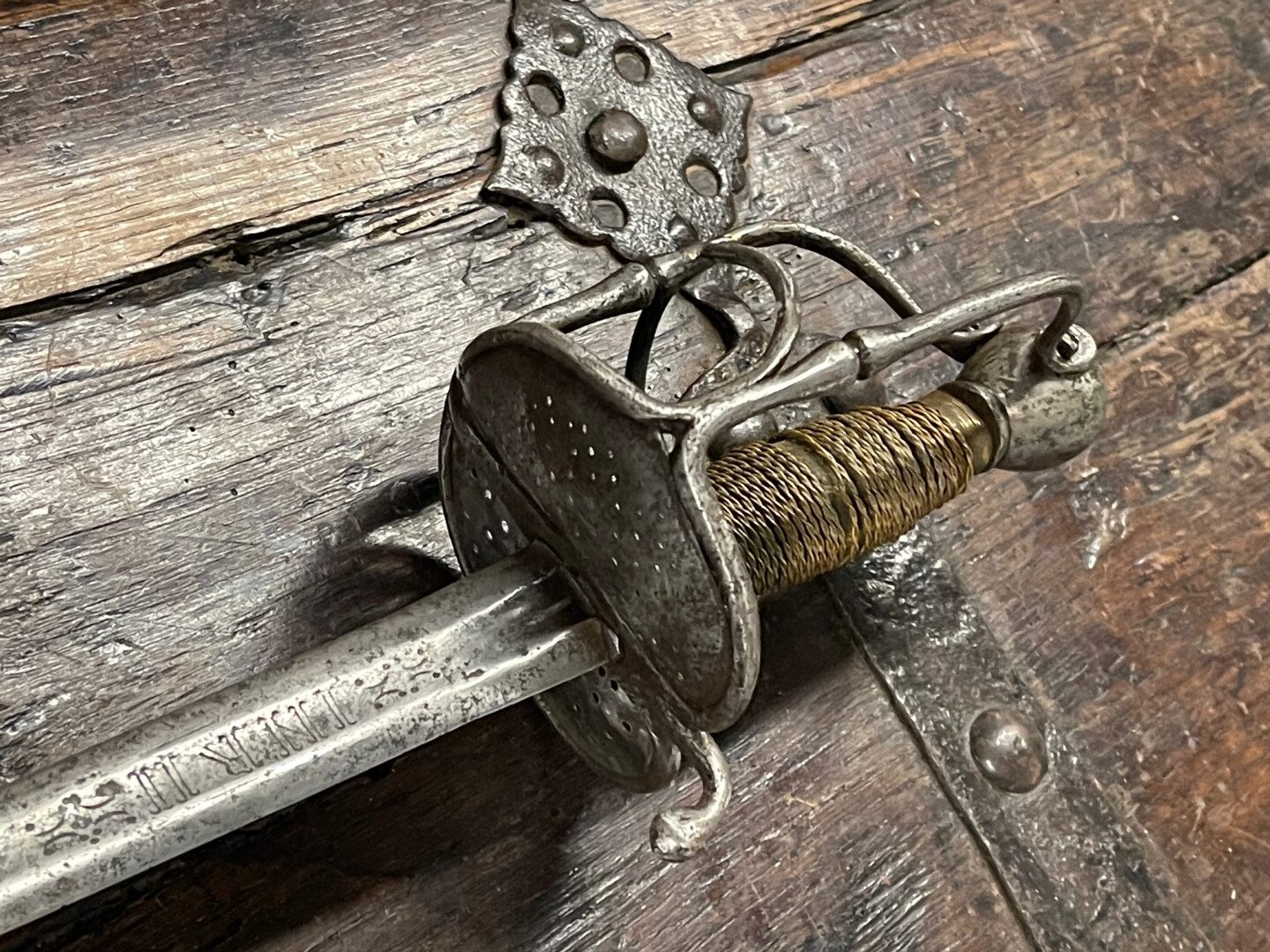
WALLON SWORD CIRCA 1640 WITH ENGRAVED INVENTORY CONTROL NUMBER: . Description: A single wide fullered short blade, with the inscription = z  I.N.N. R. MRA with a floral decoration originating from a circle as pictured below, blade tapering to a sharp point, spherical shaped pommel with an etched armory inventory control number No. I I 7. An inventory control number is a number assigned by the arsenal/armory to keep track of their items. An inventory control number answers questions like: How many do we have? Where is it located in the arsenal, etc.? (See Fig 4A on page 33 in my book). Grip has the original wood and wire, with two ferrules, Two side ring guards with pierced plates ( one replaced during working life), and a  thumb ring.  The condition is good. Length: 36 inches. Conclusion: A great addition to any collection wanting to add an iconic sword for under $2,000.
  • Nation : Dutch
  • Local Price : Price on request
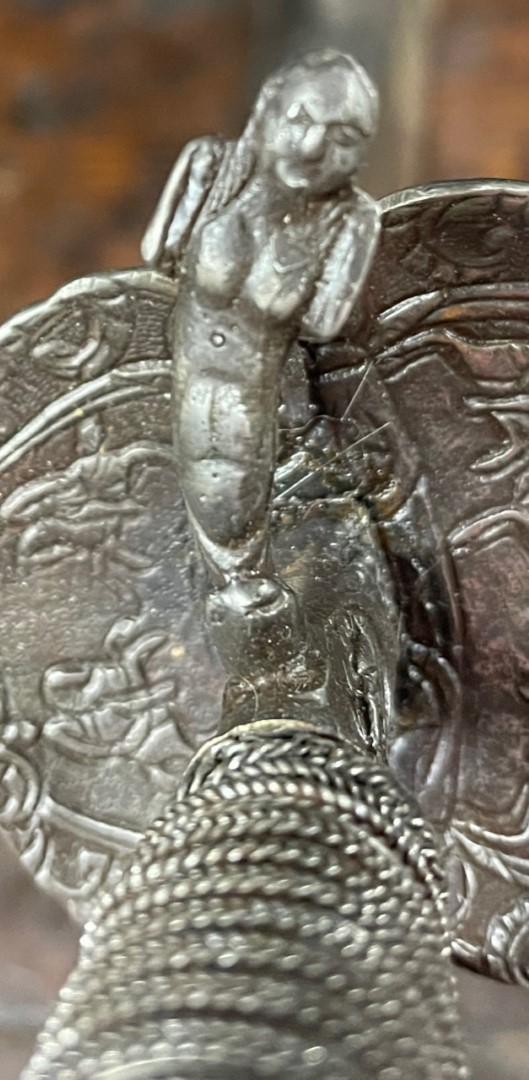
ELEGANT CHISELED AND EMBOSSED DUTCH CAVALRY SWORD CIRCA 1650. Description: Constructed with a broad engraved blade, chiseled hilt depicting mounted cavalry battle scenes, and superb guard finials in the form of figures. Period correct grips with Turk’s heads. Total length: 40 1/2″. Discussion: The shorter sword was the evolution of the longer and heavier rapier of the Renaissance. It was said to have been introduced in the second quarter of the 1600s and evolved over the next 100-plus years. Conclusion: Nothing says chivalry like a sword. In my opinion, chiseling is the most impressive decoration on arms and armor. The problem is swords that are chiseled are very expensive and seldom are found in the collectors market. Even though this sword may be slightly later than the period many collectors collect, it’s still an excellent addition to any collection, and you get a lot of value for your money. Contact Me To Get The Latest Lowest Price Possible From The Owner*
  • Nation : British
  • Local Price : Price on request
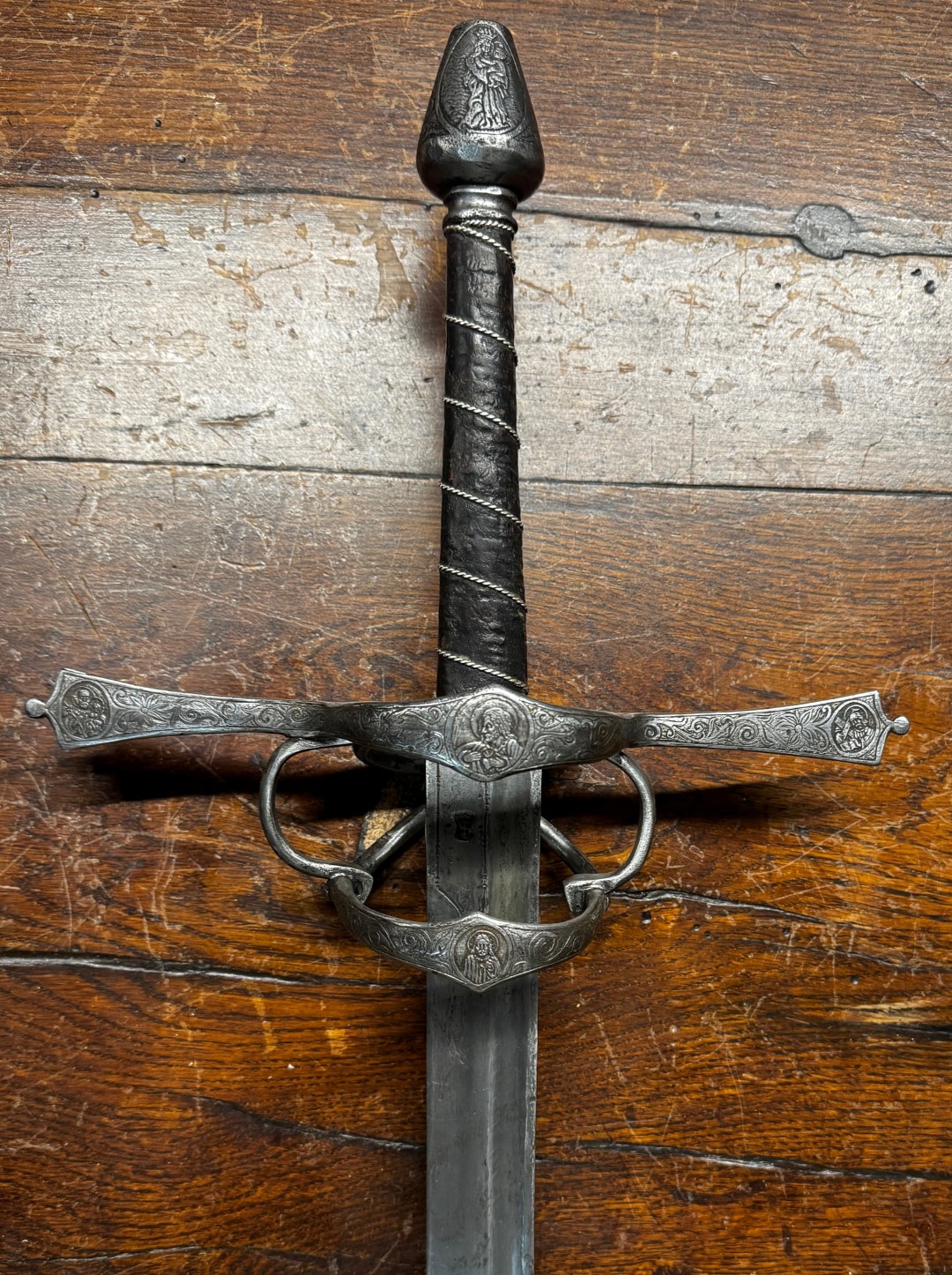
EXCEPTIONAL AND IMPORTANT DECORATED TWO-HAND SWORD CIRCA 1550 MUSEUM QUALITY. Description: Masterfully chiseled hilt.  Featuring the Virgin and Child Jesus on the pommel with St Joseph and numerous apostles, including: St Paul. St Peter, St Andrew, St Mark throughout the hilt. The hilt is constructed with swelling tips ending in circular quillon tips, two quillon rings swelling at the center, a reverse conical pommel,  a thick, straight two-sided blade with a strong taper at the tip, a false edge extending about two-thirds the length of the blade, a deep fuller, original or working-life leather grip, and a makers mark at the rectangular ricasso and a Passau wolf on each side of the blade. Approximate length: 48.35 inches. Conclusion: This war sword masterpiece is in superb, 100% original condition. Collectors love two-hand fighting swords like this one; they are rare¦ big¦ elegant¦. easy to display, and ¦ make a powerful statement. This sword is as beautiful as any processional sword; however, it was conceived as a weapon of war for a noble or person of great wealth. It&#acute;s a great addition to any major collection or museum. The owner priced it to sell quickly. This is a rare opportunity to own an important piece of Medieval/Renaissance military history. ACT NOW- Swords like this seldom are available in the collectors market!!!*
  • Nation : Dutch
  • Local Price : Price on request
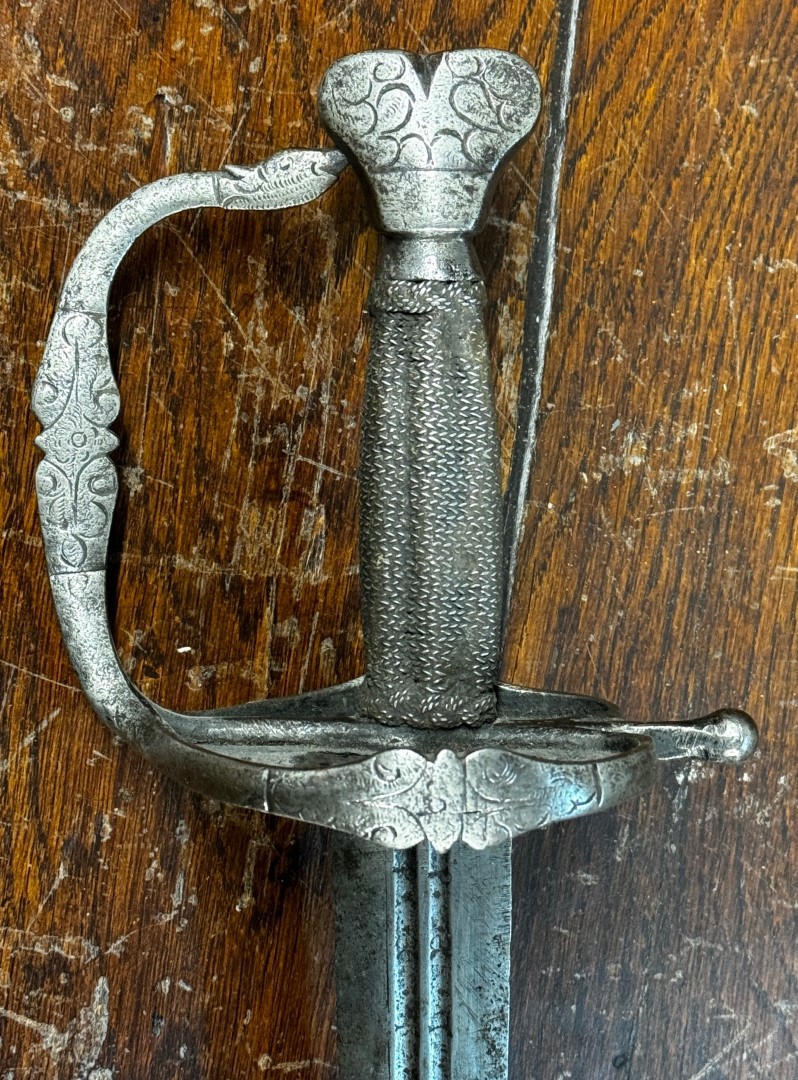
DECORATED OFFICERS GRADE SWEDISH/DUTCH BROADSWORD CIRCA 1620: . Description: Constructed with a decorated etched heart-shaped pommel, the asymmetrical punched guard plates are original, original wood/wire grip with Turk’s heads, a knuckle guard decorated en suite with the pommel but with a dragon head meeting at the pommel, a spherical tip on a short quillon, tapering blade with short thin double fillers with inscriptions as pictured below. Length: 39 inches.  Condition: Very good. Conclusion: This is an impressive sword in its original condition. An officer-grade sword like this decorated, inscribed and in its original condition is getting harder and harder to find in the collectors market. The owner says to sell it, and it’s priced to sell today. ACT-NOW this one should sell quickly!!!*
  • Nation : Italian
  • Local Price : Price on request
RARE VENETIAN CIRCA 1450 TYPE XIII BASTARD SWORD FOR SALE:. Description: Wide slightly tapering blade with triple fuller, center fuller extending slightly longer than two parallel fullers, three inlays on both sides of blade, slightly tapering horizontal guard with large circular quillion ends, tang with three makers or talismanic marks , J pommel with trimmed corners, peen on the apex of the pommel. A unique opportunity to own a rare piece of European military history.  Publication: The Collector&#acute;s Course On Medieval Arms and Armor, page 361 fig 2. Priced to sell today!!!* Contact Me To Get The Latest Lowest Price Possible From The Owner*
  • Nation : British
  • Local Price : Price on request
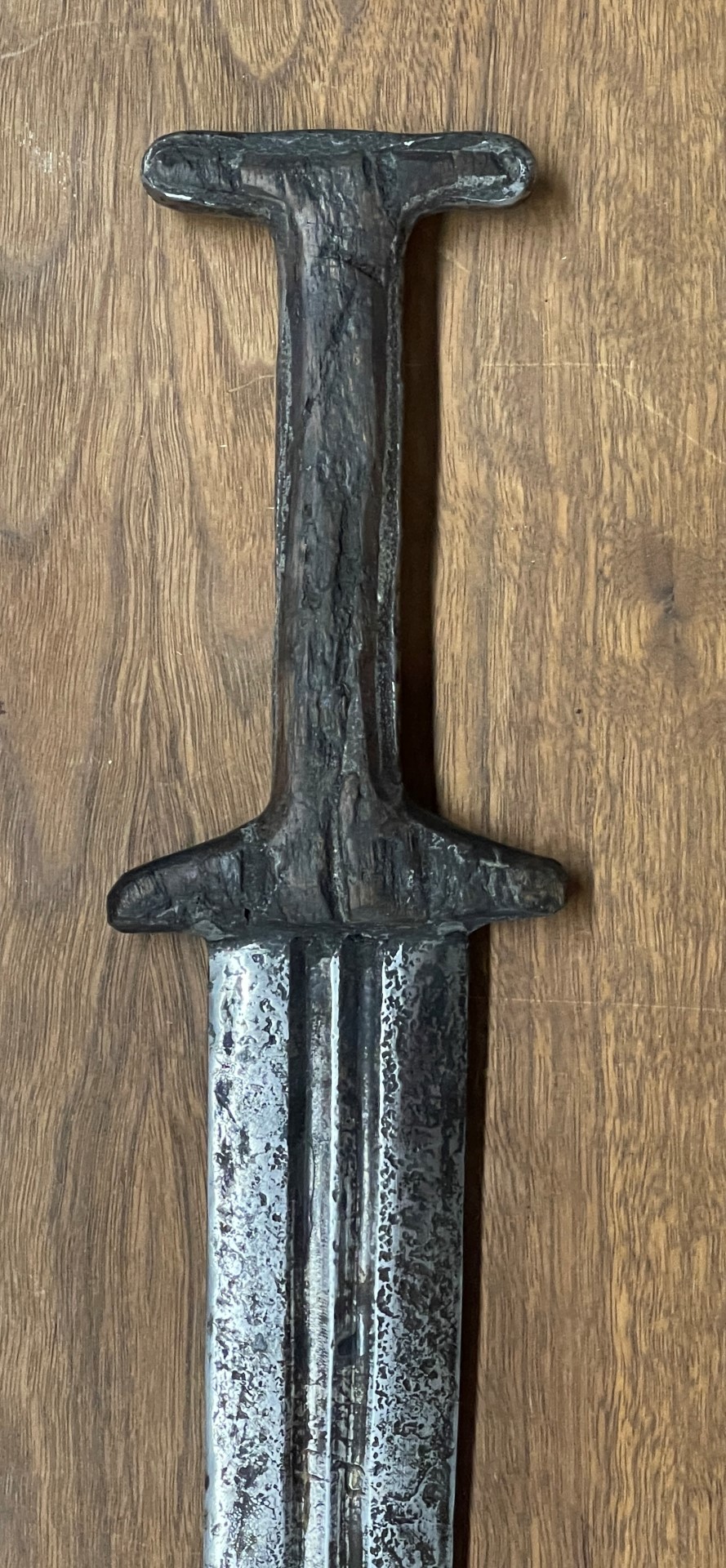
RARE MASSIVE SWISS BASILARD SWORD CIRCA 1450 WITH ORIGINAL GRIPS:. Description: Constructed with a stout flattened lozenge section blade with two short fullers side by side, edges on both sides tapering to a point, and holes for rivets on a metal T-shaped hilt with its original wooden grip. Condition: Very good.  Length: 35 inches. Discussion:  Basilard is a French or Latin term identifying a dagger with a hilt shaped like a capital I (or,a capital T, see page 318 in my book) developed during the 1300s. Basilards can be found in contemporary literature, books, poems, paintings, effigies, brasses, and other period representations. After circa 1350, the basilard became a favorite of civilians and peasants in England. The basilard was probably the most used dagger circa 1350 in Western and Central Europe. The basilard was believed to have originated in South Germany or North Italy in the late 1200s; this appears in many older publications. However, a discovery at the Datini archives in Prato, Italy, dated 1375 by Claude Blair of the Victorian and Albert Museum, indicates the dagger&#acute;s origin is Basel, Switzerland, hence the name Basilard. Basilards varied in length from 12-inch daggers to swords over 36 inches. The masses used the basilard, from peasants to the knightly class. The basilard was part of mainstream Medieval Europe. A few basilards have survived that were made for the megawealthy. Basilard sheaths are rare. Their sheaths consisted of a metal throat, chape, and middle band. Because leather is organic, few leather sheaths have survived. The sheath was worn in various ways: 1) On the right side, hanging from the belt, sword belt, or sword hanger. 2) Hanging in the front from the sword belt. 3) Seldom carried on the lower back. The basilard finally evolved into the Swiss (Holbein) dagger in the late 1490s. Some refer to the original variant as the Swiss basilard (see page 320 in my book). Comparables:  A.) The Royal Collection, England, item #IX 3482. B.) Schweizerisches Landesmuseum , taf.3 #7. Provenance: From the collection of Gottlob Herbert Bidermann Stuttgart/Aach Germany. Herr Bidermann was one of Europe&#acute;s largest collectors of Arms and Armor. He wrote several books on the subject of Medieval and Renaissance Arms and Armor and was appointed court expert on Medieval/ Renaissance Arms and Armor by the German Government (Öffentlich bestellter und vereidigter Sachverständiger für Historische Waffen). Conclusion: Although not the most elegant of Medieval swords certainly one of the rarest and highly prized by collectors. It is priced to sell for under $4K, a lot less than you expect!!!*
Page 118 of 120