
Show

Forgot your password?

Error message here!

Error message here!

Error message here!

Error message here!

Show Error message here!

Show Error message here!

Lost your password? Please enter your email address. You will receive a link to create a new password.

Error message here!

Back to log-in

Close

For Sale

The following items are listed by for sale by users of the site and dealers. They are in no way endorsed or guaranteed by www.antiquearmsresearch.com

Add a Classified Item
to

Clicking on the sword will take you through to the relevant classified item or dealer site.
Don't miss out! - Do you want to be kept informed weekly of new aditions? Just join our weekly update list.

You can also receive regular email notifcations when items match your keywords. To recieve them just register or logon at the top right of this page.
Page 119 of 120
  • Nation : Italian
  • Local Price : Price on request
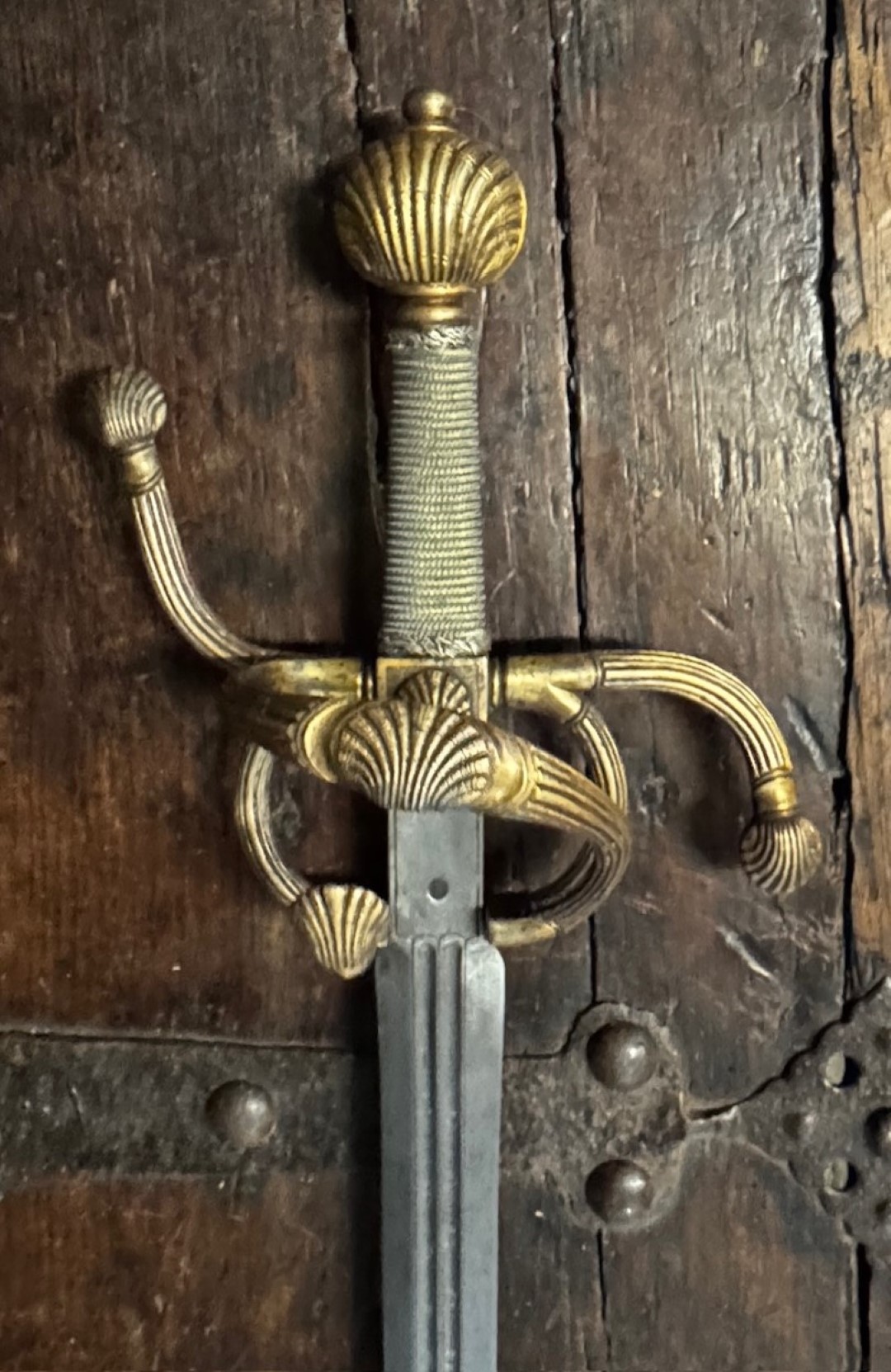
RARE VENETIAN SHELL AND KNUCKLE GUARD BROAD SWORD CIRCA 1620: . 1548) RARE VENETIAN SHELL AND KNUCKLE GUARD BROAD SWORD CIRCA 1620:  Discussion: A rare and elegant example of a unique typology of Venetian broadsword that is highly collectible. Priced to sell quickly at under $3K!!!* Constructed: with a long, slightly curving single-edged blade with a long, double-edged point, the fuller at the top running concurrently with the false edge about two-thirds the length of the blade, steel hilt with downward turned octagonal quillons, a knuckle guard en-suite to the quillons, a shell guard with incised decoration,  beautiful, circular pommel. Original wood grip with Turks Heads, style Z steel pommel (found on some Schiavonas). Length: 37 inches. Conclusion: A rare and elegant example of a unique typology of Venetian broadsword that is highly collectible. Very well-balanced and in very good condition. It’s a great addition to any collection, especially since it is priced to sell quickly at under $3K!!!*
  • Nation : German
  • Local Price : Price on request
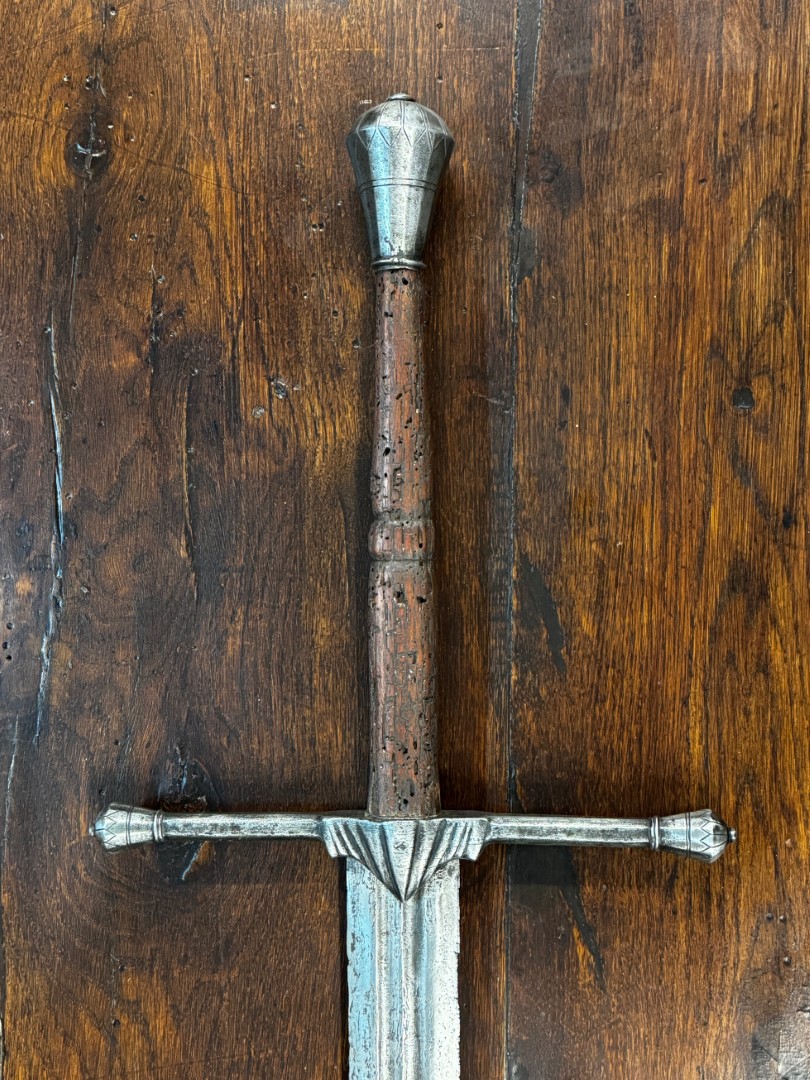
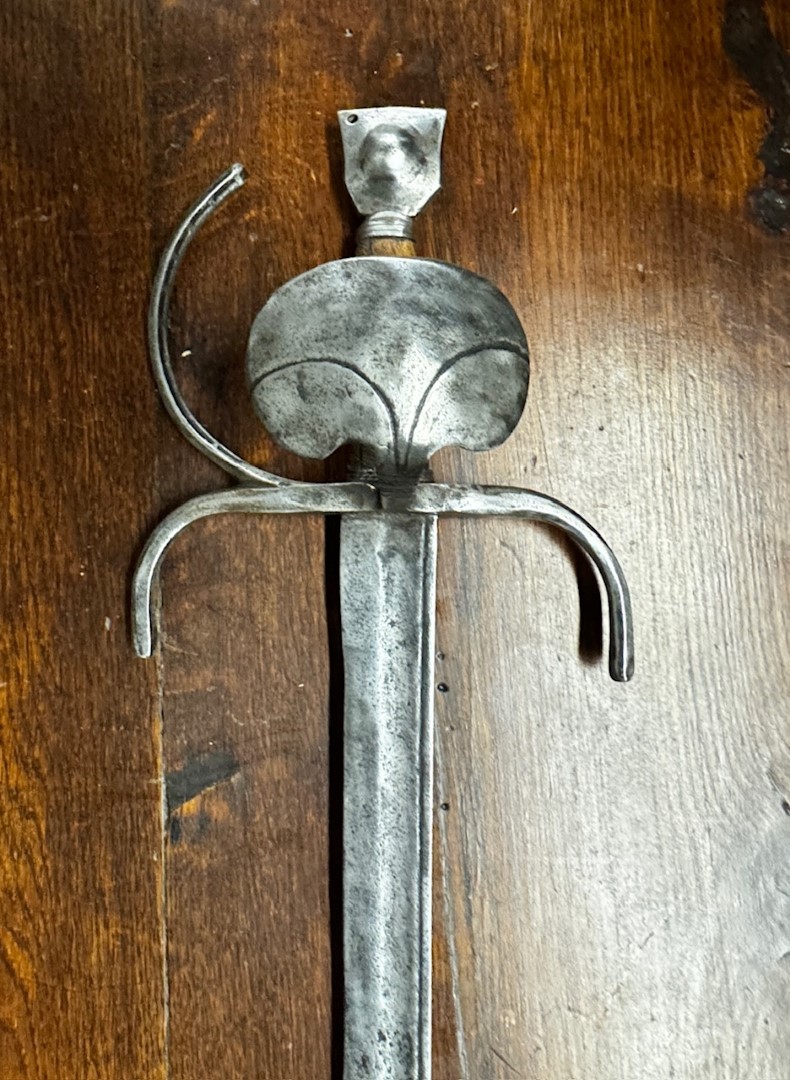
RARE TWO-HAND DECORATED GERMAN FIGHTING SWORD  CIRCA 1500:. Description:  Its construction consists of a two-sided blade of flattened hexagonal shape, a Passau wolf, and a cross and orb inlaid on the blade. three deep central fullers originate at the quillon block and extend about a third of the length of the blade. Quillon block in chevron shape with three hash lines, an Oakeshott conical pommel Style T with zig-zag linear decoration, a large original wooden grip of two-stage &156;hock bottle&157; form, an octagonal shaped guard with tips swelling in conical form and decorated en suite with the pommel. Total length: 54.5 inches. Conclusion: This war sword is in good condition; however, the blade was stored in its sheath for several generations, and the blade has suffered slightly. However, it’s almost not noticeable because of the brute power that this sword displays from its size and superb construction. Collectors love two-hand swords like this one; they are big, elegant, easy to display, and make a powerful statement. This sword is as beautiful as any processional sword however was conceived as a weapon of war. It’s a great addition to any collection or museum. The owner priced it to sell quickly. This is a rare opportunity to own a piece of medieval/Renaissance military history. ACT NOW!!!*
  • Nation : Spanish
  • Local Price : Price on request
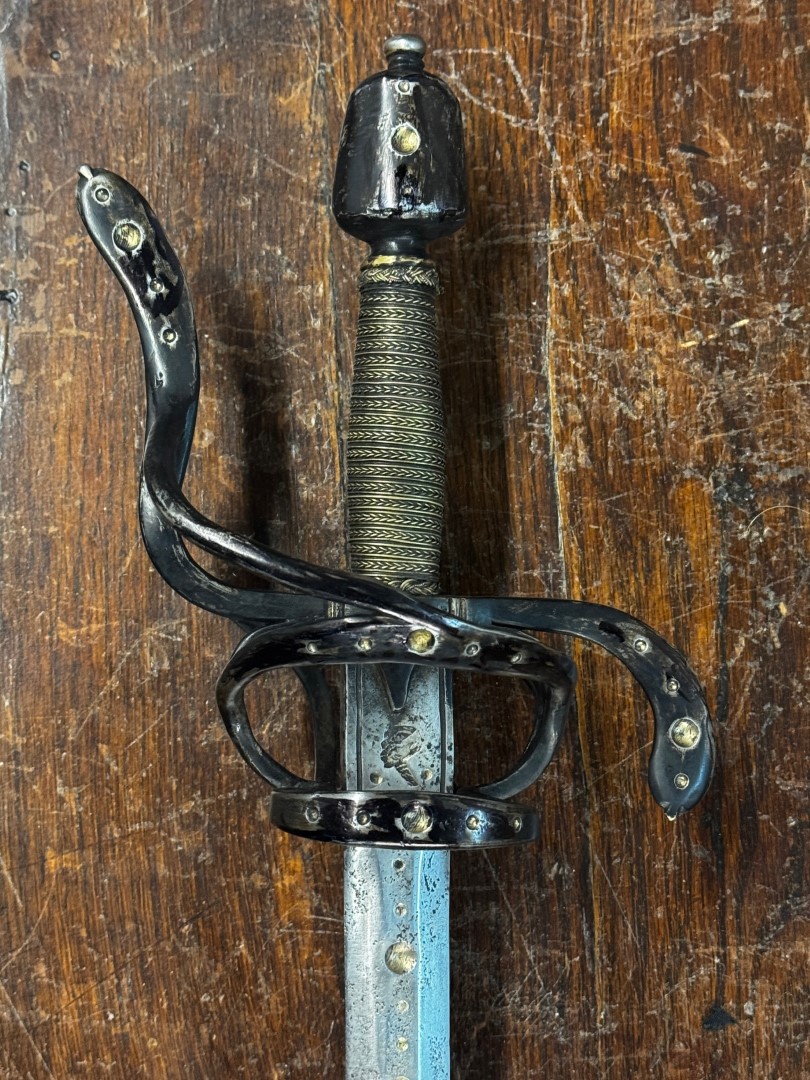
BLACK, GILDED AND DECORATED ITALIAN RAPIER CIRCA 1580 WITH MAKERS MARK:. Description: Under the Norman classification, this is a hilt 57. Constructed with a fuller about a third the length of a strong diamond-section blade that tapers to a very sharp point, a rectangular outlined ricasso stamped with a makers mark in the lower bottom center, a chevron shape at the quillon block, a type 32 pommel with a button at the finial. The hilt with a black finish was probably refreshed and decorated with gilded half-spheres; the fuller decorated en suite with gilded half sphere, replaced grip with Turk&#acute;s heads. Two repairs to the counter guard, rapiers like this were used for fighting, not ballet.   Length: 44.5 inches. Discussion: Military rapiers were longer and usually of stronger blade manufacture than your average civilian rapier. Military rapiers were also exempt from length restrictions. Because fencing is more of a thrusting art, it became commonplace throughout Europe to have as long a blade as possible to obtain an advantage. This extravagance in length reached the point that municipalities passed statutes regarding the allowable lengths of blades. Those in violation had the misfortune of having their rapier blade cropped at the tip at the city gate to comply. One example of these statues is from an English Royal Proclamation on March 17, 1557. The earliest illustration of this sword type is in a 1588 portrait of John Shirley, currently housed in the Metropolitan Museum of Art (#51.194.2). It is also illustrated in a portrait of Luccio Foppa circa 1585 by Giovani Antonio Figino.  In a day and age lacking appropriate policing, the private citizen was forced to protect himself from society&#acute; criminal dregs. The weapon of choice was the rapier from the middle of the 16th to the end of the 17th century. The rapier is a simple but highly effective sword against the non-armored. The rapier was primarily a thrusting weapon that could inflict serious injury to an adversary&#acute; vital organs with minimal effort. It was also an exceptional slashing and cutting weapon; however, the slash was not as lethal as the thrust. The slash was used more as a feint to set up a finishing thrust. The slash was also a dire warning to a would-be assailant of the horrors to quickly follow if he chose not to acquiesce. The rapier is almost undeniably of Spanish origin and is probably Spain&#acute;s most significant contribution to the Renaissance arms race. A highly expensive, ornate rapier was the equivalent of a person in our day and age making a fashion or opulence statement by wearing very expensive jewelry, such as a Rolex or Audemars Piguet watch.  The French adopted the phrase &#acute;espee rapiere&#acute; by 1475, which later was shortened to simply &#acute;rapiere. The English in 1505 spelled it &#acute;rappyer. The Giles Duwes English/ French dictionary of 1532/3 adopted the rapiers definition as &#acute;”Spannyshe sworde”. By 1550, the term rapier had been adopted to describe a slender, sharply pointed sword designed for thrusting, cutting, and slashing attacks. The rapier now consisted of a hilt protected by a handguard. Comparables: Similar examples of type 57’s can be found in: “ The Musee de l Armee in Paris (Cat no. 1379). “ The Wallace Collection (Cat no. 621). Provenance: From a private collector in Austria who seldom, if ever, sells his best !!!* Conclusion: This is an elegant sword with a fighting past. I like the decoration and the condition. This rapier is very reasonably priced at under $4K. This is a rare opportunity. Act now so that you won&#acute;t be disappointed!!!* All my items come with the following: “Free shipping. “10-day review period. “Certificate of Authenticity. “ Free autographed copy of my book if you do not have one. “ In the event of an international shipment, we will help assign the lowest correct Customs tariff so you pay the least as low as 5% or even nothing. I believe you will be very pleased.
  • Nation : British
  • Local Price : Price on request
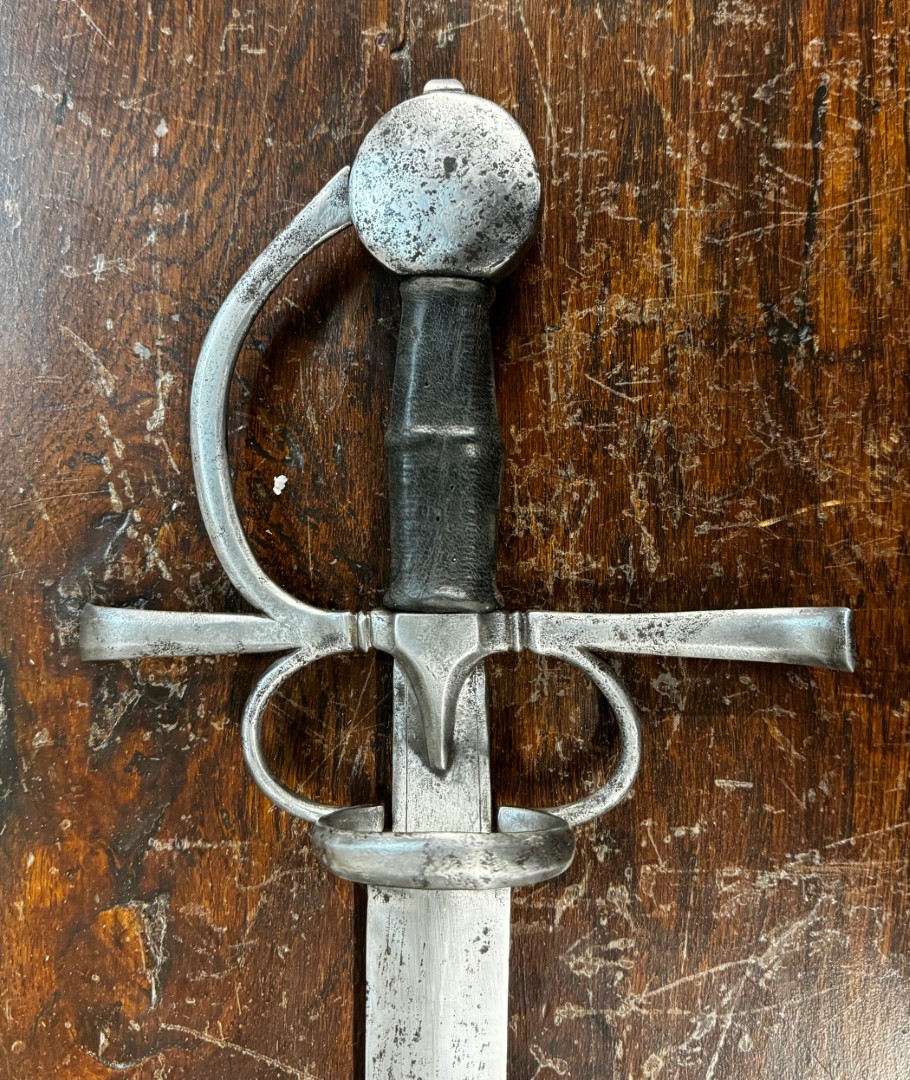
EXCEPTIONALY RARE NORMAN TYPE 41 SWORD WITH ORIGINAL GRIP CIRCA 1560: . Description: Constructed with a tapering blade with a medial ridge, wheel-shaped pommel with square finial, what appears to be an original or working life leather grip, expanding at the ends rectangular guard with curvatures at the tip and facing in opposite directions, quillon block in a chevron shape with two gutters on each side,  knuckle guard extending to the pommel, two finger guards and a ring guard. Condition very good, perhaps slightly over cleaned. Dimensions: total length 41 inches, blade 35 inches. Comparables: -Metropolitan Museum of Art, accession # 14.25.1169 (pl 7). -The State Hermitage Museum St. Petersburg, Z.O. # 1950. – An exceptionally ornate example signed by Damianus de nerve is preserved in The Waffensammlung in Vienna Inv. #A586. Conclusion: For the collector who wants the rare of the rare, here it is. This sword has a very elegant design. It’s the only one of this typology I have had in 35 years. ACT NOW, or you could be very disappointed. I have no idea if I will ever have another. I believe you will be very¦.very¦. pleased. All my items come with the following: “Free shipping. “10-day review period. “Certificate of Authenticity. “ Free autographed copy of my book if you do not have one.
  • Nation : Spanish
  • Local Price : Price on request
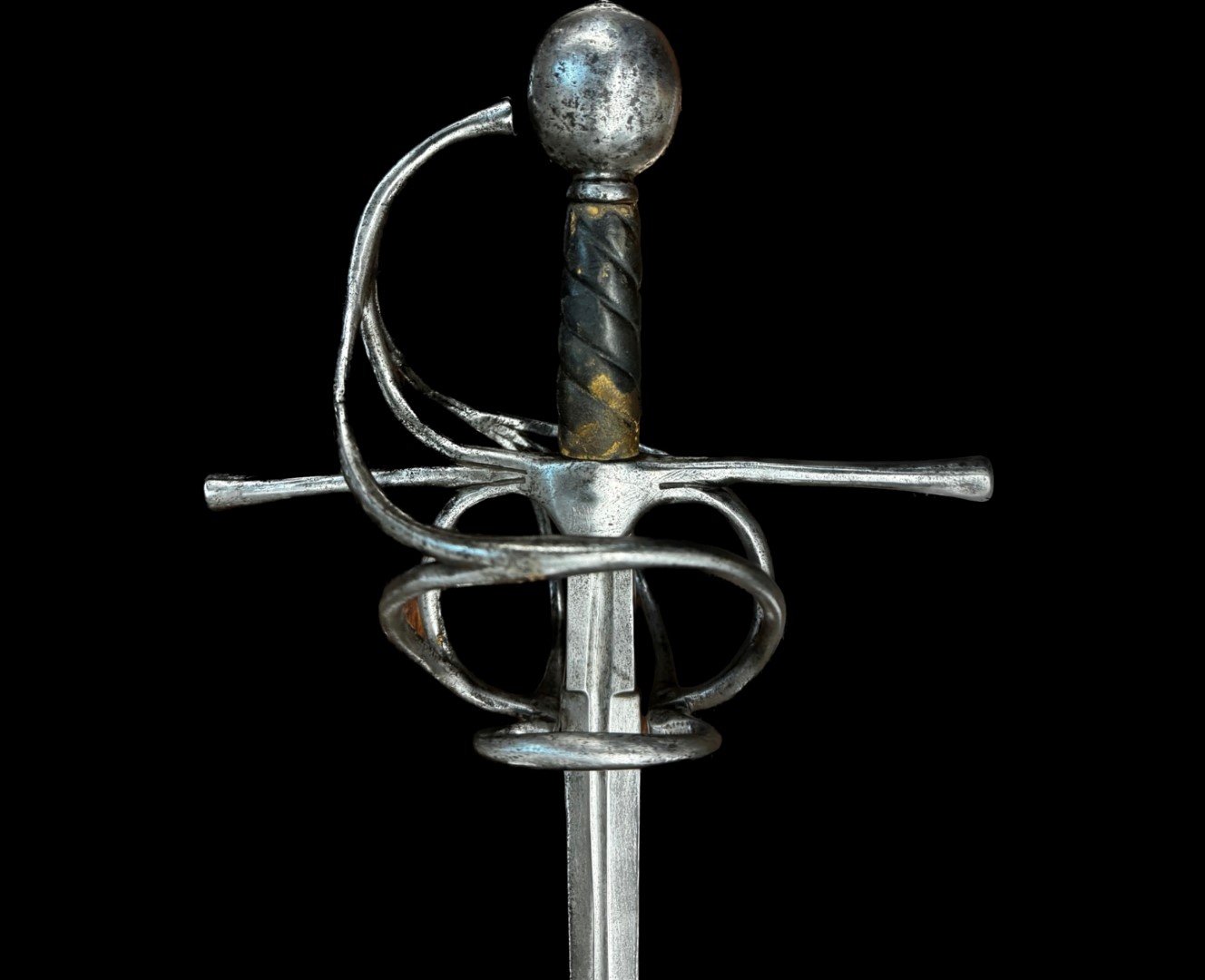
A FINE MASSIVE GERMAN MILITARY RAPIER, CIRCA 1600. Description: An example of this typology of a sword can be found in the painting of Christian the IV of Denmark in 1603 before receiving the Order of the Garter. Another is a painting by Juan Pantoja de la Cruz of Diego Villamayor dated 1605. Under the Norman classification, this is a hilt 58.  Constructed with a strong diamond-section tapering blade to a very sharp point, a short fuller originating at its rectangular ricasso, a chevron shape at the quillon block,  an expanding tubular tip at the quillons and end of the knuckle guard where it meets the type 14 spherical pommel. Original twisting wood grip with original leather covering ( slightly worn).  Length:48.50 inches. Condition: very good. Discussion: Military rapiers were longer and usually of stronger blade manufacture than your average civilian rapier. Military rapiers were also exempt from length restrictions. Because fencing is more of a thrusting art, it became commonplace throughout Europe to have as long a blade as possible to obtain an advantage. This extravagance in length reached the point that municipalities passed statutes regarding the allowable lengths of blades. Those in violation had the misfortune of having their rapier blade cropped at the tip at the city gate to comply. One example of these statues is from an English Royal Proclamation on March 17, 1557. The earliest illustration of this sword type is in a 1588 portrait of John Shirley, currently housed in the Metropolitan Museum of Art (#51.194.2). It is also illustrated in a portrait of Luccio Foppa circa 1585 by Giovani Antonio Figino.  In a day and age lacking appropriate policing, the private citizen was forced to protect himself from society&#acute; criminal dregs. The weapon of choice was the rapier from the middle of the 16th to the end of the 17th century. The rapier is a simple but highly effective sword against the non-armored. The rapier was primarily a thrusting weapon that could inflict serious injury to an adversary&#acute; vital organs with minimal effort. It was also an exceptional slashing and cutting weapon; however, the slash was not as lethal as the thrust. The slash was used more as a feint to set up a finishing thrust. The slash was also a dire warning to a would-be assailant of the horrors to quickly follow if he chose not to acquiesce. The rapier is almost undeniably of Spanish origin and is probably Spain&#acute;s most significant contribution to the Renaissance arms race. A highly expensive, ornate rapier was the equivalent of a person in our day and age making a fashion or opulence statement by wearing very expensive jewelry, such as a Rolex or Audemars Piguet watch. The French adopted the phrase &#acute;espee rapiere&#acute; by 1475, which later was shortened to simply &#acute;rapiere. The English in 1505 spelled it &#acute;rappyer. The Giles Duwes English/ French dictionary of 1532/3 adopted the rapiers definition as &#acute;Spannyshe sworde. By 1550, the term rapier had been adopted to describe a slender, sharply pointed sword designed for thrusting, cutting, and slashing attacks. The rapier now consisted of a hilt protected by a handguard. Comparables: include from such notable institutions as: “ A Odescalchi Collection  inv # 223. “ Wallace Collection cat # A589. “ Zurich Landsmuseum  Inv. No. AG2476 Provenance: From a private world-class rapier collector who seldom, if ever, sells his best. Conclusion: Military-class rapiers like this one seldom make it to the collectors’ market. This is a fighting sword, not a rapier worn by some fat, wealthy person who had bodyguards and never personally engaged in mortal combat in his life. This is a rare opportunity. ACT-NOW! I promise you won&#acute;t be disappointed with the rapier or the price under $3,5K.!!!* All my items come with the following: “Free shipping. “10-day review period. “Certificate of Authenticity. “ Free autographed copy of my book if you do not have one. “ In the event of an international shipment, we will help assign the lowest correct Customs tariff so you pay the least as low as 5% or even nothing. I believe you will be very pleased. ACT-NOW!!!*
  • Nation : Spanish
  • Local Price : Price on request
HIGHLY DECORATED RARE ITALIAN GILDED RAPIER CIRCA 1600:  . Description: This sword, under the Norman classification system, is a type 27 with a shell-shaped gilded pommel, the tips of the quillons, quillon block (front and back), and the center of the side guard decorated en-suite. Incised lines en-suite on the hilt and with punch decoration. It is constructed with a wide, slow tapering blade with two narrow inscribed fullers. On the first fuller side 1: “M. O. H. C. N. I. S.”  with talismanic symbols. On the second fuller side 1: ” D. I. C. R.”  with talismanic symbols. On the first fuller side 2: “R. G. J. I.” with talismanic symbols. On the second fuller side 2: T. A. V.”  with talismanic symbols. A maker mark on the rectangular ricasso with an insisted edge. Wooden handle covered with silver-thread wire grip with Moor’s heads. Approximate dimensions: total length 45 inches, blade 38.5. Discussion: In a day and age lacking appropriate policing, the private citizen was forced to protect himself from society&#acute; criminal dregs. From the middle of the 16th to the end of the 17th century, the weapon of choice was the rapier. The rapier is a simple but highly effective sword against the non-armored. The rapier was primarily a thrusting weapon that could inflict serious injury to an adversary&#acute; vital organs with minimal effort. It was also an exceptional slashing and cutting weapon; however, the slash was not as lethal as the thrust. The slash was used more as a feint to set up a finishing thrust. The slash was also a dire warning to a would-be assailant of the horrors to follow if he chose not to acquiesce quickly. The rapier is almost undeniably of Spanish origin and is probably Spain&#acute; most significant contribution to the Renaissance arms race. A highly expensive, ornate rapier was the equivalent of a person in our day and age making a fashion or opulence statement by wearing very expensive jewelry, such as a Rolex or Audemars Piguet watch. Because fencing is more of a thrusting art, it became commonplace throughout Europe to have as long a blade as possible to obtain an advantage. This extravagance in length reached the point that municipalities passed statutes regarding the allowable lengths of blades. Those in violation had the misfortune of having their rapier&#acute; blades cropped at the tip at the city gate to comply. One example of these statues is from an English Royal Proclamation on March 17, 1557- 1558. Provenance: From a private Italian collection. Conclusion: An exceptionally elegant and rare example of a Renaissance rapier that must have been owned by a very wealthy person or Nobel. It has survived in exceptional condition. It may have been reguilded/refreshed during the Victorian period using original Renaissance gilding, which has been illegal due to gas poisoning for many years.   In my opinion this would make a great addition to any collection or museum. Act now. This sword is priced to sell today. They seldom come this nice. ACT-NOW!!!*
  • Nation : British
  • Local Price : £0.00
**RESERVED**RESERVED** Post 1952 QE II British WD Pattern 1827 Wilkinson Sword Royal Navy Officer’s Sword With Etched Blade Bullion Cord, Portepee and Scabbard. Sn 22120 -. This is a very good British WD Royal Navy Officer’s Sword and Scabbard. The sword has a clean single edged straight blade which is 31” in length (37 ½” overall) with central fuller. Both sides of the blade have blued and etched panels including foliate decoration, Queen’s Crown ER (Elizabeth Regina) II & Queen’s Crown with Royal Navy fouled anchor device. The blade is marked on one side with Wilkinson Sword London name and crossed swords legend together with QEII Royal appointment. The reverse has etched and blued ‘Star’ panel with ‘W’ (Warranted) mark. The spine of the blade is numbered 110274 alongside a small WD ‘broad arrow’ mark. It has a brass Lions head with mane pommel and grip strap & full knuckle guard with the Royal Navy Queen’s Crown and fouled anchor motif. One side of the guard has a small hinged folding langet which, when folded flat fastens to a pin on the throat mount of its scabbard and holds the sword securely in place. The hilt’s fish skin grip with bullion wire binding is undamaged. Attached to the guard is its original bullion cord and portepee. The sword is complete with its black leather scabbard which has gilt brass mounts and 2 hanging rings. All leather and stitching are clean and intact The price includes UK delivery. Sn 22120
  • Nation : British
  • Local Price : £0.00
**RESERVED**RESERVED** British 1845 Pattern Royal Navy Boarding Cutlass Guard With Brass Lozenge Marked Weapon Number ‘4’. Sn 22370:2 -. The British Royal Navy due to its global presence and command of the sea was by far the most organised and trained of all the World major sea services and it’s edged weapons used for boarding and repelling boarders reflected this. The Royal Navy was one of the first Navies in the 18th Century to begin standardising the personal edged weapons used by ordinary seaman. Experiments during the early 1840s for a new naval cutlass design to replace the venerable 1804 Pattern resulted in a design by George Lovell, the Inspector of Small Arms, being accepted in 1842. A fire at the Tower of London destroyed early stocks and the design did not enter service in bulk until three years later, hence being termed the 1845 Pattern. It was considered very successful, handling well compared to its bulky predecessor the 1804 Pattern and being simpler to manufacture (see page 248 of World Swords by Withers). Our example has the classic single edged 29 ½” (35 ¼” overall). The blade is 1 ½” broad at its widest and the spine is 7mm width at its widest. The blade has staining consistent with age & service use. It has the correct full steel bowl knuckle guard and ribbed steel hilt all blackened with original black paint or paint and tar mix much of which is present. The guard is slotted for wrist strap and has its original brass lozenge riveted to the front with a weapon / rack number punch dot applied ‘4’ (Wither’s book illustrates a similar afore described hilt plates). These weapons were stored in locked racks on board ships and issued only for training or combat so are often found without scabbards. Only a small number were furnished with scabbards so that with a baldrick they could be worn for land-bound duties. Our example is without scabbard. The price for this piece of British Naval history includes UK delivery. Sn 22370:2 (tub armoury)
Page 119 of 120